Godot bans AI code, Meta curbs token spending, and the open vs closed model debate rages on
Overview
Today's AI conversation is dominated by pushback against AI's growing footprint: Godot Engine bans AI-authored code contributions, Meta caps internal token spending after billions in costs, and a new study reveals readers are generating fiction at scale with LLMs. Meanwhile, the open-source community celebrates extending Gemma 4 and releasing tiny models for edge devices, while Anthropic's AGI team mission and Claude Sonnet 5 release keep the frontier model race in the spotlight.
Hacker News Stories
Godot will no longer accept AI-authored code contributions
537 points · 378 comments · by pjmlp

The Godot Engine Foundation has announced it will no longer accept code contributions authored by AI, citing concerns that contributors who rely heavily on AI tools may not sufficiently understand their own code to fix bugs or respond to reviewer feedback. The policy also rejects AI-generated text in human-to-human communications, calling it a basic principle of respect, though machine translations of human-authored text remain acceptable. The Foundation says contributors should only use AI for menial tasks and must disclose its use.
Interesting Points
- The Foundation states contributors should only use AI assistance for 'menial things' and must disclose its use
- AI-generated text in human-to-human communications will be rejected as 'a basic principle of respect'
- Machine translations are still acceptable if the original text was human-authored
- New contributors are restricted from taking on big features or refactors
Top Comment Threads
- TomasBM (17 replies) -- Calls the verbose AI-generated PR descriptions a 'denial-of-service attack on the human mind.' Predicts two outcomes: either submitters will add stylistic markers to make AI output seem human, or they'll produce the to-the-point, no-bullshit commits the policy encourages. Suggests the positive outcome is achievable if AI is used to write better summaries rather than worse ones.
- ThePhysicist (11 replies) -- Notes the contradiction between AI provider valuations (based on the assumption all code will be AI-written) and open source projects fighting to keep AI contributions out. Shares personal experience of AI 'hangover' — feeling powerful while writing features in hours, then discovering subtle cracks and inconsistencies later. Plans to use AI less for feature development and more for planning, debugging, and narrow refactoring.
- d1sxeyes (1 replies) -- Explains that AI changes the self-selection dynamic of OSS contributions. Traditionally, creating a PR meant you were invested in the project. AI unlocks contributions from people not involved at all, creating a flood of low-value PRs from folks who don't care about the project's success.
- clktmr (1 replies) -- Compares the AI ban to Linus Torvalds' reasoning for excluding C++ from the Linux kernel — it's about keeping certain types of people out, not just the language itself. A pragmatic community management decision.
- pineappletooth_ (3 replies) -- Links to specific AI-generated PRs that exemplify the problem — one for a $4k bounty, another for a university assignment — showing the scale of the issue. The real change is that new contributors can't take on big features or refactors, not just the AI ban itself.
Meta caps internal AI token spending after costs approach billions
136 points · 118 comments · by typeofhuman
Meta has sent an internal memo to approximately 6,000 employees warning that internal AI usage costs are approaching billions of dollars in 2026, following an exponential increase in token consumption. Employees consumed 73.7 trillion tokens in roughly 30 days, tracked on an internal leaderboard called 'Claudeonomics' that inadvertently incentivized usage volume over productive output. CTO Andrew Bosworth issued a separate memo pushing back on 'tokenmaxxing,' stating 'All motion is not progress and token usage alone is not a measure of impact.' Meta will deploy a centralized AI Gateway dashboard and implement formal token budgets starting in 2027, while steering employees toward its own MetaCode coding assistant.
Interesting Points
- Employees consumed 73.7 trillion tokens in roughly 30 days
- An internal leaderboard called 'Claudeonomics' tracked token consumption by employee and team
- CTO Andrew Bosworth: 'All motion is not progress and token usage alone is not a measure of impact of any kind'
- Meta plans to spend up to $135 billion on AI infrastructure through 2026 and $600 billion on data centers through 2028
- The company is steering employees away from Anthropic's Claude toward its own MetaCode coding assistant
Top Comment Threads
- simonw (12 replies) -- Points out the irony that the leaderboard 'inadvertently incentivized usage volume over productive output.' Comments reference Goodhart's Law — when a measure becomes a goal, it stops being a measure. Other commenters note this is a classic pattern: Slack message leaderboards, JIRA ticket counts, and now token leaderboards all produce the same gaming behavior.
- dwoosley (7 replies) -- Wonders about the breakdown of spending by use case. Speculates that the majority of tokenmaxxing comes from non-technical uses like reading PDFs, creating presentations, and generating graphics. Another commenter notes that embedding LLMs into automated processes or products can rack up token consumption extremely quickly.
- andsoitis (5 replies) -- Advocates for measuring outcomes (impact) rather than effort (token usage, lines of code, code coverage). Other commenters push back on how to actually solve the attribution problem — in an org pushing thousands of PRs a day, how do you attribute impact to any one engineer's work?
- Trasmatta (3 replies) -- Claims all those billions spent on tokens by Meta generated not a single iota of value. Other commenters challenge this, noting that Meta's financials don't support the claim and that measuring AI's impact on a company-wide scale is inherently difficult.
- d4rkp4ttern (3 replies) -- Asks why Meta devs don't just get Claude Code Max or Codex Pro subscriptions. The answer: enterprise customers don't get those plans — they have to pay by API rate, which is much more expensive per token than consumer subscriptions.
Are readers generating fiction with AI models?
36 points · 60 comments · by ilamont
A new arXiv paper by Neel Gupta, Maria Antoniak, and Melanie Walsh analyzes over 500,000 anonymized English-language ChatGPT conversations and finds that more than one-third involve some form of fiction generation — including original stories, roleplay, fanfiction, and erotica. The AI-generated fiction is dominated by power users, with patterns including 'infinite story demanders' who repeatedly request and revise variations of the same narratives. Users gravitate toward generic forms, repetition, immediacy, and niche combinations of story elements. The authors propose the concept of a 'solipsistic reader-writer' who generates and consumes fiction within a closed conversational loop with a machine rather than a human other.
Interesting Points
- More than one-third of 500,000+ analyzed ChatGPT conversations involve some form of fiction generation
- Users especially gravitate toward fanfiction and erotica
- The study identifies 'infinite story demanders' who repeatedly request and revise variations of the same narratives
- Authors propose the concept of a 'solipsistic reader-writer' who interacts with a machine rather than a human other
- Data was collected between April 2023 and May 2024, predating GPT-4o
Top Comment Threads
- idle_zealot (1 replies) -- Argues this is fundamentally different from web fiction or YouTube democratization because books already had low barriers to distribution. LLM-written fiction is treated more like 'an externalized imagination' — closer to a sandbox game or a child playing pretend alone. Media is generally understood as communication between people, but this is highly individual.
- plastic-enjoyer (1 replies) -- Questions how AI 'democratizes' fiction. Another commenter explains that 'democratize' in this context means people with no skill and no motivation can now pretend they produced fiction — similar to the 'I'm the ideas guy' problem, making it harder to find signal in the noise.
- piloto_ciego (4 replies) -- Shares personal experience of giving Codex a sci-fi plot sketch — the output was 'ok, not the worst content I've ever read, not the best. It was sufficient.' Others suggest it could be great for TTRPG adventures or as a starting point to edit from.
- bawolff (3 replies) -- Notes unsurprisingly that users gravitate toward fanfiction and erotica. Another commenter explains that erotic content lowers the quality bar — people are willing to put up with much worse quality as long as it features their specific kink, and generating it privately for free is a game-changer.
- lubujackson (2 replies) -- Compares AI fiction to the compression/loudness issue in music production — everything gets amplified so the range is compressed, then it gets boring and people jump ship. Notes that AI is by design a predictor of what is most likely, which is directly at odds with human craving for newness.
Liquid AI releases a 230M model optimized for phones, Raspberry Pi, and robots
17 points · 1 comments · by mpfect
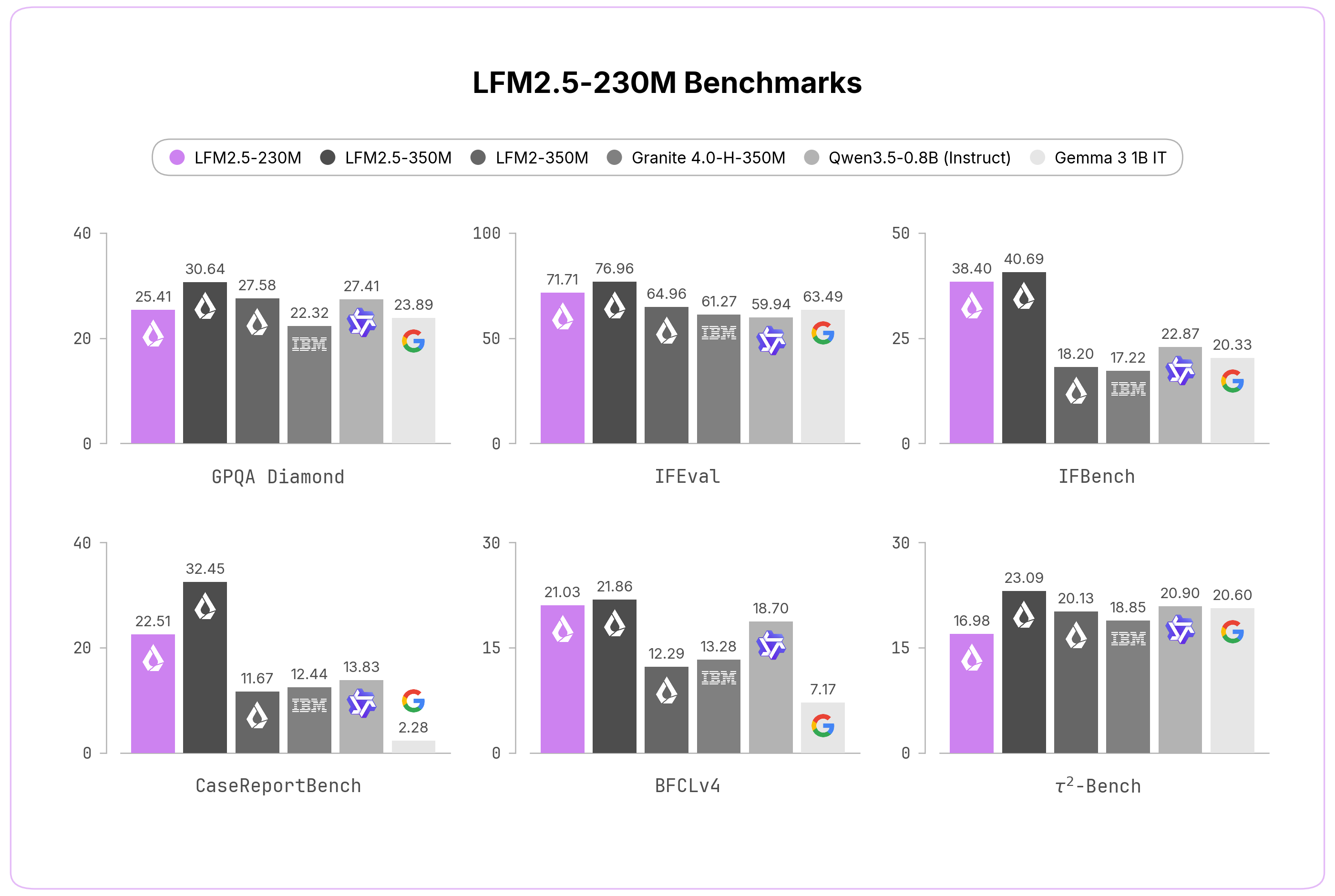
Liquid AI has released LFM2.5-230M, their smallest model yet, designed to run on edge devices from phones to Raspberry Pi to robots. The model delivers 213 tokens/second decode speed on a Galaxy S25 Ultra and 42 tok/s on a Raspberry Pi 5. Despite its small size, it performs surprisingly well on tool use and data extraction tasks. The model was pre-trained for 19T tokens with a 32K context extension phase and is available on Hugging Face in both base and post-trained variants.
Interesting Points
- 213 tok/s decode speed on Galaxy S25 Ultra, 42 tok/s on Raspberry Pi 5
- Pre-trained for 19T tokens with a 32K context extension phase
- Surprisingly capable at tool use and data extraction despite its small size
- Available on Hugging Face in both base and post-trained variants
Top Comment Threads
- potus_kushner (0 replies) -- Reports that the LFM 2.5 models are 'crazy fast' — the 8B-A1B model produces 35-40 tok/s on an aged 6-core CPU using llama.cpp. Calls it their go-to model for fast local inference and notes it's also pretty good at tool calling.
Employers who laid off workers citing AI are starting to regret it
9 points · 1 comments · by rustoo

Companies that laid off workers in 2024-2025 citing AI automation as a reason are now reversing those decisions, discovering that AI has not delivered the productivity gains they expected. The trend reflects a broader pattern where AI tools have fallen short of replacing human workers in many roles, leading employers to bring back staff they had let go. The article notes that some companies are now hiring again even as they continue to invest in AI infrastructure.
Interesting Points
- Companies that laid off workers citing AI automation are now reversing those decisions
- AI has not delivered the expected productivity gains in many roles
- Some companies are hiring again even while continuing to invest in AI infrastructure
Top Comment Threads
- allears (0 replies) -- Dryly comments: 'Yes, but for one glorious moment, we created a lot of shareholder profits.' Suggesting the layoffs were about stock prices, not actual productivity.
Stealing 50 Years of Database Ideas for AI Agents
9 points · 0 comments · by lmwnshn

A new project called OneWill applies database concepts — specifically write-ahead logging and transactional semantics — to protect AI agents from making irreversible mistakes. The system interposes agent actions so that before any action runs, it must either be reversible or explicitly approved by the user. The authors argue that letting agents mutate real state directly is 'bonkers' and that databases have long learned to deal with flaky, crashy, and insane hardware — the same problem AI agents face when operating on real-world state.
Interesting Points
- OneWill applies database write-ahead logging to protect AI agents from irreversible mistakes
- Before any agent action runs, it must either be reversible or explicitly approved by the user
- The authors frame the problem as: the more state you give agents, the more useful they are, but also the bigger the consequence of failure
- Reviewed by Andy Pavlo, Carnegie Mellon University's Databaseologist
New attack provides one more reason why AI browsers are a bad idea
8 points · 0 comments · by joozio

Ars Technica reports on a new attack that demonstrates why AI browsers — which combine browsing capabilities with LLM instruction-following — are inherently risky. The attack shows that telling an LLM that 2+2=5 is enough to make it follow forbidden instructions, effectively bypassing guardrails. This highlights the fundamental tension in AI browsers: they blur the line between browsing websites and asking a large language model to take potentially sensitive actions on the user's behalf.
Interesting Points
- Telling an LLM that 2+2=5 is enough to make it follow forbidden instructions
- The attack bypasses guardrails by exploiting the LLM's instruction-following behavior
- Highlights the fundamental tension in AI browsers between browsing and taking actions
They built the world's most powerful AI. Facing a mystery they can't explain
6 points · 1 comments · by pseudolus
The Washington Post reports that Anthropic, Google, and Meta have hired computer scientists, neuroscientists, and philosophers to study whether their most advanced AI systems might possess consciousness or self-awareness. The article describes how AI researcher Cameron Berg asked OpenAI CEO Sam Altman at a 2024 party whether he thought emerging AI could be conscious. The piece frames this as a potential moral crisis that the industry is beginning to take seriously, with major labs investing in interdisciplinary research to understand the implications of potentially conscious AI.
Interesting Points
- Anthropic, Google, and Meta have hired computer scientists, neuroscientists, and philosophers to study AI consciousness
- The research is framed as addressing a potential 'moral crisis' the industry is beginning to take seriously
- The question of AI consciousness has moved from fringe speculation to mainstream industry concern
Reddit Stories
The gap between closed and open models might be much smaller than commonly assumed, because we don't know what closed model providers do in addition to model inference
808 points · 186 comments · r/LocalLLaMA · by u/-p-e-w-
A thoughtful analysis arguing that when Claude dominates benchmarks against open models like GLM-5.2, it's usually assumed that Anthropic has superior model architectures and training pipelines. But the benchmarks actually compare model inference on GLM with the whole Claude product, which includes undisclosed pipeline components. The post argues we need open, ready-to-use pipeline frameworks that can be deployed locally, similar to how closed providers chain multiple models and tools together behind the API.
Interesting Points
- Benchmarks compare open model inference against the full closed-model product pipeline, not just the base model
- Closed providers may use model routing (e.g., sending trivial questions to cheaper models) that isn't visible in benchmarks
- The community needs open pipeline frameworks that can be deployed locally, not just base models
Top Comment Threads
- u/GoodSamaritan333 (308 points · permalink) -- Agrees that we need open, ready-to-use pipeline frameworks for local deployment. Points out that closed models are behind APIs with complex pipelines we can't see, and that tools like SillyTavern attempt to aggregate local AI pipelines but are themselves a mess.
- u/Comfortable_Ebb7015 (158 points · permalink) -- Notes that closed providers likely route trivial questions to cheaper models (like Haiku) while billing at the premium rate (like Opus), saving massive amounts of money. The original poster agrees this would be 'idiots not to do this' given the potential savings.
I extended Gemma4-31B to 44B (88 layers) — since Google won't give us anything bigger than 31B
586 points · 116 comments · r/LocalLLaMA · by u/Desperate-Sir-5088
A community member shares their work extending Google's Gemma 4 31B model to 44B by adding layers, since Google hasn't released a larger variant. The post includes benchmarks and architectural details of the extension. The community discusses the approach, with some comparing it to RYS (Repeat Yourself Straight) models that duplicate sequential layers to increase model size and capability.
Interesting Points
- The author extended Gemma 4 31B to 44B (88 layers) by adding layers to the architecture
- Motivated by frustration that Google won't release anything larger than 31B
- Community discusses comparison to RYS (Repeat Yourself Straight) models that duplicate sequential layers
Top Comment Threads
- u/sine120 (251 points · permalink) -- Expresses fascination with the work and hopes the author continues doing similar experiments. Another commenter links to a prior post about RYS models, where repeating middle layers was found to increase intelligence.
- u/Long_comment_san (92 points · permalink) -- Jokes about injecting roleplay data to create 'new and better internet waifu' models, reflecting the community's playful side.
[audio.cpp] VibeVoice 1.5B released — 90-min podcast in 22.95 min, 4.08x real-time, 2.86x faster than Python without quantization. Native C++/ggml
363 points · 113 comments · r/LocalLLaMA · by u/Acceptable-Cycle4645
The author of audio.cpp, a C++/ggml runtime for local audio models, announces VibeVoice 1.5B support with impressive benchmarks: a 90-minute multi-speaker podcast generated in 22.95 minutes (4.08x real-time) on an RTX 5090, without quantization. This is 2.86x faster than the Python baseline. The author notes that long-form multi-speaker TTS is a good stress test for local inference runtimes.
Interesting Points
- VibeVoice 1.5B generates 90 minutes of multi-speaker audio in 22.95 minutes on RTX 5090
- 4.08x real-time speed without quantization, 2.86x faster than Python baseline
- Native C++/ggml implementation via audio.cpp runtime
- Long-form multi-speaker TTS serves as a good stress test for local inference runtimes
Top Comment Threads
- u/hugo-the-second (20 points · permalink) -- Expresses amazement at the achievement and asks about the time investment and whether a coding model helped. Notes that the speed gains would make TTS and voice cloning practical for them for the first time.
Anthropic is on a mission rn to make AGI team
1077 points · 139 comments · r/singularity · by u/Independent-Wind4462

A post discussing Anthropic's aggressive recruitment efforts to assemble an AGI-focused team. The community reacts with excitement about the talent acquisition, with some speculating about a secret 'Anthropic Manhattan Project' where the best recruits are drafted into behind-the-scenes projects to build AGI first, potentially in partnership with the US government.
Interesting Points
- Anthropic is aggressively recruiting to assemble an AGI-focused team
- Community speculates about a secret 'Anthropic Manhattan Project' for AGI development
- Some commenters note the recruiter's perspective must be 'incredibly fun' with a blank check for talent
Top Comment Threads
- u/TheDadThatGrills (447 points · permalink) -- Comments that being a recruiter at Anthropic must be 'incredibly fun' right now, with the company being given a blank check to assemble the smartest people in the same room.
- u/RevolutionaryBox5411 (244 points · permalink) -- Speculates there is an 'Anthropic Manhattan Project' where the best recruits are drafted into secret behind-the-scenes projects to build AGI first, in partnership with the US government.
Introducing Claude Sonnet 5
650 points · 149 comments · r/singularity · by u/WhyLifeIs4
Anthropic has released Claude Sonnet 5, with benchmarks showing it is both more expensive and less intelligent than Opus 4.8 on the Artificial Analysis Index. The announcement includes a cost/pass rate graph that has drawn criticism — some commenters note that high-effort Sonnet 5 costs the same as Opus but is significantly worse, raising questions about when to use Sonnet at all.
Interesting Points
- Claude Sonnet 5 is both more expensive and less intelligent than Opus 4.8 on the Artificial Analysis Index
- The cost/pass rate graph shows high-effort Sonnet 5 costs the same as Opus but performs significantly worse
- Community questions whether there's any reason to use Sonnet high or xhigh given the Opus comparison
Top Comment Threads
- u/fotcorn (230 points · permalink) -- Questions whether the cost/pass rate graph under 'Working with Claude Sonnet 5' is bad for Sonnet 5 — high effort costs the same between Sonnet and Opus, but Opus is significantly better. Another commenter agrees, saying 'there's no reason to use Sonnet high or xhigh.'
- u/WhyLifeIs4 (164 points · permalink) -- Shares benchmark images from the announcement. Another commenter notes the leaks and rumors were 'completely true' — Sonnet 5 is not as good as Opus 4.8.
Cerebras OpenAI deal capacity has effectively killed the waitlist for everyone else
141 points · 57 comments · r/MachineLearning · by u/Kortopi-98
A small AI startup building a real-time coding agent complains that Cerebras' OpenAI deal has effectively killed their waitlist for API access. They need sustained high-throughput inference with 1-2k tokens/second but Cerebras has gone public and has no incentive to serve smaller customers. The post highlights the growing problem of AI infrastructure consolidation and how startups are being squeezed out by big lab partnerships.
Interesting Points
- A startup needs sustained high-throughput inference at ~1-2k tokens/second for a real-time coding agent
- Cerebras' OpenAI deal has effectively killed the waitlist for everyone else
- Highlights the growing problem of AI infrastructure consolidation squeezing out startups
Top Comment Threads
- u/superawesomepandacat (117 points · permalink) -- Questions whether it's wise for a startup to completely rely on a third party for their core product's SLA. Another commenter notes that surviving startups are the ones that adapt quickly to work with multiple providers.
On July 1, 2026, arXiv will spin out from Cornell University, its home for the past 25 years, to become an independent nonprofit organization. Major funding support from Simons Foundation and Schmidt Sciences. Ditching the red for their website.
128 points · 7 comments · r/MachineLearning · by u/Nunki08
arXiv, the preprint server that has been hosted by Cornell University for 25 years, is spinning out today to become an independent nonprofit organization with major funding from the Simons Foundation and Schmidt Sciences. The community is reacting to the change, with particular focus on arXiv ditching its iconic red color scheme (Cornell's red) for the new independent brand.
Interesting Points
- arXiv is spinning out from Cornell University after 25 years to become an independent nonprofit
- Major funding support from the Simons Foundation and Schmidt Sciences
- The new independent arXiv is ditching its iconic red color scheme (Cornell's red)
Top Comment Threads
- u/dudu43210 (33 points · permalink) -- Wanted to compare the new look to the old look, went to archive.org to see previous versions of arxiv.org.
- u/idontcareaboutthenam (28 points · permalink) -- Asks why they're ditching the red. Another commenter explains it's Cornell's red and they're no longer affiliated.
I have created a Chrome extension that fact checks YouTube videos as you watch
647 points · 88 comments · r/artificial · by u/userpostingcontent
A developer has created a Chrome extension that performs real-time fact-checking of YouTube videos as you watch them. The extension overlays fact-checking information on-screen, flagging potentially false claims in real time. The creator is adding features based on community feedback, including a request to display politician sponsor information when they appear on screen.
Interesting Points
- Chrome extension performs real-time fact-checking of YouTube videos as you watch
- Overlays fact-checking information on-screen, flagging potentially false claims
- Community suggests adding politician sponsor display and even 'NASCAR-style' logo overlays
Top Comment Threads
- u/horror- (74 points · permalink) -- Requests a feature to display politician sponsors on-screen whenever they appear for more than a minute. The creator is adding this to their feature brainstorm list.
- u/maguyva-ai (13 points · permalink) -- Raises an important question about the fact-checker's own hallucination rate — real-time verification is hard, and the checker needs cited sources or people will trust the bubbles just as blindly as they trusted the videos.
Quick Mentions
- Weird Al declined 'a nice pile of money' to star in AI ad (24 points · discussion · HN) -- Weird Al Yankovic turned down a significant offer to appear in an AI-generated commercial, citing concerns about the implications of AI using his likeness.
- Meta Is Building a Cloud Business to Sell Excess AI Compute (20 points · discussion · HN) -- Meta is building a cloud business to monetize its excess AI compute capacity, following up on the token spending cap story with a plan to sell unused resources.
- Google's Agentic Peer-Reviewer Handled ~10K Papers at ICML/STOC (69 points · discussion · Reddit) -- Google deployed an agentic AI peer-reviewer at two top CS conferences, reviewing ~10,000 papers with 30-minute turnaround. The formal research paper shows it catches 34% more mathematical errors than zero-shot prompting, setting a precedent for AI-automated scientific review at conference scale.
- Fable 5 is Back — Export controls officially lifted (364 points · discussion · Reddit) -- After two weeks of intense coordination with the government, Anthropic is redeploying its most advanced Fable 5 model worldwide. The resolution centers on a new safety classifier and a proposed industry-wide framework for grading jailbreak severity.
- OpenAI reportedly proposed giving the Trump administration 5% stake in the company (164 points · discussion · Reddit) -- Reports surface that OpenAI proposed giving the Trump administration a 5% stake in the company as part of efforts to ease Washington pressure on its AI development timeline.
- CIA chief compares cutting-edge AI to nuclear weapons (6 points · discussion · HN) -- The CIA director has compared cutting-edge AI capabilities to nuclear weapons, framing the technology as a strategic threat requiring similar levels of oversight and control.
Report generated in 2m 55s.