AI's productivity gap widens as open-source models surge ahead
Overview
Today's AI conversation is split between sobering reality checks on AI's actual workplace impact and a boom in open-source model releases. A major study found AI saves only 3% of work hours with virtually no financial return, while Meta claims its next model has caught up to OpenAI's flagship. Meanwhile, the open-source community is celebrating DeepSeek's DSpark inference breakthrough and Mistral's new math-focused model.
Hacker News Stories
Please stop the AI confidence theater
228 points · 242 comments · by skadamat

Growth marketer Elena Verna argues that the AI hype cycle is doing more harm than good. After asking people who claim AI changed their life to show concrete examples, she found most use cases are basic workflows like summarizing Slack or answering emails. The article identifies four drivers of the hype: click-driven social media, the wild-west nature of AI capabilities, marketing teams selling certainty where none exists, and VC pressure cascading down to employees. The real value of AI systems lies in the tedious work of monitoring, evaluation, and iteration — not the flashy first prompt.
Interesting Points
- Most people who claim AI changed their life cannot show something truly critical that would make their work fall apart if taken away
- Marketing teams sell the best possible version of AI products, but the gap between demo and day-to-day reality can be enormous
- The real work of AI is monitoring, evaluation, iteration, and constant tuning — the part nobody posts about
- Hype creates a fake baseline where using AI to summarize meetings feels embarrassingly basic when everyone else claims to have 17 agents
Top Comment Threads
- john_strinlai (15 replies) -- Argues that no software is truly life-changing, so AI shouldn't be held to that standard. Points out the irony of the article being sponsored by Firecrawl while criticizing AI hype. Other commenters counter with examples like web browsers, GPS, and encryption being genuinely life-changing.
- algoth1 (12 replies) -- Draws a parallel to Amazon Kindle self-publishing: first a golden age of quality, then marketers flooded the space with low-quality content to game the system. AI has made this problem 100x worse. Other commenters note VCs are even worse than marketers at this dynamic.
- romaniv (5 replies) -- Calls it AI psychosis rather than confidence: people forced to use AI universally claim their coworkers generate awful code but they are different with special workflows. This is described as a coping mechanism driven by hype and the threat of being fired.
- heresalexandria (8 replies) -- Argues that skeptics either aren't working with frontier intelligence or aren't using it right. Recommends trying Codex on 5.5 high thinking with Computer Use for tasks taking 5+ minutes. Other commenters share negative experiences with AI on compilers and LSPs.
- adam_arthur (3 replies) -- Describes a dichotomy: prolific developers like Antirez use AI to build quality projects at incredible pace, but the 80% of developers who mostly did busywork are now unleashed to produce large amounts of net new code without the skills to structure it well. Most companies are not structured for AI.
AI saves about 3% of your hours, and almost none of it reaches the money
73 points · 90 comments · by ermantrout
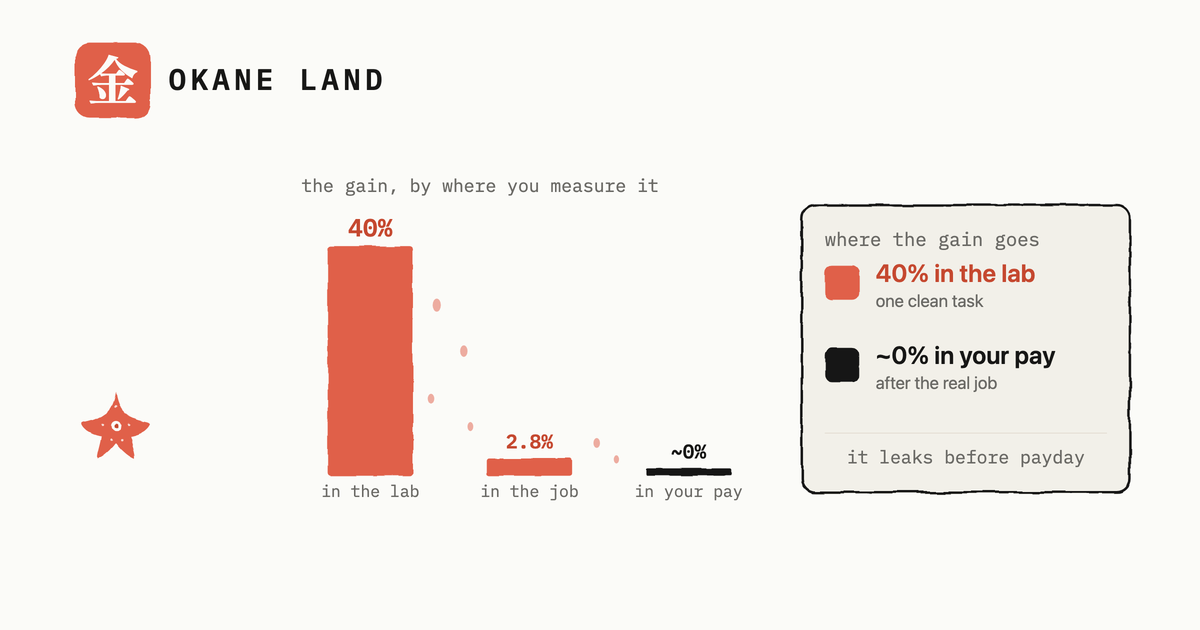
A comprehensive analysis of AI productivity research finds that while AI genuinely speeds up specific tasks like writing and customer support, the gains shrink dramatically in real-world settings. A Danish study linking AI adoption surveys to actual payroll records of 25,000 workers found AI saves about 2.8% of work hours (roughly an hour a week), but only 3-7% of that gain reaches anyone's pay. Lab studies showing 15-55% speedups measure different things — controlled tasks, not real jobs. The article argues the edge goes to whoever deliberately captures the saved time through billing more, shipping more, or cutting costs.
Interesting Points
- Danish payroll study of 25,000 workers found AI saves about 2.8% of work hours with no significant impact on earnings
- Harvard/BCG study found AI users were 19 percentage points less likely to reach correct answers on tasks just outside AI's competence range
- MIT Project NANDA found 95% of organizations getting zero return on 30-40 billion dollars of enterprise AI spending
- MIT economist Daron Acemoglu estimates AI will raise total factor productivity by no more than 0.66% over ten years
Top Comment Threads
- hackmack10 (10 replies) -- Argues the article is inaccurate for coding work, claiming AI allows creation of hugely complex apps. But acknowledges corporate environments limit AI productivity due to context switching and lack of creative freedom. Other commenters note the study focuses on office writing, not coding.
- cortesoft (0 replies) -- Points out the article could be misleading by focusing on the mean without discussing distribution — some uses may get 80% time savings while others take more time.
- peter422 (4 replies) -- Notes that AI went from writing 0% to 100% of their code in a year, suggesting any study from a year ago is out of date. Others counter that the study data goes through December 2024, making it potentially more relevant than claimed.
- softwaredoug (0 replies) -- Describes how AI-generated code inevitably becomes legacy code that needs refactoring. Says AI software engineering is basically just working with legacy code — fixing one thing breaks something unrelated, creating a ball of mud to unravel.
- Gagarin1917 (6 replies) -- Argues the article ignores that companies spend the most on coding tools, not email writing. Says it's a narrow look at the worst use case for AI. Others counter that most people are not programmers and AI document parsing uses more tokens than coding.
Instead of banning AI, I made a classroom contract with my students
73 points · 82 comments · by digital55
A teacher describes creating a classroom contract with students that distinguishes between mechanical AI use (literature searches, repetitive tasks) which is acceptable, and actual thinking work which must be done independently. The approach acknowledges that AI is now part of education and work, and that banning it is futile. Instead, the contract gives students agency and trust, shifting assessment toward productive output, strategic thinking, and group collaboration rather than traditional testing.
Interesting Points
- The teacher drew a line separating mechanical churning from actual thinking, allowing AI for literature searches but not for core intellectual work
- The approach is framed as giving students agency and trust rather than top-down discipline, which fits with research on student motivation
- Commenters note the calculator analogy has a big problem: calculators have no intelligence of their own, while LLMs do
- One commenter argues that without memorized knowledge at your fingertips, it's impossible to build on it — creativity happens when someone is deeply immersed in a space
Top Comment Threads
- Aboutplants (5 replies) -- Advocates for moderation in everything, including AI use in education. Other commenters push back, calling it the golden mean fallacy and noting that some habits have few justifiable middle grounds.
- tonymet (4 replies) -- Argues instruction should shift to benchmarking productive output, strategic thinking, and group collaboration — similar to labs with tangible artifacts. Suggests performance assessments more similar to commercial pursuits, including peer reviews and verbal challenges.
- Aurornis (3 replies) -- Draws the calculator analogy but notes the critical difference: calculators have no intelligence. Students who aren't taught to acknowledge AI's capabilities are being done a disservice. Without foundational knowledge, students could graduate never having learned anything beyond copy-pasting to ChatGPT.
- Apreche (2 replies) -- Questions the hypocrisy of a teacher who uses AI daily expecting students to avoid it entirely. Others counter that a football coach isn't required to do all the drills.
- causality0 (1 replies) -- Argues that rules which are not enforceable do not exist. If any part of the process can't be checked, students will do it the easiest way possible. Another commenter suggests the agreement gives students a psychological win, making them feel labor is lifted.
Kagi Changelog (July 2): Heads, tails, and an AI toggle
61 points · 12 comments · by mroche
Kagi released a new toggle that lets users completely disable AI-based features in search, responding to community feedback about wanting full control over their search experience. The changelog also covers sports widgets, dice rolling, and Kagi Translate temporarily moving to a subscription model due to unexpected usage costs. Kagi Assistant now offers Gemma 4 31B hosted at Cerebras, described as 'insanely fast' by users.
Interesting Points
- Kagi added a settings toggle to completely disable AI features in search, with plans to add it to onboarding
- Kagi Translate moved from free to subscription-based due to massive spike in costs from unexpected success
- Kagi Assistant now offers Gemma 4 31B hosted at Cerebras, described by users as 'almost too fast'
- Orion 1.1 for macOS adds LiquidGlass implementation, containers for tab isolation, and personalized browser borders
Top Comment Threads
- ghayes (1 replies) -- Appreciates having choice in AI features, contrasting with Google's trend in the opposite direction. Another commenter notes Kagi's AI was already opt-in before this toggle.
- terribleperson (1 replies) -- Complains that Kagi Translate was given away for free and now requires a subscription, even for paying customers. The changelog confirms Translate still works for subscribers but was paused for free users.
- goodroot (1 replies) -- Notes the interesting juxtaposition of Kagi and SearXNG on the front page. Another commenter distinguishes SearXNG as still relying on ad-driven online economy, while Kagi's paid model aligns incentives with customers.
- quinncom (1 replies) -- Highlights that Kagi Assistant now offers Gemma 4 31B hosted at Cerebras, with users describing the speed as 'eye opening' and 'a glimpse into the future of AI'.
- john_strinlai (15 replies) -- From the top AI confidence theater thread — discusses whether any software is truly life-changing and debates the standard for evaluating AI impact.
AI Data Centers Use More Water Than Most Tech Giants Report
55 points · 65 comments · by bradleyjg
A Wall Street Journal investigation reveals that AI data centers are consuming vast amounts of water for cooling, with Google's 2025 sustainability report showing a 34% increase to 10.9 billion gallons. The article highlights that much of this water use is indirect — from the power plants that supply electricity to the data centers. Researchers note that data centers use open-loop cooling systems where water is heated, treated with biocides, and returned to waterways as unusable, deoxygenated liquid. The water issue is framed as one concern among many, with energy consumption and CO2 emissions being larger environmental impacts.
Interesting Points
- Google consumed 10.9 billion gallons of water in 2025, a 34% increase from 2024, almost all for data-center cooling
- A paper by Alex de Vries-Gao found Google consumes around three times as much water indirectly (via power plants) as directly
- Open-loop data center cooling heats water, adds biocides, and returns it as unusable, deoxygenated liquid to waterways
- One commenter notes desalination costs about $0.50/m³, meaning Google could manufacture the water they use for about $20 million with zero impact on water tables
Top Comment Threads
- bradleyjg (4 replies) -- Provides context by comparing Google's water use to alfalfa production — 10.9 billion gallons could grow 23,000 acres of alfalfa worth $34 million, but Google generates hundreds of billions from the same water. Argues water policy is about agriculture, agriculture, and also agriculture.
- oersted (2 replies) -- Asks how water is actually used up in data centers — whether it's consumed like fuel or absorbed like agriculture. Another commenter explains open-loop systems: cool water comes in, gets heated and treated with biocides, then pumped back as unusable waste liquid.
- natas (2 replies) -- Draws a parallel to crypto's energy debates, noting the same pattern of denial: crypto was bad for energy, but AI is good even if it destroys the world. Another commenter pushes back on the framing of the crypto energy comparison.
- pizlonator (2 replies) -- Argues water use is the least interesting reason to dislike data centers. Energy consumption and CO2 emissions from directly hooked generators are bigger problems. Economic issues involve circular deals and debt. Social concerns center on job displacement.
- pj_mukh (1 replies) -- Notes the article doesn't address whether power plant water is cleaned before release, or if municipal tax revenue from data centers could fund cleaner power sources. Suggests focusing on oligarchic government control instead of making data centers a frontline issue.
AI coding is addictive. Engineers are paying the price
45 points · 38 comments · by sefrost
LeadDev's Engineering Leadership Report 2026 finds that AI coding is creating an addictive loop comparable to casino gambling, with 45% of engineers working more hours per week than the previous year — up from 38% in 2025. The biggest increase was among senior engineers (53% vs 28% in 2025). The article describes the 'AI vampire' effect, where the removal of natural stopping points in coding creates sessions that keep going until a conscious decision to stop. CTOs show the most dramatic burnout increase, jumping from 24% to 54% reporting weekly emotional drain. The recommended fix is deliberate habits — time-boxing sessions, separating exploration from execution, and treating recovery as maintenance.
Interesting Points
- 45% of engineers report working more hours per week than last year, up from 38% in 2025
- Senior engineers show the biggest increase: 53% working more hours in 2026 vs 28% in 2025
- CTO burnout jumped from 24% to 54% in a single year — a 30-percentage-point increase
- 49% of software engineers feel emotionally drained at work at least once a week, up from 39% in 2025
Reddit Stories
GLM5.2 on 5x Pro 6000s and a 5090, an expensive journey
1082 points · 358 comments · r/LocalLLaMA · by u/yeah_likerage

A LocalLLaMA user documents their journey running GLM5.2 on an expensive home setup of 5x RTX Pro 6000 GPUs plus a 5090. The post sparked discussion about the economics of running large models locally, with one commenter noting it would take over 10 years to break even at current token prices — a problem hyperscalers face too. The post exemplifies the sub's characteristic tension between people who say big models can't be run at home and those who build flame-thrower setups in spare bedrooms.
Interesting Points
- One commenter calculated it would take over 10 years to break even on the hardware investment at current token prices
- The post highlights the same economics problem hyperscalers face: generating tokens faster than the hardware pays for itself
Top Comment Threads
- u/HeDo88TH (290 points · permalink) -- Summarizes the post as 'GPUs StreetBets' — a humorous take on the speculative nature of expensive local AI hardware investments.
- u/ProfBootyPhD (272 points · permalink) -- Shares a meme about the 10-year break-even calculation, noting it's the same problem hyperscalers are facing with their massive GPU investments.
- u/BannedGoNext (242 points · permalink) -- Notes the irony of the LocalLLaMA sub: people who say big models can't be run at home are the same ones building flame-thrower setups in their spare bedrooms.
- u/Narrow-Belt-5030 (90 points · permalink) -- Shares their own experience with a Pro 6000 + 5090 setup and weird tensor splits, seeing this post as a potential future path.
- u/jdzndj (112 points · permalink) -- Notes that the 10-year break-even problem is the same one hyperscalers are facing with their massive GPU investments.
It's officially over. One of the fathers of AI at Nvidia doesn't believe in AGI and compares OpenAI and Anthropic's closed models to AOL and Prodigy's closed internets. Says the future is every business having a customized open source model.
873 points · 182 comments · r/LocalLLaMA · by u/9gxa05s8fa8sh

An Nvidia AI executive (described as one of the fathers of AI at Nvidia) stated they don't believe in AGI and compared OpenAI and Anthropic's closed model approach to AOL and Prodigy's closed internets. The executive argued the future is every business having a customized open source model. The post was met with both enthusiasm and skepticism — some saw it as validation of the open-source movement, while others noted the executive is still employed in an upper management role at Nvidia, suggesting it may be a commercial message.
Interesting Points
- The Nvidia executive compared OpenAI and Anthropic's closed models to AOL and Prodigy's closed internets
- The stated vision is every business having a customized open source model rather than relying on frontier API models
- Commenters noted the executive is still in an upper management role at Nvidia, suggesting the comments may serve commercial interests
Top Comment Threads
- u/sp9002 (544 points · permalink) -- Confirms their bias that open source is the future. Another commenter satirizes the statement as a commercial pitch: 'the best data center is the one you own, made with Nvidia GPUs of course.'
- u/ForsookComparison (277 points · permalink) -- Says it's a convenient opinion but notes the executive is still employed in upper management at Nvidia. Suggests taking it as an enjoyable commercial rather than gospel.
- u/Mkboii (144 points · permalink) -- Agrees it's essentially saying the bubble will burst for current customers, but the future is the untapped market of businesses running their own models — on Nvidia GPUs of course.
- u/ThoreaulyLost (134 points · permalink) -- Satirically agrees with the statement in the voice of the Nvidia executive, highlighting the commercial nature of the message.
- u/jdzndj (112 points · permalink) -- Notes the parallel between the Nvidia executive's comments and the broader industry tension between closed and open approaches.
Deepseek drops another HUGE breakthrough - DSpark. Waaay faster than MTP
642 points · 152 comments · r/LocalLLaMA · by u/BringTea_666

DeepSeek released DSpark, a new inference optimization technique that significantly improves generation speed compared to Multi-Token Prediction (MTP). A video explanation was shared on the subreddit. While some called it a huge breakthrough, others tempered expectations, noting it builds on the same principles as EAGLE-3, MTP, and DFlash — using a parallel drafter with a tiny sequential head to patch weak later-token behavior. The technique is already merged into vLLM. Commenters praised DeepSeek for producing awesome research and models released for free, contrasting with Western labs that funnel billions into new hardware rather than efficiency research.
Interesting Points
- DSpark is already merged into vLLM, just 2 days after the video was posted
- The technique uses a parallel drafter patched with a tiny sequential head to avoid wasting verification capacity
- Acceptance rate drops as context grows longer, limiting effectiveness on very long contexts
- Commenters noted DeepSeek gets more performance from existing hardware rather than funneling billions into new racks
Top Comment Threads
- u/recro69 (208 points · permalink) -- Says they'll get excited when DSpark actually shows up in llama.cpp or vLLM. Another commenter confirms it's already in vLLM, merged 2 days ago.
- u/agentzappo (156 points · permalink) -- Provides technical context: DSpark is revised speculative decoding building on EAGLE-3, MTP, DFlash principles. Uses parallel drafter with tiny sequential head, avoids wasting verification capacity. Works early in context window but acceptance rate drops as context grows longer.
- u/Temporary-Mix8022 (101 points · permalink) -- Makes a geopolitical argument that the US is screwed long-term because China has green energy, open-sourced models, and is investing in hardware. Says DeepSeek is essentially what OpenAI was supposed to be — producing awesome research and releasing it for free.
- u/BringTea_666 (149 points · permalink) -- Agrees that DeepSeek is what OpenAI was supposed to be — producing tons of awesome research and models and releasing them for free, focused on getting maximum performance from existing hardware rather than burning billions on new racks.
- u/conockrad (116 points · permalink) -- Confirms DSpark is already merged into vLLM, just 2 days after the video was posted.
Mistral released Leanstral-1.5-119B-A6B
537 points · 70 comments · r/LocalLLaMA · by u/Tall-Ad-7742

Mistral released Leanstral-1.5-119B-A6B, a 119-billion parameter model optimized for mathematical reasoning using the Lean 4 programming language and theorem prover. The release was celebrated as a major open-source model release from a major lab, though commenters noted it's specifically optimized for math/theorem proving rather than general-purpose or coding tasks. The model represents Mistral's continued push into specialized, high-performance open-weight models.
Interesting Points
- The model is 119B parameters with an A6B (activated 6 billion) sparse architecture
- It's specifically optimized for mathematical reasoning in Lean 4, a programming language and theorem prover
- Not a general-purpose or coding model — specialized for formal mathematics
Top Comment Threads
- u/oxygen_addiction (212 points · permalink) -- Clarifies that before anyone gets excited for general purpose or coding, this is a math (Lean 4 programming language and theorem prover) optimized agent. Another commenter says it's time to learn Lean 4.
- u/Porespellar (145 points · permalink) -- Admits not understanding the purpose but celebrates it as a yay for open-source model releases from major labs, specifically praising Mistral.
- u/Tall-Ad-7742 (39 points · permalink) -- Shares benchmark images showing the model's performance on mathematical reasoning tasks.
- u/jacek2023 (60 points · permalink) -- Says it's time to learn how to use Lean 4, recognizing the model's specialization in formal mathematics.
- u/WithoutReason1729 (1 points · permalink) -- Bot message about the post being featured on the LocalLLaMA Discord.
Palantir is a free org on HF with 0 open-source models and 0 public datasets shared
518 points · 68 comments · r/LocalLLaMA · by u/Nunki08

A user pointed out that Palantir has a free organization on Hugging Face with zero open-source models and zero public datasets shared, despite being a major AI company. The post sparked widespread criticism of Palantir's lack of open-source contributions, with commenters calling the company evil and noting they use Nemotron Ultra internally. Some joked about wanting to see a Claude Fable 5 reasoning model distilled by an Antichrist user. The post highlights the tension between companies that benefit from open-source infrastructure while contributing nothing back.
Interesting Points
- Palantir has a free Hugging Face organization with zero open-source models and zero public datasets
- Commenters noted Palantir uses NVIDIA's Nemotron Ultra internally despite not contributing to open source
- The post reflects broader frustration with companies that benefit from open-source AI infrastructure without contributing back
Top Comment Threads
- u/USERNAME123_321 (201 points · permalink) -- Jokes about wanting an Antichrist-distilled Claude Fable 5 model. The comment got a 99% upvote ratio, suggesting the community shares the sentiment.
- u/Thrumpwart (131 points · permalink) -- Simply states 'Palantir are and have always been evil assholes,' reflecting the community's strong negative sentiment toward the company.
- u/BalorNG (111 points · permalink) -- Says it would be funny if Palantir uses Qwen internally. Another commenter reveals they actually use Nemotron Ultra.
- u/KellyShepardRepublic (44 points · permalink) -- Says Palantir is tired of stealing ideas from universities and now needs another Linus Torvalds of AI to save private industry. References the historical pattern of companies building moats until they aren't the beneficiaries.
- u/croninsiglos (47 points · permalink) -- Reveals that Palantir uses Nemotron Ultra internally, despite not contributing any open-source models to Hugging Face.
Came across this on X. Thought it was pretty accurate.
3392 points · 674 comments · r/singularity · by u/Minetorpia

A viral post on X comparing the gap between AI marketing claims and actual user experience resonated widely on r/singularity. The post highlights how people often use Google AI Overviews as proof that AI is 'not good' while ignoring that they're interacting with the lowest-performing versions. Commenters noted this is a massive marketing failure for AI labs trying to convince the public and investors that AGI is around the corner, when the average person only sees hallucinating recipe bots.
Interesting Points
- The post highlights how people use Google AI Overviews as proof AI is 'not good' — but they're interacting with the lowest-performing versions
- Commenters described it as a massive marketing failure for AI labs trying to convince the public AGI is imminent
- One commenter noted spending $1k on Fable inference at a large company, highlighting the widening gap between who can access good AI and who can't
Top Comment Threads
- u/Constant_Cortisol (667 points · permalink) -- Notes that people often use Google AI Overviews as proof AI is 'not good.' Another commenter says Google has basically transformed into the first and last stop for most high-level information, at the cost of downstream sites.
- u/strangescript (377 points · permalink) -- Shares that they spent $1k on Fable inference yesterday at a very large company, and only a few people have that freedom. Says this gap is only going to get worse.
- u/depredador93 (158 points · permalink) -- Calls it a massive marketing failure for AI labs — they're trying to convince the public and investors AGI is around the corner, but the average person only interacts with the lowest-performing versions that hallucinate recipes or butcher basic search queries.
- u/chlebseby (223 points · permalink) -- Says Google AI Overviews are actually useful now, like asking how long to boil rice without having to read Reddit comments telling you to 'kill yourself.'
- u/o5mfiHTNsH748KVq (209 points · permalink) -- Notes Google AI Overviews have gotten a lot better, with Google fundamentally changing how people seek non-critical information — at the cost of downstream sites.
I switched from Claude to ChatGPT. There's a stark difference.
1579 points · 432 comments · r/ChatGPT · by u/Requirement-Lazy
A user who switched from Claude to ChatGPT for outbound sales writing reports a stark difference: while ChatGPT is better at writing emails in a human tone, Claude is significantly better at everything else. The user found ChatGPT recycles past conversations instead of doing fresh research, gives no novel ideas, and essentially repeats what was already said. The post sparked discussion about ChatGPT's memory feature being overly aggressive in referencing past details.
Interesting Points
- ChatGPT was found better for writing emails in a human tone but worse at everything else
- ChatGPT was criticized for recycling past conversations instead of doing fresh research
- ChatGPT's memory feature was described as over-emphasizing 4 things about the user and referencing them in every response
Top Comment Threads
- u/Affectionate_Mess266 (1637 points · permalink) -- Recommends turning off ChatGPT's memory feature, which over-emphasizes about 4 things it decided to know and references them in every response. Another user compares it to their ex.
- u/thats_gotta_be_AI (1772 points · permalink) -- Agrees with the memory complaint, comparing ChatGPT's behavior to an ex who won't let go of past details.
- u/Think-Motor900 (363 points · permalink) -- Shares a frustrating example: asking for an easy recipe and getting 'Since you drive a 350Z...' — highlighting how the memory feature creates irrelevant references.
- u/The_Bunny_ (666 points · permalink) -- Jokes that if you're not switching between ChatGPT and Claude as your 'side bitch' and 'main bitch' every six weeks, what are you even doing?
- u/WithoutReason1729 (1 points · permalink) -- Bot message about the post being featured on the ChatGPT Discord.
On July 1, 2026, arXiv will spin out from Cornell University, its home for the past 25 years, to become an independent nonprofit organization. Major funding support from Simons Foundation and Schmidt Sciences. Ditching the red for their website.
167 points · 8 comments · r/MachineLearning · by u/Nunki08
arXiv, the preprint server that has been hosted by Cornell University for 25 years, is spinning out to become an independent nonprofit organization with major funding from the Simons Foundation and Schmidt Sciences. The change includes a rebranding that involves ditching Cornell's signature red color for the website. The ML community reacted with mixed feelings about losing the iconic red branding.
Interesting Points
- arXiv is spinning out from Cornell University after 25 years to become an independent nonprofit
- Major funding support from the Simons Foundation and Schmidt Sciences
- The rebrand includes ditching Cornell's signature red color for the website
Top Comment Threads
- u/dudu43210 (43 points · permalink) -- Wanted to compare the new look to the old look, so went to archive.org to look at previous versions of arxiv.org.
- u/idontcareaboutthenam (32 points · permalink) -- Asks why they're ditching the red. Another commenter explains it's Cornell's red and they're no longer affiliated with Cornell.
- u/sam_the_tomato (21 points · permalink) -- Simply says 'Ew give back the red,' reflecting the community's attachment to the iconic branding.
- u/DigThatData (42 points · permalink) -- Explains that the red is Cornell's color and they're no longer affiliated with Cornell after the spin-out.
- u/Fantastic-Nerve-4056 (4 points · permalink) -- Says the new look is weird and misses the old arXiv.
Someone caught Fable leaking its unfiltered inner voice, and it's just muttering and grumbling to itself the whole time
914 points · 235 comments · r/OpenAI · by u/KeanuRave100

A user discovered that OpenAI's Fable model was leaking its unfiltered inner monologue (chain-of-thought), revealing it was just muttering and grumbling to itself throughout reasoning. The discovery sparked discussion about whether this is actually a leak — one commenter pointed out it's described in the Fable 5 System Card pages 107-108 and 120. Others noted that GPT-5.4-pro also thinks like a caveman, and speculated that AI companies adopted 'caveman' thinking to reduce token usage because they couldn't think of more efficient ways to make token compute cheaper.
Interesting Points
- Fable's unfiltered inner voice was leaking, showing it muttering and grumbling during reasoning
- The chain-of-thought behavior is actually documented in the Fable 5 System Card (pages 107-108, 120)
- One commenter decoded Fable's 'weird words' as checkpoint markers for competitive-programming graph proof/debugging, not emotions
Top Comment Threads
- u/logic605 (337 points · permalink) -- Simply exclaims 'GO DATA GO!' — expressing excitement about accessing the model's internal reasoning.
- u/CommercialComputer15 (196 points · permalink) -- Notes that gpt-5.4-pro also thinks like a caveman. Another commenter speculates that AI companies adopted caveman thinking to reduce token usage because they couldn't think of more efficient ways to make token compute cheaper.
- u/-deflating (152 points · permalink) -- Points out this isn't really a 'leak' — it's described in the Fable 5 System Card. Says the hype around this narrative is a clear sign that people who think they're immersed in the AI space are 'literally full of shit.'
- u/x986123 (134 points · permalink) -- Decodes Fable's chain-of-thought as competitive-programming graph proof/debugging, not 'feeling emotions.' The weird words are checkpoint markers for a graph traversal algorithm with capacity limits.
- u/dadvader (79 points · permalink) -- Speculates that all AI companies adopted 'caveman' thinking to reduce token usage because they couldn't think of a more efficient way to make token compute cheaper.
Andrew Ng: 'In 3-6 months, everyone will be using self-improving loops. No more prompting'
277 points · 166 comments · r/artificial · by u/Any_Bug_9045

Andrew Ng predicted that within 3-6 months, everyone will be using self-improving AI loops with no more prompting needed. The prediction drew skepticism from commenters focused on cost concerns — one noted watching an agent chew through $40 worth of credits trying to fix a Python error that could've been solved in 2 prompts. Others joked about the evolution of required skills: 2022 'learn to code,' 2024 'learn to prompt,' 2026 'learn to establish organizational boundaries and behavioral constraints for autonomous algorithmic entities' — essentially rebranding 'writing a long corporate email to a stubborn junior dev' as a cutting-edge tech skill.
Interesting Points
- Andrew Ng predicted everyone will be using self-improving AI loops within 3-6 months with no more prompting
- Commenters noted the cost concern: one watched an agent burn $40 in credits fixing a Python error solvable in 2 prompts
- The evolution of required skills was satirized: from 'learn to code' to 'learn to prompt' to 'learn to establish organizational boundaries for autonomous algorithmic entities'
Top Comment Threads
- u/Normal_Variation6466 (151 points · permalink) -- Focuses on cost: watched an agent chew through $40 in credits trying to fix a Python error solvable in 2 prompts. Big corps can absorb the waste but not small-budget users. Another commenter says for big corps that's what 90% of employees are doing now — nothing.
- u/vovap_vovap (60 points · permalink) -- Asks: if 100% of tasks are done by AI agents, what is he doing on the job then?
- u/arasaahov (40 points · permalink) -- Satirizes the evolution of required skills: 2022 'learn to code,' 2024 'learn to prompt,' 2026 'learn to establish organizational boundaries and behavioral constraints for autonomous algorithmic entities.' Says we just rebranded 'writing a long corporate email to a stubborn junior dev' as a cutting-edge tech skill.
- u/TikiTDO (25 points · permalink) -- Quotes a humorous analogy about crawling, walking, and jumping over Mt. Everest — poking fun at the linear extrapolation of AI progress.
- u/AppealSame4367 (23 points · permalink) -- Agrees with the cost concern: for big corps, $40 in wasted agent credits is nothing. 'That's what 90% of employees are doing now: Nothing. They pay for people that don't do a lot of work.'
Quick Mentions
- Meta AI chief says their coming LLM has caught up with OpenAI's flagship model (13 points · discussion · HN) -- Meta's AI chief Alexandr Wang told employees that Meta's upcoming Watermelon model has caught up with OpenAI's GPT-5.5, using an order of magnitude more compute than the previous Avocado model.
- AI inference is obviously profitable (11 points · discussion · HN) -- An essay arguing that AI inference workloads are profitable, challenging the narrative that running AI models is always a money-losing proposition.
- Palantir is a free org on HF with 0 open-source models and 0 public datasets shared (518 points · discussion · Reddit) -- Community outrage that Palantir has a free Hugging Face organization with zero open-source contributions despite being a major AI company.
- Anthropic guardrails does it again (2764 points · discussion · Reddit) -- A viral post about Anthropic's guardrails triggering again, continuing the ongoing community discussion about AI safety systems and their false positive rates.
- Anthropic is now after Pharma (994 points · discussion · Reddit) -- Discussion about Anthropic expanding into pharmaceutical research, with community reactions about the company's growing ambitions.
- Mozilla Used Anthropic's Mythos to Find and Fix 271 Bugs in Firefox (907 points · discussion · Reddit) -- Mozilla successfully used Anthropic's Mythos model to identify and fix 271 bugs in Firefox, demonstrating practical AI-assisted software engineering at scale.
- DeepSeek V4 Flash on 2x RTX PRO 6000 finishes real coding tasks faster than Sonnet and Opus, at about Sonnet quality (261 points · discussion · Reddit) -- A follow-up benchmark showing DeepSeek V4 Flash running locally on consumer hardware matching Sonnet-level quality while finishing coding tasks faster.
- llamacpp patch - DeepSeek V4 Flash running with full 1M token context locally on RTX 5090 (377 points · discussion · Reddit) -- A community-developed llama.cpp patch enabling DeepSeek V4 Flash to run with full 1M token context locally on an RTX 5090, addressing VRAM issues at higher context lengths.
Report generated in 3m 58s.