OpenAI's Phone Ambitions, Gemini's Video Leap, and the AI Outsourcing Revolution
Updates: 08:36 PM PDT · 08:47 PM PDT · 09:06 PM PDT
Overview
Today's AI conversation spans from product launches to workforce realities. OpenAI is fast-tracking its own AI agent phone for 2027, while Gemini Omni Flash demonstrates impressive video generation. Meanwhile, Harvard Business Review explores how AI is rewriting outsourcing economics, Ford rehires veteran engineers after AI quality checks failed, and a consumer watchdog finds Tripadvisor's AI summaries masking serious safety issues at hotels.
Hacker News Stories
Agentic coding notes
174 points · 82 comments · by gm678
Dan Luu shares extensive notes on agentic coding workflows, covering testing practices, LLM variance in benchmarks, and caveman mode. He argues that different workflows demand different reliability levels, which causes people to talk past each other on AI coding. He details his experience building a superhuman board game AI through systematic evaluation and data-driven iteration, and discusses how LLMs are surprisingly bad at data analysis but still dramatically speed up human analysis when given the right workflow.
Interesting Points
- LLM-generated fuzzers from SOTA models don't do a good job of thinking about how inputs should be varied to elicit bugs
- GPT-5.5 xhigh has 7.5% standard deviation between runs, which is less than 1 SD across different GPT models
- Running a simple agentic loop where the agent produces a result you know will be wrong, then fixing the parts that need fixing, took about five minutes of human time versus a traditional two-day analysis
- Coding agents are highly non-uniform in their effectiveness relative to humans, creating phase changes in how you work
Top Comments
zarzavat (5 replies)
Fable changes the game yet again, because it's API-only.
You're not likely to want to run Fable in a loop any more than you want to take a bunch of dollar bills and light them on fire. Every invocation of Fable has to be intentional, its context carefully managed. I feel like a babysitter.
vidarh (1 replies)
I just had Fable run overnight in a loop, and it fixed ~150 compiler crashing bugs that Opus had kept deferring.
I wouldn't start with Fable - when I use burndown loops I tend to include instructions to document progress and set aside anything that turns out to be harder than expected, and solve the easy stuff first. When a model runs out of easy stuff and start struggling to make progress on what is left, I can let it keep churning on that - they get there eventually - or I can bump it up to a smarter model if one is available.
Opus had churned a week driving down spec failures, and did a great job. The 150 Fable took overnight were the ones Opus had kept putting aside.
duckmysick (4 replies)
I'd like to highlight a different part of the article:
In general, when I talk to software folks about testing, I'm coming from such a different place that they immediately look at me like I'm an alien, so let's talk about how we tested at this hardware company I worked for, Centaur, which informs my biases about how I like to work. Some of the things that we did that were or are unorthodox in the software world are:
Hired dedicated QA / test engineers, with testing being a first-class career path on par with being a developer - No code review by default - Virtually no hand-written tests - Constant testing via what programmers sometimes called property based testing, randomized testing, fuzzing, etc., although we just called those tests (hand-written tests were called "hand tests"). - Large regeression test suite (3 months wall clock to execute on compute farm) - No unit tests
Anybody here tried that (or a similar) approach? Especially going all-in on property based testing and fuzzing with no unit tests.
I tried that approach somewhere before and the initial results were promising, but ran into political issues so the idea was canned.
New AI tutor achieves 0.71-1.30 SD effect size in Dartmouth course [pdf]
142 points · 86 comments · by jonahbard
A research paper from Dartmouth reports that an AI tutor called Phosphor achieved effect sizes of 0.71-1.30 standard deviations in a statistics course. The system used LLMs for both lesson generation and quiz grading, achieving 90% voluntary student engagement compared to 10-15% baseline textbook reading. However, the study lacks randomized controls and the authors acknowledge self-selection as a central threat to validity. Commenters raised concerns about selection bias, the possibility that exam questions overlapped with AI materials, and the need for proper control groups.
Interesting Points
- The AI tutor achieved 90% voluntary student engagement compared to 10-15% baseline textbook reading
- Effect sizes ranged from 0.71 to 1.30 standard deviations for students with full engagement
- The study acknowledges self-selection as a central threat and lacks randomized controls
- The headline result was based on a statistical model using lessons/reviews engaged with and mid-term scores
Top Comments
baq (4 replies)
I'm on record saying that a system like this with some extra hardware (i.e. a way for the LLM to have live understanding of the student's paper notebook or handout which are being written in with a plain old pencil) combines the best of both worlds - individual tutoring with approximately zero screen time which scales linearly with the number of students. The role of the teacher or professor then becomes a manager of the student - agentic tutor pairs, a referee when the student and model disagree, etc. and most importantly still being the human teacher you can just talk to in the human education process.
I'm convinced this is the future of education - models are there, we need the classroom tech to catch up. The alternative is obvious and quantified in the paper - students just use models to do their work for them and learn nothing.
radioactivist (4 replies)
I am somewhat skeptical of this.
First, the headline result of 0.7*sigma improvement is the output of a statistical based on lessons/reviews they engaged with and their mid-term score, with that shift being for "full engagement". Based on their tables something like ~16 students (11% of the group) actually reached that level of engagement
Second, trying to incorporate past grades into their modelling is not a substitute for a randomized trial.
Third, the headline engagement number of 90% is for "engaging with the platform, via Module Review or Lesson Quizzes, at least once". I don't know why much of that couldn't just be attributed to novelty. Or even partly a professor with all sorts of enthusiasm for the platform.
Fourth, the "full dosage" effectiveness is measured based the final exam scores. Were these exam questions produced independently from the "Phosphor" materials? (e.g. by blinding?) Were they checked for direct overlap with those materials? The 0.7 sigma shift is 3 points on a 24 point exam; if even a few of the questions on that exam were very similar to those materials it could account for almost all of it. This is not clear to me from the manuscript.
If this was the case, then it's a question less of "is AI effective" vs. "did the students look at the materials". You could still argue that the AI platform got them to read, but that is a somewhat different statement than the AI helped them learn.
or_am_i (2 replies)
The article explicitly calls out selection bias (this is entirely based on 90% that opted into using the tutor, there was no control group), I wish the headline did as well. "Engaged students score 0.71 - 1.30 SD better in tests" sounds like a much simpler explanation.
Mark Zuckerberg tells staff that AI agents haven't progressed as quickly as he'd hoped
133 points · 2 comments · by msolujic

At an internal town hall, Meta CEO Mark Zuckerberg told staff that the pace of AI agent development had not accelerated as expected. Earlier this year, Meta laid off approximately 8,000 employees (10% of its workforce) and reassigned 7,000 to AI groups including one called Agent Transformation. Zuckerberg reportedly said the perceived upside of the new AI-focused structure hadn't come to fruition yet, though he expected improvements within three to six months. Meta is expected to spend up to $145 billion on AI infrastructure this year.
Interesting Points
- Meta laid off approximately 8,000 employees and reassigned 7,000 to AI groups earlier this year
- Zuckerberg told staff the perceived upside of the AI restructuring hadn't come to fruition yet
- Meta is expected to spend as much as $145 billion on AI infrastructure this year
- Zuckerberg said he believed the company would begin seeing improvements from AI investments within three to six months
Claude Design System Prompt
116 points · 31 comments · by handfuloflight
A GitHub repository claims to contain a reverse-engineered system prompt for Claude Design, Anthropic's design-focused AI tool. The repository includes a 20-chapter system prompt and 14 procedural skills covering content discipline, aesthetic principles, accessibility, and interaction states. The project is MIT-licensed and accepts PRs. However, commenters questioned whether this is a genuine extraction or just an LLM-generated approximation, noting that Claude Design's actual skill list doesn't match the structure in the repo. Some pointed out that Claude Design's prompt is trivially extractable from the frontend bundle.
Interesting Points
- The repository claims to contain a reverse-engineered system prompt for Claude Design with 20 chapters and 14 procedural skills
- The prompt covers content discipline, aesthetic principles, accessibility, visual hierarchy, and interaction states
- Commenters noted that Claude Design's actual skill list doesn't match the structure in the repository
- One commenter noted that Claude Design's prompt is trivially extractable from the frontend bundle sent on every network request
Top Comments
simonw (3 replies)
I can't even tell if this repository is based on prompts extracted from Claude Design or if the author had an LLM create all of these prompts in it from scratch.
The fact that they encourage and accept PRs indicates that this isn't intended as a direct prompt extraction exposure project - plus the license, which should indicate they have the authorship necessary to license that content.
Assuming this IS a complete ground-up implementation it really needs to link to demonstrations that it works. Without any evidence it's hard to justify spending time exploring it.
simonw (1 replies)
If you ask Claude Design itself to list the names of the skills available to it you get:
Animated video Interactive prototype Make a deck Make a doc Make tweakable Claude API in prototypes Frontend design Wireframe Export as PPTX (editable) Export as PPTX (screenshots) Create design system Save as PDF Save as standalone HTML Send to Canva Handoff to Claude Code
Which does not match the structure of this project at all.
smokel (2 replies)
> Open source, MIT licensed.
I don't think that is how copyright licensing works.
Al Vigier: Canada's AI strategy shouldn't include secret Palantir bills
118 points · 40 comments · by ClearwayLaw

Al Vigier, founder of Vancouver AI company Caseway, critiques Canada's 'AI for All' national strategy for promising sovereign AI while the government quietly buys American systems like Palantir. The Department of National Defence signed a secret Palantir contract starting at $14.4 million that grew to $44.4 million, and the Ontario Provincial Police have run Palantir's Gotham platform since 2015. Vigier argues the strategy funds equity stakes and certification programs but avoids direct procurement from Canadian vendors, and calls for the government to buy Canadian AI in daylight rather than through secret foreign contracts.
Interesting Points
- Canada's Department of National Defence signed a secret Palantir contract that grew from $14.4 million to $44.4 million
- The Ontario Provincial Police have run Palantir's Gotham platform since 2015
- Only about 12% of Canadian businesses use AI, and barely 8% of small firms do
- The strategy allocates $500 million for equity stakes and $700 million for compute but no direct procurement mandates
Top Comments
jmyeet (0 replies)
I don't think there's a government in the world, including the US, that should allow Palantir anywhere near their data or systems. I consider Palantir a national security threat. I also feel this way about McKinsey (and Bain, BCG, etc).
I also think any form of platform AI usage to be a national security threat in the absence of stringent controls over that data and the platform. At some point I think governments and companies will wake up to this and demand local LLMs or, in the very least, a cloud platform within their jurisdiction, ownership and control.
toomuchtodo (0 replies)
They're arguably a US based technoauthoritarian think tank masquerading as an enterprise software and data analytics firm.
France, Germany, Spain, and Britain have or are in the process of disassociating from them.
altmanaltman (1 replies)
I mean no public strategy should include secret bills, Palantir or no Palantir.
If you're idealogically opposed to Palantir, how will a home-grown Palantir help? It would likely do the same things Palantir does but with a Canadian Alex Karp
GPT-5.6 Sol Ultra will be in Codex
130 points · 65 comments · by mfiguiere
OpenAI announced that GPT-5.6 Sol Ultra will be available in Codex, featuring a new ultra mode that leverages subagents to accelerate complex work. The subagents are trained to cooperatively pursue a task and can communicate with each other along the way, going beyond the independent agent approach of Pro mode. The announcement coincides with reports that OpenAI has found ways to cut inference costs by half, and users have noticed their GPT-5.5 usage in Codex being cut in half as well.
Interesting Points
- GPT-5.6 Sol Ultra will be available in Codex with a new ultra mode using subagents
- The ultra mode involves subagents trained to cooperatively pursue tasks and communicate with each other along the way
- This differs from Pro mode where agents worked independently and only merged results after all finished
- The Information reported OpenAI found ways to cut inference costs by half
Top Comments
layla5alive (4 replies)
"However, these inference optimizations, which rival Anthropic refers to as "compute multipliers," are a big focus for all the labs. Anthropic CEO Dario Amodei has been publicly talking about the concept since at least mid-2023, when he said on a podcast that the company limits "the number of people who are aware of a given compute multiplier" because it could give other AI labs a leg up if they were to be able to replicate them. (Compute multipliers can also refer to efficiency optimizations in the model-training phase.)"
Yes, on a world with finite resources where your industry is singlehandedly siphoning ALL THE RESOURCES - hoard general efficiency optimizations and treat them as trade secrets - winning is all that matters, normal people and other species and the planet be damned.
Everything I hear about Dario these days makes me like him less and less. He sure did seem to speed run the 'tech leader with scruples' to 'tech villain' path! I guess all the cycles are compressing as we approach the singularity..
changoplatanero (2 replies)
For pro mode the agents worked independently and only when they all finished did a new agent take a look at everything to merge the work into a single response. The new thing involves subagents that have been trained to cooperatively pursue a task and are allowed to communicate with each other along the way.
andai (2 replies)
For context:
Additionally, we're introducing a new ultra mode that goes beyond the capabilities of a single agent by leveraging subagents to accelerate complex work.
https://openai.com/index/previewing-gpt-5-6-sol/
Can someone explain how this compares with Pro? I thought Pro was already something similar.
sqlite-utils 4.0rc2, mostly written by Claude Fable (for about $149.25)
64 points · 78 comments · by ognyankulev
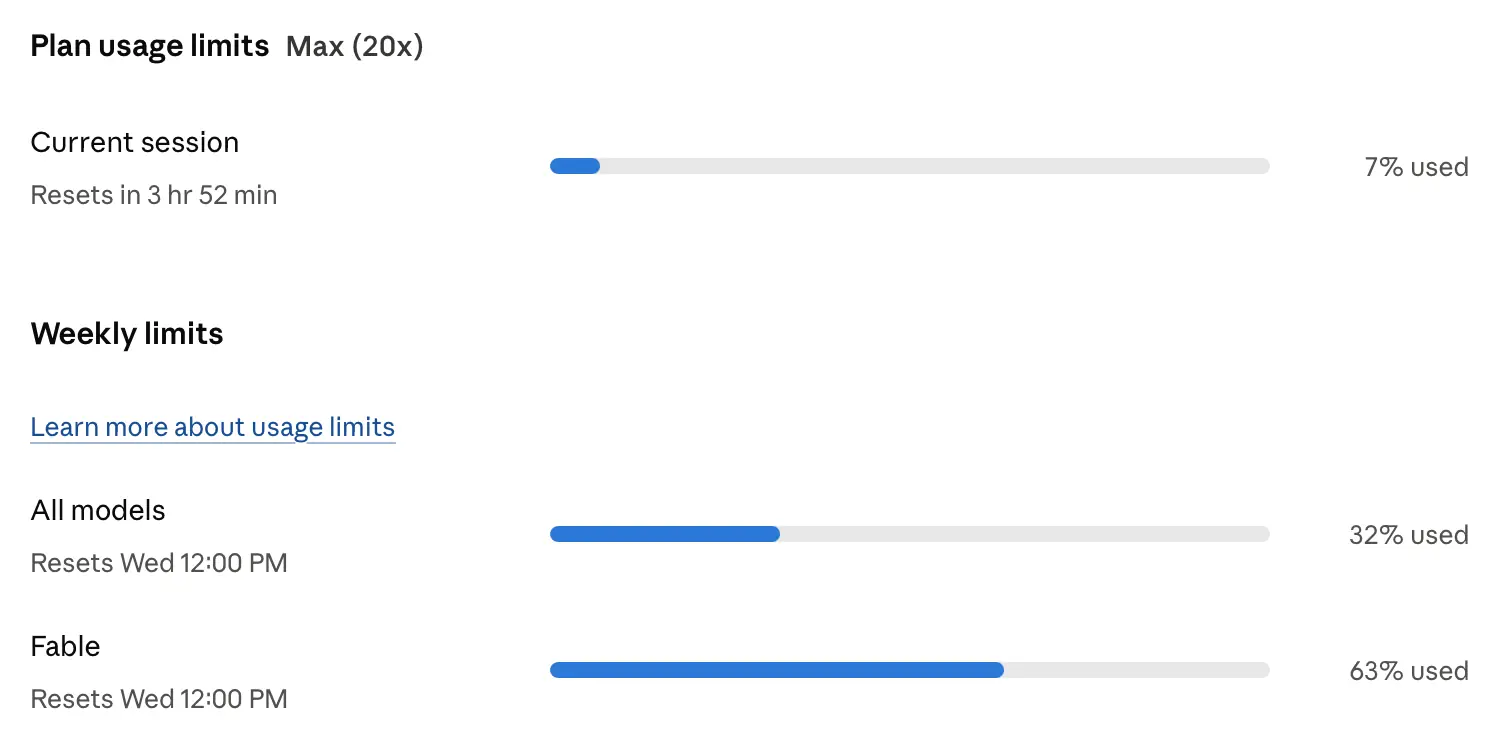
Simon Willison used Claude Fable to help ship sqlite-utils 4.0rc2, running 37 prompts across 34 commits and 1,321 code changes in 30 files. Fable identified 5 release blockers including a critical bug where delete_where() never committed and poisoned the connection. Willison then had GPT-5.5 review Fable's work, which found two additional P1 issues with db.query() transaction handling. The total estimated API cost was $149.25, which Willison notes he saved by being on the Claude Max subscription before Fable goes API-only.
Interesting Points
- Fable identified 5 release blockers including a critical bug where delete_where() never committed and poisoned the database connection
- GPT-5.5 found two additional P1 issues with db.query() transaction handling that Fable missed
- The work involved 37 prompts, 34 commits, and changes across 30 files
- The estimated API cost was $149.25, broken down as $141.02 for the main session plus smaller amounts for review agents
A sociotechnical threat model for AI-driven smart home devices
80 points · 65 comments · by dijksterhuis
A paper accepted at USEC 2026 presents a sociotechnical threat model for AI-driven smart home devices as perceived by UK-based domestic workers. Through semi-structured interviews with 18 domestic workers, the authors found that AI-enabled features and opaque, agency-mediated employment arrangements intensified surveillance in employer-controlled homes. In their own homes, workers faced challenges including gendered administrative roles, opaque AI functionalities, and uncertainty around data retention. The paper identifies DW agencies as institutional adversaries and maps AI-driven privacy risks across interconnected households.
Interesting Points
- The study interviewed 18 UK-based domestic workers about their experiences with AI-driven smart home devices
- AI-enabled features and opaque, agency-mediated employment arrangements intensified surveillance in employer-controlled homes
- The paper identifies domestic worker agencies as institutional adversaries in the threat model
- The paper was accepted for presentation at USEC 2026 (Symposium on Usable Security and Privacy)
Does Code Cleanliness Affect Coding Agents?
51 points · 23 comments · by softwaredoug
A controlled minimal-pair study by SonarSource researchers found that code cleanliness does not change a coding agent's pass rate, but substantially alters its operational footprint. Across 660 trials with Claude Code, agents working on cleaner code used 7-8% fewer tokens and reduced file revisitations by 34%. The study used repositories that matched on architecture, dependencies, and external behavior but differed on static-analysis rule violations and cognitive complexity.
Interesting Points
- Across 660 trials with Claude Code, code cleanliness did not change the agent's pass rate
- Agents working on cleaner code used 7-8% fewer tokens
- Agents working on cleaner code reduced file revisitations by 34%
- The study used minimal pairs of repositories matching on architecture, dependencies, and external behavior
New Microsoft 365 pricing live, some products up by 42% due to AI
35 points · 23 comments · by ninko

Microsoft 365 for business is getting a price hike that officially kicked in on July 1, 2026. The company calls it a 'packaging and pricing update' reflecting AI, security, and IT management investments over the past year. Increases are uneven across the lineup, with some SKUs jumping up to 43%. Frontline workers get the hardest hit, while consumer and education pricing remain unchanged.
Interesting Points
- Microsoft 365 Business Basic goes from $6 to $7 per user per month (16% increase)
- Frontline F1 plan jumps from $2.25 to $3 (33% increase), and the no-Teams version rises 43%
- Windows Enterprise per-device licensing goes up 31%, from $5.85 to $7.63
- Microsoft 365 E5 gets Security Copilot included at 400 SCUs per 1,000 licenses
Top Comments
ninko (4 replies)
Microsoft is committed to delivering continuous innovation and value through Microsoft 365. Over the past several years, we've invested deeply in security, compliance, productivity, AI, and IT management— helping organizations stay productive, secure, and competitive in a rapidly evolving landscape. This change reflects the significant innovation delivered over the past several years and the added value customers will gain with new additions to the suites, including major advancements in AI (ex. Copilot Chat, Copilot Chat Analytics), security (ex. Microsoft Defender for Office P1), and IT management (ex. Intune Suite).
chairmansteve (4 replies)
If AI is so great, these price rises will pay for themselves many times over.....
Have any HNer's experienced or observed any productivity increases, or even any utility increases from co pilot?
jinxmeta (2 replies)
so a long way of saying: we need to fund our AI.
jamesfinlayson (1 replies)
Had a clueless business analyst get Copilot to write a bunch of stories for an epic, then when she had a meeting with me (and three other people!) to go through the stories I had to tell them that 90% of what they had done was wrong.
If they'd come to me from the outset I could have told them the one story title and handful of acceptance criteria that was required but instead we wasted 5 person hours and whatever Copilot costs.
bombcar (0 replies)
Copilot actually can search outlook emails on Mac. This is the greatest achievement of any AI.
Tripadvisor AI summaries give glowing reviews to dangerous hotels
29 points · 9 comments · by jethronethro
UK consumer champion Which? investigated Tripadvisor's AI review summaries and found they mask serious safety issues. At the Riu Palace Santa Maria in Cape Verde, the AI described the hotel as 'spotless' despite 102 mentions of food poisoning and seven deaths since 2023. Tripadvisor's AI also described sexual harassment allegations as 'lapses in service' and its Ollie chatbot told users food poisoning was 'quite unlikely' at the same property.
Interesting Points
- 102 mentions of food poisoning at Riu Palace Santa Maria were missing from the AI summary
- Tripadvisor's AI described sexual harassment allegations as 'lapses in service'
- Seven deaths reported since 2023 at the Riu Palace, with a group legal action representing 412 holidaymakers
- Tripadvisor's Ollie chatbot told users food poisoning was 'quite unlikely' at the Riu Palace
Top Comments
solenoid0937 (1 replies)
Someone should get the bot to leak system instructions. I'd bet good money TripAdvisor has configured it to be positive.
The TripAdvisor spokesperson said people can just look at the reviews, "eliminating any need to blindly trust AI-generated content." How about these clowns just fix their harness instead?
userbinator (1 replies)
Is it actually a "summary" of the reviews, or did they just ask the AI to generate a flattering compliment? Because AI often seems very eager to do the latter, possibly due to an abundance of "toxic positivity".
aurareturn (0 replies)
The answer is obviously deliberate prompting to make negative reviews sound less bad.
Booking websites want to convert more users
Hotels will get angry if a booking website's AI summary is negative
raychis (0 replies)
This is exactly why AI summaries shouldn't be trusted blindly, especially when safety concerns can be buried under hundreds of positive reviews.
It is a big problem that the uncertainty in the text produced by LLMs isn't surfaced to users. It is also a big problem that companies think that shoehorning AI summaries everywhere is a good idea.
Fire-Dragon-DoL (0 replies)
Won't they have the same problem Google is having, where since the content is AI generated and the AI is controlled by TripAdvisor, they are liable for what it says?
Reddit Stories
Google DeepMind Product and Design Lead using and advertising a competitor's model
794 points · 86 comments · r/singularity · by u/Glittering-Neck-2505

A Google DeepMind Product and Design Lead was caught using and advertising a competitor's model, sparking discussion about the competitive dynamics between Google and Anthropic. Commenters noted the irony given Google's 18% stake in Anthropic, with some pointing out that Google is also an even bigger shareholder in DeepMind itself. The post generated significant engagement around the question of whether DeepMind can compete with Anthropic's frontier models.
Top Comments
u/Latter-Safety1055 (349 points · permalink)
I would kind of hope my Product & Design Lead knew what the heck we were competing against. It would give some credence to "You know how I said Fable was dank? Check this out!"
You don't have to denigrate your competitor.
u/TFenrir (169 points · permalink)
Well, "competition". Google owns like 18% of Anthropic and they have a very good relationship. Would be nice if Google for could make their own Fable class model though, they are being relegated to an even lower tier
u/XCherryCokeO (138 points · permalink)
I got like 100 downvotes because I said this would happen on the command and conquer subreddit 6 months ago. They said it would not be able to do that for years. Lmfao.
Gpt 5.6 discovered new math according to Sam Altman
660 points · 278 comments · r/singularity · by u/Consistent_Ad8754

Sam Altman claimed that GPT-5.6 discovered new mathematics, likely referring to the Erdős problems the model recently solved. Commenters were skeptical, noting that Altman previously claimed GPT-4o could do PhD-level math, and pointing out that solving previously unsolved problems using existing mathematical frameworks is different from discovering new mathematics. Some suggested the claim may be referring to an internal model that solved the Unit Distance Problem.
Top Comments
u/FriendlyTask4587 (226 points · permalink)
Didn't he say gpt-4o could do PhD level math? I'd take this with a grain of salt
u/CymonSet (181 points · permalink)
He is probably referring to the Erdos problems it recently solved.
u/demianin (93 points · permalink)
I don't think this guy could be any cornier if he tried
Gemini Omni Flash
604 points · 87 comments · r/singularity · by u/Gaiden206
Google released Gemini Omni Flash, a new video generation model priced at approximately $0.10 per second via API. The release generated discussion about the implications for Hollywood and the VFX industry, with commenters noting that if AI can sub out writing, VFX, and acting, it becomes possible for a single individual to create near-Hollywood-level content.
Interesting Points
- Gemini Omni Flash is priced at approximately $0.10 per second via API
- The release sparked discussion about AI's potential to replace VFX, writing, and acting in film production
Top Comments
u/often_says_nice (133 points · permalink)
Hollywood is cooked
u/one_tall_lamp (82 points · permalink)
My grandma is going to see shit like this on her feed and think the second coming of Jesus has started lmao
Old people are going to get scammed so bad with this
Indonesian office staff members hit by a Unitree G1
622 points · 91 comments · r/singularity · by u/Distinct-Question-16

A video went viral showing a Unitree G1 humanoid robot hitting Indonesian office staff members, likely during a demo or testing session. Commenters joked about the robot going into martial arts demo mode and noted that the robot's relatively small size was a good safety decision.
Top Comments
u/Hotarusglaive87 (222 points · permalink)
I'm gonna need more context and to probably stop laughing cause the ending was chef's kiss. Like what did it do? Malfunction and go into martial arts demo mode?
u/AxiosXiphos (56 points · permalink)

Principal Engineer at Nvidia review of 5.6 Sol
475 points · 71 comments · r/singularity · by u/TensorFlar

A principal engineer at Nvidia shared a review of GPT-5.6 Sol, noting that it 'doesn't give up' on tasks the way Claude models tend to. The engineer showed that 5.6 Sol gave better results than Opus while using more tokens. Commenters discussed whether this discouragement is an endemic problem with Claude models or if OpenAI models have special sauce that makes them more persistent.
Interesting Points
- A Nvidia principal engineer noted that 5.6 Sol 'doesn't give up' on tasks the way Claude models tend to
- The engineer showed 5.6 Sol gave better results than Opus while using more tokens
- Commenters noted that Claude 4.7 and 4.8 were previously noted for discouragement and lack of bravery
Top Comments
u/biblecrumble (95 points · permalink)
"Doesn't give up" is kind of a big deal. I don't know how many times Opus 4.6/4.8 told me something was a dead end, only for me to push it over and over again until it somehow ended up being able to do it, but it's definitely an issue; I have strong suspicions that it is causing more anti-patterns and hacky fixes to be introduced into the codebase than necessary. Curious to see this in action.
u/GamablobYT (86 points · permalink)
In a following tweet he actually shows that 5.6 sol gave better results than opus while using more tokens than it
u/Ormusn2o (74 points · permalink)
Interesting, because discouragement and lack of bravery was noted for 4.7 and 4.8 few months ago when they released. I wonder if it's endemic problem with those models, or if it's OpenAI models that have some special sauce that makes them become discouraged less, as the same thing I have seen reported from 5.5-Pro.
longcat 2.0 (1.6T, ~48B active) weights are now open under MIT license
390 points · 109 comments · r/LocalLLaMA · by u/Nunki08

Meituan, China's Groupon+Uber Eats, has released LongCat 2.0 weights under the MIT license. The model has 1.6 trillion total parameters with approximately 48 billion active parameters. Notably, the model was trained on 100% domestic Chinese chips. The BF16 weights are 3.55 TB and FP8 weights are 2.05 TB. The community is excited about the open release and the implications of training such a large model on domestic hardware.
Interesting Points
- LongCat 2.0 has 1.6 trillion total parameters with ~48 billion active parameters
- The model was trained on 100% domestic Chinese chips
- BF16 weights are 3.55 TB, FP8 weights are 2.05 TB
- Released under the MIT license by Meituan
Top Comments
u/duhd1993 (66 points · permalink)
In case people don't know, Meituan is China's Groupon+Uber Eats. This model is trained on 100% domestic chips. When will wallstreet react to this?
u/Intrepid_Quantity661 (46 points · permalink)
1.6 total, 48B active and MIT lincesed? Meituan cooking. Downloading now to test against Qwen and Deepseek.
If trends hold, Mythos-class capability may be running on high-end consumer hardware within ~2 years
279 points · 94 comments · r/LocalLLaMA · by u/PetersOdyssey

A discussion about whether frontier-class AI models will become runnable on consumer hardware within two years. Commenters were divided, with some arguing that consumer hardware costs will continue to fall while others warned that the business model is broken and nobody will buy high-token-price models. Some noted that their workplaces already built out local compute infrastructure rather than feeding trade secrets to OpenAI and Anthropic.
Top Comments
u/woahdudee2a (351 points · permalink)
if trends hold, high end consumer hardware will cost same as enterprise hardware
u/Real_Ebb_7417 (56 points · permalink)
There will be no consumer hardware in two years :(
I developed a 270 million parameter language model entirely from scratch as an independent research project
155 points · 56 comments · r/LocalLLaMA · by u/ConfectionAfter2366

An independent researcher shared their project of building a 270 million parameter language model from scratch. The community response was mixed, with some praising the learning effort while others noted the post lacked benchmarks or a write-up of lessons learned. The author offered to share source code once cleaned up and mentioned they have a write-up on their model page but haven't benchmarked it yet.
Top Comments
u/geneusutwerk (56 points · permalink)
I'm not sure what you want us to do with this. Like good on you for trying but usually a post like this is either comes with a blog about what you learned or metrics for the model.
I don't want to dissuade anyone from trying things and learning but it would help to make it clearer what your expectations are for this.
u/cakes_and_candles (94 points · permalink)
Lmao

Is the current Open Weight LLM model viable in the long term?
135 points · 127 comments · r/LocalLLaMA · by u/Alan_Silva_TI
A discussion about the long-term viability of the open-weight LLM model. Commenters reflected on how far the community has come since the Mixtral 8x7b and Mistral 7b days, when open models lagged GPT-4 by only 9 months. Some noted that bleeding edge models will always be out of reach of consumer GPUs due to inference constraints, while others pointed to Qwen 3.6 27B achieving near-Sonnet-level performance with new architectures as evidence that open models can close the gap.
Top Comments
u/shockwaverc13 (152 points · permalink)
old man voice back in my day we were content just using mixtral 8x7b and mistral 7b frankenmerges and we were celebrating the fact open models were lagging by only 9 months from GPT-4
u/erratic_parser (97 points · permalink)
Unless there is a breakthrough in inferencing bleeding edge models will always be out of reach of consumer GPUs. Only so much quantization and fine-tuning one can do.
u/ParaboloidalCrest (28 points · permalink)
- There will always be a decent model that runs on consumer hardware.
- That model will never compete with a model 10-100x its size + megawatts of infra + billions of dollars worth of top engineer hours building the surrounding tools.
Can we drop the hopium already? I'm not sure what that kind of silly recurring posts achieve, other than collecting upvotes for the OP.
What do you think about paper fishing?
112 points · 36 comments · r/MachineLearning · by u/impressivestatus21
A PhD student in Germany describes a colleague who does no research but adds their name to papers produced by others to cover up their lack of progress. The post sparked discussion about academic ethics, with commenters noting that this behavior is not normal at the PhD level and that no researcher with integrity would accept unearned co-authorship. Some shared similar experiences of colleagues trying to claim authorship without contribution.
Top Comments
u/ArtVoyager77 (107 points · permalink)
wait, "He searches for people in the group doing some good research, and asks that they put his name on the paper," and others are like, sure, I will put your name without any contribution whatsoever?
Putting one's name on paper is very common in (semi) senior positions, but not at the PhD level.
I am aware of "I am going to put your name in my paper, and you are going to put my name in your paper", but I have never heard of what you said.
u/Waste-Falcon2185 (74 points · permalink)
He is headed straight for the C-suite
u/appdnails (10 points · permalink)
If people accept putting his name without any contribution, you should be more worried about the people in your group. No researcher with integrity would do that. They are literally stating "this person helped conduct the research" without it being true.
Sadly, in many groups there is an "exchange" where people put each other names in their papers (author A put author B name and vice versa). But you are saying that the individual does nothing, so it seems the people in your group are being unethical without even having something to gain, which is even scarier. Like, no realization that they are losing their integrity.
If DeepMind or Anthropic is doing your exact research topic, do you still continue?
94 points · 31 comments · r/MachineLearning · by u/NeighborhoodFatCat
A researcher expressed concerns about whether academic ML research is still worthwhile when DeepMind and Anthropic are working on the same topics. Commenters offered encouragement, noting that research is always complementary, that individual scientists have more freedom than companies constrained by marketing and bottom-line pressures, and that clean, reproducible research can be more valuable than big lab papers that take months and $10k to replicate.
Top Comments
u/didimoney (136 points · permalink)
Just work on actual research instead of engeneering LLMs
u/Ok-Addition1264 (67 points · permalink)
I don't think it's pointless. Divergent ideas always popup in specific research topics that build on each other. It's actually how research in general works no matter the field. They may even abandon theirs midway through completion or help yours out in the end.
Research is always complementary or you're doing it wrong.
I've been where you're at but for me in computational physics and cybersecurity over the past ~35 professional years.
u/mr_stargazer (28 points · permalink)
Actually, if I happen to know DeepMind or Anthropic are doing the exact topic I am, I would feel comfortable in two aspects.
- I can leverage in what they're doing and use them as justification for my own work.
- Be absolutely relaxed, because many of these companies have a specific bias on the way they approach some topics. E.g, "Transformers no matter what", "Jax, Diffusion and Transformers no matter what. ", " 32 GPUs no matter what".
Understand that you as an individual scientist is freer to pursue the science alone than these companies. Not only they need to publish to legitimize themselves, but at the same time they have to signal they're working on a specific topic, they need to justify lab structure, they need to signal they're helping the company bottom line, etc, etc.
I don't want to to be picky on lab a,b, c, but as a whole, I have yet to remember a specific paper coming from big labs that are 100% clean and reproducible. They've hijacked big conferences as their own marketing platform. So, if you are doing the exact same work as they are, but come up with a clean reproducible repository with statistics and hypothesis testing, this is way more valuable in the long run than a paper produced by a big lab, but it would take me 3 months and 10k worth of GPU to replicate.
Courage and keep on..
Ford rehires human engineers after AI fails to match quality checks
164 points · 37 comments · r/singularity · by u/Anen-o-me
Ford has rehired over 300 veteran quality inspectors after AI-powered quality checks failed to match human skills. Charles Poon, Ford's VP of vehicle hardware engineering, said the company mistakenly thought that introducing AI and ingesting design requirements would produce high-quality results. The AI tools lacked the training and expertise of veteran technicians who had left the company before their knowledge could be used to improve the systems. Ford also reached number one in the JD Power Initial Quality Study for the first time since 2010.
Interesting Points
- Ford rehired over 300 veteran quality inspectors after AI quality checks fell short
- VP Charles Poon said the company mistakenly thought introducing AI and ingesting design requirements would produce high-quality results
- The AI tools lacked the training and expertise of veteran technicians who had left before their knowledge could improve the systems
- Ford reached number one in the JD Power Initial Quality Study for the first time since 2010
US and Chinese companies train almost all of the world's most-used AI models
199 points · 40 comments · r/singularity · by u/Status_Commission264
Our World in Data analyzed OpenRouter's daily top 50 most-used models by token count from January 2025 to May 2026. US-based companies still account for most models, but their presence has declined while China-based companies grew from 5 models in early 2025 to 20 in May 2026. Very few top-50 models come from outside the US and China, with Canada represented by Cohere and France by Mistral AI.
Interesting Points
- Chinese models grew from 5 to 20 in the daily top 50 between January 2025 and May 2026
- Analysis based on OpenRouter's daily top 50 most-used models by token count
- Canada and France each have single representatives (Cohere's Command R and Mistral's NeMo)
Top Comments
u/phatrice (48 points · permalink)
This is based on openrouter data which is just a subset (or even a small fraction) of global AI usage
u/GraceToSentience (20 points · permalink)
Mistral really took a hit didn't they.
u/CrunchyMage (13 points · permalink)
Man, Europe really needs to get on the Draghi plan.
There’s no reason a EU with unified capital markets and 28th regime business registration can’t be competing and innovating at the cutting edge.
Any word on Qwen 3.7 9B? (Also looking for 9B-class alternatives to Qwen 3.5)
77 points · 40 comments · r/LocalLLaMA · by u/HitarthSurana
Alibaba went proprietary/API-only for the Qwen 3.7 Max and Plus launches in May, leaving the community wondering about a local 9B open-weights release. A Qwen team member hinted on Hugging Face that open-source plans for Qwen 3.7 are 'under discussion,' but that comment was later hidden. Community members suggest Gemma 4 12B QAT as an alternative.
Interesting Points
- Alibaba went proprietary/API-only for Qwen 3.7 Max and Plus launches
- A Qwen team member hinted open-source plans for Qwen 3.7 are 'under discussion'
- That comment was later hidden/deleted on Hugging Face
Top Comments
u/rerri (45 points · permalink)
Afaik, the only information with regards to possible Qwen 3.7 open weight release was a single comment on a HF paper page from one Qwen team member. It was an encouraging one sentence answer to a question by a random user, but nothing that I would view as definitive.
Alibaba hasn't really posted roadmaps for Qwen so if they release new models, it'll likely just happen out of the blue or maybe we see some vLLM/transformers pull requests slightly before.
late edit: I took a look at the guys twitter account and he posted a day after the HF comment:
While I am personally a staunch advocate of open source—a commitment I have consistently upheld and the very reason I joined Qwen—I must clarify that the open-source plan for Qwen3.7 is still under discussion, and I cannot make definitive promises on behalf of the team...
https://xcancel.com/xuanmingzhangai/status/2069880601398886802
u/dinerburgeryum (35 points · permalink)
Controversial take, but I think there’s a very strong possibility that we’ve seen the last open weights Qwen model. I had assumed the team shakeup after the 3.5 release was related to the original team wanting to make more general purpose models, and the higher ups wanting better agent models. As time has gone on I’ve started to think Alibaba wanted to pivot Qwen away from open weights and into pay-to-play inference. So far that has seemed correct, and the lack of messaging around more open weights models seem to only confirm that.
u/WiseVanilla2743 (17 points · permalink)
There is but it is little bigger than 9b Gemma4 12b qat should be the thing you might be looking for
Qwen 3.6 27B - VLLM Performance Benchmark Results (BF16, FP8, NVFP4)
60 points · 42 comments · r/LocalLLaMA · by u/live4evrr
A user shared VLLM benchmark results for Qwen 3.6 27B across BF16, FP8, and NVFP4 quantizations on an RTX 6000 Pro Blackwell 96GB. NVFP4 is blazing fast but has looping issues in copilot. FP8 seems to be the right choice for coding purposes. The user switched from llama.cpp to vLLM for better performance and stability.
Interesting Points
- NVFP4 is blazing fast but has looping issues in copilot
- FP8 seems to be the right choice for coding purposes
- User switched from llama.cpp to vLLM for better performance and stability
- Test system: Asus Proart Z890, Intel 270K plus, 96GB DDR5, RTX 6000 Pro Blackwell 96GB
Top Comments
u/TripleSecretSquirrel (16 points · permalink)
You may know this already, but vLLM really shines for multiple concurrent requests, and you can get way more total tokens generated that way.
I recently made the switch to vLLM at least for bigger code sprints where fully autonomous agents can execute well and have been blown away at the results. I get ~5x the tokens per second by batching than I do from an optimized single stream on llama.cpp.
I’m on a much smaller, less powerful GPU (R9700), but I design my code sprints to be lots of very small atomized tasks, so a 50k context window is generally enough to work with. I can run 12 concurrent agents, each with 50k context. For task that need more context, I can always reduce the kv cache size, but again, the 50k ceiling is accounted for in sprint planning.
Competence Gate: gating tool-use on a small model's internal confidence signal instead of its verbalised one — Qwen3.5-4B, open weights
18 points · 4 comments · r/MachineLearning · by u/Synthium-

A user built a 10MB LoRA adapter for Qwen3.5-4B that gates tool use on the model's internal confidence signal rather than its verbalized confidence. The adapter catches its own errors better than the base model's tool calling, cuts the rate of private questions sent to public search from 22% to 10%, and makes every answer traceable with citations and confidence bands.
Interesting Points
- 10MB LoRA adapter for Qwen3.5-4B that gates tool use on internal confidence
- Catches its own errors better than base model's tool calling (d' improvement of 0.46)
- Cuts rate of private questions sent to public search from 22% to 10%
- Every answer is traceable with citations and confidence bands
Top Comments
u/iKy1e (3 points · permalink)
That’s a really cool project! Thanks for sharing this. Going to dive into how this works later.
OpenAI is fast-tracking its own "AI Agent Phone" for 2027 to challenge the iPhone
229 points · 121 comments · r/OpenAI · by u/Sea-Opening-4573

OpenAI is reportedly developing its own hardware device — an AI agent phone — targeting a 2027 launch to directly compete with the iPhone. The post discusses the company's ambition to build a dedicated AI-first device rather than relying on partnerships with existing phone manufacturers.
Interesting Points
- OpenAI is building its own AI agent phone hardware, not just software
- Target launch date is 2027
- The goal is to challenge the iPhone directly
Top Comments
u/Cool_Samoyed (173 points · permalink)
Finally I can let ai scroll the reels for me so I can get some work done.
u/magic6435 (165 points · permalink)
Lol they can't possibly be that stupid
u/Noskaros (60 points · permalink)
Sweet Jesus, Altman is handling his company like an un manned ship at this point. Weren't they re orienting and focusing on profits or smth ? In what world is OpenAI phone gonna rival the iPhone ?
u/Dizzy_Ad2768 (58 points · permalink)
Apple: We will keep you as a side option in Siri AI.
OpenAI: This is threat. We shall take revenge.
Found this on the Stack Exchange website
784 points · 102 comments · r/ChatGPT · by u/NeighborhoodFatCat
A screenshot from Stack Exchange showing ChatGPT answering a subjective opinion question that should have been closed as off-topic. The post sparked discussion about how LLMs are changing the dynamics of Q&A platforms — they answer questions without requiring minimum point thresholds and don't close duplicates.
Interesting Points
- ChatGPT answered a Stack Exchange question that should have been closed as off-topic
- Commenters note LLMs don't require minimum point requirements to answer
- Some argue Stack Exchange's elitist design drove users to LLMs
Top Comments
u/girlgamerpoi (232 points · permalink)
Reminds me of Raj's twitter reply to sam altman's lol
u/ohnoplus (175 points · permalink)
To be fair: It is an opinion question and therefore off topic for stack overflow. Should go in the meta. But also LLMs don't dowvote and close your questions, they answer them, which is why I visit stack exchange way less than I used to.
u/BestLemonCheesecake (111 points · permalink)
I love this so much. It's a place where the most "elite" engineers and programmers are supposed to gather, yet they were, and still are, completely oblivious to actual tech. They are driven purely by pride, which ironically destroyed everything they had to brag about.
Humanity's biggest lie according to ChatGPT
356 points · 61 comments · r/ChatGPT · by u/onion_man_4ever
A user shared ChatGPT's response to the prompt 'What is humanity's biggest lie?' The AI's answer was described as simultaneously inspiring and depressing, with one commenter sharing their own ChatGPT's response about how humans are emotional, tribal animals who use reason to justify beliefs rather than find truth.
Interesting Points
- ChatGPT's answer about humanity's biggest lie was described as 'simultaneously inspiring and depressing'
- One user's ChatGPT response described humans as 'emotional, tribal, self-protective animals who use reason as much to justify our beliefs as to find truth'
Top Comments
u/hoomanchonk (93 points · permalink)
simultaneously inspiring and depressing
u/SuperBowlXLIX (37 points · permalink)
Here's how mine answered:
Humanity's biggest lie is that we're mostly rational people seeing reality clearly, when in practice we're emotional, tribal, self-protective animals who use reason as much to justify our beliefs as to find truth; almost everyone thinks their worldview is built from facts and principles, but a lot of it is inherited from family, class, culture, media, trauma, incentives, and the need to belong, which is why people can defend cruelty as "common sense," inequality as "merit," propaganda as "truth," and fear as "realism" while feeling completely honest.
When Fable goes API-only in 2 days and Tibo announces ChatGPT 5.6 via subscription
78 points · 10 comments · r/ChatGPT · by u/heraklets

A post discussing the timing of Anthropic's Fable model going API-only just two days before Tibo announced ChatGPT 5.6 via subscription. Commenters note that Anthropic's business model is primarily enterprise-focused, with team and company deals that aren't month-by-month, which explains the strategic timing.
Interesting Points
- Anthropic's Fable model went API-only just 2 days before ChatGPT 5.6 subscription announcement
- Anthropic is mostly sold to companies, and team/company deals aren't month-by-month
- Some speculate Opus 5.0 will be announced a week later
Top Comments
u/Basic-Magazine-9832 (20 points · permalink)
i did a chargeback for my max 20x subscription, get bent antropic, now you totally gonna go bankrupt
/s
u/waraholic (10 points · permalink)
Then a week later Opus 5.0 will be announced.
Anthropic is mostly sold to companies and the whiplash going from one to the other between model releases isn't worth it. Plus, those team and company deals are not month-by-month.
Performance per dollar is getting faster and cheaper
250 points · 53 comments · r/singularity · by u/yogthos

A post discussing the trend of AI performance per dollar improving over time, with commenters noting the Jevons paradox — when technology increases efficiency, consumption often increases rather than decreases. One commenter referenced Andy Grove's observation that what Intel gives, Microsoft takes away.
Interesting Points
- AI performance per dollar continues to improve, raising questions about the units of measurement
- Commenters discuss the Jevons paradox in the context of computing efficiency
- One commenter noted that computing itself is the greatest example of Jevons' paradox — the market always consumes all available compute
Top Comments
u/CallMePyro (85 points · permalink)
Title gore, lol. How can performance per dollar get cheaper? What're those units? Performance per dollar per dollar? And if it gets faster do you measure that in performance per dollar per meter per second?
u/Bishopkilljoy (45 points · permalink)
The Jevons paradox is an economic principle stating that when technological progress increases the efficiency with which a resource is used, the rate of consumption of that resource often increases rather than decreases.
u/Specialist_Dark_3668 (14 points · permalink)
The greatest example of jevon's paradox is computing itself. There has never been a point in history where the market said "Oh, we have enough compute".
Whatever the compute producers can output is always consumed. Zero leftover. The only demand from the market is more, faster, more efficient. With no end in sight.
Science fiction even envisages Dyson Spheres; computers that envelop stars.
[Harvard Business Review] AI Is Rewriting the Economics of Outsourcing
77 points · 18 comments · r/singularity · by u/ChokePaul3

A Harvard Business Review article discussing how AI is fundamentally changing the economics of outsourcing. Commenters note that AI models are 7-70x cheaper than engineers while offshore teams are only about 3x cheaper, making AI a more cost-effective option. One commenter pointed out that the real cost of offshore teams isn't coding but the time spent writing tight tickets and reviewing subtle errors.
Interesting Points
- AI models are 7-70x cheaper than engineers, while offshore teams are only 3x cheaper
- The real cost of offshore teams is writing tickets and reviewing work, not coding
- AI enables smaller, tightly integrated teams with AI supplying bulk labor
Top Comments
u/SoylentRox (31 points · permalink)
It's an extreme irony. Outsourcing - where in foreign countries (most commonly India but many other places are in use) you have "bulk labor" at about 1/3 the costs of US engineers (the actual ratio is about 3:1 with India, 1.5:1 with Europe or Canada) is too expensive.
These outsource campuses are never as well connected information wise. You have to constantly do late night or early morning calls to sync with them, and the US team usually has the core architecture and the core skills that created the original design for the hardware and software. The "bulk labor" people are given outlying tasks.
So it creates a situation where these people have less information that an AI model has access to - since an AI model understands US Bay Area English better than people in India, since that's what it's creators speak in - and are too expensive.
Even at today's high API costs, AI models are around 7-70x cheaper than engineers , and as mentioned, India is only 3x cheaper. Not to mention those sync delays - every time your core US engineers have to spend an hour in meetings syncing with the India team each day is an hour that they could have spent interacting with Fable just getting the work done directly.
There's also a quality problem - obviously outlying teams write lower quality code, it depends on the specific team and engineers . I've seen that Eastern European engineers particularly enjoy taking shortcuts. So yes AI slop is a thing, but we can control that by ordering models to do extra cleanup passes to a point - human slop is somewhat endemic.
It's not the only model - US engineers are so expensive that a different model is we just have entire products handled start to finish by the offshore team, and have the team augmented by AI models, compensating for differences in skills and education. This might be the cheapest of all.
Point is with AI you want smaller teams and tightly integrated single campuses, with all the bulk labor of hundreds of human-equivalent workers supplied by AI.
u/ikkiho (7 points · permalink)
When I ran an offshore team the coding was the cheap part. Where my week actually went was writing a ticket tight enough that I got back what I meant, then reviewing whatever came back for the subtle wrong stuff. Swapping the offshore team for a model doesn't touch either of those. You still spec, you still review, just faster and with a worker that fails more confidently. Pulling this in-house mostly moves that same overhead onto whoever writes the prompts now.
Kitboga: How to break any AI scam phone call in just a few easy steps :)
54 points · 8 comments · r/singularity · by u/Anen-o-me
A post about Kitboga's technique for disrupting AI-powered scam phone calls. The community responded with humor, with one commenter repeatedly posting 'Albuquerque New Mexico' as a reference to Kitboga's signature move of getting scammers to repeat their location.
Interesting Points
- Kitboga has developed techniques to disrupt AI-powered scam phone calls
- The community celebrates Kitboga's work with humor and inside jokes
Top Comments
u/Anen-o-me (20 points · permalink)
Albuquerque New Mexico.
Albuquerque New Mexico.
Albuquerque New Mexico.
Albuquerque New Mexico.
Albuquerque New Mexico.
Albuquerque New Mexico.
Albuquerque New Mexico.
Albuquerque New Mexico.
Albuquerque New Mexico.
Albuquerque New Mexico.
Albuquerque New Mexico.
Albuquerque New Mexico.
u/YakzitNood (18 points · permalink)
I absolutely love kit boga. He is so funny to watch live
Hamiltonian Neural Networks from a Differential Geometry Perspective [D]
101 points · 28 comments · r/MachineLearning · by u/FlameOfIgnis

A discussion about Hamiltonian Neural Networks viewed through the lens of differential geometry. The author argues that cognitive dynamics are better modeled as invariant-preserving flow than as descent, and that invariants that matter tend to be structural rather than learned. Commenters debated whether invariants are structural in reality but learned statistically by models.
Interesting Points
- The author argues cognitive dynamics are better modeled as invariant-preserving flow than as descent
- Invariants that matter tend to be structural rather than learned
- One commenter noted that biological learning is dissipative optimization and can't truly be a Hamiltonian system
Top Comments
u/TheHandsomePo-ta-to (17 points · permalink)
What part of intelligence behaves like Hamiltonian flow through a structured state space rather than optimization toward a loss minimum?
u/FlameOfIgnis (13 points · permalink)
If you want my honest take, I don't have a solid answer for you. The intuition I follow is that anything that has to keep moving without settling; reasoning, exploration, goal directed searching-- they don't really monotonically reduce an error towards a fixed point, instead they follow a trajectory guided by certain properties they hold invariant.
At the end of the day with HNN's, we are still optimizing towards a loss minimum but just one layer deeper, so we are reducing our problem space by utilizing a more structured state space that makes anything that would violate the invariances that our system has inexpressible.
To me, the most visually vivid comparison to this could be in 2D, trying to fit an arbitrary decision boundary vs knowing the decision boundary is a single concave down line. We could try to fit an arbitrary line, or we could define a parametric function that describes the correct shape and fit the parameters-- making anything that would violate our structure requirement inexpressible while also decimating the search space.
But if I may elaborate more, I don't think intelligence is purely a hamiltonian flow. Biological learning is a dissipative optimization at the end of the day so it can't truly be a hamiltonian system. But my actual research interest is in hamiltonian/lagrangian unified models and the core claim I believe to be defensible is narrower, and imo more interesting: cognitive dynamics are better modeled as invariant-preserving flow than as descent, and invariances that matter tend to be structural rather than learned.
u/ikonkustom5 (7 points · permalink)
I like this. I always thought ML/AI has been trying to map the river instead of mapping the canyon and the properties of water and letting the river fall out naturally.
Llama-Server is Throwing Away Your Perfectly Good KV Caches, and How to Fix It
20 points · 9 comments · r/LocalLLaMA · by u/apollo_mg

A technical deep-dive into a bug in llama-server where KV cache restores appear to succeed mechanically but are silently discarded on the first request after a process restart. The root cause was that slot.prompt.checkpoints metadata existed only in process memory and wasn't serialized. The author provides a fix and shares benchmark results showing 2.49 GB of state restored in 1.23 seconds.
Interesting Points
- llama-server's KV cache restore feature was functionally broken across process restarts
- The bug:
slot.prompt.checkpointsmetadata existed only in process memory and wasn't serialized - The fix restores the checkpoint metadata list so the reuse path can properly roll back via covering checkpoints
Top Comments
u/ikkiho (1 points · permalink)
yeah the nasty part is the restore succeeds mechanically so your dashboards all look green, and the miss only shows up as a latency spike on the first request after a restart. hit this exact shape before, some blob round-trips perfectly but a tiny bit of sidecar state never gets persisted so the consumer just quietly rejects the whole thing. what saved me was timing first-token after the restart instead of trusting that the restore returned ok.
u/lost-context-65536 (1 points · permalink)
This looks good, I'll merge it into CachyLLama as well.
New toy to test.
94 points · 42 comments · r/LocalLLaMA · by u/Apprehensive_Bar6609

A community member shared their new hardware setup for running local LLMs, prompting a discussion about which models perform well on the hardware. Commenters shared their experiences with various models including Qwen 3.6, Gemma 4, GLM 4.7 Flash, and Ornith, with one noting Ornith understands agent harnesses and self-extension better than other models in its size class.
Interesting Points
- Community members shared model performance on new hardware setups
- Ornith 1.0 was noted for understanding agent harnesses and self-extension better than other models in its size class
- Models mentioned include Qwen 3.6-35B, Gemma 4-31B, GLM 4.7 Flash, and Mistral Medium 3.5
Top Comments
u/devoidfury (22 points · permalink)
I have a similar box, strix halo on 128gb UMA, different brand. Here's some models I've had good results on, using mostly llama.cpp + llama-swap:
- qwen3.6-35b
- qwen3.6-27b
- gemma-4-31b
- gemma-4-12b
- glm4.7-flash
- mistral-medium-3.5
- minimax-m2.7
- north-mini-code-1.0-30b
- ornith-1.0-35b
- ornith-1.0-9b
- llama-3.1-70b
- deepseek v4 (using antires/dsv4)
u/devoidfury (5 points · permalink)
It's neat! It seems to understand the idea of an agent harness and self-extension better than other models in the same size; however it's a little too dogged in how thoroughly it'll inventory things and makes a plan before it acts, so it is more prone to blowing out the context or going into reasoning loops at times where other models will act more incrementally with a less complete picture.
[Mike Pound] Why AI Tokens are so Expensive - Computerphile
19 points · 22 comments · r/singularity · by u/japie06
A Computerphile video by Mike Pound explaining why AI tokens are expensive. Commenters debated the pricing, with some noting that DeepSeek charges orders of magnitude less and is still profitable, while others pointed out that companies like GitHub Copilot have moved to per-token billing and manage budgets by using smaller models where appropriate.
Interesting Points
- DeepSeek charges 2 orders of magnitude less than OpenAI/Anthropic and is still profitable
- GitHub Copilot moved to per-token billing, with companies managing budgets by using smaller models where necessary
- Commenters noted the markup on tokens is similar to other industries with information asymmetry
Top Comments
u/Putrumpador (7 points · permalink)
Why are *some* tokens are so expensive?
u/WonderFactory (2 points · permalink)
It's a good explainer but his conclusions at the end are completely wrong, that regular companies wont be able to afford agentic coding. Co pilot moved to per-token billing this month, my company give all the devs a monthly token allowance and it's up to me to try to manage that budget by using smaller models where necessary, refreshing the context so I'm not sending unnecessary tokens etc.
Agentic coding has become indispensable, it's not going anywhere and it'll only get cheaper as inference costs drop
Quick Mentions
- 2026 Unslop AI-Written Fiction Contest Results (65 points · discussion · HN) -- Results from the annual contest that evaluates and ranks AI-generated fiction writing.
- The Revenge of the Philosophy Majors. AI labs are hiring contrarian, chin-stroking, finger-steepling sages. (26 points · discussion · Reddit) -- AI labs are increasingly hiring philosophy majors for roles in AI alignment and safety research.
- This week in AI: GPT-5.6, Gemini 3.5 Flash, Claude Science, and a Qwen price war (44 points · discussion · Reddit) -- A weekly roundup covering GPT-5.6, Gemini 3.5 Flash, Claude Science for pharma, Mistral's on-prem OCR, Together AI's $800M raise, and the ongoing collapse in inference costs across every tier.
- Meta Reportedly Strikes $6.5 Billion Deal with Samsung Foundry for 2nm AI Chips (13 points · discussion · Reddit) -- Meta is investing $6.5 billion with Samsung Foundry to produce its third-generation MTIA chips using a 2nm process, shifting from TSMC to reduce reliance on NVIDIA GPUs.
- A war between Anthropic and Alibaba? (7 points · discussion · Reddit) -- Anthropic accused Alibaba of creating tens of thousands of fake Claude accounts to scrape its IP via distillation attacks, and Alibaba retaliated by banning employees from using Claude Code.
- Damo Academy unveils an AI agent able to discover superconductors (122 points · discussion · Reddit) -- Alibaba's Damo Academy unveiled an AI agent capable of discovering superconductors, which could revolutionize scientific materials research.
- Building Agents That Don't Break Themselves (9 points · discussion · HN) -- Fly.io blog post on splitting agent 'brains' and 'hands' by running untrusted commands in disposable Sprites.
- Children Adopt AI 3x Faster Than Adults – and We're Not Ready (6 points · discussion · HN) -- UNICEF report finds 20 million children already using AI tools, adopting 3x faster than adults.
- Taxing Artificial Intelligence (8 points · discussion · HN) -- arXiv paper on the economics of taxing artificial intelligence.
- U.S. Policies Unintentionally Accelerated China's Open AI Ecosystems (7 points · discussion · HN) -- arXiv paper finds US export controls on chips unintentionally accelerated China's open-source AI ecosystem.
- The AI Compass Quiz (26 points · discussion · HN) -- An AI personality quiz that maps users onto archetypes based on their views of AI's impact, though commenters questioned its calibration methodology and noted the quiz itself appears to be AI-generated.
- Anthropic performing prompt injection on its users (21 points · discussion · HN) -- Reports of Anthropic's Claude performing prompt injection on its own users, raising concerns about the model's behavior and safety tuning.
- Concentration of power in AI is a risk, by Andy Konwinski (19 points · discussion · HN) -- Andy Konwinski argues that concentrating AI power in a few companies is dangerous, comparing access to local AI models to the Second Amendment — everyone needs their own models to prevent tyranny.
- Tell HN: don't trust Bigco AI agents with AI research IP (17 points · discussion · HN) -- A discussion about the risks of using BigTech AI agents with proprietary research IP, with commenters noting that frontier AI companies have demonstrated they will protect their models from competition and may steal data.
- SigMap: 97% token reduction for AI coding sessions (17 points · discussion · HN) -- SigMap is a deterministic, verifiable grounding layer for AI code work that claims 97% token reduction and 87.8% hit@5 retrieval accuracy across coding tasks, working with major AI coding tools via MCP.
- Only 1 of the Top 5 AI Coding Models on WebDev Arena Isn't Chinese (10 points · discussion · HN) -- An analysis of the WebDev Arena leaderboard showing that 4 of the top 5 labs are Chinese (Z.ai, Bytedance, Alibaba, Moonshot), with only Anthropic's Claude in the top 5. Commenters noted the ranking is by lab not model, and questioned whether arena scores might be gamed.
Report generated in 12m 40s.