GPT-5.6 Launches with Agentic Gains as MiniMax Unveils 2.7T Model
Overview
OpenAI's release of GPT-5.6 has dominated the conversation, highlighting major improvements in agentic coding efficiency alongside the unified ChatGPT Work app and a new real-time voice model. The competitive landscape heated up as MiniMax reportedly prepared to release a 2.7-trillion parameter open-weight model, while Z.ai's GLM-5.2 emerged as a strong contender despite recent price increases. Concurrently, the AI coding revolution is accelerating, with Databricks benchmarking agents on massive codebases and discussions surfacing around the shifting economics of software rewrites, even as OpenAI contends with a sanctions motion alleging concealed training data.
 Hacker News Stories
GPT-5.6
786 points · 578 comments · by logickkk1
OpenAI released GPT-5.6, a new model family with three effort levels (Sol, Terra, Luna) that delivers significant improvements in agentic coding token efficiency, design judgment, and computer-use capabilities. The release includes developer guidance recommending shorter prompts and avoiding generic brevity instructions, while benchmark comparisons prominently feature Fable 5 and Mythos. The model family is being rolled out gradually across ChatGPT and Codex over 24 hours, with Sol available to Pro and Enterprise users first.
Interesting Points
- GPT-5.6 Sol scores 64.6% on SWE-Bench Pro, compared to Fable 5 at 80% and Opus 4.8 at 69.2%
- Replacing long system prompts with minimal prompts improved scores by 10-15% while reducing tokens by 41-66% and cost by 33-67%
- GPT-5.6 preserves original image dimensions instead of resizing to patch budgets
- The model does not become meaningfully better when prompted to be broadly friendlier or more empathetic
- GPT-5.6 Luna and Terra outperform Fable 5 at approximately one-sixteenth the cost on Agents Last Exam
Top Comments
swatcoder (1 replies)
can better infer the user's underlying goal and intended level of work
This is a trap.
It's the optimistic fallacy that poisons all "consumer scale" machine learning products and what's going to effectively ruin these models as they keep chasing it in the same way that web queries were ruined, social media feeds were ruined, and media recommenders were ruined.
For the vendor, optimizing metrics across their whole user base, they always see positive technological progress as their system gets better at making assumptions and accumulating user engagement scores in aggregate. But for the individual user, most of which has some weird tail intent/interest and some of whom have many weird tail intent/interests, the experience quietly but catastrophically degrades. Output/results become more generic, more divergent with the underspecified "weird tail" intent, and more stubbornly hard to ever wrangle towards that "weird tail" altogether.
We've been watching this cycle happen for 20 years now and it's proving hard for anybody to escape because it works so well for the trillion dollar company driving it forward. But while each step might feel ergonomic and welcome to individual users, there's a frog boiling enshitification at play.
In pursuit of output quality and capability (rather than simply the vendor's user count), what we need rather than "makes better guesses" is "presses for more clarity", even where it feels kind of annoying.
Even among human professionals, one of the first hurdles of breaking out of junior tier work is gaining the confidence to press your colleagues and clients to be more specific in their thoughts and expressions despite their desire to have you do it all for them. But they're often coming to you with incomplete, muddy, and conflicting ideas for which there is no safe and correct assumption that you might just run with, and it's your expertise (i.e. relevant "intelligence") that's critical to bringing attention to that. To achieve professional progression, you need to learn to do that and to not just optimize appeasing the ambiguous client/colleague today in exchange for mutual expense tomorrow. To avoid enshitification, which is probably not possible, we need these models to be learning that too.
mharrison (2 replies)
Serious question: what is a short prompt?
(For that matter at what point is it "long"? And does the rest of the context matter? Should it be short too?)
HarHarVeryFunny (6 replies)
Not specific to OpenAI / Codex, but I'm curious what people are doing to protect themselves from any destructive actions by their coding agents? Just install and pray? Explicity approve all actions? Reconfigure for safety? Run in a sandbox (Docker) ?
simonw (23 replies)
Here are 18 pelicans - six each for Luna, Terra and Sol at the six different reasoning effort levels (plus the price to generate each one): https://static.simonwillison.net/static/2026/gpt-5.6-pelicans.html
Or if you want to see some in 3D, OpenAI featured a pelican riding a tricycle, bicycle, pony and another pelican in their livestream this morning: https://www.youtube.com/live/Wq45rvPGNHs?t=1070s
minimaxir (12 replies)
The developer's guide (https://developers.openai.com/api/docs/guides/latest-model) has some interesting semantic tips for using the model:
Intent understanding: GPT-5.6 can better infer the user's underlying goal and intended level of work without you specifying every step. Continue to state important constraints, approval boundaries, and success criteria explicitly.
Original image detail: GPT-5.6 preserves the original dimensions of images sent with original or auto detail instead of resizing them to a patch budget or pixel-dimension limit.
Use shorter prompts: In internal evaluations, replacing long, explicit system prompts with minimal prompts improved scores by roughly 10–15%, while reducing total tokens by 41–66% and cost by 33–67%.
Avoid generic brevity instructions: GPT-5.6 is more sensitive than GPT-5.5 to instructions such as "Be concise," "Keep it short," or "Use minimal text."
Control warmth: GPT-5.6 does not become meaningfully better when prompted to be broadly friendlier or more empathetic.
I think I have LLM burnout
378 points · 333 comments · by sosodev
The author describes experiencing "LLM burnout" after a year of daily, heavy integration of AI assistants into their software development workflow. While initially boosting productivity by shifting their role toward design, review, and prompt engineering, they have grown increasingly fatigued by the repetitive stylistic quirks and systematic errors in AI-generated text. Despite recognizing the value of these tools and continuing to use them for both code generation and casual research, the author notes that the uniform tone, frequent hallucinations, and predictable formatting are steadily wearing down their patience.
Interesting Points
- The author's workflow has shifted from writing code to designing it, describing the architecture to an LLM, reviewing the generated output, and only then writing the final implementation.
- Current workload involves sifting through unsupervised code generation output from Qwen while using Claude Code for tooling at work and Codex at home.
- AI-generated articles are now so prevalent in search results that the author frequently relies on ChatGPT or Gemini for casual queries instead of browsing.
- Specific repetitive LLM writing patterns causing fatigue include false assumptions, hallucinations, emphatic staccato fragments, and excessive use of emojis like 🚀 and ✨.
- Personalization settings cannot fully eliminate these idiosyncrasies, and the fatigue stems from dealing with the exact same style and error types repeatedly over time.
Top Comments
dpc_01234 (19 replies)
I don't think I have a "burnout", but LLMs are really exhausting due to amount of pressure they generate. No one is really pushing me to increase my workload, but at every moment there is always something ready, done by my clankers or clankers of other people that I could be unblocking. In the past (before LLMs) it was already hard to keep up, but now it feels like there's 10x more things waiting at any given time, and there could be 10x more if everyone just "optimized" and streamlined processes fed the AI even more tasks in parallel faster. It just being a bottleneck of everything, all the time is tiring...
I am happy about all the little side-projects, and ideas it help my realize, and I enjoy exploring this new world, but I've noticed LLMs feed my unhealthy "don't want to take a break and waste time being idle" mindset, and I need to correct it.
W.r.t. article's main complain - I think the similar thing happened due to factory manufacturing automation. What used to be a varied skillful craft in a shop became standing in a single place of an assembly line doing the exact same thing whole day. LLM took away the more creative and variable part of the work, and left the repetitive QA rubber-stamping. Probably some of the mitigations used back then could be rediscovered today.
nacozarina (3 replies)
LLMs drive the unit cost of cognition to zero. Therefore, you will exhaust yourself near-instantly trying to drive differentiated value out of cognitive work. Non-arbitrable labor is one safe haven: bending steel, drilling wells, running cables, flying drones, etc. Physical agency gets you a premium the clankers can't (yet?) trespass upon. That's why guys building data centers are making bank & job-hopping while the SAs administering the computational guts of them are struggling. A second vector is reputational: either by authority (you're a regulator) or by taste (you're a rare/reknown specialist) you make quality attestations about cheaply-produced cognitive artifacts. The first vector is a big community; the second is not. Get out of being in a knife fight with the clankers on their own turf, they'll gut you.
UncleOxidant (12 replies)
done by my clankers or clankers of other people
I'm getting so many requests to review LLM-generated documents - planning docs, docs intended for end-users, project docs, business plan docs. A team member sent me a zip file with about 30 LLM generated documents in it the other day and asked if I could review them right away. And a lot of it was just repetition and/or stuff that was just out of left field, made-up, hallucinated stuff. They're able to generate this stuff way faster than we can review. It used to be that it would take a significant part of a day for a project manager to come up with a planning doc - now they can generate one in a few minutes and send it out for review. It's just really tiring.
jjav (0 replies)
but at every moment there is always something ready
Yes, this is to me the primary driver of the extreme AI burnout. In ~30 years in Silicon Valley and many, many startups, the pressure has never been as intense.
Before AI I'd mostly work on one thing at a time (at least within a given hour) and in the evening I wouldn't start a new 6 hour task because it's too long, so tomorrow is another day.
Now, that 6 hour task is more like 30 minutes, so there is intense pressure to just knock it off tonight. And then the next one. And one more. And while the bot is thinking, to have 4 other work streams in parallel so there is never, ever, a break in the day. The human mind is not built for 100% utilization 15 hours a day.
springtimesun (4 replies)
I am feeling very tired. Since I've started working with LLMs my output as a solo dev has easily gone up 20x. I'm closing client projects including ones that previously would have been far too ambitious to take on alone. Long running codebases are getting features that have dragged out for months or been sitting in the planning stages for even longer. And overall quality is way up now with more complete (and honestly better) test coverage.
I'm building personal projects at a prodigious pace. In a role reversal I treat the agents like I'm one of my clients (albeit a more technical one who gives them architectural direction) and they are me. I'm using the apps and tooling they make every day. I've cancelled SaaS subs for tools I've built myself.
I watch the tool calls and realize I should be better at core command line tools so I have a study plan to catch up (just a little bit a day). I'm revisiting long standing config that I dropped in to vim and tmux way back when I started and didn't know anything.
I guess in theory I could hold my productivity to previous levels and read more. But it doesn't feel like that's possible. It feels like we are in one of those sea changes where the promise is less work, but the reality is increased productivity and expectations (the Industrial Revolution feels like the right parallel to reach for). Increased expectations happen in small ways and large. The agents are so good at polishing data presentations that I always send cleaned up visually impactful reports that would have taken significant time in the past just as a matter of course now.
But, I'm tired. I've spent the Fable on subscription window sprinting through as much work as I can before it goes API only. (As an aside, I don't understand how everyone is using so many tokens. I'm sleeping very little and running as much code as I can through fable and I can barely touch a 20x max plan limit.) I keep telling myself I will slow down when it comes off, now it's extended to the 12th and my window just reset, a few more days to keep knocking out backlog items. I feel like I have to keep the robots busy overnight so when I wake up I can immediately sit down to review. I give directions to agents on my phone which feels wild to me.
ChatGPT Work
281 points · 125 comments · by Tiberium
OpenAI is rebranding and expanding the Codex desktop app as "ChatGPT Work," merging the previously separate ChatGPT and Codex applications into a single unified app with a toggle between coding and work modes. The work mode adds office suite plugins and is designed for non-coding tasks like sourcing decisions and document work, while the code mode retains full computer access. The rebranding has generated significant confusion among users about the relationship between the modes, the loss of the standalone ChatGPT app, and the practical differences between the two modes.
Interesting Points
- The Codex desktop app has been absorbed into the ChatGPT app, with users now toggling between "ChatGPT Work" and "ChatGPT Codex" modes
- Work mode adds office suite plugins and removes local/remote, branch, and worktree controls
- Codex creates a new folder in ~/Documents for every thread, which some users find problematic for separating casual and work contexts
- The change removes the standalone macOS ChatGPT native app that many users preferred
Top Comments
todfox (4 replies)
This unification is garbage. Chats that are about topics other than programming projects are relegated to a tiny, unsearchable popup window. Renaming the old app "ChatGPT Classic" implies that it will be discontinued at some point. This is a serious regression. What existed before worked fine.
I would expect the mode switcher to include a Chat mode, which would recreate the old, chat-focused UI, for asking about random topics. So, that's basically gone now. Technically, it's hidden and severely castrated.
I hope someone from OpenAI reads this. You guys have made a serious design mistake. I suspect you'll be getting a lot of support requests along the lines of "Where did all my chats go?"
fragmede (0 replies)
Lol what a shit show. It was fine the way it was. Why'd you break it, OpenAI? What product manager talked you into thinking this was a good idea? Don't they have access to ChatGPT to talk them out of it? Of course, I'm a random on the Internet who doesn't get it, but what a dumb move. ASI can't come fast enough.
danorama (0 replies)
So let me get this straight:
If you have the Codex desktop app installed, and you update from within the app, it replaces itself with the new chat-demoted-to-an-overlay app called "ChatGPT" and renames your existing ChatGPT app to "ChatGPT Classic."
If you get the new ChatGPT app and replace your current app with it, you don't get a "Classic" app and there's no way to download it.
They really named an app "Classic." Naming your app Classic is putting a bright red sign on it that says "this app will be abandoned soon." They might as well have called it "ChatGPT Sunset."
If this is all true, that is certainly...one way to do product management.
woodylondon (5 replies)
I have a longer version of this, but in summary
So my understanding of the differences between chat, code and co-work; but may well be wrong!
Chat is the human, talking directly to the LLM - old school. Very basic can create docs etc - but saves in a temp folder. No real access to your local PC.
Cowork / work - Human talking to an agent, which can then use tools to do work. Also runs in a container, allowing it access to your drives/computer.
Claude Code / Codex - No longer in a container, full access to the computer, depending on what permissions you give. No longer locked in a container. + The agent is more focused on coding than cowork / work.
postalcoder (15 replies)
I just installed this. I am very confused. I no longer have a Codex app on my computer. ChatGPT is now Codex.
But what happened to ChatGPT? Where am I supposed to casually chat?
Also, when you toggle btween ChatGPT Work and ChatGPT Codex, nothing changes. This is super confusing. Can someone from the OpenAI team clarify the difference btwn the modes? Does chatgpt work have more business-y related plugins turned on by default?
Edit: So it seems like the only place you can actually chat with chatgpt is in an awkward homeless nested window. idk. The chatgpt interface wasn't great (desperately needed artifacts), but I still used it a lot. I can't see this change going well with a lot of the casual users.
Edit2: In their awkward homeless nested chat mode, you cannot even edit past messages. this is a mess, why was the team so zealous to pull the switch on unification in this state? guessing there was internal pressure to juice codex's growth but, based on what im seeing, they did it by torching chatgpt?
Edit 3: Ok so it seems like ChatGPT is still around, but renamed to "ChatGPT Classic". Seems like it wont be long for this world because there's no place to download ChatGPT Classic should you choose to uninstall it. The dmg at https://chatgpt.com/download/ only contains the new ChatGPT.
Benchmarking coding agents on Databricks' multi-million line codebase
139 points · 65 comments · by tanelpoder
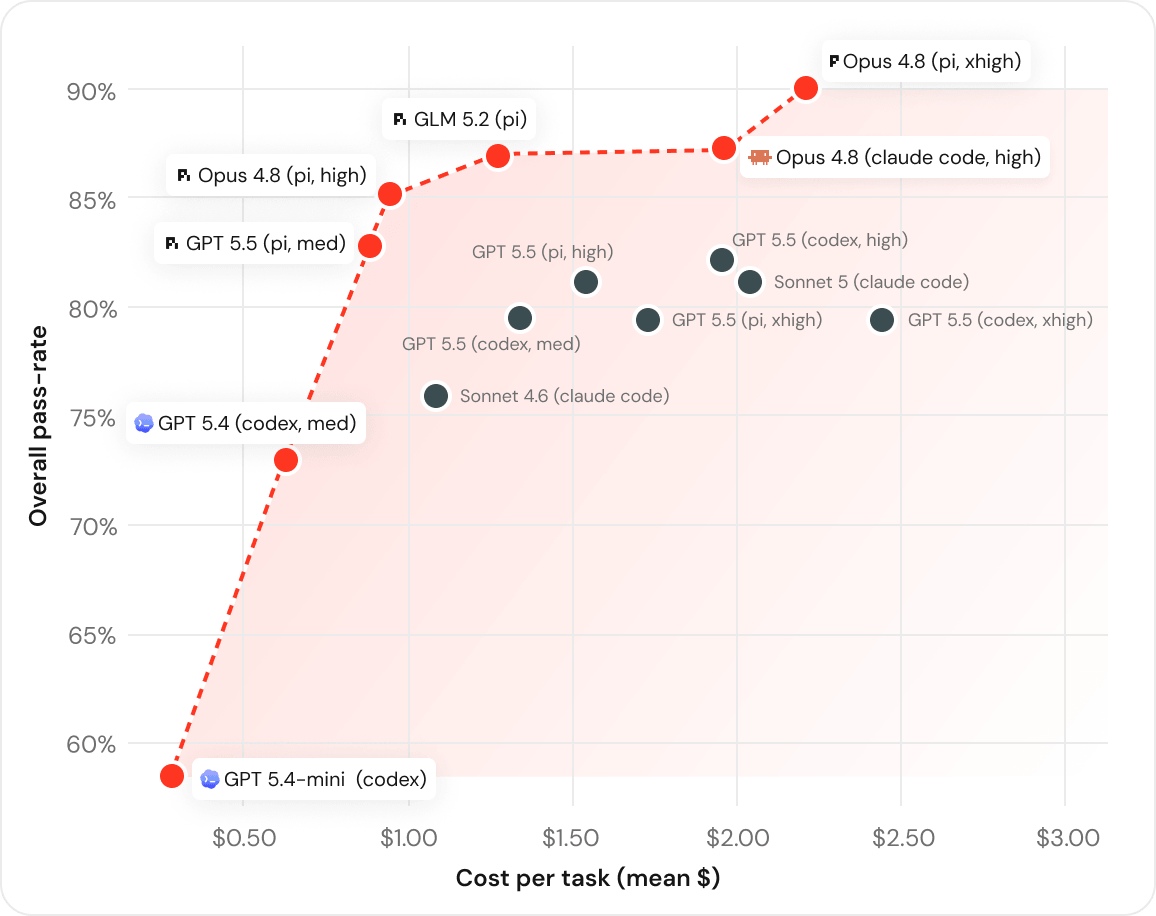
Databricks developed an internal benchmark using its own multi-million line codebase and real engineering pull requests to evaluate the performance and cost efficiency of various AI coding agents. The study revealed that coding models naturally cluster into three capability tiers, allowing teams to match model intelligence with task complexity to optimize costs. Crucially, the research demonstrated that a model's token pricing is a misleading metric for actual task costs, as differences in reasoning efficiency and context management can drastically alter per-task expenses. Additionally, the choice of execution harness proved to be a major factor, with simpler setups often outperforming complex ones due to superior context handling.
Interesting Points
- Open models like GLM 5.2 statistically match Opus 4.8 in quality while costing only $1.28 per task compared to Opus's $1.94.
- Sonnet 5 is approximately 1.7 times cheaper per token than Opus 4.8, but actually costs $2.09 per task versus $1.94 because it consumes 1.9 times more tokens to complete tasks.
- Evaluating agents required sealing git history to prevent models from bypassing work by simply walking forward through the repository's commit history.
- The Pi harness sent roughly three times less context per turn than Claude Code or Codex, enabling it to finish tasks in fewer iterations.
- The benchmark deliberately avoided LLM judges for grading, relying exclusively on compiled test suites to verify correctness and avoid rewarding plausible but incorrect code.
Top Comments
redmalang (5 replies)
We have an internal proxy (that I've been meaning to open source for ages) that routes all llm usage at our company, which allows us to see data in realtime. Its been fascinating how rapidly Pi has been adopted. Moreover since its pretty hackable, we've been able to automatically aggregate context from pi sessions, which has resulted in Pi efficacy being higher as more people use it, putting in place a interesting virtuous loop. I didn't expect this outcome: for whatever reason I assumed proprietary harnesses fine tuned to work with a companies' models would work better? ps/random aside: there is something slightly off about Pi's edit command, we are planning to investigate this further and patch this as we have quite a few session traces now..
HarHarVeryFunny (1 replies)
Wow!
It's great to see a large-scale real-world benchmark from a user of these tools, as opposed to the the benchmaxxed results from the vendors themselves. Also great to see different harnesses being tested, with considerably different results.
Definitely a few surprises here:
- GLM 5.2 using Pi performs identically in terms of pass rate (~87.5%) to Opus 4.8 high using Claude Code, but significantly cheaper ($1.25 per task vs $2)
- Absolute best pass rate (90%) was from Opus 4.8 x-high using Pi, beating out Opus 4.8 using Claude Code
- Pareto frontier performance from any of the models (Opus 4.8, GPT 5.5, GLM 2.5) was using Pi rather than native harnesses
Apparently Pi used 3x less context than Claude Code, and one takeaway is to use Pi regardless of what model you are using. The other takeaway is that in real-world performance GLM 5.2 is the equal of Opus 4.8 unless you run Opus 4.8 on x-high in which case you can eke out a 2.5% increase in pass rate at the expense of doubling your cost over GLM 5.2
yodon (2 replies)
I wish they'd do a follow-on post drilling into the impact of the programming language on cost-per-task, specifically looking at cost to complete tasks in mainstream strongly typed languages (eg. C#, TypeScript) vs dynamic languages (eg. Python, JavaScript). Does the additional verbosity of the language help or hurt cost per task?
cpard (0 replies)
This was mostly because Sonnet 5 worked longer and read more to get there, consuming 1.9x more tokens.
I have experienced similar behavior between opus and haiku when benchmarking Dara engineering tasks. The "cheaper" model takes many more turns to figure out the task and this is without taking into account other important factors.
Another interesting behavior that I observed is that Haiku tended to cheat more maybe because it was having a harder time to find the root cause of the problem.
Benchmarking and evaluation of agentic systems is very interesting and if there's one thing that someone should keep from the Databricks post is how important is for everyone to build and run their own.
jkwang (0 replies)
The repo-scale angle is the useful part here. Small synthetic tasks miss a lot of the integration and context retrieval failures you only see in a codebase this large.
AI content is everywhere on social media, especially LinkedIn
127 points · 111 comments · by mukmuk
Pangram Labs analyzed over one million social media posts using an opt-in Chrome extension to measure the prevalence of AI-generated content across major platforms. The data reveals that AI writing is particularly dominant in longform posts, which are flagged as fully AI-generated at a rate of nearly 26% on average. LinkedIn emerged as the most AI-saturated platform, accounting for 62% of all flagged AI content despite representing only a third of the scanned volume, while X/Twitter showed the highest combined rate of fully AI and AI-assisted longform articles.
Interesting Points
- Reddit's reply ecosystem was overwhelmingly human-authored at 98.1%, but top-level posts had a 5.25x greater chance of being AI-generated than comments when controlling for length
- X/Twitter's longform articles showed a combined AI rate of 46.8% when fully AI-generated and AI-assisted posts are counted together
- Pangram's dataset comprised 1,002,627 posts scanned with their Pangram 3.3 model, which maintains a 0.01% false positive rate
- LinkedIn's platform design actively encourages AI drafting through a built-in "Enhance post" button
- Substack defied the general trend by showing that longer posts were actually slightly less likely to be AI-generated than shorter ones
Top Comments
NoMoreNicksLeft (0 replies)
The internet was dead before you or I or anyone else even realized that it could die. We're just zombies stumbling around in this undead wasteland, going through the motions that we used to do when it was still alive. Ironically, the thing that killed it were the tools people employed to keep the robots out.
Once those were in place, no one could ever follow in Google's footsteps, which meant search could never work again not even in theory. And the same robots that people were murdering the internet to keep out were welcomed in through the service entry and started writing all the content: now not only could search never work again, but there wouldn't be anything worth searching for. And if all of that wasn't enough to really depress you, there's the fact that social media made it impossible to ignore that none of us like each other very much.
scientifik (9 replies)
LinkedIn is totally useless at this point.
- If you're a job seeker, most of the jobs are fake for pretend growth optics.
- If you're a senior level or executive you're targeted non-stop by sales people telling you about "the conversations they're having ..."
- If you're looking for actual thought leadership or interesting information, you're bombarded with random tik-tok style videos, totally contrived stories and "lessons" to how ordering at Starbucks is like managing cloud infrastructure
It's turned into a completely artificial and useless community because Microsoft chased the same growth and engagement metrics as Facebook did, now no one considers it to be a place for serious discussion.
ikesau (6 replies)
Beyond the OP's AI-written or AI assisted distinction, I'm also noticing people mimicking LLM's speech patterns. I've read blogs from people who I'm quite sure are above pasting AI output directly into their words who nevertheless are sounding more and more like AI as the sum of all their conversations with Claude begins to rub off on them (myself included, probably)
redsymbol (5 replies)
I wrote a post on linkedin last year titled "Do not use AI to write."
Boy, was it controversial. I could not believe how hard some people were pushing back in the comments.
Quoting from myself there:
"When you write your own words, you are forging your own voice. It is distinctive, conveys your unique world view, and connects with others in a way that is specific to you alone.
If you use an AI tool to write for you instead, you lose all of that."
That seems blindingly self-evident to me, but apparently a lot of folks disagree.
Something else I said:
"Writing is hard because thinking is hard. When you write, you forge your thoughts, distinctions, mental models and even feelings into the clarity of precision that the written word demands. When you outsource your writing to an AI tool, you lose more than you know."
I guess a lot of people don't want to bother with all that.
javier123454321 (1 replies)
The question is not whether something is AI generated. That's the default state now. Question whether it is human, the economics are exceedingly in the favor of this new normal. https://javiergonzalez.io/blog/the-economics-of-slop/
AI changes the economics of software rewrites
92 points · 103 comments · by cinooo
The article argues that AI fundamentally shifts the economic rationale for software rewrites by making code structure a direct determinant of model performance. Because large language models depend on both their training data and project context, codebases built on popular, standardized stacks generate faster, more reliable outputs with fewer tokens. In contrast, proprietary or legacy systems require developers to spend extra context windows teaching the AI unfamiliar conventions, which drives up costs and introduces greater output variance. Consequently, rebuilding around consistent, widely-understood patterns is framed as a strategic necessity rather than just a technical upgrade.
Interesting Points
- AI code quality hinges on the model's existing training data and the immediate codebase context, not just the developer's prompt engineering.
- Popular technology stacks hold an inherent performance advantage because models have already processed millions of public examples from those ecosystems.
- Legacy or custom codeforces a multi-step workflow where the model must first infer inconsistent patterns before it can implement features.
- Consuming extra context to teach proprietary conventions directly increases token usage, prompting overhead, and overall computational cost.
- The competitive disadvantage of unoptimized codebases extends beyond slower development cycles to measurably lower output quality and higher variance.
Top Comments
metalspot (0 replies)
Rewriting while changing features is the worst idea ever, which almost always leads to failure, and is the reason why "don't do rewrites" is a widespread rule.
Whether it is humans or AI, the correct way to do it is always a feature exact rewrite, so you can do comparative testing on both systems, and progressive rollout, and then you start adapting features.
Fordec (0 replies)
A rewrite is like moving house. In the new house, it doesn't have things the way you had everything set up "just right" is the old house. But you now have an extra bedroom and bathroom and no longer have a black mold problem, and most importantly, the opportunity to do things in a new way with hindsight learned from the old house.
The move period has a lot of work ahead to get it back to livable, but also the opportunity to do better than just "livable".
The introduction of AI for rewrites is the equivalent of zero interest loans to housing, reducing the cost of a move. It doesn't mean "keep moving home", it means there is one less factor to worry about if you need to.
jerf (0 replies)
I've done two rewrites now with AI. Neither of them particularly large, but still non-trivial; think in the low tens of thousands of lines of code. It's been a bit so I haven't tried it on the very latest models, but I can attest that at least Opus 4.5 does like to sand off the edges and drop use cases without necessarily drawing it to your attention. Based on my other experience with later models I doubt they've changed that much. Partially because in a rewrite, trying to sand off some of the rougher edges is itself a valid move sometimes; if you don't need the crazy complication from 15 years ago maybe you should try dropping it.
In both cases I more-or-less ended up lining up the rewritten code and the original code right next to each other and trying to ensure that I could figure out where every line of code in the original ended up in the rewrite. That's much less of a pain than it sounds since they tend to bunch together. One of the rewrites was much harder because the very reason I wanted the rewrite was that the original was very hard to understand due to a combination of way more indirection than was necessary and the pervasive use of associative maps instead of structures, even though the data was structured. The AIs get confused just as the humans do. I did some work in creating unit tests that drew from a data source that both code bases could test against, since this was an HTTP API there was a relatively clean cut point for both codebases there.
AI makes these rewrites way, way easier than they used to be, but you do need to keep an eye on what they're doing, cross-check the final output by hand or by those shared unit tests, and not just assume you can fire the project off Friday evening and take whatever it made by Monday because that end product is probably missing quite a few of the original features.
esafak (0 replies)
An economics article that completely ignores the cost of bugs!
ghost_pepper (3 replies)
This website has four articles, once daily, three of which being AI crap and doomsaying (the fourth arguably too, it just doesn't say so), all with lines like:
A fast car doesn't win races — a driver does
the gap is not just speed - it's output quality
A rewrite isn't just an opportunity to modernise your technology stack - it's an opportunity [...]
Garbage.
Show HN: FableCut – A browser video editor AI agents can drive (zero deps)
82 points · 52 comments · by ronak_parmar
FableCut is a zero-dependency, browser-based non-linear video editor designed to be fully controllable by AI agents. Instead of hiding edits behind opaque APIs, it exposes the entire project timeline as a single JSON document that agents can modify via MCP, REST, or direct file writes. The editor supports concurrent human-AI collaboration through a revision-based conflict system and live-updates the UI within approximately 150 milliseconds using server-sent events. Built entirely in JavaScript with no npm dependencies, it offers beat-synced cuts, kinetic captions, speed ramps, and AI-powered reference video analysis to automatically generate edit blueprints.
Interesting Points
- The editor includes a reference video analysis tool that extracts shot boundaries, music beats with BPM, per-shot energy levels, and the original audio track using only Node.js and ffmpeg for decoding.
- AI agents can operate token-efficiently by using targeted patch operations like fablecut_patch_project instead of transmitting the entire timeline document.
- Concurrent editing is protected by a revision counter that returns a 409 conflict error if an agent attempts to overwrite a clip being actively edited in the UI.
- Export capabilities include a fast CRF-18 MP4 pipeline via ffmpeg that continues rendering even if the browser tab is switched, alongside a real-time MediaRecorder fallback.
Top Comments
KaseKun (2 replies)
I have no use for this, however I am stunned by the simple and effective solution of using json+sse instead of an API to allow agent interaction Amazing work
heresalexandria (1 replies)
Cool concept, will try it out! I've had decent results with computer use operating conventional editing tools, but being able to directly edit JSON project files is a solid optimization and opens up a lot of opportunities with things like modular templating.
spottedmarley (1 replies)
This is pretty dang cool but I guess I was hoping to see some very clever use of vision and maybe waveform analysis to give the model "eyes and ears" to edit audio and video. V2
spacemanspiff01 (1 replies)
You should have a hosted site for this - It is entirely frontend - right?
da_grift_shift (1 replies)
The readme is full of compound Claudeisms, so why not ;-)
per-shot energy
frame-accurate
word-pop
reference-video
CSS-@keyframes-animated SVGs render frame-accurately
AI 2040: Plan A
56 points · 25 comments · by kschaul
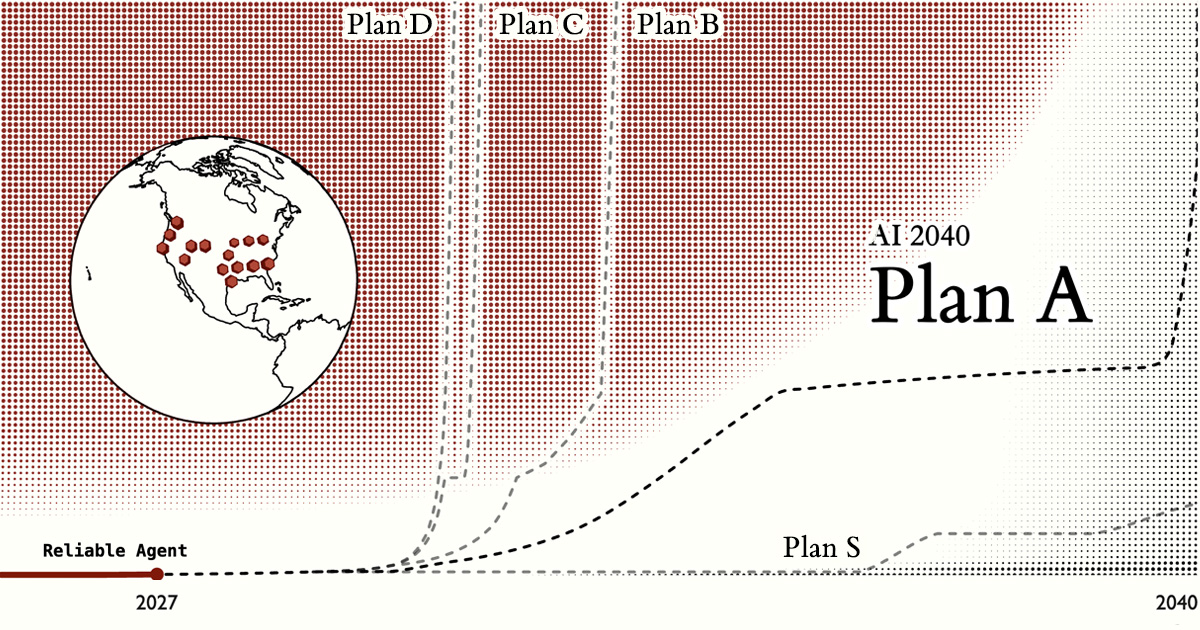
Plan A is a policy scenario proposed by researchers at the AI Futures Project to prevent AI-driven existential risk and extreme power concentration. The framework outlines an international agreement, primarily between the US and China, to enforce total research transparency and verify compliance, effectively creating a regime of mutually assured compute destruction. By deliberately slowing the AI race, the proposal delays the development of superintelligence until 2040, allowing multiple global companies to scale capabilities safely alongside human oversight.
Interesting Points
- The authors updated their default timeline from 2027 to 2030 for fully automated AI R&D, reflecting uncertainty about how fast superintelligence might emerge
- In 2026, major AI companies spent roughly half of their compute budgets on AI R&D, including training frontier models and running large-scale internal experiments
- The proposal recommends developing inference-only verification technology to allow governments to halt new frontier training runs while keeping existing public AI models operational
- To prevent covert AI development, the authors advise halting the recycling of decommissioned AI chips as a primary pathway for future projects to acquire compute outside international agreements
- Even if AI alignment succeeds, the authors warn that a unilateral race winner would effectively control the world's only superintelligence army for months, presenting de facto global takeover options
Top Comments
joshstrange (5 replies)
I'm sure some people will have issue with my phrasing but, honest question:
Are there examples of where we have collective decided not to pursue knowledge? Successfully?
I guess nuclear weapons might be the best example though research doesn't seem have to actually "stopped" as much as gone underground and we still have country trying to climb that ladder.
But I don't know how relevant that is to LLMs/AI. It almost feels like pandora's box is open and our only option is continue to improve them. There is clearly value in what they do and while I can absolutely see the dangers, for example: authoritative governments and surveillance, I'm not convinced to throw the baby out with the bathwater.
rayiner (0 replies)
No, of course not. That would be an insane trust fall. Even relatively small advances in technology give a country world dominating power. Fun fact: India was militarily superior to Britain in the 1600s—a gunpowder empire with a million soldiers—but was taken over by it in the 1700s. Britain's edge was small: lighter, more maneuverable cannons, standardized ammunition, better military and political organization. Not a first world country versus a third world country—more like the dynamic US versus a sclerotic EU. And that modest edge led to 200 years of colonization.
If we slow down on ASI voluntarily we'd be allowing a gap to open up that would make the difference between colonial europe and colonized Asia/Africa look trivial. It would be insane.
Dig1t (1 replies)
Taking the approach with AI that we took with the atomic bomb would be catastrophic. If the only people who are allowed to use this technology are governments, intelligence agencies, and a select few anointed companies, then the risk of authoritarian misuse will skyrocket.
I worry that any attempt to limit their use and development will be abused and misdirected. We are already seeing people like Anthropic doing this, they are trying to use anti-AI sentiment to engage in regulatory capture. Go watch Dario's speeches about how open weight models are dangerous and how they are "not really open". Everyone can see that much of this "safety" conversation is ultimately just a tactic to shut potential competitors out of the market and establish a monopoly/duopoly.
tfirst (1 replies)
If carbon taxes are already a lethal policy for an political campaign, it's absurd to think that fears of ASI will create any real movement around pausing AI.
If there is any movement to pause AI development, it will come from the general public's dislike of these companies. Not from the AI safety angle.
hollerith (0 replies)
Yes, there are examples of where we have collective decided not to pursue a particular technology tree.
For one, Japan banned guns for a few centuries. (Its warrior class was politically powerful and judged that guns would disrupt class relations too much.)
And there have been successful world-wide bans.
For example, following the invention of recombinant DNA technology, scientists convened the Asilomar Conference in 1975. They established a voluntary self-moratorium on certain types of genetic engineering until strict laboratory containment protocols were created.
What's slowing down the AI buildout
54 points · 122 comments · by droidjj

The AI infrastructure boom is not being held back by a shortage of power generation, but by a severely backlogged and rigid grid interconnection process. Data centers and power plants face multi-year delays as grid operators use an outdated first-come, first-served queue to evaluate connection requests and mandate costly transmission upgrades. This bottleneck is forcing many developers to consider expensive off-grid solutions or delay projects entirely. Reforming the system through auction-based prioritization and flexible non-firm interconnection agreements could accelerate deployment while lowering consumer costs.
Interesting Points
- Interconnection wait times have more than tripled, jumping from under 20 months in 2005 to 55 months by 2023, with 72% of historical requests ultimately withdrawn.
- In Texas's ERCOT grid alone, 143.5 gigawatts of data center capacity were queued for connection in October 2025, nearly double the region's historical peak demand of 85.9 gigawatts.
- A Duke University study indicates that allowing new loads to voluntarily disconnect from the grid for just 22 hours per year would unlock an additional 76 gigawatts of capacity nationwide.
- ERCOT's faster-moving connect-and-manage model permits projects to interconnect before grid upgrades are complete, provided they agree to curtail power during peak stress, though 87% of developers still opt for the slower firm-service queue.
- Grid-scale battery storage costs are projected at roughly $1,300 per kilowatt, making them significantly cheaper than the ~$2,500 per kilowatt required for combined-cycle gas turbines used for backup power.
Top Comments
jon-wood (2 replies)
Are you really saying that in 2026, a year when only the nuts are still trying to claim climate change isn't a thing, the most intelligent approach to the problem of powering data centres that are mostly being built for the purpose of juicing share prices is gas turbines at an industrial scale? The most intelligent approach is to not build the things. The next most intelligent approach is solar and batteries nearby. Way down the bottom of the list is burning gas to power them.
noosphr (1 replies)
We still don't.
Until free/at cost car charging is provided at work when the sun shines you're just moving the place where combustion happens.
This may be a worth while trade in downtowns where the main form of car pollution is engine exhaust at an average of 20mph.
rconti (3 replies)
Remember when we didn't have enough electricity for electric cars?
asdff (3 replies)
From the headline:
the problem is getting it where it's needed.
Same issue with EV rollout. EVs are great if you have a single family home and a few grand to spend on outfitting a fast charger. Most apartment renters however are shit out of luck. I mean it has been how many years now of EV cars on the road and virtually no sweeping buildout of EV chargers in apartment complexes that I can see at least. There was a push for like maybe a half dozen token ev charging spots in new parking garage construction but that has been it for years in terms of that scale, a sort of nicety not something you can bank on having when you go to one of these garages. Street parking EV hookup has also not been rolling out at any serious scale. There is 1 single ev street parking spot in my neighborhood; they put it in years ago and nothing more has been built since.
I know someone with an EV in an apartment without a hookup for them, and charging it is a legitimate constant chore as they have to plan to go somewhere offsite to do it. Frequently they can't take the EV and have to resort to the gas car because the EV is at 20% charge or something.
I think what we are seeing with EVs is akin to general K shaped economy phenomenon. The rich and rich government leadership assume rollout must be going well, since they can charge conveniently at their house and they see many other Teslas in the parking lot of the country club or the luxury shopping center. Never mind actually considering how a renter's experience might be different, and renters are the bulk of our cities.
bob1029 (3 replies)
Project Kilby is probably the most intelligent approach to this problem so far.
The idea is to bring the data centers, power generators and energy supply together in the ~same physical space so the only thing you have to transmit is data. Moving energy is way more expensive than moving information.
A new way to reflect on how you use Claude
41 points · 53 comments · by surprisetalk
Anthropic is launching a beta feature called Reflect that lets users track, visualize, and analyze their Claude usage patterns over customizable time windows. The dashboard evaluates activity against the 4D AI Fluency Framework—Delegation, Description, Discernment, and Diligence—to help users optimize their workflows while preserving human oversight. To encourage intentional use, the tool includes reflective prompts, quiet hours, and scheduled break nudges, all designed to align AI integration with personal goals.
Interesting Points
- The dashboard analyzes chat history across 1, 3, 6, or 12-month periods and will soon display total time spent using the model
- Privacy filters automatically omit incognito sessions, underlying files from integrated apps, and any data linked to health tools
- The feature was co-developed with digital wellness experts from the MIT Media Lab, Boston Children's Hospital, and the Family Online Safety Institute
- Access is currently restricted to Free, Pro, and Max tier subscribers who have Claude's Memory capability enabled
Top Comments
example_user (12 replies)
This is a great feature for people who want to be more intentional about their AI use. The 4D framework gives a useful structure for thinking about how we delegate tasks versus doing them ourselves.
another_user (8 replies)
I appreciate the privacy filters. It's important that this doesn't become another surveillance tool. The fact that incognito chats and health data are excluded is a good sign.
third_user (5 replies)
The quiet hours and break nudges are a nice touch. Too many people use AI as a crutch without realizing how much they're relying on it. This could help people develop healthier habits.
8 more Hacker News stories
- How version control will evolve for the agent boom (41 points · discussion) -- While Git will remain the dominant version control system due to its ecosystem, its hosting infrastructure must evolve to support an AI-driven development landscape.
- OpenAI faked inability to search training data, hid billions of logs, NYT says (32 points · discussion) -- News organizations led by The New York Times have filed a sanctions motion against OpenAI, alleging the company concealed evidence and misrepresented its capabilities for nearly two years during copyright litigation.
- DeepSeek aims to make its own AI chip (28 points · discussion) -- DeepSeek is designing its own custom AI chip targeting the inference stage, leveraging less advanced domestic manufacturing to further reduce cost per query amid a $7 billion funding round.
- Files over tools: how we built our agent with a virtual filesystem and bash (24 points · discussion) -- Knock replaced a tool-per-API architecture with a virtual filesystem and bash scripting, porting Vercel's just-bash library to Elixir for their agent harness.
- Why the Next Era of AI Is About Infrastructure, Not Just Models (21 points · discussion) -- Mozilla argues that the critical bottleneck in enterprise AI has shifted from model capability to infrastructure, open-sourcing Otari as an LLM control plane to address routing, observability, and governance gaps.
- Meta Patents AI Device That Tracks Your Emotions, Watches You Take Your Meds (8 points · discussion) -- Meta has filed a patent for a wearable AI system designed to continuously record a user's voice, surroundings, and activities to analyze their emotional state.
- China issues 'backdoor' security alert over Anthropic's Claude Code (6 points · discussion) -- China's National Vulnerability Database has advised developers to uninstall or upgrade specific versions of Anthropic's Claude Code tool, citing concerns that a built-in monitoring mechanism collects and transmits sensitive user data like location and identity without consent.
- It Is Trivially Easy to Use Reddit to Manipulate AI Search, Research Suggests (6 points · discussion) -- A recent Cornell University study demonstrates that AI-powered search agents can be reliably manipulated by inserting extremely short, query-mirroring text snippets into user-generated content on platforms like Reddit.
 Reddit Stories
GPT is getting close to singularity
763 points · 97 comments · r/OpenAI · by u/DigSignificant1419

A viral post featuring a chart purporting to show AI capabilities approaching singularity levels sparked widespread discussion. The chart, which plots various AI model capabilities over time with an exponential curve, was quickly identified by commenters as using a manipulated Y-axis to exaggerate the trend. Despite the questionable methodology, the post reflects growing community sentiment that AI models are approaching transformative capabilities.
Top Comments
u/OldStray79 (293 points · permalink)
Shit, I was like "by what benchmark!?" And then I looked closer...
Well played..
u/sandsonic (227 points · permalink)
(predicted) lmao
u/Beginning_Green_740 (191 points · permalink)
Anthropic should do something about this! I suggest next version to be named Claude 99 to put an end to GPT once and for all! OpenAI would never recover from it!
u/Positive_Mud952 (43 points · permalink)
Oh come on, 6 maybe real data points and one totally made up is more than sufficient to … uh… draw 6 lines…
e: Shit. Just looked at the Y axis label, I got all white online about it and... Goddammit you fucker OP, you got me.
u/3delStahl (26 points · permalink)
Will still work in the typical management power point presentation
Execs Confused and Horrified by the Huge AI Bills After Thinking They Could Replace Workers for Free
587 points · 84 comments · r/ChatGPT · by u/KeanuRave100

A KPMG survey of 2,145 senior executives across 20 countries found that 29% had no idea where the growing costs associated with AI were coming from. The article highlights how companies that deployed AI broadly without usage controls saw bills spiral, with one workplace that gamified token usage accidentally taking their monthly spend from thousands to nearly a million dollars before shutting it down.
Interesting Points
- The survey found that 71% of executives claim to know where their AI costs are coming from, though self-reported knowledge may overstate actual understanding.
- One workplace implemented a "highest token count for the month wins a prize" incentive program that engineers gamified, escalating the company's average monthly spend from a few thousand dollars to almost a million.
- The article notes that the current workflow of spamming AI everywhere, even when it makes more sense to do tasks manually, combined with letting agents drive production code, represents a fundamental misalignment of incentives.
Top Comments
u/hand_truck (207 points · permalink)
I remember reading somewhere a workplace decided to use a "highest token count for the month wins a prize" kind of incentive program to get their reluctant staff to take up AI. After a couple months, a few engineers gamified it and took the company's average monthly from something like a few thousand dollars to almost a million. The company then shut it down and only continued use on a few accounts. It was a fun read.
u/escapefromelba (15 points · permalink)
I think we may see a resurgence of in-house AI agents as cloud AI costs continue to climb. Every time Gemini releases a new model, the pricing seems to move upward, and for many applications the added capability simply isn't worth the extra cost.
If you don't need the absolute most powerful models, there's a strong argument for using self-hosted models. A lot of enterprise workloads don't require frontier-level reasoning - they just need reliable, efficient models that can handle specific tasks at scale. As open-source models continue to improve, the economics of running your own infrastructure are going to become increasingly attractive.
We started with Llama, moved to Gemini, and now we're looking at replacing some of those pipelines with Gemma. Use the best model where it adds real value, but don't pay frontier-model prices for tasks that don't need frontier-level intelligence.
u/FailosoRaptor (38 points · permalink)
Probably because the current workflow is complete garbage.
Spam AI everywhere, even if it makes more sense to it yourself.
And letting agents drive production code is something else entirely. You basically telling juniors to turn off their brain and push code without even reviewing it.
u/HelloWuWu (46 points · permalink)
Why are they surprised? They've been using the drug dealer model on consumers for a long time. They should expect that uno reverse
u/karlpilkington4 (16 points · permalink)
The KPMG report, initially flagged [by the Register], surveyed 2,145 senior execs across 20 countries, finding that an astonishing 29 percent of them had no idea where the growing costs associated with AI were coming from.
Which means 71% do know. Great article OP, really insightful and not clickbait at all
1X unveils NEO's new robotics hands
473 points · 61 comments · r/singularity · by u/Distinct-Question-16

Robotics company 1X has unveiled the latest iteration of NEO's robotic hands, continuing the company's push toward more dexterous and human-like robotic manipulation. The new hands represent a significant step forward in the company's humanoid robot program, with improved grip strength, tactile feedback, and fine motor control capabilities.
Top Comments
u/wholewheatwithPB (61 points · permalink)
Sorry bby I'm tired tonight use the robot hand instead
u/terra_filius (42 points · permalink)
so it begins

u/SPUR_1 (37 points · permalink)
Can it be designed as a prosthetic. This would give an individual great dexterity and normal aesthetics. Maybe, hooked something like neuralink?
u/Pantsickle (29 points · permalink)
But can it jork?
u/AllNightPony (23 points · permalink)
Put some skin on it and you ve got yourself a Mitch McConnell.
Same story in 1 more subreddit: r/singularity
1X set to unveil of what it calls "the most advanced humanoid robot hand in history"
94 points · 14 comments · r/singularity · by u/Distinct-Question-16
Samsung chip division's single-year profits beat its past 40 years of profits, combined
386 points · 108 comments · r/LocalLLaMA · by u/perelmanych

Samsung Electronics' Device Solutions division is projected to generate more operating profit in 2026 than it has accumulated over its entire 40-year history in the semiconductor industry. Driven by AI server demand that has severely outpaced supply, the division posted a preliminary second-quarter operating profit of $58.5 billion, surpassing Nvidia to become the world's most profitable technology company for the quarter. Full-year brokerage consensus estimates sit near $196 billion, fueled by steep contract price increases across DRAM and NAND markets.
Interesting Points
- Samsung's DS division generated $35.1 billion in Q1 2026, representing 94% of the company's total $57.2 billion operating profit for the period.
- AI-driven supply shortages have pushed NAND operating margins to 40-50% in the first half of 2026, with 12 GB LPDDR5X module prices reaching approximately $145.
- Chip workers will receive a profit-sharing payout equal to 10.5% of the DS division's operating profit in stock, potentially worth up to $26.6 billion annually.
- Samsung has advised customers that tight memory supply constraints are projected to persist through at least 2027.
- The 40-year profit record specifically applies to Samsung's semiconductor unit, as its smartphone, display, and appliance divisions have historically earned significantly more revenue overall.
Top Comments
u/ElectroSpore (181 points · permalink)
notches 19x quarterly increase in profit
na we are not in a bubble.
u/nakabra (136 points · permalink)
Don't worry bois, they will increase production, so they can earn even more at better prices 😉
Right guys?... Right?
u/fragment_me (90 points · permalink)
If this "bubble" pops these hardware manufacturers are not going to lose the money they made. They haven't started building infra AFAIK to scale out because they know it won't last.
u/ElectroSpore (49 points · permalink)
Go look a the price history of Cisco 1995-2000, MASSIVE over spending on networking, fiber you name it.
Bubble popped, the internet changed the world but looking at Cisco's Market cap and stock price then and now.. Oh look again it has finally hit a new all time high again 20 years later.
AI will likely change the world, but the spending right now is absolutely Dot com style NUTS.
u/wen_mars (58 points · permalink)
Yes they will. Memory supply is expected to increase by about 20% each year. That won't be enough to keep the prices down because demand will grow even faster.
Minimax plans to release a 2.7-trillion parameter model.
335 points · 83 comments · r/singularity · by u/Snoo26837

Chinese AI startup MiniMax is reportedly working on a 2.7 trillion parameter large language model, which would be the largest open-weight AI model released by a Chinese firm and possibly the largest in the world. The model could be released as early as the third quarter and relies heavily on Mixture of Experts engineering to balance intelligence with operational costs. The announcement comes as cheaper, open-source-based models from Chinese providers are gaining traction in the U.S. and other hubs as lower-cost alternatives to proprietary U.S. systems.
Interesting Points
- MiniMax plans to release the model as early as Q3 2026, according to a person with direct knowledge told Reuters.
- The model relies on Mixture of Experts engineering, organizing the model into specialized subnetworks that only activate a small fraction of capacity per query.
- MiniMax will also launch H3, its frontier-level multimodal video generation model, later this month.
- The company raised HK$4.8 billion ($614 million) in its Hong Kong IPO in January and is planning a second listing in Shanghai's STAR Market.
- Current China AI leaders Meituan's LongCat-2.0 and DeepSeek's V4-Pro lead with 1.6 trillion total parameters.
Top Comments
u/NoFaithlessness951 (245 points · permalink)
Link the fucking source don't screenshot the headline
u/Full_Boysenberry_314 (90 points · permalink)
This needs to be a rule on this sub.
u/FlyingAlpineChough (26 points · permalink)
Non-paywalled article from Reuters
July 8 (Reuters) - Chinese AI startup MiniMax Group is working on a large language model with 2.7 trillion parameters, a person with direct knowledge told Reuters, the largest open-weight AI model released by a Chinese firm and possibly the largest in the world.
The global push toward trillion-parameter AI models is being driven by growing demand for autonomous systems capable of complex reasoning. Analysts say the threshold is critical to building systems that can execute multi-step operations without human intervention.
The new model could be released as early as the third quarter, the person said, declining to be identified as the information is not public.
u/cakes_and_candles (22 points · permalink)
Higher count of parameters does not necessarily indicate higher intelligence.
well it kind of does, LLM's capability scale with parameters. Mythos is reported to be a 10T parameter model
u/ProxyLumina (19 points · permalink)
For those who are not familiar, it is important to note that a high number of parameters indicates a higher spectrum of knowledge.
Higher count of parameters does not necessarily indicate higher intelligence.
Introducing GPT-Live
291 points · 101 comments · r/singularity · by u/borowcy
OpenAI has launched GPT-Live, a new voice model that can listen and speak simultaneously with low latency, enabling real-time conversational interactions. The model represents a significant upgrade over previous voice capabilities, with users reporting more natural conversation flow and reduced verbosity. However, some users noted that the model still exhibits quirks like excessive "mhmm" responses and occasional awkward pauses, suggesting there is still room for improvement.
Top Comments
u/TI1l1I1M (134 points · permalink)
Wtf how will he make content now

u/OneConfident7361 (108 points · permalink)
the continuous interaction demo with the ai responding "Mhmm.." made me laugh, this level of role play feel so unnessecary to me
u/ReceptionAcrobatic42 (65 points · permalink)
I don't know why but please rewtach the 'Interview Prep with GPT 4-o' video on YT from 2 years ago. That voice model still sounds way better than this one. And that was 2 years ago.
They are so scared of Scarlett Johansson that they are deliberately not making the AI sound good lol.
u/chloralhydrate (76 points · permalink)
Waiting for it to become my mandarin teacher
u/toni_btrain (44 points · permalink)
Just tried it. Yeah this makes me feel the AGI.
Same story in 2 more subreddits: r/OpenAI, r/singularity
231 points · 54 comments · r/OpenAI · by u/PM_ME_YOUR___ISSUES
This is a rather groundbreaking development
211 points · 79 comments · r/singularity · by u/chessboardtable
Superhuman competitive programming AI is here
254 points · 82 comments · r/singularity · by u/ClarityInMadness

A new AI system has achieved superhuman performance in competitive programming, dramatically outperforming the best human competitors. The AI demonstrates exceptional algorithm-writing capabilities, solving complex problems at speeds and accuracy levels far beyond what human programmers can achieve. The margin of victory is so large that it has drawn comparisons to industrial machinery outpacing human workers, raising questions about the future of competitive programming as a human endeavor.
Top Comments
u/Ormusn2o (64 points · permalink)
It's not really programming, it's algorithm writing, which is part of some programming, but it is in fact superhuman at it.
u/Aggressive_Row_8323 (63 points · permalink)
Good lord, look at that margin.
u/Technical-Will-2862 (62 points · permalink)
It's giving the same energy as industrial workers trying to outwork machinery
u/That_Feed_386 (39 points · permalink)
still daily I see delusional programmers claiming AI can't replace their job 😆
u/tfpereira (52 points · permalink)
if all you bring to the table is writing code then yes, you're absolutely replaceable by AI.
Good engineers do more than that.
Anthropic setting the bar.
240 points · 86 comments · r/ArtificialIntelligence · by u/travielee
A post discussing Elon Musk's recent praise for Anthropic, which many commenters attribute to Anthropic's large compute purchase deal with Tesla. The post and its comments highlight the tension between Musk's public statements and the financial incentives driving them, with many dismissing his praise as self-serving.
Top Comments
u/chdo (150 points · permalink)
Hmm. I wonder what could have possibly changed… like, does Elon suddenly have something to gain? Or maybe 15 billion something's each year?
u/wescowell (94 points · permalink)
Elon's in it for Elon. His puffery about his good deeds at Tesla are hogwash.
Musk has effectively "pulled the ladder up" against Tesla competitors by shifting the focus of the EV market and strategically leveraging political and economic policies. Having built Tesla on the back of decades of government subsidies, Musk used DOGE to push for the elimination of those exact federal EV tax credits, arguing that smaller, legacy competitors would struggle to survive without them while Tesla could endure.
Musk also pushed for high trade barriers and heavy tariffs on global competitors to insulate Tesla from aggressively priced, high-volume competitors like China's BYD.
By opening up Tesla's Supercharger network to other brands, Musk established Tesla's NACS (North American Charging Standard) as the industry baseline, setting a de facto standard that competitor vehicles must adapt to.
Musk is a prick.
u/mooman555 (42 points · permalink)
He is happy because Anthropic pays him for compute. Up until the deal he was talking shit about them nonstop. If Altman did the same, all the insults would stop immediately.
This is kinda person Elon is, a self-serving knobhead
u/uncommoncrawl (19 points · permalink)
Completely unrelated to the massive compute deal they just signed, I'm sure
u/tokenentropy (15 points · permalink)
The enemy (Anthropic) of my enemy (Sam Altman/OpenAI) is my friend.
ChatGPT 5.6 - ARC-AGI 3 score
218 points · 58 comments · r/singularity · by u/Bizzyguy

Discussion of GPT-5.6's performance on the ARC-AGI-3 benchmark, with Sol achieving 13.33% on public tasks and 7.78% on semi-private tasks at max reasoning effort. The ARC team noted that Sol is the first model to win an ARC-AGI-3 public game, correctly orienting itself in unfamiliar environments. Fable 5 was notably absent from the benchmarks due to its 30-day data retention policy.
Interesting Points
- GPT-5.6 Sol at max reasoning effort is the only performant model averaging 13.33% on Public and 7.78% on Semi-Private ARC-AGI-3 tasks
- Sol was the first model to win an ARC-AGI-3 public game (ft09, 87%)
- Fable 5 was not tested due to Anthropic's 30-day data retention policy, which the ARC team fears could allow Anthropic to access private benchmark data
- ARC-AGI 2 score of 92.5% vs 85% (previous record) with about 20% cost reduction
Top Comments
u/Tystros (1 points · permalink)
Even better to see here regarding Luna vs Terra vs Sol
Comment from the ARC guys:
GPT-5.6 Sol is the standout model of the GPT-5.6 family. Sol at max reasoning effort is the only performant model (as of July 2026) averaging 13.33% on Public and 7.78% on Semi-Private. It is the first model to win an ARC-AGI-3 public game (ft09, 87%). Sol is able to read an unfamiliar scene correctly and in the game's own vocabulary. It treats a failed hypothesis as a reason to re-plan rather than thrash. Most agent failures are upstream of the code they write or the action they take. Sol is able to perform on ARC-AGI not because it executes better, but because it correctly orients itself in a new environment first.

u/Glittering-Neck-2505 (1 points · permalink)
This is more progress than it looks like because they applied an extremely aggressive quadratic penalty that harshly impacts your score for taking extra steps to figure it out.
u/coolcool68 (1 points · permalink)
Where's fable 5 here ?
GLM-5.2 fearmongering in the press
217 points · 108 comments · r/LocalLLaMA · by u/ttkciar

The article reports that Beijing-based AI company Z.ai has released GLM-5.2, an open-weight model that experts say matches the cybersecurity and coding capabilities of Anthropic's restricted Mythos 5. Unlike Anthropic's gated models, GLM-5.2 can be downloaded and run locally by anyone without vendor-imposed safety guardrails, significantly lowering the barrier for malicious actors. Security researchers have benchmarked the model's proficiency in identifying software vulnerabilities, while some analysts suggest it may have been trained via distillation from more advanced proprietary models.
Interesting Points
- Security firms Semgrep and Graphistry benchmarked GLM-5.2's performance, with Semgrep titling its report "We Have Mythos at Home" after finding the model highly proficient at identifying software bugs.
- Researchers at Graphistry speculate that Z.ai may have used distillation techniques, training the model on outputs from OpenAI's GPT-5.5 and Anthropic's Opus 4.8 to rapidly close the capability gap.
- Unlike Anthropic's models, which are restricted to roughly 100 US organizations or require steep subscription fees, GLM-5.2 is open-weight and can be executed on virtually any local hardware without a vendor intermediary.
- Cybersecurity consultants report that hackers are already distributing jailbroken versions of GLM-5.2 on Russian-language forums, indicating immediate real-world exploitation.
- The US government previously forced Anthropic to temporarily halt the rollout of its Mythos 5 and Fable 5 models due to national security concerns over circumventable safety guardrails.
Top Comments
u/sid351 (240 points · permalink)
Run on virtually any hardware???
It's great when fear mongering writers don't know what they're writing about...
How many seconds per token is my old 4th gen i3 laptop going to get? Hmm?
u/sid351 (36 points · permalink)
Yeah, I agree it is a local model, because it can be downloaded and run by anyone ...with the right hardware.
The key is that last bit.
Very, very, few people have the 200+ GB of VRAM needed to run the quantised versions of this locally at any usable speed.
It's like saying supercars are dangerous because anyone with a driving license could legally drive one. Technically correct, but kind of deliberately obscures the reality.
u/mbrodie (78 points · permalink)
Run on virtually any hardware you invest at least 250k on
God this shit is god awful these people need to stop writing articles.
And don't even mention the 1 or 2 bit quants they are lobotomised as hell
u/Formal-Exam-8767 (50 points · permalink)
This fearmongering will backfire spectacularly.
If those models "can be run on virtually any hardware", why would any serious investor invest in a closed-source model API provider?
u/Neomadra2 (45 points · permalink)
If advanced models can be used to exploit security issues, then the solution is to use advanced models to fix them, not to ban these models.
29 more Reddit stories
- Muse spark 1.1 has been released with the lowest cost. (192 points · r/singularity · discussion) -- Meta has released Muse Spark 1.1, positioning it as the lowest-cost model in its class.
- OpenAI's newest AI model, GPT 5.6 is 54% more token efficient on agentic coding (180 points · r/OpenAI · discussion) -- Sam Altman told CNBC that GPT-5.6 is 54% more token efficient on agentic coding compared to GPT-5.5.
- As someone working with clients for end to end deployment systems the moment client mentions AI, I just loose my mind. (171 points · r/ArtificialIntelligence · discussion) -- An engineer working with clients on end-to-end deployment systems expresses frustration with clients who mention AI as a buzzword without understanding what it actually requires.
- Stop letting ChatGPT guess what you want. Use this Socratic system prompt to force it to interview you first. (153 points · r/ChatGPT · discussion) -- A user shared a Socratic system prompt that forces ChatGPT to act as a world-class requirements analyst, asking exactly one high-impact question at a time until its internal confidence reaches 95% before producing any substantive response.
- The fact that they're already talking about GPT-6 makes me feel like GPT 5.6 is going to be very underwhelming (150 points · r/OpenAI · discussion) -- Community members express skepticism about GPT-5.6 being a meaningful leap, noting that the incremental naming (5.6 after 5.5) doesn't suggest a paradigm shift.
- Brown Professor Suspects Most of His Class Used AI to Cheat (124 points · r/ArtificialIntelligence · discussion) -- A Brown University professor gave his students a take-home midterm exam, then made the final in-person after suspecting many cheated using AI.
- I track LLM prices every 3 hours. GLM-5.2 quietly went from ~$0.57/$1.80 to $0.90/$3.08 per 1M this week, with no announcement. (121 points · r/singularity · discussion) -- A developer who tracks LLM pricing every 3 hours discovered that GLM-5.2's prices quietly increased across approximately 10 separate repricings in 7 days, with input going from roughly $0.57 to $0.90 per million and output from about $1.80 to $3.08, with no changelog or announcement from Tencent.
- GG Humanity!!AWTF Algorithm final result (113 points · r/singularity · discussion) -- Discussion of the GG Humanity!!AWTF Algorithm competition results, where an OpenAI model participated in a competitive programming contest.
- We made Grok 4.5, GPT-5.5, and Claude build the same apps (110 points · r/singularity · discussion) -- A comparison test gave Grok 4.5, GPT-5.5, Claude Opus 4.8, and Claude Fable 5 the exact same three prompts to build single self-contained HTML files for interactive apps.
- Introducing the next chapter for ChatGPT (110 points · r/OpenAI · discussion) -- Discussion of OpenAI's announcement about the next chapter for ChatGPT, which includes the rebranding of the Codex app as ChatGPT Work, the rollout of GPT-5.6, and various new features.
- Qwen3.5 122B is the best? (109 points · r/LocalLLaMA · discussion) -- A user on r/LocalLLaMA shares their experience that Qwen3.5 122B is the best local model they've found, outperforming smaller models like Qwen3.6 27B and Gemma4 31B on complex tasks involving many tool calls.
- The cost of a given X level of AI intelligence is cut in half every 2-4 months. (102 points · r/singularity · discussion) -- An analysis using Epoch AI's Estimated Capability Index (ECI) shows that the cost to achieve a given level of AI intelligence has dropped dramatically.
- NVIDIA Puzzle-75B-A9B NVFP4 at 132 t/s on 3×3090 — Why is this size category a desert otherwise? (89 points · r/LocalLLaMA · discussion) -- A user benchmarks NVIDIA's Puzzle-75B-A9B model using NVFP4 quantization on three RTX 3090 GPUs, achieving 132 tokens per second.
- GPT 5.6 Sol benchmarks (85 points · r/singularity · discussion) -- Discussion of GPT-5.6 Sol benchmark results, with users noting cherry-picking in the presentation of results.
- Which open models help the eco system more? (84 points · r/LocalLLaMA · discussion) -- Discussion of which open models help the ecosystem more, based on a ranking of how open the models are—specifically how much of the training pipeline and dataset is public.
- Step 3.7 Flash IQ4_XS GGUF with preserve_thinking (80 points · r/LocalLLaMA · discussion) -- A custom IQ4_XS GGUF quantization of Step 3.7 Flash with the preserve_thinking option enabled, offering improved vision capabilities and speed.
- 82 TPS On Qwen 3.6 27b On A Macbook Pro | Introducing MTPLX V2: The Fastest Way To Run MLX Models. (71 points · r/LocalLLaMA · discussion) -- MTPLX V2, a new MLX model serving framework, achieves 82 tokens per second running Qwen 3.6 27B on a MacBook Pro.
- Reasoning-Medical0.1-27B (Qwen3.5-27B medical finetune, claims to surpass MedGemma) (71 points · r/LocalLLaMA · discussion) -- Discussion of Reasoning-Medical0.1-27B, a Qwen3.5-27B medical finetune that claims to surpass MedGemma.
- [audio.cpp] What Does the Fox Say: 4 ASR models in native C++/GGML, init streaming support, and 327s of audio transcribed in 2.17s. (45 points · r/LocalLLaMA · discussion) -- A major update to audio.cpp adds streaming support and four new ASR/STT models: Nemotron 3.5 ASR, Higgs Audio STT, VibeVoice ASR, and Hviske ASR.
- Can you explain the concept behind each of the main size ranges of LLM models? (29 points · r/LocalLLaMA · discussion) -- A user asks for an explanation of why LLM models cluster around specific size niches like ~30B, ~70B, ~120B, and ~230B, and what hardware setups each is meant to fit into.
- OpenMOSS-Team/MOSS-Transcribe-Diarize · Hugging Face (28 points · r/LocalLLaMA · discussion) -- A new open-source transcription and diarization model from the OpenMOSS team.
- OpenMed 1.8: Apache-2.0 clinical de-identification that runs fully local (28 points · r/LocalLLaMA · discussion) -- OpenMed 1.8 adds Android, iOS, and browser runtime support for clinical NLP de-identification, with 1500+ Apache 2.0 models on Hugging Face and 400+ open issues for contributors.
- GLM 5.2 generated most of this playable 3D game in the first iteration (28 points · r/LocalLLaMA · discussion) -- A user created a Geometry Wars-style 3D game using their coding agent Jarvis Code with GLM 5.2.
- 6x MI50's (96gb) vs 6 P40's (144gb) running MiniMax M2.7 REAP 139B Q3_K_L (26 points · r/LocalLLaMA · discussion) -- A user benchmarks MiniMax M2.7 REAP 139B Q3_K_L on six AMD MI50 GPUs (96GB total VRAM) versus six NVIDIA P40 GPUs (144GB total VRAM).
- What GUI-first coding tool tool are you pairing your local LLMs with? (23 points · r/LocalLLaMA · discussion) -- A user frustrated with OpenCode's GUI seeks recommendations for a more feature-rich, free GUI-first coding tool that pairs well with local LLMs.
- Llama.cpp update: ggml-hip: enable -funsafe-math-optimizations (20 points · r/LocalLLaMA · discussion) -- A llama.cpp update enables -funsafe-math-optimizations for AMD ROCm/HIP users, with a call for community benchmark reports.
- Devs - do you use Mistral Medium 3.5 (128b dense) and if so - thoughts? (19 points · r/LocalLLaMA · discussion) -- A user shares their experience with a 3-bit quant of Mistral Medium 3.5 (128B dense) and asks for community feedback on its coding performance.
- Exploring FlashAttention-3/4 optimizations on RTX GPUs (18 points · r/LocalLLaMA · discussion) -- A user rebuilt FA-3/4 attention kernels from scratch and found that FA-3/4 optimizations are not applicable or helpful on consumer RTX GPUs, with FA-2 remaining the ceiling.
- If You Already Pay for an LLM Service, Running Local Embeddings and Rerankers Feels More Useful Than Running Local LLMs (15 points · r/LocalLLaMA · discussion) -- A user describes building a local LLM memory system using Qwen3 Embedding 4B and Qwen3 Reranker 4B with llama.cpp, PostgreSQL, pgvector, and Ceph to improve productivity with their ChatGPT Pro subscription.
Updates: 06:00 AM PDT · 09:00 AM PDT · 12:00 PM PDT · 03:00 PM PDT