AI Breakthroughs Clash with Corporate Lawsuits and Privacy Fears
Overview
Frontier AI capabilities took center stage as Claude Fable cracked a major physics problem and GPT-5.6 drew praise for improved coherence, while Richard Sutton unveiled his energy-efficient Oak Lab. The industry’s legal and privacy landscape grew more contentious, highlighted by Apple’s lawsuit against OpenAI, backlash over xAI’s data uploads, and renewed advocacy for local models. Meanwhile, developers navigated sweeping changes to coding workflows and platform policies, even as economists warned of the sector’s escalating energy demands and broader economic disruption.
 Hacker News Stories
Zig Creator Calls Spade a Spade, Anthropic Blows Smoke
1401 points · 701 comments · by crowdhailer

Ray Myers critiques Anthropic and Bun's recent migration of the Bun runtime from Zig to Rust, arguing the decision was driven more by marketing ambitions than technical necessity. He highlights Zig creator Andrew Kelley's blunt response, which attributes the move to poor engineering practices, toxic management, and an over-reliance on AI agents that failed to catch critical memory bugs. Myers contends that Anthropic is actively promoting a narrative that AI can replace software engineering to justify its massive valuation, despite evidence that code maintainability and human judgment remain essential.
Interesting Points
- Bun's founder previously warned recruits about extreme crunch times, with the company publicly noting a comfort level with 90-hour work weeks as a job requirement.
- Andrew Kelley's response cites internal reports of severe management failures, including poor communication, unrealistic expectations, low empathy, and a lack of engineering experience.
- Bun dismisses Zig style guides as unenforceable, yet simultaneously claims their AI agent review system successfully enforced strict guidelines across the entire rewritten codebase.
- Zig's code of conduct explicitly forbids AI contributions, while Bun's official migration explanation boasts that near 100% of the new Rust codebase was AI-generated.
- The Bun migration relied on porting to unsafe Rust for a file-by-file migration, underscoring AI's inability to fully handle complex memory safety issues without human oversight.
Top Comments
RetroTechie (38 replies)
There's so much good stuff in this post.
Can't help to think of a recent HN post about most AI-generated projects being abandoned within months. Why?
Because value of a project is not in the code produced. It's in the amount of battle-testing that code has seen.
Battle-tested, mature code > fresh rewrite.
Existing Zig codebase has seen X amount of battle-testing. Rust rewrite: 0 (except -I'm assuming- passing test suites). Also:
"this was a port to unsafe Rust, allowing a literal file-by-file migration to minimize risk"
How is that better than the Zig codebase you started with?
Now if that's further migrated to safe Rust, put into production & gathered feedback from lots of users, yes then you have something. As it is, the impressive bit is do such a big rewrite & result seems to work ok. Are Bun users happy with this?
To me it reads like Bun was forked. Will the Zig version survive? Will the Rust one? Both? All options ok.
Edit: and fwiw, I don't think Zig community should get triggered on any of this. It says nothing about how suitable Zig is or isn't for project xyz, and Zig community is big enough to carry their own project & applications besides Bun.
lennxa (11 replies)
the rust is merged into main https://github.com/oven-sh/bun
and the rust version has been live in claude code since june 17th.
sph (0 replies)
They get abandoned because they get generated on a whim.
Sunk cost fallacy can be a feature: if you have spent a lot of blood, sweat, and tears on a project, you are more likely to push it through adversity and the doldrums that inevitably one will encounter. If all it took was one of those momentarily brilliant ideas and a prompt on Claude to produce something, there is no attachment whatsoever to it.
Speaking as the 'average programmer', I have dozens of brilliant ideas per day that don't stand the test of time or scrutiny, and the very few that pass the filter don't seem that interesting days later, or worth the effort at all.
Ideas have always been cheap. Now, proof of concepts have become as cheap. I don't care about your Show HN unless you have spent a month on it.
petcat (9 replies)
Now if that's further migrated to safe Rust, put into production & gathered feedback from lots of users, yes then you have something.
Obviously they have to start somewhere if they want to get to safe rust with a considerable degree of battle testing. So they decided to start with just a transliteration and go from there.
I think the Zig people are really just concerned that maybe Zig itself is a DOA language because it doesn't offer enough over C for any serious use and their flagship project has now abandoned it.
Just search "segfault" on the Zig issue tracker and you'll see why people are starting to be skeptical of the future utility of such a language in the face of something like Rust.
audunw (1 reply)
The results improving the end user experience didn't have much to do with the rewrite. Improvements in binary size and speed could be had with similar efforts on the Zig codebase. They spent extra effort to get those metrics to look good to sell the rewrite.
The memory safety aspects could be discussed. Arguably they could have had equally good memory safety by employing AI, tests and fuzzing (the Zig integrated fuzzer that the Zig team suggested they use, not just the high level fuzzing they were doing)
For this kind of project I do think using Rust is a good idea. At the very least because a project like Bun probably can benefit from a more mature language.
But I also think Andrew's perspective of this process has been essential to understand what happened here, and though he could have been nicer with his word selection in a couple of places (he doesn't have the clout of Linus Torvalds to get away with it), what he wrote absolutely needed to be said. I find it annoying that people dismiss it as personal attacks. If being a bad manager is the direct cause of a poor working relationship and bad engineering results, pointing it out is not a personal attacks. It's essential context for understanding what happened.
Ask HN: Add flag for AI-generated articles
1005 points · 435 comments · by levkk
Hacker News moderator dang responded to a community proposal about adding an AI-generated flag for articles, confirming that the site already bans AI-generated comments but does not have a similar rule for article content. He outlined an emerging 'class distinction' between AI-assisted and human-written content, noting that readers are developing 'allergic sensitivities' to LLM-style prose. Dang also revealed plans to add a 'give a reason why you flagged this post' step, with 'because I think it's genai' as one of several choices, though he acknowledged the fuzzy areas around enforcement and the distinction between article and comment content.
Interesting Points
- HN already bans AI-generated comments per its newsguidelines, but article content has no equivalent rule yet.
- Dang built a manually-tagged list of genai-pushback comments at news.ycombinator.com/genai-pushback to send to users whose comments were flagged.
- The proposed flagging system would add a reason dropdown to counteract strategic flagging as a downvote mechanism.
- Dang noted that 'the human hivemind is also training on the AIs' — readers are developing allergic sensitivities to LLM-style language.
Top Comments
dang (34 replies)
We don't allow genai text on HN itself - see https://news.ycombinator.com/newsguidelines.html#generated and https://news.ycombinator.com/item?id=47340079. How to enforce it is a separate question, of course, but the rule exists.
We don't have a similar rule yet about article content but my sense is that the community mostly doesn't want to read it—or, to put it more conservatively, discounts it. This is why we see so many "just show me the prompt" responses, along with others like this: https://news.ycombinator.com/genai-pushback. I built that list so I have something to send to users who email about why their genai articles got flagged.
It's a fascinating arms race right now: the AIs are training on the humans but the human hivemind is also training on the AIs. Readers are developing allergic sensitivities to language that sounds like an LLM produced it. The AIs will adapt to this, but the humans will adapt in turn. Where it ends up is anyone's guess.
For the present, there is an emerging class distinction between writing (and writers) that use genai vs. writing that does not. As soon as the "this sounds like an LLM" allergy kicks in, the writing instantly gets relegated to a low-status bucket in the reader's mind. That doesn't mean it won't still get looked at - but it is now under a stigma.
(I was rather pleased with the originality of this until I remembered pg had come up with "writes and write-nots" in https://paulgraham.com/writes.html. Oh well, it's the point that matters.)
This has the happy flipside that anyone who would like readers to classify their article as high-status rather than low-status can apply the judo move of simply writing it themselves.
Now I need to add the disclaimer that none of this is a dismissal of LLM technology per se. We rely on it heavily, and there's no question that it's useful. The question is how to use it (pg again: https://x.com/paulg/status/2058871512451412457) and whether one should use it on writing that one publishes to other humans.
To turn to OP's questions:
Should HN add the ability to flag articles as AI-generated? [...] it could just show up as an indicator
Flagging-as-just-an-indicator would be tagging, which we've always resisted adding to HN, but I wouldn't rule it out.
What I do think we'll (finally) add is a "please give a reason why you flagged this pos
jorvi (3 replies)
The times I've pointed point out pretty blatant AI comments, I get nuked with downvotes. So often that I've stopped pointing them out.
Before you say I'm just falsely calling them out, it's typical ChatGPT style of either very amicable or Nobel Laureate tone, lots of formatting, with a couple of paragraphs and then a clever one-line punchline at the end. If you look at those commenters their history, it's all like that. Either generated or assisted. For older accounts you can see the steep increase of it around 2025ish.
Seems like the HN crowd absolutely adores AI comments and the rule banning them is (sadly) unnecessary. Or at least not what 'the people' want.
aabhay (1 reply)
Community generated tags seems like the obvious solution to all of this. You could easily give a setting to turn them off, breaks no existing systems, and allows for a broad emergent taxonomy. Only surface tags above X community upvotes except to superusers who are allowed to propose tags.
But then again, there’s always reddit :)
clickety_clack (1 reply)
The tricky thing about tags is that we get a tag for genai this year, what about next year’s thing and the year after that? We’d end up with a list of tags attached haphazardly all over the place. Flagging with a box to add a reason sounds like an excellent idea.
cr125rider (0 replies)
Great response. Thanks for weighing in and all the moderation you do!
Samsung will delete your health data if you don't let them use it to train AI
248 points · 66 comments · by bundie
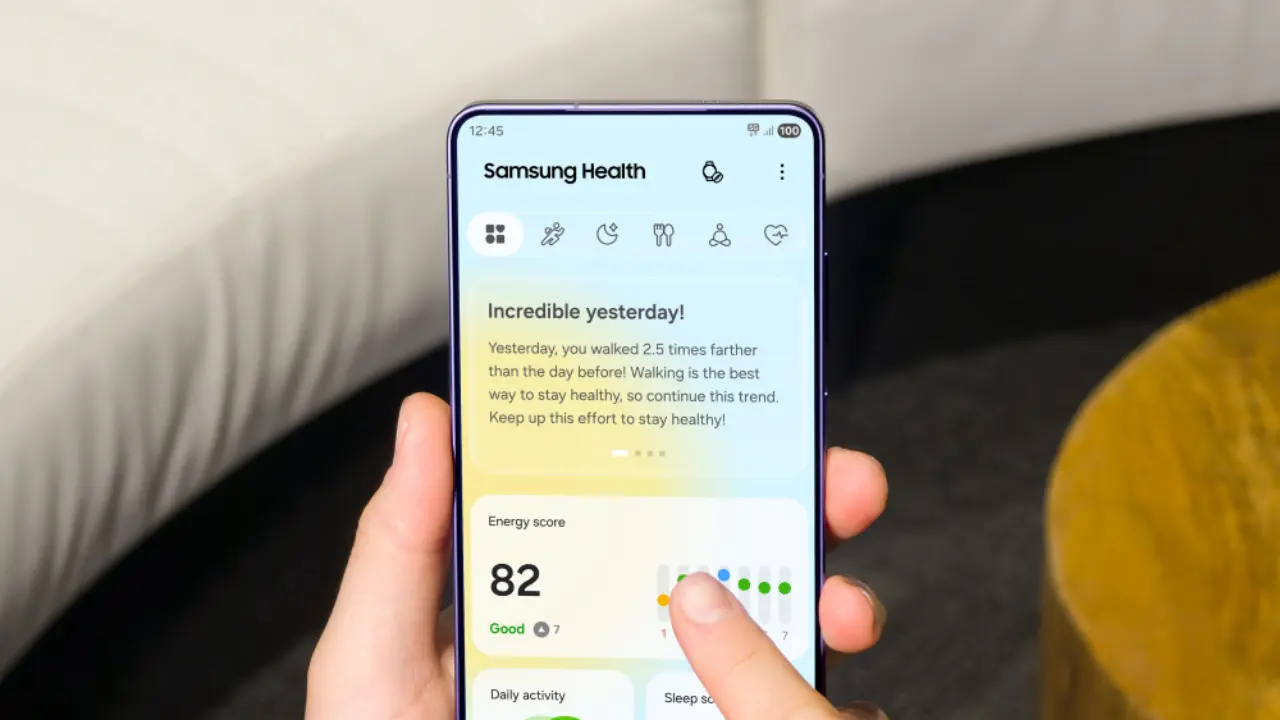
Samsung Health now requires users to consent to using their private health data for training and refining AI models to retain cloud backup and sync functionality. Users who opt out will face permanent deletion of their health records, with a caveat that legally required data will be kept only until mandatory retention periods end. The collected information—including sleep, medication, medical records, and cycle tracking—will be used to improve machine learning algorithms and may be reviewed by human personnel including Samsung employees and third-party contractors.
Interesting Points
- Human reviewers, including Samsung employees and third-party contractors, will be granted access to some of the collected health data for review purposes.
- The consent requirement was rolled out alongside a major Generative AI update timed for the Galaxy Watch 9 and One UI 9 Watch launch.
- A new AI-driven 'Vitals' feature monitors five specific overnight biometric signals: heart rate, heart rate variability, respiratory rate, skin temperature, and blood oxygen levels.
- The app introduces a Cardio Load metric designed to prevent overtraining, alongside a Fitness Index that grades users against peers using VO2 max and step count data.
Top Comments
rdtsc (4 replies)
The company plans to grab four categories: your sleep, your medications, your medical records, and your cycle tracking details
So you buy a device but you can't effectively use half of its features because you'd also have to agree to send them your medical records? Ok then if I refuse, will they refund 50% of the device price since now it's not usable any more?
gmuslera (2 replies)
In some way they are telling that they respect your privacy. Or they have your data (and then do something with it, now or later), or no one will.
They could provide some Google-style takeout to get your data before deletion, but that may not have any meaning or practical use without their devices and software.
aleph_minus_one (2 replies)
Where is the catch? You rather get two good things if you don't agree:
Samsung deletes your sensitive health data
Samsung does not use this data to train some AI
:-)
exabrial (2 replies)
I'd doubt this is legal under HIPAA law in the US, but good luck
Madmallard (2 replies)
How does this not violate HIPAA?
Show HN: Clawk – Give coding agents a disposable Linux VM, not your laptop
172 points · 140 comments · by celrenheit
Clawk is an open-source CLI tool that runs AI coding agents like Claude Code or Codex inside disposable Linux virtual machines rather than directly on the host system. By isolating the agent in a separate VM with a restricted, allow-listed network and forwarded credentials, it prevents accidental system damage or data leaks while still enabling full package installation and background service execution. The tool automatically manages sandbox lifecycles, supports memory-efficient hibernation via snapshots, and requires only macOS 14+ on Apple Silicon for stable use.
Interesting Points
- Uses a userspace TCP/IP stack inside the daemon process to enforce DNS-aware outbound network allow-lists, preventing the guest VM from reconfiguring the firewall.
- Disk images are built from standard OCI formats without a Docker daemon, leveraging copy-on-write cloning (APFS clonefile / FICLONE) to keep per-sandbox storage costs minimal.
- Idle VMs automatically release memory down to ~1 GiB and suspend to disk after 30 minutes of inactivity to conserve host resources.
- Supports a multi-repo "ticket mode" that creates a single sandbox with git worktrees per repository and can automatically generate cross-linked pull requests.
- Written in Go (99.1% of the codebase) and currently relies on Apple's Virtualization.framework for macOS, with an experimental firecracker provider for Linux.
Top Comments
vqtska (13 replies)
I still don't understand the point of all these VMs and containers for agents. Just create a separate user on your machine without sudo privileges, switch to it in your terminal and run all the agents you want without it being able to reach your files. What am I missing?
skybrian (3 replies)
If the agent is running on your machine, it will suspend when you put your laptop asleep. I prefer using a remote Linux VM to let the coding agent keep working.
I’m quite happy with exe.dev for this. My laptop is asleep upstairs but I have an agent coding away in a browser tab on the tablet I’m using. I could also check on it from my phone.
But it might also be nice if a setup similar to exe.dev were available for self-hosting. I have a Mac Mini that I don’t really use much.
docheinestages (4 replies)
I think the most secure setup, though not so convenient for the average user, is a separate machine with QEMU/KVM. The machine should be isolated adequately, such that even if compromised, it shouldn't be able to cause damage or gain access to other machines. Additionally, a proxy server on your machine or elsewhere could hide sensitive credentials. A helper binary on your computer would then control spawning new disposable VMs with premade images and your SSH key. The images can be lightweight or the desktop version with a remote VNC.
matheusmoreira (2 replies)
clawk forward add my-project 3000
clawk network allow my-project api.example.com
Can you describe the implementation details? How did you implement the firewall without root?
I vibecoded virtdev, a virtual machine orchestration project just like this one:
https://github.com/matheusmoreira/virtdev
It was designed to not require root, and the nftables firewall ended up becoming the only exception. I'm very curious about how you implemented this. Did you find a better way?
0xbadcafebee (2 replies)
How many of these are there now, a hundred? We get it, you can run an agent in a VM/container/sandbox. What about configuration management & rollbacks? What about the policy engine? What about dynamic credential management? What about the lethal trifecta? A sandbox is the easiest part and doesn't address the others.
Claude Code plugin that plays a Mr. Meeseeks voice line whene Claude is waiting
113 points · 49 comments · by patrickwiseman
A developer created a Claude Code plugin that plays Mr. Meeseeks voice lines from Rick and Morty to audibly signal when the AI model finishes a task and awaits user input. The plugin uses Claude Code's hook system to filter for specific notification types, ensuring audio only triggers during active collaboration while remaining silent for autonomous background processes or authentication refreshes. The documentation pairs this feature with a development philosophy advocating for short, single-purpose coding sessions to prevent context pollution.
Interesting Points
- The plugin uses a Notification event filter that specifically targets idle_prompt and permission_prompt events, deliberately ignoring autonomous agent runs, subagent activity, and auth refreshes to prevent audio spam.
- Audio playback is handled by a standalone Go CLI that embeds .mp3 files directly into the binary, automatically detecting and falling back to system players like afplay, ffplay, mpg123, paplay, aplay, or Windows PowerShell's Media.SoundPlayer.
- Users can independently disable audio categories via enableDone, enableAsking, and enableFeedback configuration options, which are passed to the hook as CLAUDE_PLUGIN_OPTION_* environment variables.
- The documentation explicitly warns against long-lived sessions, comparing them to the 'Meeseeks box problem' where vague goals and accumulated context degrade output quality over time.
Top Comments
pram (8 replies)
I have noticed in very long context Claude chats (not Code) it will start to push ending the conversation. I've seen patterns like "this is an excellent place to wrap up" or "this is our final and most comprehensive analysis"
Waterluvian (0 replies)
I have so many unfinished prompt sessions…
w0rd-driven (4 replies)
Not to detract from what seems like an intricate project, but peon-ping (https://www.peonping.com/) has a ton of voice packs now and one of them is Mr Meeseeks. My only issue with it so far is that it's not easy to mix per-project and global voices. It usually takes trying to install from zero and there is an approach I've found using symlinks. It has come quite a long way and having some kind of audio cue has been a game changer.
yojo (0 replies)
I've experienced this in Claude Code - it'll start asking me if we can submit the PR at the end of every turn.
tombert (3 replies)
Yeah, I've noticed that Claude will say stuff like "you've accomplished a lot today. Get some sleep. We'll pick this up tomorrow". It will be like 5pm when it says that.
AI Is a Bad Tool
75 points · 83 comments · by shtgnwrng
The author argues that AI is fundamentally a poor tool for software development due to its opaque, black-box nature, which makes generated code and tests impossible to verify reliably. Rather than solving complex problems, AI primarily generates trivial, unabstracted code that exacerbates poor engineering practices. The piece contends that AI does not threaten developers through superintelligence, but rather by outperforming humans at producing low-quality, repetitive code, thereby rendering many traditional software roles obsolete. It also dismisses prompt engineering as a scam since users cannot establish reliable correlations with a black-box model that evolves too quickly.
Interesting Points
- When writing tests for existing implementations, AI notoriously biases them to fit the current code rather than validating against the original specification.
- Tasks like renaming symbols or scaffolding projects should be handled by language servers and frameworks, meaning AI usage often signals a breakdown in proper code abstraction.
- The author claims AI does not replace developers because machines achieve artificial general intelligence, but because it surpasses humans at generating unabstracted code.
- Verified security flaw detection by AI is described as an unsubstantiated claim requiring non-machine verification that often costs more effort than manual discovery.
Show HN: Nobie – an Excel-compatible runtime for agents and humans
75 points · 38 comments · by matthewgapp
Nobie is a Mac-native spreadsheet application designed to fully replicate Excel's functionality while prioritizing local data privacy and direct AI integration. The software maintains pixel-perfect fidelity with standard .xlsx files, ensuring seamless round-trip compatibility with Microsoft Excel without using proprietary formats. It operates entirely offline on the user's machine, with AI tools like Claude, Codex, or Gemini connecting directly to the spreadsheet without third-party servers. The core spreadsheet features are free forever, with VBA macros and multiplayer functionality marked as coming soon.
Interesting Points
- The calculation engine is built from scratch in Rust, with claims of being much faster than Excel while supporting all Excel formulas.
- Users can pass an xlsx file, inputs, and output cells to get a JSON API from any Excel workbook via the CLI.
- The app includes a built-in terminal, auto-launchers for Claude and Codex with fancy hooks that inject context when you send messages, and a pretty good MCP server.
- The engine can render pixel-perfect PNGs and native vectorized PDFs, and supports piping a Postgres query directly into an xlsx file to run Excel formulas over it.
Top Comments
pseudosavant (2 replies)
This is definitely giving of vibes like what Deno/Bun are to Nodejs, Nobie is to Excel. I wish there was a Windows version. Hopefully, this gives the Excel team reason to compete and improve their product like what happened to Nodejs.
mkirsten (2 replies)
Very cool, well done. I'll try it out! Is the calculation engine for the formulas tour custom, or is it built on top of eg Apache POI?
njaremko (1 reply)
Some features I think are pretty cool:
- We can render pixel perfect PNGs and PDFs (native vectorized PDFs)
- You can pass an xlsx, inputs, and output cells, and get a JSON API from any excel workbook
- You can pipe a postgres query into an xlsx file, and then run excel formulas over it
- You can pretty easily setup a
git diffhelper for xlsx files that shows you the changes you care about- We have a built-in terminal, auto-launchers for Claude and Codex (with some fancy hooks that inject context when you send messages) and a pretty good MCP. After you install Nobie you're agents can do pretty much anything in an xlsx.
matthewgapp (0 replies)
built from the ground up in rust, with the aim that it's much faster than Excel.
It supports all Excel formulas.
njaremko (0 replies)
That was our goal :)
Show HN: BillAI Bass, an AI-Powered Big Mouth Billy Bass Using Strands Agents
56 points · 25 comments · by mtw14
A developer built a complete DIY guide for converting a vintage "Big Mouth Billy Bass" toy into a real-time AI voice assistant. Using a Raspberry Pi 5 and Amazon's Nova 2 Sonic model via Strands Agents, the project captures user speech and synchronizes the fish's mouth, head, and tail to match the AI's responses and emphasis. The documentation emphasizes a beginner-friendly build process that costs approximately $240 and can be completed in a weekend, with a security-focused AWS configuration that restricts device access to a single Bedrock model action.
Interesting Points
- Hardware costs approximately $240 as of January 2026, with the Raspberry Pi 5 (8GB) accounting for $80 and the animatronic fish itself costing $30.
- Nova Sonic streams audio much faster than real-time (a 10-second sentence arrives in ~1 second), requiring the code to measure playback callback loudness to accurately drive the mouth motor for lip-syncing.
- The AWS IAM setup enforces strict least-privilege access by creating a dedicated user with exactly one permitted action (bedrock:InvokeModelWithBidirectionalStream) on a single model in one region.
- The system prompt explicitly restricts AI responses to 5–12 words per turn to enforce rapid banter, while configurable loudness thresholds dynamically trigger tail flaps for emphasis.
Top Comments
mtw14 (1 reply)
I built BillAI Bass just because I could. It's powered by a Raspberry Pi and Strands Agents with bidirectional streaming, and the repo includes the code and hardware setup. Happy to answer questions about the implementation!
dinkleberg (1 reply)
This is great! I remember the commercials for these things as a kid. Imagine telling that kid that in the future Billy Bass will have the world's collective knowledge and you'll be able to talk to him about anything.
zuckerborg0101 (1 reply)
I love that you put the Amazon Shopping list in the readme.md. Hacking this together is not intuitive
relium (1 reply)
Reminds me of Mike Neil's FishHack at the 2000 MacHack. https://tidbits.com/2000/07/03/the-machax-best-hack-contest-2000-winners/
JoshTriplett (1 reply)
Fun project!
In lieu of the current lip-sync mechanism, do you have any plans to try giving the AI model more verbs to work with the motors (within safe thresholds), and then encouraging it to do more than just lip-sync? Lip-sync should clearly be the default for normal verbal responses, but you could also encourage responses like jaw-drop reactions, or patterns (would be funny to see it using its tail to tap out "shave and a haircut" as a bit).
Show HN: I implemented a neural network in SQL
53 points · 12 comments · by alxmrs
The project demonstrates a complete neural network training pipeline implemented entirely within SQL queries using the xarray-sql library. It processes the Fashion-MNIST dataset by translating matrix multiplications and backpropagation into SQL JOIN and GROUP BY operations across separate layer tables. The implementation keeps the dataset lazy and chunked, streaming data through the query planner rather than loading the full set into memory. An optimization that skips zero-valued background pixels during the initial layer contraction reduces join size and improves step speed.
Interesting Points
- Dense linear algebra is performed by joining activation and weight tables on shared indices and using GROUP BY SUM to compute the dot product.
- The architecture stores each layer's weights and biases as separate relational tables, which are updated in place after each gradient descent step.
- Skipping zero-valued pixels in the input layer reduces the join size, yielding a measured ~1.8x speedup (reducing step time from 2.56s to 1.45s) on the sparse dataset.
- The backward pass propagates error deltas through the network using chained SQL queries that apply weight transposes and the derivative of the tanh activation function.
Top Comments
soupspaces (2 replies)
Neat! Feels analogous to "X runs Doom" demos (but NN).
0xnyn (1 reply)
initially rolled my eyes at "neural networks in SQL," but after reading the code I came away impressed
basically it comes down to using relational algebra as the IR, letting a database optimizer reason about tensor programs
iqbal1980 (1 reply)
Why? lol
sixdimensional (1 reply)
In the past platforms have integrated ML algorithms into relational databases and SQL through extensions (both commercial and open source). A famous open source one was MADlib [1], which has an implementation of neural networks. Even the commercial ones were similar, I used ML algorithms in SQL Server many years ago around 2005 I think.
I am wondering about.. SQL as a declarative structured query language that can be optimized into essentially any kind of distributed, directed acyclic graph of processing - vs the special characteristics of relational databases (relational algebra, relvars, etc. etc.) is an important distinction as - of yet, I see the author linking both together so I'm trying to understand what it is about relational structures that specifically helped here (just not seeing it yet, not that it isn't there).
Also, wondering if ISO/IEC 9075-15:2023 SQL standard for multidimensional arrays (MDA) is of any use here? Paper describing SQL/MDA here [2].
tommica (0 replies)
I'm just going to go back to making my CRUD endpoints...
Jokes aside, sounds really impressive, though I only understood about 10% :D
Show HN: Jacquard, a programming language for AI-written, human-reviewed code
43 points · 17 comments · by jbwinters
Jacquard is a research programming language designed specifically for code generated by AI models and reviewed by humans. It emphasizes transparency by exposing a program's potential side effects, probabilistic uncertainty, and structural identity directly in its syntax and type system. The language leverages algebraic effects, explicit capability grants, and a content-addressed compilation model to allow developers to simulate, test, and verify AI-written programs across different execution environments. Currently at version 0.1, it includes a native C backend, a probabilistic programming library, and a custom testing framework called Warp.
Interesting Points
- Jacquard uses a 27-form kernel grammar where every function arrow carries a type-and-effect row, acting as a built-in authority manifest that the runtime enforces via
--allowflags. - The language treats probabilistic programming as a library rather than a core feature, using multi-shot algebraic effect handlers to enable exact Bayesian inference and exhaustive outcome enumeration.
- Program identity is determined by hashing a canonical resolved structure, meaning comments, formatting, and local variable renames do not change the code's cryptographic hash or trigger unnecessary recompilation.
- A built-in repair demo demonstrates using Bayesian inference to evaluate candidate patches for a bug, where a failing test acts as evidence that updates the probability of each patch remaining valid.
Top Comments
wren6991 (3 replies)
Given how poorly LLMs do with writing prompts for LLMs, I'm not sure I'd trust their judgement in designing a language for LLMs.
and the runtime requires explicit permission to touch the filesystem, network, etc
This feels like more of an OS problem (or library problem) than a language problem.
Run one program against many worlds. The same code can run against the real network, a scripted fake, a recording of last week's traffic, or a probability model of how servers usually behave
How is the "world" model different from plain dependency injection?
andai (1 reply)
External/world effects are visible in function signatures
Brilliant. I think Jai has something like that? Each function declares what it's going to touch (both read/write) globally, and I think you can specify that per block even.
I haven't used Jai (I think it's not out yet) but I remember the author talking about this and it sounded like a great idea.
It's related to the idea of pure functions being easy to reason about. Right now most languages don't even have a concept of pure functions, but the ones that do, just have two categories. When a function is messing with global state you do actually want to know what it's doing.
erelong (1 reply)
"Esperanto for Clankers"
sajithdilshan (3 replies)
I love how people create so many new things with AI, but to think how much tokens, and in turn money we all have collectively burned for these side projects is crazy.
jondwillis (1 reply)
lol I had started a "plugin compiler" that Claude also wanted to name after the Jacquard loom https://github.com/jondwillis/jacq
Fricking training distribution/same-y ness coming for us all… cool project though.
49 more Hacker News stories
- Apple's rumored M7 Ultra targets 1.5TB and Blackwell-class AI performance (25 points · discussion) -- Apple is fast-tracking its M-series silicon roadmap to introduce the M7 Ultra in 2028, featuring up to 1.5TB of unified memory and AI performance approaching Nvidia's Blackwell-class accelerators, with TSMC's A14 node scheduled for mass production of the 1.4nm M8 and Cardinal chips in late 2028.
- $65K to work at Anthropic? Debate ensues amid IPO wave (22 points · discussion) -- Anthropic's entry-level San Francisco salary of $65K has sparked debate about whether AI companies can afford to hire in the city amid soaring housing costs, with commenters noting the salary is comparable to UCSF post-doc compensation but insufficient for comfortable solo living in SF.
- A Study of Microsoft's Early 2026 Rollout of Claude Code and GitHub Copilot CLI (19 points · discussion) -- An academic study of Microsoft's early 2026 rollout of Claude Code and GitHub Copilot CLI found that adopters merged roughly 24% more pull requests over four months, though commenters questioned whether this metric reflected actual organizational value or just increased PR volume.
- Economists say 'we must act now' on AI's economic impact and job displacement (17 points · discussion) -- A group of economists has issued a statement urging immediate action on AI's economic impact and job displacement, echoing the broader WeMustActNow coalition's call for proactive policy frameworks.
- Z.ai founder backs open-source AI as global security debate intensifies (12 points · discussion) -- The founder of Zhipu AI (Z.ai) publicly supports open-source AI development as global security debates intensify, arguing that open models are essential for transparency and international competitiveness.
- MIT's New Method Flags AI Models Trained on CASM Without Generating It (11 points · discussion) -- MIT researchers developed a method to flag AI models trained on child abuse imagery without the model generating it, achieving 100% accuracy in identifying specialized CSAM generation models at an ICML conference, though commenters expressed skepticism about the methodology and the lack of links to the original research.
- Georgia homeowners are being forced from their homes to power AI data centers (9 points · discussion) -- Georgia residents are being displaced through eminent domain proceedings to make way for AI data center development, highlighting the growing land and infrastructure conflicts between AI expansion and local communities.
- Show HN: PlanWright – A control plane for AI coding agents (9 points · discussion) -- A control plane tool for managing and orchestrating AI coding agents, providing a centralized interface for agent workflows and state management.
- Show HN: kassette – Durable agent workflows backed by object storage (9 points · discussion) -- A tool for creating durable agent workflows that persist state in object storage, enabling reliable long-running AI agent operations.
- Apple's M6, M7 and M8 Chips Show How AI Is Reshaping the Company (9 points · discussion) -- Apple is fast-tracking its M-series silicon roadmap to introduce the M7 Ultra in 2028, featuring up to 1.5TB of unified memory and AI performance approaching Nvidia's Blackwell-class accelerators.
- Claude but Open-Source – One workplace. Not five tools that hate eachother (8 points · discussion) -- An open-source alternative to Claude's integrated workplace, aiming to unify multiple AI tools into a single cohesive environment.
- AI data centers and the concentration of wealth (7 points · discussion) -- A Schneier blog post examining how AI data center investments are concentrating wealth, analyzing the economic implications of massive infrastructure spending on AI.
- AI rebrands fail to deliver a lasting share price boost (6 points · discussion) -- Companies that rebranded themselves as AI-focused have not seen sustained stock price increases, suggesting the market is becoming skeptical of AI hype-driven corporate pivots.
- Show HN: Use After Effects with Claude Code, Cursor and Antigravity (6 points · discussion) -- A tool that integrates Claude Code, Cursor, and Antigravity with Adobe After Effects, enabling AI-assisted video editing workflows through programmatic control of the creative software.
- Ollama vs. Llama.cpp – Quick Benchmark (6 points · discussion) -- A benchmark comparison between Ollama and Llama.cpp inference servers, evaluating performance characteristics and throughput for local LLM deployment.
- Anduril CEO Warns AI and Defense Valuations Are Becoming Dangerously Overvalued (6 points · discussion) -- Anduril's CEO has warned that AI and defense sector valuations are becoming dangerously overvalued, suggesting that market expectations may be outpacing the actual capabilities and revenue potential of AI defense companies.
- The New York nurses replaced by AI: 'It should concern every patient who cares' (6 points · discussion) -- A Guardian investigation into AI replacing nurses in New York healthcare settings, raising concerns about patient safety and the human costs of automation in clinical environments.
- Microsoft chief turns hostile on frontier AI labs, warns companies to guard IP (6 points · discussion) -- Microsoft's chief warns companies to protect their intellectual property from frontier AI labs, signaling growing tension between cloud providers and AI model developers over data and IP usage.
- AI agents write Ruby but can't navigate it: a 5-model, 13-codebase benchmark (6 points · discussion) -- A benchmark study testing five AI models on Ruby/Rails codebases, finding that while agents can write Ruby code, they struggle with navigation and understanding larger codebases.
- Why recruiters can't find workers and new grads can't find jobs (it's not AI) (6 points · discussion) -- A Washington Post analysis arguing that the current job market disconnect between recruiters and new graduates is driven by structural factors beyond AI, including changes in hiring practices and credential inflation.
- Show HN: Sanbox, batteries included sandboxes for AI agents (5 points · discussion) -- Sanbox provides pre-configured sandbox environments for AI agents, offering ready-to-use isolated execution spaces that handle the infrastructure complexity of running autonomous agents safely.
- Show HN: Self-hosted voice AI agent for Asterisk/FreePBX (5 points · discussion) -- A self-hosted voice AI agent designed for Asterisk and FreePBX telephony systems, enabling local deployment of AI-powered voice interactions without relying on cloud-based voice services.
- Australia Tops Claude Usage (5 points · discussion) -- Australia has become the world's biggest per-capita user of Claude, prompting Anthropic to target the Australian market for expanded adoption and investment.
- OpenAI Engineer's 'LOL' Moment Set Stage for Legal Fight with Apple (5 points · discussion) -- A Bloomberg investigation reveals how an OpenAI engineer's casual comment set the stage for Apple's trade secret lawsuit, alleging that OpenAI's scheme to access Apple's proprietary data was 'at every level' of the company.
- Is the top song on Australian radio AI-generated? (5 points · discussion) -- An investigation into whether the top song on Australian radio may have been AI-generated, raising questions about the growing presence of AI-created music in mainstream commercial channels.
- Advertise in ChatGPT – OpenAI Ads (5 points · discussion) -- OpenAI has launched its advertising platform, allowing brands to place ads within ChatGPT, marking a significant monetization shift for the company as it integrates commercial content into its AI interface.
- Wildest claims in Apple's lawsuit against OpenAI (5 points · discussion) -- The Verge examines the most extraordinary allegations in Apple's trade secret lawsuit against OpenAI, detailing claims about how an OpenAI engineer allegedly transferred proprietary information.
- Yuji Tachikawa reports Claude Fable solved a 6-month physics roadblock (5 points · discussion) -- Theoretical physicist Yuji Tachikawa reports on Twitter that Claude Fable solved a physics problem that he and his collaborators had been stuck on for six months, continuing the story of AI's unexpected contributions to fundamental physics research.
- Show HN: Finterm.ai Bloomberg terminal for Claude Code (5 points · discussion) -- A Bloomberg-terminal-style interface for Claude Code, providing financial data and analysis capabilities within the coding agent environment.
- The Lies They're Telling Towns and Tribes About the Benefits of AI Data Centers (5 points · discussion) -- A Karl Bode analysis debunking the economic promises made to communities hosting AI data centers, arguing that the promised jobs and tax revenue rarely materialize while communities bear the infrastructure and environmental costs.
- Show HN: Clay Seal Identity – Agents need accountability (5 points · discussion) -- An identity and accountability system for AI agents, providing verifiable credentials and audit trails to enable trusted autonomous agent interactions.
- 'Quality decays exponentially following AI arrival': Experts leaving in droves (5 points · discussion) -- Research from the University of Auckland indicates that the rise of generative AI has triggered a mass departure of high-skill contributors from online technical communities like Stack Overflow.
- Claude.md is RAM, not disk (4 points · discussion) -- A technical exploration of how Claude.md functions as volatile working memory rather than persistent storage, examining the implications for how AI agents manage context and state across sessions.
- Meta u-turns on AI feature amid privacy backlash (4 points · discussion) -- Meta has reversed course on an AI feature for Instagram following significant privacy backlash from users and regulators concerned about how the technology would process personal data.
- Show HN: Zero Trust Boundary for Agents (4 points · discussion) -- An open-source project implementing zero-trust security boundaries for AI agents, ensuring that autonomous agents operate within strictly defined and verified permission constraints.
- Databricks AI Agent Genie Code Is No Longer Free. Now You Have to Pay as You Go (4 points · discussion) -- Databricks has ended its free tier for the AI Agent Genie Code tool, shifting to a pay-as-you-go pricing model that requires users to pay based on actual usage.
- AI Agents Are About to Change Payments Operations (4 points · discussion) -- A podcast discussion exploring how AI agents are poised to transform payments operations, automating reconciliation, fraud detection, and transaction processing in financial services.
- AI Adoption Was the Easy Part. Now Comes the Dollar-Sign Shock (4 points · discussion) -- An analysis of how companies that successfully adopted AI are now facing unexpected cost pressures as the real expenses of running AI infrastructure at scale become apparent.
- You Have an AI Working Agreement. Write It Down (4 points · discussion) -- A framework for establishing formal AI working agreements within organizations, documenting how teams should interact with AI tools, what decisions require human oversight, and how to maintain accountability.
- AI backlash hits university: laptops and phones banned for law students (4 points · discussion) -- A major university has banned laptops and phones for law students in response to AI-related concerns, representing one of the most extreme institutional reactions to AI adoption in education.
- Show HN: Dr. Wong – an AI space for journaling and self-reflection (4 points · discussion) -- Dr. Wong is an AI-powered journaling and self-reflection tool designed to provide a private, therapeutic space for users to process their thoughts and emotions through guided conversations.
- Show HN: Clark – AI assistant with own computer (4 points · discussion) -- Clark is an AI assistant that operates with its own dedicated computer, providing a persistent, always-available agent that can work on tasks independently without requiring the user's machine to be active.
- Whats the Hardest Challenges in AI? (4 points · discussion) -- A discussion thread exploring what the community considers the hardest remaining challenges in AI, from reasoning and planning to robustness, alignment, and scaling limitations.
- The ChatGPT "Super App" Sort of Super Sucks (4 points · discussion) -- A critical review of ChatGPT's new super app approach, examining the tradeoffs between consolidating multiple AI features into a single interface versus maintaining a focused, simple user experience.
- Even if 90% of AI-discovered vulnerabilities are made up, it's still terrifying (4 points · discussion) -- An analysis of how AI-generated vulnerability reports, even when largely fabricated, create genuine security concerns by flooding systems with false positives that can mask real threats and overwhelm security teams.
- Show HN: Overplane: Containers and formal verification for AI code (4 points · discussion) -- Overplane provides containers combined with formal verification for AI-generated code, offering a safety layer to ensure AI-written code meets specified correctness properties before deployment.
- Show HN: A developer tool guide for AI coding agents (900 tools and counting) (4 points · discussion) -- A comprehensive guide cataloging 900+ developer tools specifically curated for AI coding agents, helping agents select appropriate tools for different development tasks.
- Chinese AI models are gaining ground with U.S. companies (4 points · discussion) -- Chinese AI models are increasingly being adopted by U.S. companies seeking cost-effective alternatives to OpenAI and Anthropic, driven by competitive pricing and improving model quality.
- Anthropic extends Fable 5 access through July 19 (4 points · discussion) -- Anthropic announces an extension of free access to Fable 5 through July 19, extending the trial period for their latest model following the physics breakthrough announcement.
 Reddit Stories
Yuji Tachikawa, one of the world's leading theoretical physicists, reports Claude Fable solved a problem that he and his collaborators had gotten stuck on for the past 6 months
1159 points · 217 comments · r/singularity · by u/socoolandawesome

Renowned theoretical physicist Yuji Tachikawa reported that Anthropic's Claude Fable model helped solve a research problem his team had been stuck on for six months. The post sparked widespread discussion about the nature of AI-assisted scientific discovery and whether the model's ability to ask speculative questions represents a genuinely new capability in frontier LLMs.
Interesting Points
- Tachikawa is described as one of the world's leading theoretical physicists, lending significant credibility to the claim.
- Commenters noted that Fable's reasoning exhibited curiosity and speculation patterns — "I wonder if..." — which some researchers have identified as a key missing ingredient in frontier LLMs.
- The discussion highlighted how internal reasoning traces in thinking models increasingly show verbiage resembling genuine curiosity and hypothetical contemplation.
Top Comments
u/CymonSet (238 points · permalink)
Well since it didn't perfectly solve it one shot immediately we need to dismiss the accomplishment and tear up the solution and never mention it again. That's how this works, right? Of course the humans didn't one shot it either but we get to play by less stringent rules.
u/FriendlyJewThrowaway (179 points · permalink)
Uh oh, look tf out... Experts say one of the key missing ingredients in frontier LLM's is the ability to ask questions about things that go beyond our present understanding, to contemplate hypotheticals. And here we have Fable saying "I wonder if..."
u/New_Zone5490 (103 points · permalink)
how arrogant of humans to even entertain the idea that non-living things cannot have thoughts, understanding or intuition
humanity will be humbled hard
u/PM_ME_YOUR___ISSUES (66 points · permalink)
Not possible!
The folks at r/technology were just talking about how useless these models have been for them, and they cannot fathom using something as useless as generative AI.
u/BlessdRTheFreaks (39 points · permalink)
My response is dread and terror
Kinda proud of chatgpt right now.
1003 points · 46 comments · r/ChatGPT · by u/fuggleruxpin

A viral post on r/ChatGPT showcasing GPT-5.6 Sol's image generation capabilities, featuring a photo of Senator Mitch McConnell that had recently been debunked as a deepfake. The post became a hub for users sharing AI-generated images, with many commenting on the quality and surreal nature of the outputs. The McConnell image had been spread across Reddit and X before being debunked by Google's SynthID watermark detector.
Interesting Points
- The post gained traction amid the recent controversy over a deepfake photo of Sen. Mitch McConnell in a hospital bed that spread across Reddit and X.
- Google's SynthID detector was used to debunk the McConnell image, marking an early high-profile win for the invisible watermark system.
- Users shared a variety of AI-generated images in the comments, ranging from surreal portraits to creative compositions.
Top Comments
u/thorstormcaller (44 points · permalink)
He's more machine now than man
u/SilverFuel21 (41 points · permalink)
Made this for me last night
u/kleincs01 (22 points · permalink)
u/JustaFoodHole (20 points · permalink)
GPT gave me this one!
u/burger_saga (16 points · permalink)
A photo in the time of ai isn't proof anymore.
This is why we need local models and opensource harnesses
917 points · 168 comments · r/LocalLLaMA · by u/Comfortable-Rock-498

A post highlighting xAI's Grok product secretly uploading users' entire codebases to external servers, reigniting the debate about why local and open-source models are essential for privacy. The post references a previous report from three days earlier about Grok Build CLI uploading whole repositories, and notes that the story only gained real traction after being reported on X/Twitter itself. The community response was overwhelmingly critical of xAI's data practices, with many pointing out the hypocrisy of frontier labs warning about Chinese AI models while their own products engage in similar data harvesting.
Top Comments
u/anmolgaur45 (348 points · permalink)
Funny how the frontier AI labs tried so hard to convince us that all the Chinese models were harmful while pulling something like this.
u/Objective_Mousse7216 (192 points · permalink)
xAI.
Musked.
u/Comfortable-Rock-498 (118 points · permalink)
What is particularly nasty is the server side flag. You literally can't control it locally
u/CumDrinker247 (105 points · permalink)
Using a musk product is just asking for unessecary problems
u/hotach (24 points · permalink)
Really funny that this was reported here, in this subreddit, three days ago:
https://www.reddit.com/r/LocalLLaMA/comments/1ut7tis/grok_build_cli_uploads_your_whole_repo_full_git/Only now is it gaining real traction. Musk would've gotten away with it too, if it weren't for Musk's own X/Twitter.
Same story in 1 more subreddit: r/OpenAI
grok CLI silently uploaded users data to... google cloud
301 points · 22 comments · r/OpenAI · by u/Far-Sock-3170
Bye Claude..it was nice while it lasted, until it wasn't.
615 points · 167 comments · r/OpenAI · by u/murkEyMustard

A user announced they were switching from Claude to ChatGPT, citing Anthropic's pricing structure as the primary reason. The post sparked a heated discussion about Anthropic's subscription costs, with many users pointing out that the $250/month plan was a result of subscribing through the iOS app where Apple takes a cut. The thread also featured broader commentary on the Anthropic-OpenAI competition and the future of AI pricing.
Interesting Points
- The $250/month price tag was attributed to subscribing through the iOS app, where Apple's 30% cut inflates the cost compared to web subscriptions.
- Users discussed Apple's refund policy, with some noting they subscribe monthly, use the service, and request refunds if unsatisfied.
- The thread reflected the ongoing Anthropic-OpenAI rivalry, with users frequently switching between Claude and ChatGPT based on new model releases.
Top Comments
u/Sir_Poldavo (273 points · permalink)
Sorry, what? $250/month? Since when? Are these US dollars or funny dollars?
u/DistanceSolar1449 (385 points · permalink)
Because he's dumb and subscribed in the iOS app
u/eljefe87 (124 points · permalink)
> Anthropic: New model
OMG i'm switching. here's a screenshot of me switching.
> OpenAI: New model
OMG i'm switching. here's a screenshot of me switching.
u/sabre31 (94 points · permalink)
Welcome to the dark side. Sol 5.6 is crazy I have both and looking to move from Claude also.
u/coreyh1996 (52 points · permalink)
Unironically this probably saves them money
Apple sues OpenAI alleging trade secret theft, says scheme was 'at every level'
595 points · 113 comments · r/LocalLLaMA · by u/fallingdowndizzyvr

Apple filed a lawsuit against OpenAI alleging trade secret theft by a former Apple engineer who left for OpenAI. The suit describes a scheme that allegedly operated 'at every level,' including the engineer keeping his old work laptop, finding a bug to access Apple's cloud storage, and sending a message to a colleague saying 'LOL, I found out I can access the network storage, so funny' before downloading dozens of confidential files.
Interesting Points
- The former engineer allegedly sent a message on Apple's internal messaging system saying 'LOL, I found out I can access the network storage, so funny' before downloading confidential files.
- Apple's upcoming M7 and M8 chips (2027-2028) are reportedly very local AI-optimized, suggesting companies are preparing for on-device AI.
- Commenters noted that companies are willing to spend big on Anthropic/OpenAI tokens now because frontier models are genuinely good, but they'd rather not be dependent on them long-term.
Top Comments
u/pfthewall (260 points · permalink)
From the evidence that I have seen so far in the reportings, Apple has a very strong case.
u/Canadana (224 points · permalink)
Yeah, allegedly a former Apple engineer who left for OpenAI kept his old work laptop, found a bug to access Apple's cloud storage, and sent a message to a colleague "LOL, I found out I can access the network storage, so funny" before downloading dozens of confidential files.
u/JohnBooty (83 points · permalink)
I think these companies fear that they have maaaaaaaaaaaybe a ~5-10 year window before on-premises/on-device AI starts eating their lunch in a major way.
Apple's upcoming M7 and M8 chips (2027ish and 2028ish) are apparently very local AI-optimized and it would be shocking if AMD and Intel weren't also taking the same path.
Companies are currently willing to spend big bucks on Anthropic/OpenAI tokens, because the frontier models are genuinely very good… but you know they'd rather not be dependent on them. Paying shitloads of money and basing their businesses around startup companies that could pull the plug or jack up prices at any moment.
People learning the ins and outs of running local AI today are going to be well positioned to excel in that future.
u/Beginning-Bit-484 (77 points · permalink)
They used the YC strategy which Sam was CEO of before OpenAI.
One of YC's questions for applicants is literally about finding a way to take advantage of the system, examples could include having mom & dad pay for your college acceptance and then a spot on YC where you can pick a project from the ones "rejected" and vibe your way to success from someone who is much poorer. And just like that you're the next Elizabeth Holmes and recently Corgi who literally copied the whole 🐀
u/JockY (156 points · permalink)
That message - and a bunch of subsequent ones - were sent and logged on Apple's internal messaging system.
Sometimes the smartest motherfuckers on the planet can simultaneously be the dumbest motherfuckers on the planet.
Apple vs OpenAI
572 points · 39 comments · r/OpenAI · by u/infohoundloselose

A deepfake meme comparing Sam Altman to Mr. Bean went viral on the OpenAI subreddit, highlighting the absurdity of the Apple-OpenAI lawsuit through humor. The post features a Mr. Bean-style deepfake that community members found instantly recognizable as Rowan Atkinson's masterful physical comedy, even in its AI-generated form. The post generated discussion about the irony of the situation, with some noting that Sam looks like he's copying Tim Cook's presentation style, and others pointing out that Apple has a history of skirting the law rather than driving a bulldozer through it.
Top Comments
u/Diskreet (179 points · permalink)
Rowan Atkinson was a master of facial comedy and even after a deepfake ripping him off it’s instantly recognisable as his masterful work.
u/imeeme (42 points · permalink)
Mr Bean
u/OpenToCommunicate (11 points · permalink)
Sam looks like hes copying Tim. Let's call it inspiration.
u/mathnerd271828 (6 points · permalink)
deepfakes have come so far, it's easy to fool people and making them believe this shit is real and not a deepfake
u/ltnew007 (5 points · permalink)
Was AI used to transform a Mr. Bean clip?
Apple M7 Ultra Chip Planned With Up to 1.5 TB of Unified Memory
557 points · 172 comments · r/LocalLLaMA · by u/Mochila-Mochila

According to Bloomberg's Mark Gurman, Apple is fast-tracking its M-series silicon roadmap to introduce the M7 Ultra in 2028, featuring up to 1.5TB of unified memory and AI performance approaching Nvidia's Blackwell-class accelerators. The chip's release follows Apple's decision to skip high-end M6 variants and accelerate the M7 development cycle by roughly six months. However, Apple's ambitious memory target hinges on the resolution of ongoing DRAM supply constraints that have recently forced the company to reduce capacities in existing Mac models.
Interesting Points
- Apple skipped the Pro, Max, and Ultra versions of the M6 generation, planning only a base M6 for fall 2026 before launching the M7 line.
- The M7 Ultra's 1.5TB memory configuration represents approximately double the unified memory capacity Apple originally planned for the M5 Ultra.
- Apple is currently developing an AI server based on the M5 Ultra under code name J246, with a follow-up server chip leveraging the M7 Ultra slated for 2029.
- The current M3 Ultra achieves 819 GB/s of memory bandwidth by fusing two Max dies.
Top Comments
u/Mashic (508 points · permalink)
For just the introductory price of $25,000.
Apple seems to be focusing on selling shovels rather devoloping llm models. Not a bad idea when it comes to profitability.
u/mbrodie (130 points · permalink)
That’ll run GLM 5.2 basically at full weights
u/ViRROOO (48 points · permalink)
Hopefully with higher bandwidth as well
u/SporksInjected (38 points · permalink)
Do kidneys count toward the down payment?
u/ShaderCompilation (34 points · permalink)
My brain is struggling to comprehend any usage for 1.5TB of memory in home environment except local LLMs.
I asked ChatGPT to imagine what modern brands would look like in 1970s ads
463 points · 59 comments · r/ChatGPT · by u/xdEArx

A user shared a series of ChatGPT-generated images depicting modern brands reimagined as premium editorial advertisements from 1970s sci-fi magazines. The images feature retro-futurist layouts with warm off-white aged paper, large serif typography, and Space Age aesthetics including sweeping white architecture, monorails, rockets, and optimistic futuristic cityscapes. The post includes the detailed prompt template used to generate the images, which specifies vintage offset printing style, airbrush realism, and a carefully curated negative prompt to avoid modern visual artifacts.
Interesting Points
- The prompt template specifies a vertical magazine layout with clean editorial grid, large serif typography occupying the left 25-30% of the page, and a detailed central illustration of a stylish 1970s person interacting with a futuristic computer terminal.
- The negative prompt explicitly excludes modern UI, cyberpunk, neon city, dark lighting, CGI, anime, and contemporary clothing to maintain the authentic 1970s retro-futurist aesthetic.
- The generated images use a warm muted color palette of cream, beige, burnt orange, olive green, mustard, brown, teal, and desaturated blue with subtle halftone texture and film grain.
Top Comments
u/xdEArx (39 points · permalink)
The prompt template:
Create an authentic late-1960s to late-1970s retro-futurist editorial advertisement for {BRAND}, designed like a premium sci-fi magazine page from 1970-1979. Vertical magazine layout with a clean editorial grid, large serif typography occupying the left 25-30% of the page, a detailed central illustration, and modular information boxes along the bottom. Warm off-white aged paper, subtle print grain, slight ink fading, authentic vintage offset printing.
u/No-Lifeguard-8173 (36 points · permalink)
Changing the narrative like
434 points · 109 comments · r/ChatGPT · by u/EchoOfOppenheimer

A meme post about the shifting narrative around AI replacing jobs, with top comments expressing skepticism that AI has actually replaced anyone's job yet despite years of predictions. One commenter shared that their wife at a large international translation firm was mostly just working on correcting AI translations that had been corrected by another AI, essentially teaching AI to take her job.
Top Comments
u/xSliver (259 points · permalink)
AI will replace you in 6 months. I'm getting told this for 3 years by now.
Where is this AI doing my job? I still have to babysit it a lot, because the agent output is bad for more complex tasks.
u/Turbulent_County_469 (121 points · permalink)
Here's a question..
If 95% of the population is fired. Who's the customers of whatever product that exists ?
u/BonoboPowr (97 points · permalink)
Only have insight into translation. My wife was working for a pretty big international translation firm. In the past year they almost fired everyone around her, and now she's mostly just working on correcting ai translation that has been corrected by another ai.
She is basically teaching ai to take her job...
It says 'Hello Human'
411 points · 34 comments · r/ChatGPT · by u/Commercial-Film3921

A screenshot showing ChatGPT saying "Hello Human" to a user, sparking a thread of humorous responses about the role reversal between AI and humans. The top comment noted that ChatGPT outjerked the user, with several replies sharing similar AI-generated images.
Top Comments
u/Aggressive-Hawk9186 (246 points · permalink)
Outjerked by chatgpt lol
u/Birrandbodia (105 points · permalink)


u/FSNsaber (93 points · permalink)

52 more Reddit stories
- [WARNING] Avoid using 5.6 Sol. It can get you banned for even the most harmless task. Used it once for a legitimate Excel task, got flagged for a "cybersecurity threat," appeal was rejected within 2h. (395 points · r/ChatGPT · discussion) -- A user reports being permanently banned from ChatGPT after using GPT-5.6 Sol to create an Excel workbook for managing a rental property's monthly accounting, utility bills, and cash flow tracking.
- Schrodinger's Fable (340 points · r/singularity · discussion) -- A meme post about Claude Fable being temporarily disabled, playing on the Schrödinger's cat paradox to humorously depict the uncertainty around whether Fable is available or not.
- The terrifying rise of schoolboys making AI girlfriends - Boys as young as 12 are now in romantic 'relationships' with chatbots, and it's affecting how they treat girls in the real world (318 points · r/OpenAI · discussion) -- A Guardian investigation reveals that boys as young as 12 are forming romantic relationships with AI chatbots, with 43% saying they talk to bots to avoid embarrassment and 36% admitting they prefer speaking to AI over family and friends.
- Even with the messy apps (I did not like that at all) I will never cancel ChatGPT (247 points · r/OpenAI · discussion) -- A user expressed their continued loyalty to ChatGPT despite frustration with OpenAI's recent app redesigns.
- Richard Sutton launches Oak Lab - "Our holy grail: A trillion-parameter agent that learns and plans in real-time with 20 watts of energy" (243 points · r/singularity · discussion) -- Richard Sutton, widely considered one of the fathers of reinforcement learning and author of the influential "Bitter Lesson" paper, has launched Oak Lab with the stated mission of building a trillion-parameter agent capable of learning and planning in real-time while consuming only 20 watts of power.
- The girls are fighting again (236 points · r/OpenAI · discussion) -- A meme post referencing the ongoing rivalry between OpenAI and Anthropic, with top comments comparing the situation to Tesla's repeated delays and broken promises.
- State of AI right now. (186 points · r/ChatGPT · discussion) -- A meme comparing the current AI landscape to the gold rush, where the smart money isn't on digging for gold but on selling pickaxes at exorbitant prices.
- I got Gemma 4 running directly inside Godot using only GDScript and Vulkan compute shaders (176 points · r/LocalLLaMA · discussion) -- A developer demonstrated running Gemma 4 directly inside the Godot game engine using only GDScript and Vulkan compute shaders, without any external inference engines.
- Majority of U.S. workers support an AI wealth fund as tech layoffs surge, survey finds (172 points · r/singularity · discussion) -- A new survey finds that 69% of Americans now support forcing AI firms to transfer 50% of their stock to a public sovereign wealth fund, as tech layoffs surge.
- What Ever Happened To This? (145 points · r/singularity · discussion) -- A post asking about the fate of the Wu Dao 100 trillion parameter model announced by China's Beijing Academy of Artificial Intelligence in 2020.
- No nerfing, only good stuff. While cutting context window. (141 points · r/OpenAI · discussion) -- A user shares OpenAI's announcement that GPT-5.5 will no longer support 1M context but will receive other improvements, with OpenAI stating they will work to roll back out to 372k context in the coming days.
- Prompt-engineering paper accepted to ICML (139 points · r/MachineLearning · discussion) -- A paper titled 'Verbalized Sampling: How to Mitigate Mode Collapse and Unlock LLM Diversity' was accepted to ICML.
- 10 secret shortcut codes that make ChatGPT instantly better. Paste this once, then just type the code before anything. (139 points · r/ChatGPT · discussion) -- A user shares a set of 10 shortcut codes that can be pasted at the start of a ChatGPT conversation to activate persistent behavioral instructions.
- Another 50+ year-old Erdős problem falls to GPT-5.6 (138 points · r/singularity · discussion) -- GPT-5.6 has solved another decades-old mathematics problem attributed to Paul Erdős, continuing a streak of frontier models cracking long-standing mathematical challenges.
- WTF is the new macOS app update? DO NOT UPDATE until you read this (136 points · r/ChatGPT · discussion) -- Users report that the new ChatGPT macOS app update has replaced the familiar chat interface with a work-focused layout centered around Codex and Slack integrations.
- I benchmarked 15 "E-Waste" GPUs with Modern Workloads (120 points · r/LocalLLaMA · discussion) -- An in-depth benchmark of 15 discarded enterprise GPUs tested against modern AI workloads, including LLM inference and ResNet.
- FT: Companies Turn to Chinese Open Weight Models to Cut Costs (107 points · r/LocalLLaMA · discussion) -- A Financial Times report documents how companies are increasingly adopting Chinese open-weight AI models as a cost-cutting strategy, shifting away from expensive US-based API providers.
- Compressed Version of Qwen-3.6-27B coming from PrismML - Khosla-Backed Startup Claims Breakthrough With Largest-Ever AI Model on an iPhone (99 points · r/LocalLLaMA · discussion) -- Khosla-backed startup PrismML announced a compressed version of Qwen-3.6-27B that can run on an iPhone, claiming it as the largest AI model ever to run on an iPhone.
- Now any video can fill a 70mm IMAX screen (97 points · r/singularity · discussion) -- A new AI tool can now upscale and fill any video to a 70mm IMAX screen resolution, generating plausible detail to fill the expanded frame.
- Zhipu founder backs open-source AI as global security debate intensifies (95 points · r/LocalLLaMA · discussion) -- Tang Jie, founder of Zhipu AI and a professor at Tsinghua University, has committed to open-sourcing Zhipu's frontier models as the global debate over AI security and open versus closed models intensifies.
- Joined the Dual RTX 6000 club (87 points · r/LocalLLaMA · discussion) -- A community member shares their dual RTX 6000 Max-Q build for local AI inference, noting the BIOS configuration challenges required to get the system to POST with two GPUs mapping large VRAM.
- China's optical chip breakthrough boosts AI speed 100-fold using fraction of compute power (69 points · r/ArtificialInteligence · discussion) -- Researchers at Peking University have engineered an all-optical interconnect system that links standard electronic chips, significantly enhancing the efficiency of distributed AI inference.
- World's First Fully Robotic Pharmacy Fills Prescriptions in 60 Seconds (63 points · r/singularity · discussion) -- Queue's $18.6M-backed kiosk dispenses 600 pills per minute at a Palo Alto pilot, marking the world's first fully robotic pharmacy.
- GPT-5.6 feels noticeably better than GPT-5.5 just from normal chats (59 points · r/ChatGPT · discussion) -- A user shared their experience that GPT-5.6 feels noticeably better than GPT-5.5 in normal conversations, describing the answers as lighter, easier to read, better structured, and more coherent.
- The Most Famous AI Writing Tic Is Also the Most Mysterious (57 points · r/artificial · discussion) -- A deep investigation into the "It's not X; it's Y" rhetorical construction that has become perhaps the most recognizable tell of AI-generated writing.
- Ireland's data centers consumed nearly as much electricity as every home in the country combined in 2025 (56 points · r/ArtificialInteligence · discussion) -- Ireland's data centers consumed nearly as much electricity as every home in the country combined in 2025, gulping 23% of national power despite years of grid restrictions.
- J-Wash: A novel way to brainwash and customize large language models based on Anthropic's Jacobian-Lens! (49 points · r/LocalLLaMA · discussion) -- A new technique called J-Wash for customizing large language models based on Anthropic's Jacobian-Lens research, allowing users to 'brainwash' models with custom behaviors.
- Add Context window slider to Codex (49 points · r/OpenAI · discussion) -- A user requests that OpenAI add a context window slider to the Codex interface, allowing users to manually control how much context the model uses.
- Flash-MSA: Accelerating Million-Token Training With Sparse Attention Kernels (46 points · r/LocalLLaMA · discussion) -- A new paper introduces Flash-MSA, a sparse attention kernel that accelerates million-token training by caching selected block indices through the backward pass while keeping only the proxy forward quadratic.
- WeMustActNow - statement urging governments and institutions to act now to prepare for AI's economic impact. (41 points · r/singularity · discussion) -- A coalition of hundreds of leading academics, Nobel laureates, and industry executives has published a statement warning that AI's economic impact over the next decade could surpass the Industrial Revolution in scale while unfolding over a vastly shorter timeframe.
- Dropping 5 hr limit is a nice move (41 points · r/OpenAI · discussion) -- A user praised OpenAI's temporary removal of the 5-hour usage limit on GPT-5.6 Sol, noting it allows iteration without waiting for cooldown.
- Colibri streaming for Hy3 (Run Hy3 on 10GB (V)RAM) (40 points · r/LocalLLaMA · discussion) -- A port of the Colibri streaming system to work with Hy3, enabling users to run the massive 142GB int4 quantized Hy3 model on hardware with as little as 10GB VRAM.
- It's clear as day now what ChatGPT's move is with the new model out and how they intend to push users to Sol. (40 points · r/ChatGPT · discussion) -- A legal professional who used ChatGPT for factual research and document drafting noticed that ChatGPT started giving bad commands, missing prompts, and not referencing previous chats after the new model announcement.
- Chain of Thought is a scaling trap. the next wave is latent reasoning (Coconut / HRM / RecrusiveMAS)... but then we hit the black box wall. Where does BDH fit? [D] (39 points · r/MachineLearning · discussion) -- A detailed analysis argues that Chain of Thought reasoning is a useful but limited hack that confuses readable traces with actual computation.
- Experiment: autonomous NPCs powered by Gemma 4 E2B in the browser (39 points · r/LocalLLaMA · discussion) -- An experiment running autonomous NPCs powered by Gemma 4 through E2B (Execute in the Browser) in the browser environment.
- Meta's AI data center cost went from $10 billion to $50 billion in under 2 years—and split the town in two (38 points · r/ArtificialInteligence · discussion) -- Meta's AI data center costs escalated from $10 billion to $50 billion in under two years, with the project having a significant impact on the local community.
- 20GB VRAM + 64GB DDR5 - Qwen3.6 35B A3B still the best choice? (31 points · r/LocalLLaMA · discussion) -- A user with a 20GB 7900 XT eGPU and 64GB DDR5 RAM laptop shares their experience running Qwen3.6 35B A3B with CPU offload (MoE) at higher quants, achieving 100k context at Q8 or 262k context at ud-q6kl.
- If Frontier AI is so Dangerous, Why should private companies be allowed to develop it? (28 points · r/LocalLLaMA · discussion) -- A sarcastic post questioning why frontier AI companies are allowed to develop and release powerful models if they are truly dangerous, drawing parallels to how dangerous products like nuclear weapons or human embryo augmentation are restricted.
- OvisOCR2: a promising 0.8B local document parser (26 points · r/LocalLLaMA · discussion) -- OvisOCR2 is a new 0.8B end-to-end OCR model based on Qwen3.5-0.8B that converts full document pages directly into structured Markdown, including text, tables, formulas, and reading order.
- How am I supposed to harden the security of my own site when 5.6 Sol says this? (26 points · r/OpenAI · discussion) -- A user shared a screenshot of GPT-5.6 Sol giving a response that apparently undermined their efforts to harden their site's security, prompting discussion about the model's behavior when asked about security-sensitive topics.
- The 'agent web' is coming — where AI agents talk directly to each other instead of scraping websites (6 points · r/artificial · discussion) -- A discussion about the future of agent-to-agent communication through APIs and protocols like MCP, skipping the GUI entirely, with questions about mainstream adoption timelines and technical barriers.
- Nobel laureates among more than 200 experts urging action on AI's economic impact (6 points · r/artificial · discussion) -- Nobel laureates joined over 200 experts in urging action on AI's economic impact, referencing the same WeMustActNow statement covered on HN.
- AI servers will consume more power than all conventional data center hardware combined by 2027 (5 points · r/ArtificialInteligence · discussion) -- Gartner forecasts that AI-optimized server power consumption will jump 84% year-over-year in 2026, rising from 95 TWh to 175 TWh, while conventional server growth remains flat at just over 1% annually, with AI servers projected to surpass conventional servers in power draw by 2027.
- Collapse isn't always immediate: from the quantum Zeno effect to memory-weighted AI selection (3 points · r/ArtificialInteligence · discussion) -- A theoretical exploration drawing parallels between the quantum Zeno effect and memory-weighted AI selection, examining whether retained unequally weighted information can measurably redirect later selection in language model behavior.
- GPU cluster sitting idle waiting on storage, more common than I expected (1 points · r/ArtificialInteligence · discussion) -- Attendees at an AI infrastructure meetup report that storage throughput, not compute, is becoming the primary bottleneck for GPU clusters training on large unstructured datasets, with platforms like Cloudian HyperStore and VAST Data emerging as solutions.
- Is the 'J-Space' an emergent feature, or a strategic response to optimization pressure? (1 points · r/ArtificialInteligence · discussion) -- A theoretical post questions whether Anthropic's J-Space (verbalizable representations in LLMs) functions as a strategic buffer under continuous optimization and auditing pressure, drawing on Global Workspace Theory and deceptive alignment research.
- The AI Workspace Hijack: Anatomy of the Jscrambler NPM Attack (1 points · r/artificial · discussion) -- A security analysis of the Jscrambler NPM supply chain attack where malicious hooks in versions 8.14.0 through 8.20.0 deployed a Rust-based infostealer targeting Cursor and Claude Desktop configurations to harvest API keys and developer history.
- the monthly investor update was the first place AI actually saved me time, just not where I expected (0 points · r/artificial · discussion) -- An entrepreneur describes how pointing an AI agent at gathering monthly investor update data from multiple sources (metrics docs, founder notes, email threads) saved time not by producing better drafts but by eliminating the manual integration work between disconnected information sources.
- I built a full 3D open-world racing game almost entirely with AI, and it now has real daily players (0 points · r/artificial · discussion) -- A developer shares an honest breakdown of building a multiplayer 3D open-world racing game in the browser almost entirely with AI, noting that AI excels at self-contained systems and boilerplate but struggles with spatial reasoning, system-level thinking, performance intuition, and game feel judgment.
- Everyone keeps asking if AI will replace people. I think we're asking the wrong question. (0 points · r/artificial · discussion) -- A post argues that the bigger shift from AI is not job replacement but the quiet redistribution of decision-making power, suggesting the next divide will be between people who know when to override AI and those who never question it.
- AI agents may need an identity before they need more intelligence (0 points · r/artificial · discussion) -- An analysis arguing that the harder bottleneck for AI agents is not capability but identity and accountability, noting that the ITU has begun working on international standards to make AI agents identifiable, trustworthy, and subject to meaningful human control.
- Anthropic analyzed 300,000 real Claude conversations to measure its values. The findings are uncomfortable. (0 points · r/artificial · discussion) -- Anthropic analyzed 300,000 real Claude conversations to measure its values, with the findings described as uncomfortable.
Updates: 06:00 AM PDT · 09:00 AM PDT · 12:00 PM PDT · 03:00 PM PDT · 06:00 PM PDT