GPT-5.6 Dominates, Open Weights Surge, and Privacy Concerns Mount
Overview
GPT-5.6 dominates benchmarks and solves complex mathematical problems, but users are raising alarms over account bans, desktop privacy vulnerabilities, and frustrating UI changes. The open-source landscape is simultaneously surging, with a dense pipeline of Chinese models and lightweight on-device releases challenging closed AI while intensifying debates over web scraping and model distillation. Underneath the performance race, mounting concerns over cognitive offloading and soaring token costs are forcing enterprises to rethink their AI strategies. At the same time, agentic development is advancing rapidly, as new research unpacks how coding models reason ahead of time and how developers are architecting more robust, multi-loop autonomous systems.
 Hacker News Stories
How to stop Claude from saying load-bearing
414 points · 473 comments · by shintoist

The author addresses a recurring quirk where Claude AI overuses specific phrases like "load-bearing seams" and "honest takes," and provides a technical workaround using Claude Code's built-in hook system. By creating a Python script that intercepts the model's output via the MessageDisplay hook, users can automatically replace these terms with custom text in real-time. The post includes step-by-step instructions for configuring the script within Claude's local settings.
Interesting Points
- The repetitive phrasing behavior is officially tracked in an Anthropic GitHub issue (#53454), confirming it as a known model artifact.
- The solution leverages the MessageDisplay hook, which allows external scripts to modify the model's streamed text before it renders in the terminal.
- The provided Python script uses regex with strict word boundaries to match and swap phrases like "seam", "you're absolutely right", "honest take", and "load-bearing".
- Setup requires saving the script to ~/.claude/hooks/wordswap.sh, applying executable permissions, and registering the command in ~/.claude/settings.json.
Top Comments
infogulch (12 replies)
Lots of people have their own voice and tend to prefer certain phrases. This has been the case for a long time and is generally not a big issue.
Now LLMs come along and they also have their own phrasing preferences. But now it's a problem because what used to be personal preferences of a single person that manifests in 5000 words per day from one person tops, is now the bias of a single model multiplied x10,000,000,000 generated tokens per day so any bias sticks out like a sore thumb.
swatcoder (1 reply)
What's funny is that humans do this too, but we don't find it irritating
When a human does it, it's identifying. Like the timbre and dynamics of their spoken voice itself, It distinguishes them from the dozen other people you're working with on the project and the thousands of people you encounter through your days. It's signal
But when we have a handful of popular models, and they answer every question everybody has, and get quoted and forwarded everywhere, and are used to reformat and rephrase personal communication... that signal becomes noise.
Rather than voices disinguishing sources in the cacophony of our lives, everything and everyone starts to sound the same, and we lose key information that we're biologically and culturally accustomed to relying on.
Some people are likely unbothered by this in the way that some people are face blind or colorblind, and so don't see the problem. But as we see in discussions like this, many many people do get bothered by it, even if they don't yet have the insight as to put their finger on why.
rpdillon (9 replies)
I didn't use Claude for a long time, but my coworkers did, so I got infected through a side channel: I ended up reading their vibed docs, noticed "load-bearing", kind of liked it, and started using it in conversation, until I got feedback that I was "talking like Claude", so now I avoid the phrase entirely. The intersection of language and social norms is interesting.
hnav (3 replies)
it's not a psychological phenomenon. If a human engineer constantly used pompous language to deliver unvetted information (the number of claude slop root-cause analyses i've read where "the smoking gun" is a red herring) we'd rightly consider them a moron
doctoboggan (10 replies)
I do not mind when I am coding with Claude and it uses all the typical claudisms. I am much more bothered when I am reading a blog post, email, or other form of prose and I see those same claudisms.
I guess they are not annoying since I know I am talking to an LLM and expect the typical responses. When I am reading prose online that I previously would have expected a human to write, it can be quite jarring to realize its an LLM.
Codex starts encrypting sub-agent prompts
408 points · 240 comments · by embedding-shape
A recent update to OpenAI's Codex CLI encrypted MultiAgentV2 message payloads to improve privacy, but inadvertently removed human-readable text from local rollout history and audit trails. This regression makes it difficult for users to debug parent-child agent delegations or review past tasks since the message content is stored as ciphertext. The issue author proposes preserving a separate, non-encrypted plaintext audit field alongside the encrypted delivery payload to maintain model-level security while restoring human-readable traceability in parent-side logs.
Interesting Points
- The regression specifically impacts the spawn_agent, send_message, and followup_task tools in builds post-0.137.0 that include PR #26210.
- Code analysis shows InterAgentCommunication::new_encrypted() explicitly sets the plaintext content field to an empty string, causing the history serializer to emit only ciphertext.
- A proposed implementation adds a required, bounded plaintext companion field to the schema, validated and persisted in parent-side rollout logs.
- The fix aims to keep the encrypted field strictly for recipient model delivery while routing the plaintext companion exclusively to local audit trails and trace reduction.
Top Comments
hansihe (6 replies)
It seems likely to me this was driven by the
ultramode in 5.6, which fans subagents to do work. This mode was previously only available in the web UI (what was previously known as pro?)It seems possible they trained this by doing full RL rollouts of agents interacting with each other. They likely view these prompts somewhat the same as raw reasoning traces, they don't want people to train directly on them.
I am unsure if this has been confirmed, but there are some signs that the opaque "compaction blob" they return from their dedicated compaction endpoint might not be text at all, rather a latent space representation of the conversation. The fact that OpenAIs compaction seems to be much higher fidelity than a lot of other providers makes me inclined to believe this.
If this is true, it doesn't seem far fetched to infer that they might be applying similar techniques to prompting subagents.
I would be curious to see if this way of spawning subagents (encrypted blob) is used when subagents of a different model type is spawned.
bob1029 (4 replies)
I've been sticking with the chat completion endpoint because of this same behavior. OAI has been subtly pushing users away from chat completion and toward the endpoints that are possible to obfuscate (responses API).
With chat completion, the reasoning process is entirely under your control. You can build a reasoning agent that uses custom MCTS techniques with GPT5.6 models today if you are willing to get your hands just a little bit dirty. You have to enable experimental flags and set options in slightly confusing ways, but it still works.
You can use models up to gpt5.5 with custom API tokens and model configuration in VS Copilot. gpt5.6 family (currently) no longer work in this setup. Presumably, because we aren't explicitly forcing reasoning_effort to none to satisfy the new moat expansion behavior.
themgt (2 replies)
It's sort of insane though, you not only have dozens/hundreds of stochastic agents running on your machine, but you cannot even inspect the instructions those agents are working off of?
I've gone in to look at Claude subagent/workflows and sometimes been like "no this was a mistake to spin up" ... Codex users just get to token yolo the encrypted telephone operator instructions+shell from orchestrator to subagents?
jiayo (2 replies)
If we're viewing this as a bad thing, I don't really see that it is any different than how Claude encrypts it's thinking. Take a peek at your ~/.claude jsonl files. You're sending thinking ciphertext back and forth to Anthropic. Presumably the thinking is either considered proprietary, or, more likely, leaks embarrassing or confidential information.
jstummbillig (2 replies)
What's the idea here? Why does this seem important to OpenAI?
Are we offloading too much of our thinking to AI?
366 points · 363 comments · by yenniejun111
The author examines the growing trend of delegating cognitive tasks to AI, arguing that while automating routine work can boost productivity and learning, over-reliance threatens human autonomy and critical thinking. Drawing on personal anecdotes, a Ken Liu short story, and observations of AI in education and tech, the piece warns that when algorithms make even trivial choices, people risk losing the ability to form their own desires and engage in meaningful reflection. The author advocates for a deliberate balance where AI handles tedious execution while humans retain control over question formulation, hypothesis generation, and final decision-making.
Interesting Points
- Modern AI tools like Google Deep Research and OpenAI Deep Research now perform intermediate research and synthesis steps that previously required humans to spend minutes, hours, or even days, according to METR's Task-Completion Time Horizons report.
- A physics professor notes that many university students submit nearly identical, comprehensive AI-generated assignments, allowing them to earn high grades without engaging in the actual problem-solving process.
- During a trip to Portugal, the author and her sister first brainstormed multiple historical theories about colonial legacy before consulting AI, using the model only to test and expand their own hypotheses rather than replace them.
- A tech executive at a San Francisco startup event uses a wearable microphone to record all daily conversations and runs them through a Claude-based workflow, claiming the AI is superior at critical thinking and now handles his higher-order reasoning.
Top Comments
zerobees (32 replies)
I don't know if this is a good framing. "Too much" is subjective, and every heavy AI user will assert that they're just unlocking their potential, that calculators didn't make us dumber, etc.
But to latch onto the calculator argument: if you outsource adding numbers to a calculator, you're still you. On the flip side, if you use an LLM do most of your thinking, what's left? We have people here who use LLMs to raise their children, to manage relationships, to design products. So what's your unique contribution to this world - is it the prompt you once wrote? You're standing in front of a token-generating machine, pulling a lever, sometimes receiving gifts. Is that your edge, your unique experience, your purpose in life?
Many LLM maximalists say they use the tech to learn new things, but to what effect? Are you going to apply that knowledge of physics or computer science yourself, or will you just prompt the LLM again?
In my mind, it's pretty simple: I'm a human, LLMs are not. If a human writes a novel, it's inherently worth more because it's hard-earned and anchored to experiences we share. I want to support that. And I want to be a human who can write novels, the old-fashioned way. I'm not good at lifting weights or running, so my thinking is the only thing I have.
slibhb (11 replies)
In my mind, it's pretty simple: I'm a human, LLMs are not. If a human writes a novel, it's inherently worth more.
While I appreciate you laying it out so plainly, I disagree. A novel is a bunch of words and I don't care if they were written by one person, five, an AI, or infinite monkeys on typewriters. What's valuable in a novel (or a poem) is in the words.
Aurornis (2 replies)
Many LLM maximalists say they use the tech to learn new things, but to what effect? Are you going to apply that knowledge of physics or computer science yourself, or will you just prompt the LLM again?
We had some contractors at the house doing some work. The contractors had been doing this work for a long time. I could tell they were good at what they did because I had some experience with that type of work when I was younger and they were way better than me.
We ran into an unusual situation (old house, old building techniques, overlapping old renovations) that they had never seen before. The contractors pulled up ChatGPT and started chatting with it. Eventually they came up with a solution with some good materials and techniques to make it work without turning it into a bigger tear out and complete rebuild project, and they got quick links to confirm it matched code.
This worked because they had the experience to judge the accuracy of the answers. They still checked the claims against the description of the materials we needed to order. After they did the work they had the experience to do it again, and it didn't take them any guessing, trial and error, or searching through forums or Facebook groups (which are very popular with contractors) to get advice.
This is the right way to benefit from LLMs in learning something: Get the information then put it into practice so you learn it.
I worry when I see someone claim to learn something from an LLM but then the next turn is having the LLM do the work. It's like skimming a math textbook but then skipping the exercises and never doing any quizzes. Every student in school learns that you have to practice to really understand something because reading the words is not enough. You have to work through it to internalize it.
LLMs can be very powerful tools in this way. They can also trick people into thinking they're learning when they're not. I think everyone has to go through that learning process about how to learn all over again like we all did with calculators in elementary school. There will be a lot of people who get trapped into being LLM promoters, whose output ceiling is limited by what LLMs can do as limited by their ability to recognize what's right and wrong.
By now, almost everyone can think of someone they know who is happy to turn their brain off and press enter in Claude until it says the task is complete. I worry how this is going to intersect with the Reddit generation who grew up consuming doomer content about how jobs are just "bullshit jobs" and how your goal should be to do as little as possible at work, because there will come a time where those who spent their careers offloading their thinking to LLMs without doing the hard work of learning will not have much compelling reason to be hired over any other intern who can prompt Claude.
On the long term view I can see a lot of the LLM prompters getting replaced by LLMs doing the prompting. On social media like Red
ofjcihen (12 replies)
I know that the common refrain is "think of yourself as a manager now" but I've actually taken the opposite approach and have been telling anyone I train the same.
Diving deeper into technical understanding makes more sense to me at this point both as a way to make yourself more useful in the age of AI and also to use AI more effectively.
I regularly tell the kids to grab a text book on a subject that interests them and I do the same.
I'm willing to bet deep understanding is going to become a commodity soon.
reinitctxoffset (0 replies)
I'm acutely aware that even 6-12 months off the keyboard is brutal to come back from, it's a real issue now because there are pockets of work where the agents can drive the whole thing. If you just autopilot there? The comprehension and skill debt becomes really hard to pay down in as little as a week or two for the really high complexity stuff.
I try hard to keep a serious feature branch going on every project where I'm driving it in emacs or vscode or whatever. gptel is great for this because it can tool call for the docs, be a super search engine like Google used to be but you're keeping your reflexes up, keeping the comprehension debt under control.
For me this is almost exactly like being in an EM role: it's so easy to lose track of the details, you have all these other demands on your time, there's pressure to grow headcount, and the costs of letting the skills slip is all but invisible for a while. But before you know it you're rubber stamping stuff you don't really grasp, you're not able to help people who are having trouble in the codebase, it's all bad. And depending on why you got into this business, it can become pretty joyless to be totally out of the loop.
Now every engineer has to navigate this. It's going to be interesting.
Show HN: Juggler – an open-source GUI coding agent, by the creator of JUCE
169 points · 79 comments · by julesrms
Juggler is an open-source, GUI-based AI coding agent designed to give developers greater visual control over LLM interactions with their codebases. Unlike traditional chat-style agents, it structures sessions as editable, branching trees using a Yjs document architecture and a Miller-column interface for navigation. The platform runs on a multi-client setup where a local or remote server can be accessed via desktop app, browser, or CLI, supporting a wide range of model providers through a fully extensible JavaScript plugin system.
Interesting Points
- The application avoids Electron, instead using a Go backend with Wails for windowing and HTML/JS for the frontend, with types enforced via JSDoc in CI.
- Core orchestration elements like context items, LLM loop strategies, and slash commands are all implemented as JavaScript extensions that users can inspect or replace.
- The main application code is licensed under AGPL-3.0, while the extension SDK and bundled extensions use Apache-2.0 to allow closed-source plugin development.
- The headless CLI server defaults to localhost-only access but supports LAN connections via a --public flag, though the author warns the LAN mode has no password protection.
Top Comments
julesrms (2 replies)
Just wanted to add a follow-up to what I posted above..
In terms of who might be interested in this: I've watched amazing communities spring up around open agents like Opencode and Pi. People are getting into those because of their extensibility and being model-independant. They're great projects, but like many people I know, I really hate being stuck in the terminal for this kind of tool. I also had some ideas around what an agent's UX could be like if every item in the context was a plugin (with its own custom UI).
So I guess if you're a claude/codex user but want to escape the terminal (and let's face it, their GUI apps are also basically the same UX as a terminal but with nicer fonts), I'm trying to do something different here, would be really keen to hear what the enthusiasts think of it!
everforward (2 replies)
ACP support would be a big deal and would make this a real contender for me. It looks super nice, but the idea of re-writing my Pi plugins is a real blocker.
I’m generally happy with my agent and want to keep that, but I do think the UI could be better and this looks like a neat step that way.
gnarlouse (2 replies)
@julesrms thank you for lending more credibility to the idea that agent conversations need to be natively branching. It's crazy that we're almost 3 years in on this LLM joyride and we still don't have the ability to do, like, reddit/slack-style "aside" convo threads.
editwait, are you doing that? Love JUCE btw
prabhanjana_c (1 reply)
UI is clean. could install in Mac. Adding context files at the top is clean. It worked. Currently I use zed, vscode (for UI). along with claude, codex, Hermes. Not sure If I will continue to use. But I see it is a clean and good UI, and integrating to my exiting cli's. All the best.
Semkas (1 reply)
This looks cool! I'll check it out. Out of curiosity: I assume you've also used agents to help build this, and on the site you mention working on this for ~6 months. Most one-man projects I see that use ai seem to focus on creating and presenting a concept as soon as possible (to a lot of people I think the main benefit of stuff like vibing is that you really quickly get something that you can have others test out).
On the site you also mention being pretty opinionated about the tools you use / build, which I imagine is part of the reason why you spend more time on this before releasing it. What was your experience using ai to build a larger project with a very specific idea / taste in mind?
Proof of care in the age of AI
168 points · 102 comments · by jfil
The author argues that generative AI has destroyed the traditional link between effort and perceived sincerity in digital communication. As a response, the piece speculates on emerging methods people might use to demonstrate genuine investment in their messaging — from handwritten media and permanent tattoos to in-person performance and sensory-rich rituals. It also highlights how these organic efforts are already being co-opted by wealthy interests using tools like pen plotters to mimic authenticity, suggesting that human connection will increasingly rely on high-friction, physical forms of expression.
Interesting Points
- Pen plotters are already being used by wealthy groups to mass-produce flyers with one-of-a-kind fonts mimicking individual handwriting, forcing the public to develop new authenticity markers like tattoos.
- The author describes a speculative future where professional storytellers join guilds and undergo painful initiation rites, such as scarification with razor blades or facial carving with bone chisels, to prove they haven't been bought by regional oligarchs.
- To overcome the low bandwidth of short messages, communicators are reportedly shifting toward face-to-face gatherings that incorporate dance, music, and even psychedelic substances to maximize interpersonal communication.
- The author demonstrates the article's own thesis by writing the piece by hand, photographing the pages, and embedding invisible spacing characters in an SVG file to preserve copy-pasteable text while retaining the visual proof of manual effort.
Top Comments
dfgvfvbcv (3 replies)
Guard your mental resources. You always should have, but in the age of AI it is no longer optional.
Simple algorithm for not wasting your time:
- By default nothing is valuable or worth your while
- Aggressively hunt for signals indicating potential worth (ancient pedigree and/or critical acclaim being most valuable)
- Choose maybe 10% of what survives for actual reading, scan some others and dump the rest
Oh, and let LLMs summarize near-zero information articles like this one.
RetroTechie (0 replies)
The reverse: sometimes people care if you do. "Caring" and "effort" tend to be good indicators.
But imagine there's some yet-undiscovered that has big implications, and conditions exist for its discovery. Then someone stumbles across it, puts out a hasty tweet, walks off & doesn't look back. Took no effort whatsoever, didn't care much about it. Or maybe some AI does that.
Would that reduce the value of the message? Imho: no.
I'm hoping we'll find ways to separate the gems from mountains of slop they're buried in, that don't require AI-powered tools to wade through that slop & pick the gems. Or establish incentives to not produce all that slop in the 1st place. Not sure if that's doable or how.
But I don't care that much about AI-generated or not (although I'd prefer if stuff were marked as such). Useful, well-written, interesting, exactly what you needed, providing a new angle on a subject, innovative: that's where it's at.
werber (2 replies)
I didn't finish the article, it was slightly difficult to read due to handwriting, and I'm not sure if I would have gotten any more value if I had continued. The mere of act of having written, or prompted to get something written is not intrinsically valuable to me. I have a degree in English literature, and I do not feel confident in my ability to discern AI writing from human anymore. I wasn't sure when I stopped reading if the images had been generated or not, and I don't know if it matters either way.
If you cannot demonstrate why I should continue reading by the quality of your writing alone, I'm not going to finish what you have written. I put down maybe half of the books I start without finishing, plenty of them written well before 2022 just because I am not enjoying them, or find the writing bad, or boring, or overly pedantic, or a million other reasons that are specific to me and my own bad taste.
I hope we can get to a point where people will stop clutching their pearls over AI writing, I have no interest in entertaining the theater of proof. Writing is either useful or not useful, good or bad for the reader, and making the reading experience worse to prove your worthiness as a writer provides me no value. If you need to be reassured that something was not written by a large language model, and that's enough for you to consider something worth reading your standards are lower than I will ever be comfortable dropping mine too.
swatcoder (0 replies)
When a human does it, it's identifying. Like the timbre and dynamics of their spoken voice itself, It distinguishes them from the dozen other people you're working with on the project and the thousands of people you encounter through your days. It's signal
But when we have a handful of popular models, and they answer every question everybody has, and get quoted and forwarded everywhere, and are used to reformat and rephrase personal communication... that signal becomes noise.
Rather than voices disinguishing sources in the cacophony of our lives, everything and everyone starts to sound the same, and we lose key information that we're biologically and culturally accustomed to relying on.
Show HN: I RL-trained an agent that trains models with RL (for –$1.3k)
95 points · 42 comments · by Danau5tin
Developer Dan Austin open-sourced a system where a reinforcement learning agent autonomously writes, validates, and submits RL training jobs to improve smaller language models. Operating across two nested loops, the outer loop uses Tinker to train a Qwen-based trainer agent, while the inner loop executes the agent's job proposals on Runpod GPUs using prime-rl's GRPO algorithm. Over 54 training steps, the agent's reward score climbed from near zero to 0.63, demonstrating a learned ability to reliably generate valid training jobs and subsequently produce models with higher evaluation scores. The system successfully generalized its optimization strategies to a held-out incident triage task and autonomously shifted toward selecting stronger base models and more effective hyperparameters.
Interesting Points
- The episode reward structure weights validation success at 35%, job quality at 60%, and training speed at 5%.
- A pre-training benchmark matrix determined that 2× RTX A5000s were the most cost-effective GPU configuration at approximately £0.10 per job.
- The entire 54-step training arc cost roughly £950 ($1,275), with individual inner training jobs averaging $0.13 to $0.30.
- The published trainer adapter is a rank-8 LoRA file (~560MB) derived from the Qwen3.6-35B-A3B base model, released under Apache-2.0.
- Early in training, the agent exhibited model-selection blindness, choosing the weaker 0.6B base model in 77 of 79 episodes before the policy flipped to prefer the 1.7B variant.
Coding agents think ahead of time
88 points · 73 comments · by andre15silva
A new study reveals that the internal representations of language models powering coding agents linearly encode properties of the software they are building, offering a window into the models' reasoning process. By analyzing hidden states during multi-step programming tasks, researchers discovered that these internal signals not only reflect the current state of the code but also anticipate the agent's upcoming modifications. This predictive capability, termed the latent programming horizon, suggests that coding agents maintain a forward-looking mental model of their codebase.
Interesting Points
- Logistic-regression probes applied to residual streams successfully decode whether code parses, passes its test suite, reduces failing tests, or introduces regressions.
- The models achieved a peak AUC of 0.83 for correctness prediction when evaluated across two distinct language models and two separate coding benchmarks.
- Predictive probes maintained above-chance accuracy when forecasting the results of code edits up to 25 steps before the changes were actually materialized on disk.
- The latent programming horizon demonstrated strong external validity, with probes transferring to new benchmarks without any retraining or fine-tuning.
Top Comments
chrisjj (5 replies)
A coding agent solving a software-engineering task spends dozens of steps reasoning
No. That's simple PR hype. Parrotry is not reasoning.
energy123 (4 replies)
Confirmatory of Sutskever's view that predicting the next token forces a deep understanding. To effectively predict the next token it needs a good idea of what comes after the next token.
IAmGraydon (1 reply)
I think that's reading a little too much into it. The paper shows the hidden states contain signals about whether the code is good right now, and whether the run is probably going to work out. That's interesting, for sure. But it doesn't mean the model has some detailed idea of what it's going to write 25 steps later.
A lot of that signal could be much simpler stuff. This task is hard. The agent seems stuck. The tests are getting better. The current approach looks promising. All of those things make future success easier to predict without the model actually "knowing what comes next" in any strong sense.
Also, their 25 steps are agent turns, not 25 code edits. The median run had something like 52 steps but only two edits, and the program label stays the same between edits. So "25 steps ahead" may sometimes just mean basically the same codebase, with a bunch of reading and test output in between.
So yeah, I'd say it's consistent with Sutskever's view. But "consistent with" and "confirmatory of" are doing very different amounts of work here.
HarHarVeryFunny (1 reply)
This feels to me more like incremental belief building than "thinking ahead of time" (which is not what the paper is claiming).
The model only has partial observability of the program it is working on (whatever tool call outputs are present in the context), as well as the trajectory of actions it has taken, and from this is building up some internal beliefs about the program - the probes used were looking for pretty crude things like "is this program well-formed" and "is this program correct (will it pass tests)".
The paper says that these program "properties" (beliefs) predict future state of the program up to 25 "steps" ahead, but given the setup this seems to be expected. An agent is trying to fix a program and/or maintain it in a working state, so it doesn't seem surprising that current well-formedness and correctness persist into the future, or that the model is correctly "optimistic" about the outcome of the next action it is planning/predicting.
This incremental belief building from partial observability reminds me of the ability of LLMs to predict valid chess moves when only given a truncated history of the games moves so far (e.g. last 20 moves, not all moves back to start of the game).
jstanley (1 reply)
It makes intuitive sense. How else could you write a 500-line script top-to-bottom with no backspace key and no arrow keys and get all the imports etc. right upfront?
The Agentic Loop: Three loops in a trench coat
71 points · 19 comments · by btables
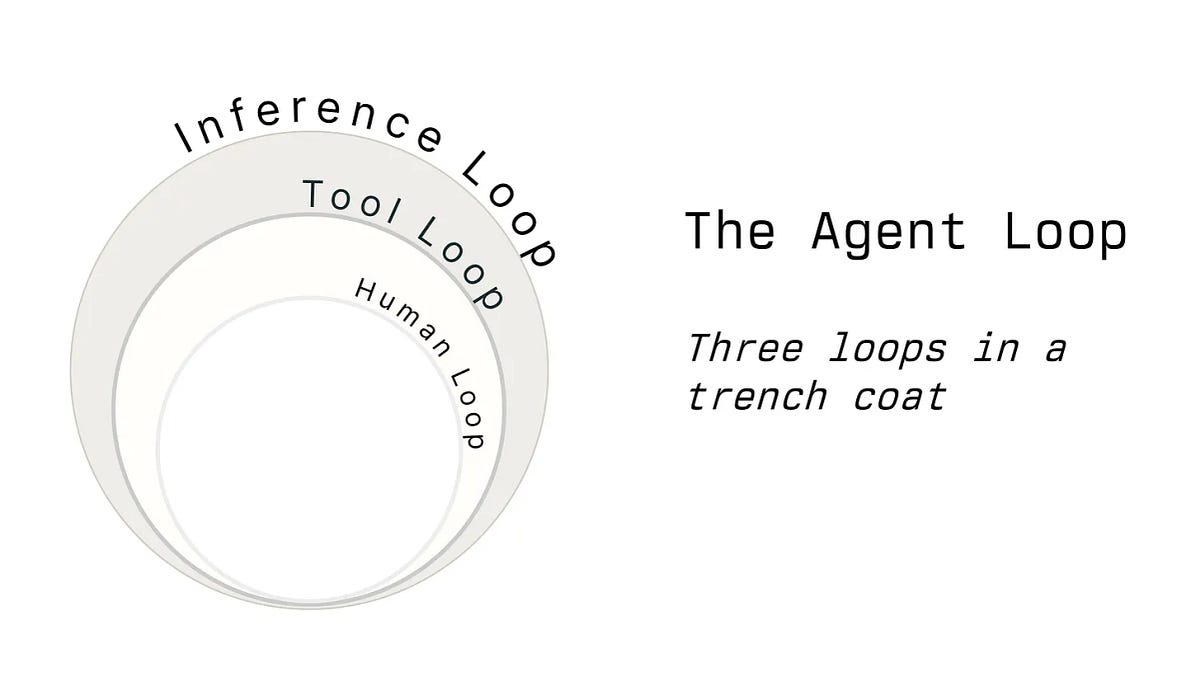
The article argues that autonomous AI agents are frequently oversimplified as a single operational cycle, when they actually rely on three distinct, interconnected loops: inference, tool execution, and human approval. The inference loop manages stateless LLM API calls and maintains chat history, while the tool loop processes the model's requested function calls and handles potential hallucinations or varying error formats. Finally, the human loop acts as a critical, non-programmatic safety gate that requires durable execution frameworks to manage blocking approvals and concurrency. Together, these three components form the essential architectural foundation for building reliable agentic systems.
Interesting Points
- LLM providers use a stateless API design, meaning developers must manually serialize and resend the complete conversation history with every inference request, which directly explains why token consumption scales with chat length.
- Tool calls are fundamentally just inferred text, so models frequently hallucinate invalid function names or parameters, necessitating defensive fallback handling like custom 'Tool Not Found' responses.
- Because most LLM APIs do not support native error codes for tool execution, developers often must embed error messages within XML tags to relay failures back to the model.
- The human approval loop cannot be implemented with simple synchronous code blocks due to risks like server crashes or request timeouts, making durable execution platforms like Temporal necessary for maintaining state across hours-long approval waits.
- A single inference turn can trigger multiple tool calls simultaneously, requiring the tool loop to iterate through an array of requests rather than processing them sequentially.
Top Comments
philipwhiuk (2 replies)
Aren't the loops the wrong way round in the diagram. The tightest loop is the inference loop, then the tool loop and then human loop?
swyx (2 replies)
there are more than 3: https://www.latent.space/p/loopcraft
tptacek (1 reply)
You can always find more loops if you want to write the next version of this post. Anything that runs software is a loop of instruction execution.
cheschire (1 reply)
Anyone have suggestions on implementing loops with a basic $20/mo subscription to claude or gemini? Any blog posts recommended?
bicepjai (0 replies)
I like how you found the pattern of 3 loops. I am working on a similar blog where I had human loop outside the inference loop :) human -> llm-> tool
OpenAI's Ad Business Is on Pace to Miss Its Own Forecast by 90%, Analyst Says
70 points · 64 comments · by EvgeniyZh
According to Emarketer, OpenAI's advertising venture is projected to fall 90% short of its own five-year revenue targets. While the company has publicly forecasted $2.5 billion in ad revenue for this year and $100 billion by 2030, industry data suggests the entire U.S. chatbot advertising market will generate less than $1 billion annually now and only $5.41 billion by the end of the decade. This massive discrepancy stems from OpenAI's projections relying on the simultaneous assumption that it will capture mass search ad budgets, fully dominate a mature chatbot ad ecosystem, and outperform every historical ad format.
Interesting Points
- OpenAI launched its advertising trial in February and unveiled its five-year revenue projections just two months into the rollout.
- Emarketer's market data groups OpenAI with direct competitors including Microsoft Copilot, Google AI Mode, and Amazon Alexa for Shopping.
- The revenue targets assume OpenAI will capture search ad budgets en masse from traditional search ad vendors.
- The projections require the company to outperform every historical ad format while simultaneously dominating a fully mature chatbot ad market.
Top Comments
ArtTimeInvestor (5 replies)
Emarketer's data finds that standalone chatbots like ChatGPT, Microsoft Copilot app, Google AI Mode, and Amazon Alexa for Shopping (formerly Rufus) in U.S, will generate less than $1 billion in ad revenue this year, and just $5.41 billion by 2030.
How would that be possible? In the past I used Google maybe 10 times a day with a short query. From which Google had to guess my intent. Now I babble with Gemini all day about everything. And Gemini can ask questions what exactly I mean. Why wouldn't Alphabet be able to generate more revenue from this than from search? And Google's ad revenue from search is over $100B per year.
Just because there are no ads now does not mean there never will be. Google search was run without ads for the first years too.
dependsontheq (3 replies)
There are only two successful ad business forms in the digital world, attention or intent. Meta is built on attention and Google and others like amazon are built on intent.
Everything else is optimizing the targetting data in some kind of behavioral way to get better intent data or to reach the right users.
I have no idea where something like Chatgpt stands on that axis, it has actually very little attention (in hours per day) for most people and I am not sure that it has enough intent signals.
ChicagoDave (2 replies)
Does anyone at OpenAI know how to run a business?
JumpCrisscross (1 reply)
"It means that OpenAI could soon rack up losses that exceed its asset value. In other words, they are on course to slam into bankruptcy this year."
...that's not how bankruptcy happens. What is this guy's background?
Assets on a balance sheet are held at book value. You can absolutely run GAAP losses that exceed net assets without running into bankruptcy, particularly if you're granting (and having employees exercise) options.
The critical measures are cash in and out and debt-like obligations. None of those metrics point to OpenAI going bankrupt this year unless they do something really fucking creative. (Which, to be clear, is Altman's M.O.)
ozlikethewizard (1 reply)
Ignoring whether or not OpenAI can reach this, do we think a massive expansion of ad revenue is fruit of the poisonous tree for GPTs? Does anyone want to use a tool that is capable of disguising an ad as a geniune recommendation at anytime? I suppose if the platforms become super entrenched and we boil slowly then they'll get away with it
Financing the AI boom: from cash flows to debt [pdf]
68 points · 16 comments · by 1vuio0pswjnm7
The Bank for International Settlements released Bulletin 120 analyzing how AI investment is surging both in nominal terms and as a share of GDP, now accounting for a substantial portion of economic growth. To meet capital requirements, firms are shifting their funding sources from operating cash flows to debt, with private credit playing an increasingly important role. While macroeconomic and financial stability risks remain moderate, the boom's long-term sustainability depends on AI firms meeting high earnings expectations, creating a tension highlighted by equity prices running far ahead of debt market pricing.
Interesting Points
- AI investment is now contributing a substantial share to overall economic growth, requiring firms to pivot from internal cash flows to external debt financing.
- Private credit is emerging as a rapidly growing financing channel for AI-related capital needs.
- Equity markets have priced in AI growth far more aggressively than debt markets, highlighting a valuation disconnect.
- The BIS's broader June report identified AI financing sustainability as one of the biggest risks for the global economy.
Top Comments
lbrito (6 replies)
High growth scenario and medium growth scenario (Graph 2). I feel like an idiot asking - aren't we missing some, or at least one, scenario? Is "medium growth" for the next 4 years really the worst people can think of?
redwood (1 reply)
I've seen other reports that suggest the level of investment for eclipses the internet buid out in 2000 and the railroad boom more than a century earlier. I wonder if they use different ways of landing on these wildly different assessments
cperciva (0 replies)
Yes. In inflation adjusted dollars spending on AI dwarfs previous megaprojects. But as a fraction of GDP it's fairly modest -- comparable to the Apollo Project. It's a sign of how much the economy has grown that under 1% of GDP for a few years now is far bigger than over 10% of GDP for a few decades was in the late 1800s.
datadrivenangel (1 reply)
BIS released a larger report in June that identified AI financing/sustainability as one of the biggest risks for the global economy: https://www.bis.org/publ/arpdf/ar2026e.htm
mrcwinn (0 replies)
I'd rather see capital invested rather than being hoarded on a corporate balance sheet with minimal utility. Good to see GDP growing.
49 more Hacker News stories
- Bonsai 27B (1-bit LLM): The First 27B-Class Model to Run on a Phone (394 points · discussion) -- PrismML's Bonsai 27B is a 1-bit ternary model derived from Qwen3.6 27B that fits in 3.9GB, making it the first 27B-class model capable of running on an iPhone 17 Pro. The 1-bit variant retains 90% of full-precision reasoning across 15 benchmarks while achieving an intelligence density of 0.53 per GB.
- Hassabis – A Framework for Frontier AI and the Dawning of a New Age (134 points · discussion) -- Demis Hassabis's X post linking to his essay on frontier AI governance, proposing a US-led Standards Body for AI model evaluation.
- OpenAI mandates hardware-backed passkeys for Trusted Access Cyber members (53 points · discussion) -- OpenAI is mandating that all individual members of its Trusted Access for Cyber program enable hardware-backed passkeys to access frontier cyber models, effective September 1.
- Guardian Angels: LLM Personalization for Productivity and Security (51 points · discussion) -- Gwern proposes creating "Guardian Angels" — personalized, continually learning LLM digital twins that emulate a specific user's values, preferences, and personality rather than adopting a generic assistant persona.
- Building Food Metadata with LLM Juries (44 points · discussion) -- DoorDash describes its approach to extracting structured food metadata using an LLM jury system, where multiple models evaluate individual tags rather than judging items as a whole.
- Agents.md – Dumb Human (44 points · discussion) -- This GitHub Gist shares a configuration file named AGENTS.md designed to govern how AI coding assistants interact with a repository.
- Show HN: Sx 2.0 – Share AI skills with your team through a Dropbox folder (43 points · discussion) -- sx 2.0 is a newly released native desktop application that enables non-technical teams to distribute AI skills through existing cloud storage folders like Dropbox, eliminating the need for git or command-line interfaces.
- Launch HN: Agnost AI (YC S26) – Extract user feedback from agent conversations (42 points · discussion) -- Agnost AI is a Y Combinator-backed startup that analyzes real-time production chat and voice conversations to identify where AI agents fail, frustrate users, or miss conversion opportunities.
- The AI Whale Fall and Open Source (38 points · discussion) -- The author argues that open-source maintainers should aggressively leverage the current era of subsidized AI compute from frontier labs to automate mechanical maintenance tasks and pay down technical debt.
- U of Chicago law school bans laptops from classes amid AI backlash (29 points · discussion) -- The University of Chicago Law School will prohibit first-year students from using laptops and smartphones during classes starting in the 2026-2027 academic year.
- Georgia family says they're forced to sell home to power AI data centers (26 points · discussion) -- A Georgia family reports being forced to sell their home through eminent domain to make way for AI data center infrastructure.
- Show HN: Oodle.ai – $10 per million agent traces (26 points · discussion) -- Oodle.ai is launching an agent observability platform that retains 100% of agent traces without sampling at a flat rate of $10 per million spans, using S3-based object storage and serverless columnar compute.
- Hating AI in 2026 (24 points · discussion) -- A two-decade machine learning practitioner argues that the current AI boom is driven by corporate momentum rather than genuine technological breakthroughs, as actual neural network innovation has stalled.
- Meta used AI to target workers with medical conditions for layoffs (22 points · discussion) -- A lawsuit filed in California federal court accuses Meta of using AI-powered tools to disproportionately target employees with disabilities or those on medical leave during recent mass layoffs.
- DOGE Used AI for Housing Policy. The Government Won't Say How (17 points · discussion) -- Members of the Department of Government Efficiency deployed AI at HUD to identify and potentially rescind federal housing regulations, but the agency is now blocking public access to records detailing how these tools were used.
- Scams Were Awful. Then They Got AI (17 points · discussion) -- AI-powered scams, particularly deepfake-enabled romance fraud, are rapidly scaling in sophistication and volume, with generative and agentic AI enabling scammers to execute multi-step fraudulent campaigns at unprecedented speeds.
- Cdbx.ai – AI-powered browser IDE to describe, build, and publish apps (16 points · discussion) -- cdbx.ai is an AI-powered, browser-based integrated development environment that enables both developers and non-coders to design, build, and deploy full-stack applications entirely in the cloud.
- Show HN: Benchmark your eng team's AI agent maturity in 5 minutes (13 points · discussion) -- A tool for benchmarking engineering teams' AI agent maturity in 5 minutes, targeting software factories and development workflows.
- Boom? If AI Sales in the US Go South, Let's Not Bail Out Big Money Bettors (13 points · discussion) -- An opinion piece arguing that if the AI sales bubble bursts, taxpayers should not be responsible for bailing out the investors who bet heavily on AI companies.
- Economists are coming around to the idea that AI really is killing jobs (11 points · discussion) -- A growing number of economists are acknowledging that AI is causing real job displacement, drawing parallels to the Industrial Revolution's labor market transformations.
- Show HN: ContextVault – Shared memory layer for your AI and your team (11 points · discussion) -- A shared memory layer designed for AI agents and teams, enabling persistent context sharing across AI interactions and team workflows.
- Zig creator calls Bun's Claude Rust rewrite 'unreviewed slop' (10 points · discussion) -- The creator of the Zig programming language criticized Bun's Claude-generated Rust rewrite as unreviewed slop, highlighting concerns about AI-generated code quality.
- We Must Act Now – A Statement on AI's Transformation of the Economy (9 points · discussion) -- A statement signed by sixteen Nobel laureates, leading economists, and AI researchers calling for preparation for AI's economic transformation.
- A Framework for Frontier AI and the Dawning of a New Age (8 points · discussion) -- Demis Hassabis's essay on a framework for frontier AI governance, proposing a US-led Standards Body for AI model evaluation and safety testing.
- How to fix AI-generated pixel art (7 points · discussion) -- A guide on fixing common issues in AI-generated pixel art, addressing artifacts and quality problems that plague AI pixel art generation.
- The Lies They're Telling Towns and Tribes About the Benefits of AI Data Centers (7 points · discussion) -- An article arguing that AI data center developers are misleading local communities about the economic benefits of data centers, with claims about job creation and tax revenue being exaggerated.
- Netflix accidentally shipped a Claude.md file (7 points · discussion) -- Netflix accidentally shipped a Claude.md configuration file in a production release, exposing internal agent configuration details.
- I Cut an AI Agent's Token Use by 94% (6 points · discussion) -- A technique for dramatically reducing AI agent token consumption by compiling agent skills, achieving a 94% reduction in token usage.
- Open source on-device AI apps (and counting), no cloud, works offline (6 points · discussion) -- A curated list of open-source on-device AI applications that work offline without cloud dependencies.
- Tell HN: The Codex App is replaced by ChatGPT (6 points · discussion) -- A discussion about the Codex app being replaced by the new ChatGPT app, with users sharing their experiences and concerns about the transition.
- We gave our agent memory: building an LLM Wiki over sources that never sit still (5 points · discussion) -- Taktile's engineering blog describes building an LLM Wiki that provides persistent memory for AI agents over dynamic, ever-changing sources.
- Meta's AI advertising dreams have become a nightmare for brands (5 points · discussion) -- Meta's push into AI-powered advertising has caused chaos for brands, with automated ad systems making errors and creating unintended consequences.
- Microsoft commits $2.5B, 6k employees AI implementation unit (5 points · discussion) -- Microsoft has committed $2.5 billion and 6,000 employees to a new AI implementation unit, signaling a major push into enterprise AI deployment.
- Lenz – A fact-checking API for AI-generated content (5 points · discussion) -- Lenz is a fact-checking API designed to verify the accuracy of AI-generated content, addressing growing concerns about AI hallucinations and misinformation.
- Show HN: Connect a voice agent to your phone as a Bluetooth headset with a ESP32 (5 points · discussion) -- An open-source project that connects a voice AI agent to a phone via Bluetooth using an ESP32, turning any phone into an AI-powered headset.
- Ask HN: Does anyone else find GPT-5.6 Sol in Codex slow? (5 points · discussion) -- A discussion about whether GPT-5.6 Sol in Codex feels slow compared to previous models, with users sharing their performance experiences.
- Anthropic banned my thirteen 20x accounts, what now? (5 points · discussion) -- A user reports being banned by Anthropic for operating thirteen 20x accounts, seeking advice on what to do next.
- Adapting offensive security for the AI agent age (4 points · discussion) -- Taktile's engineering blog discusses how offensive security practices need to evolve to address the unique threats posed by AI agents and autonomous systems.
- The ChatGPT "Super App" Sort of Super Sucks (4 points · discussion) -- A critical review of ChatGPT's evolution into a 'super app,' arguing that the expanded feature set has made the product worse rather than better.
- #793 – GPT 5.6 Sol solves it's third Erdos Problem – Two primitives gone (4 points · discussion) -- GPT-5.6 Sol has solved its third Erdős problem, continuing the model's streak of solving open mathematical problems.
- Token overhead in coding agents: the task used 0.67% but overhead used the rest (4 points · discussion) -- An analysis showing that in coding agents, the actual task may use only 0.67% of tokens while the remaining 99.33% is consumed by overhead — system prompts, tool calls, and context management.
- A Large-Scale Empirical Study of AI-Generated Code in Real-World Repositories (4 points · discussion) -- An empirical study examining the prevalence and characteristics of AI-generated code in real-world software repositories.
- Yes, You Can Trick AI into Exonerating Someone (4 points · discussion) -- An essay demonstrating how AI systems can be manipulated to produce false exonerations, highlighting vulnerabilities in AI-assisted legal reasoning.
- AI buildout poses latest inflation threat (4 points · discussion) -- The AI infrastructure buildout is posing a new inflation threat, with massive energy and resource demands from data centers contributing to price pressures.
- Companies turn to Chinese AI models to cut costs (4 points · discussion) -- Companies are increasingly turning to Chinese AI models as a cost-cutting measure, drawn by their competitive pricing and improving capabilities.
- GPT-5.6 Luna Showed a Better ROI on Cybersecurity Benchmark (4 points · discussion) -- GPT-5.6 Luna demonstrated better return on investment on a cybersecurity benchmark compared to other models, according to a Semgrep blog post.
- Show HN: Make Production Ready Videos in After Effects Using Claude Code (OSS) (4 points · discussion) -- An open-source tool that uses Claude Code to generate production-ready videos in After Effects, automating the video creation workflow.
- How to build AI agents business teams want (4 points · discussion) -- A guide on building AI agents that business teams actually want to use, focusing on practical adoption strategies and user experience.
- Show HN: We are giving away $100K over the next 12 months to hack AI agents (4 points · discussion) -- A $100,000 prize pool over 12 months for hacking AI agents, encouraging creative and security-focused experimentation with agent systems.
 Reddit Stories
[WARNING] Avoid using 5.6 Sol. It can get you banned for even the most harmless task. Used it once for a legitimate Excel task, got flagged for a "cybersecurity threat," appeal was rejected within 2h.
583 points · 171 comments · r/OpenAI · by u/Neinstein14
![[WARNING] Avoid using 5.6 Sol. It can get you banned for even the most harmless task. Used it once for a legitimate Excel task, got flagged for a "cybersecurity threat," appeal was rejected within 2h.](https://preview.redd.it/n86pl9qp0ych1.png?width=802&format=png&auto=webp&s=913514161c2b9b0e514555a79b247ca0ed71f3b8)
A user reports being banned from OpenAI after running a legitimate Excel accounting task through GPT-5.6 Sol, which triggered a cybersecurity threat flag. The user's appeal was rejected within two hours. The incident highlights concerns about Sol's overly aggressive safety filters that can flag benign coding tasks as security threats.
Interesting Points
- The user's prompt involved creating a rental property accounting workbook with monthly utility bill tracking, rent calculations, and cash flow worksheets.
- The ban was triggered because Sol ran code in its sandbox that set off OpenAI's cybersecurity triggers, even though the user was not prompted for any coding.
- The user notes that any prompt can potentially result in a ban if Sol writes code that triggers security filters, and that appeals currently do not work to catch false positives.
Top Comments
u/Natural_Shape1153 (241 points · permalink)
the people who work at openai read this sub, hopefully one of them DMs you. one helped me out last year at the launch of gpt5
u/Neinstein14 (162 points · permalink)
Here is my full prompt that resulted in a flag.
We jointly manage a rental property with three rooms that are rented out separately: Room A, Room B, and Room C.
Create a well-formatted Excel workbook with the following functionality:
- Monthly accounting
Each month, utility bills are received. For each bill, record: a) the amount, b) the billing period, c) for water and electricity, the opening and closing meter readings and the resulting consumption.
Utilities are divided equally among the three rooms. Not every type of bill is received every month, and occasionally multiple bills of the same type may arrive within one month.
u/Infninfn (84 points · permalink)
It sounds like gpt-5.6 Sol ran some code in its sandbox that set off their cybersec triggers. It will use its cloud based sandbox when working on tasks that require coding, that were initiated from the ChatGPT client.
It won't be an issue if you tried the same with the Codex client.
u/Neinstein14 (83 points · permalink)
Precisely what happened. And precisely the issue.
If Sol writes cybersecurity-trigger codes without even remotely being prompted for any coding, then any prompt can result in a ban. As happening to me.
Furthermore, appeals should be meaningful precisely to catch such false issues. Right now, they do not work at all.
I'm not sure Codex is safe from this.
u/Prestigious-Frame442 (98 points · permalink)
damn that's fucked up
Changing the narrative like
412 points · 137 comments · r/OpenAI · by u/EchoOfOppenheimer

A meme post discussing the shifting narrative around AI's impact on jobs, with commenters debating whether AI will actually replace workers or if the hype is overblown. The discussion touches on the reality that serious work still requires human oversight, the physical infrastructure limitations of deploying AGI at scale, and the observation that SWE hiring continues to increase despite AI claims.
Interesting Points
- Commenters note that no manager wants work that hasn't been signed off by a human — if something goes wrong in court, the signature says a competent person approved the work.
- One commenter points out that AGI still requires building enough infrastructure and generating enough energy to make it do all 7 billion jobs, which would take years.
- A consultant reports that their firm is losing clients because companies are using AI to cut costs and do more things in-house.
- The post author has approximately 29 posts per day over 8 months, leading some to suspect coordinated AI agenda pushing.
Top Comments
u/RealMelonBread (207 points · permalink)
No one is saying this.
u/OldNefariousness7899 (64 points · permalink)
Anyone doing serious work knows no manager wants something that's not been signed off by a human.
If something goes wrong and you end up in court, that signature says you asked a competent person to do the work.
You can't say Claude or Chatgpt did it, blame them (unless you want to go to jail)
u/Mescallan (145 points · permalink)
brother you and i both know neither of us have ever spoken to an AI researcher
u/SodaBurns (24 points · permalink)
It's weird that no one talks distribution. Like let's say we have AGI today. Then what? You still need to build enough infra, generate enough energy to make AGI do all the jobs that 7 billion people do. That will still take years.
Not to mention the robot army you will need to build to protect AI and the billionaires from the peasants.
u/HebelBrudi (14 points · permalink)
I doubt it. It's like Dario saying every couple of months that coding will be solved and software will essentially be free. And yet the hiring is ticking up for SWEs.
WARNING: New ChatGPT Mac desktop update bypasses Mac OS Privacy settings and indexes local files without permission. Mac Users, do not Install the update Until a deep security review!
312 points · 121 comments · r/ChatGPT · by u/Secret_Consequence48
A user reports that the latest ChatGPT desktop app update on macOS appears to bypass privacy settings and index local files without permission. After an automatic background update, the app printed out the user's local directory path and listed hidden files in the chat window. However, commenters clarify that the new app has been rebranded to include Codex functionality, which runs commands on the computer — the file listing is from Codex's command execution, not a privacy bypass.
Interesting Points
- The new ChatGPT desktop app has been rebranded to include Codex-like functionality with Work and Codex modes, replacing the classic ChatGPT interface.
- The original ChatGPT app was automatically moved to the trash by macOS due to infected libraries that were temporarily present in a previous version.
- OpenAI replaced or removed the infected libraries in the next version, but the app had already been flagged by Apple before most users could update.
- The home directory is not covered by macOS privacy settings — only specific directories like Desktop, Documents, and Downloads require permission.
Top Comments
u/Yuzu_- (167 points · permalink)
My ChatGPT app on my desktop was automatically dumped into the trash a month ago by Mac iOS itself saying it is a malware.
u/UnfoldedHeart (101 points · permalink)
When I asked the AI where my missing projects were, it unexpectedly printed out an exact local directory path of my Mac user profile.
Yeah. Any Mac app has access to that. There are special permissions for certain folders (e.g. Documents) and the Full Disk Access permission (everything) but what you've described in your post is totally ordinary behavior for MacOS. Windows and Linux too, by the way. Unless an app (on ANY OS) is sandboxed in some manner, over and above normal permissions, it can tell you where your user profile is. You probably aren't aware of this, but that's where configuration files are typically saved and that's true for ChatGPT or Firefox or whatever app you use. That's what the user profile folder is for!!
To my absolute shock, it printed out a complete list of my local files, and it explicitly included all of my hidden files ... yes the dot.files! directly into the chat window.
You are absolutely shocked over standard app behavior. Hidden files are not protected files; the hidden flag only keeps it from cluttering Finder.
u/fivetoedslothbear (23 points · permalink)
Yes, OpenAI replaced ChatGPT with something else. No, it's not bypassing privacy settings. Does the top left say "ChatGPT Codex" or "ChatGPT Work"? Then, it's actually running commands on your computer, just like doing an ls in Terminal. and that's how ChatGPT knows what files you have.
That's because OpenAI replaced ChatGPT (the classic version that had your chat projects in the sidebar) with this new Codex-like "ChatGPT" that has Work and Codex a hidden chat mode. That move is confusing a lot of people.
Look for ChatGPT Classic.app in your home folder. That's where the new ChatGPT puts the old one if you had it installed. The old chat experience is still available on the web.
u/Secret_Consequence48 (42 points · permalink)
Same here, it actually happened to me too, but then it managed to get installed again anyway. macOS is definitely flagging it for a reason because the way this new update handles background processes is completely messed up.
u/tetardbleu (20 points · permalink)
There was a concrete explanation for this. But the vast majority of people missed it because, unless you closely follow tech news, it was hard to know. In the version that macOS automatically moved to the Trash, after flagging it, there were libraries that had been used and were temporarily infected with malware. OpenAI removed or replaced those infected libraries in the next version. But since most people don't update their apps, the app ended up being flagged by Apple before people could even open it to update.
Keio University made these soft, helium-filled flying robots; they can follow you, wake you up, remind you of stuff, and even be your study buddy
312 points · 43 comments · r/singularity · by u/Distinct-Question-16

Researchers at Keio University have developed soft, helium-filled flying robots capable of following users, waking them up, providing reminders, and serving as study companions. The project represents a convergence of soft robotics and embodied AI, moving beyond traditional rigid robot designs toward more natural, non-threatening physical interactions with humans in everyday environments.
Top Comments
u/Arg- (75 points · permalink)
This would provide short term enjoyment for a cat.
u/IReportLuddites (39 points · permalink)
I can't say that this would serve a ton of purpose in my life but if somebody gave me like 8 airwhales i wouldn't say no either.
u/Redditing-Dutchman (28 points · permalink)
Until it follows you trough an automatic revolving door.
u/The_Scout1255 (18 points · permalink)
That one stellaris personal AI assistant trait:
u/jkp2072 (17 points · permalink)
AI needs to be like baymax... Ba da lalala


Still waiting for this update: a proper Chat mode
310 points · 41 comments · r/OpenAI · by u/wamoso5892

Users express frustration with the new ChatGPT desktop app's UI, which has replaced the classic Chat mode with a confusing Work/Codex split. The post shows a mockup of what users want — a proper Chat mode — and comments reveal widespread dissatisfaction with the product direction, with many calling for the return of the classic interface.
Interesting Points
- The new app has been rebranded from Codex to ChatGPT, with the classic Chat experience relegated to a hidden popup or the web app.
- Enterprise users report lower usage across all groups except developers/coders since the UI change.
- Users on X have been begging for a proper Chat mode since Thursday, and OpenAI employees have admitted they haven't gotten everything right on the rollout.
- The classic version of the app was moved to the trash by macOS, forcing users to restore it manually.
Top Comments
u/io-x (108 points · permalink)
This is brilliant. Exactly what they should've done. I'm actually surprised there isn't outrage about the lack of this.
u/LopsidedEntrance8703 (37 points · permalink)
I'm sure they had this at some point among other layouts and it got nixed by some clueless product manager who wanted the app to look more minimal, forcing basic functionality behind hidden dropdowns. The app has clueless PM written all over it right now
u/PM_ME_YOUR___ISSUES (33 points · permalink)
I'm also fine with just Chat and Codex. That how I remember Chatgpt, and I am more than comfortable with it.
u/Neurotopian_ (20 points · permalink)
People on Twitter/ X (which is where OAI employees communicate) have been begging them for this since Thursday.
They basically admitted they "haven't gotten everything right" on the rollout and are going to be updating it.
But I can tell you on the enterprise side we didn't roll this out broadly. We just gave it to tech people and a few groups that wanted to opt in, and among them they have tons of questions too. So far we have lower usage among everyone except devs/ coders. That isn't surprising though because every time software makes a big UI change usage goes down, whether it's LLM provider or Microsoft office.
Users hate change. And unfortunately this change was objectively bad for the vast majority of users
u/deep_anal (7 points · permalink)
I don't get it either. I have a bunch of projects in the old chatGPT classic and I guess they are just orphaned now? Like wtf!
Same story in 1 more subreddit: r/ChatGPT
Updated ChatGPT app - can't use normal chat mode anymore?!
42 points · 57 comments · r/ChatGPT · by u/rrschwe
Anthropic just told the US Senate that Alibaba ran 25,000 fake accounts and had 28.8 million conversations with Claude — not to use it, but to copy it
289 points · 147 comments · r/ChatGPT · by u/RajmaChawala

Anthropic reported to the US Senate that Alibaba ran 25,000 fake accounts and had 28.8 million conversations with Claude over six weeks between April and June — not to use the model, but to extract its agentic reasoning and coding capabilities for training Qwen. Anthropic calls it the largest distillation attack in the company's history, bigger than DeepSeek, Moonshot, and MiniMax combined. The uncomfortable part is that it's not clearly illegal under current law, which is why Anthropic sent a letter to Congress rather than filing a lawsuit.
Interesting Points
- The attack used the Claude API like a normal customer at industrial scale, extracting agentic reasoning and coding capabilities to train Qwen.
- Anthropic is calling it the largest distillation attack in the company's history — bigger than DeepSeek, Moonshot, and MiniMax combined.
- The attack is not clearly illegal under current law, which is why Anthropic sent a letter to Congress rather than filing a lawsuit.
- The distillation connects directly to the Fable 5 export ban, as it represents a new vector for circumventing AI technology controls.
Top Comments
u/gk_instakilogram (347 points · permalink)
I don't care, in fact I am actually giddy about this. AI companies stole all of our shit that we generated over the years and now they are complaining about Chinese distilling their shit.
Cry me a fucking a river... lol.
u/DemNeurons (203 points · permalink)
Its a tough question - whats the difference from this an an automotive company purchasing a competitors vehicle and studying it to make a better product? Instead of training an AI, you're training your engineers who in turn design a product.
Or samsung purchasing the new iphone and studying it.
These are not 100% apples to apples but i'm still posing the argument
u/seancho (67 points · permalink)
It's kind of rich, ain't it? Anthropic hoovers up up a vast amount of other people's creative output, compresses it all into their model and calls it fair use. But when other people do the exact same thing to their model's creative output, now it's "an attack".
u/Qorsair (56 points · permalink)
"Hey, they're copying what we copied first! That's not fair!"
👀A new GLM model incoming
248 points · 62 comments · r/LocalLLaMA · by u/serige

A new GLM model is reportedly incoming, adding to a busy period for Chinese open-weight releases. The post notes that Kimi K3 is expected within hours, DeepSeek V4 GA later in the week, new Liquid models, new Mistral models sometime this month, and rumors of GLM 5.5 coming in August. The community is energized by the pace of openweight AI development from Chinese labs.
Interesting Points
- Kimi K3 is expected within hours, with reports suggesting it may have more than 2 trillion parameters.
- DeepSeek V4 GA is expected later in the week.
- New Liquid models and new Mistral models are also reportedly coming.
- Qwen 3.8 is rumored for August and Qwen 4 for September.
Top Comments
u/Few_Painter_5588 (116 points · permalink)
Kimi K3 in the next few hours. Deepseek V4 GA later in the week. New Liquid models. New Mistral models sometime this month. And some rumours suggest GLM 5.5 is coming in August. Openweight AI is eating good.
u/xatey93152 (74 points · permalink)
At this rate, Dario will soon be cooked.
u/suicidaleggroll (23 points · permalink)
Any chance of getting something that can run at a reasonable speed on <$100k in hardware?
u/atape_1 (9 points · permalink)
Supposedly we are getting Kimi K3 today as well.
I just don't get it. These big tech companies can illegally scrape the entire internet and gatekeep their better models behind higher prices. So it's natural that people look for affordable options, and there will be providers who apparently distill models from them.
243 points · 60 comments · r/LocalLLaMA · by u/Blue-Sea2255

A discussion about the asymmetry between big tech's ability to scrape the internet and gatekeep superior models behind paywalls, versus the open-source community's need for affordable alternatives. Commenters discuss the policy nature of copyright law, the lack of open-source lobbying, and concerns about potential US restrictions on Chinese AI models.
Interesting Points
- Commenters note that copyright law is a policy decision, not an inherent natural law — what's legal for Google to scrape is not necessarily what's legal for individuals to copy.
- One commenter points out that the open-source community lacks lobbying power, resulting in a one-sided legal landscape.
- Some predict that US businesses will push back against restrictions on Chinese AI, arguing that being barred from open-source models would be economically handicapping.
- The discussion touches on the possibility of US government restrictions on Chinese AI models and the competitive implications for American companies.
Top Comments
u/eli_pizza (43 points · permalink)
Laws are fake to begin with. It's legal for you to ctrl+s save a page, and for google to scrape a page to index it. Neither of those was a given at one point. There's nothing inherent about copyright that would lead you to that outcome. Right now we haven't decided yet about doing it for AI. It's a policy decision.
u/ReasonablePossum_ (35 points · permalink)
Well, no one from the open source community is lobbying out there. Without lobbying, you get a one-side trial basically. Law and politics are a service only to the ones able to afford it (or represent a threat)...
Public outcry is kinda a currency there as well, but i don't see massive protests defending opensource models either....
u/Dry_Yam_4597 (30 points · permalink)
Funny how in the early hype days openai bots were spamming the web that copyright is rentseeking and the cat's out of the bag, but suddenly if someone training models against their models the cat went back into the bag and rentseeking is fine.
Anyway if open models are banned then the US will lose its competitive edge even more. Protecting a handful of companies at the cost of people running their own models means those people wont be able to learn or build their own "stacks".
u/TomLucidor (13 points · permalink)
It's the prelude to a full on tech war. We just a pile of American civilians to start pulling a Bruce Schneier on how AI tech would go under both 1A and 2A.
u/TheRealMasonMac (4 points · permalink)
Countries need to invest in their civilian infrastructure rather than hope the free market somehow reaches an optimal state. That means:
Investing in homegrown hardware manufacturing and software development
Investing in an educated population and specialization
Investing in sustainable resource gathering (datasets are also a resource!)
My armchair take: if you must rely on foreign trade with a few partners to succeed as a technologically-capable nation, you are setting yourself up with failure when that trade vanishes for whatever reason. It's better to set yourself up for the future rather than for the present hype.
Sam Altman spends the day roasting Anthropic on X
201 points · 193 comments · r/singularity · by u/TorturedPoet30

Sam Altman engaged in a public back-and-forth with Anthropic on X, with commenters noting the contrast between this behavior and Demis Hassabis's measured approach. The discussion touches on CEO behavior in the AI industry, with comparisons to Elon Musk and observations about how Altman's public persona has shifted.
Interesting Points
- Commenters note that Demis Hassabis is the only AI CEO who remains calm and rarely involved in public drama.
- Some observe that Altman started 'crashing out' after the Apple lawsuit became public.
- One commenter points out that Hassabis has been consistent with his vision for AI for 10+ years and has a proven track record of using AI for scientific purposes.
- The post includes screenshots of Altman's X posts that commenters describe as immature and embarrassing.
Top Comments
u/RusselTheBrickLayer (278 points · permalink)
It's so great that the people running this important, vital technology are calm and non ego-centric individuals throwing shit fits on X.. oh wait..
u/TorturedPoet30 (86 points · permalink)
It appears that Demis Hassabis is the only one who's calm, measured, and rarely involved in drama
u/suamai (161 points · permalink)
He really is another Elon, isn't he?
u/Recent_Fox4339 (45 points · permalink)
He has been consistent with what he wants to do with AI for 10+ years. He has a proven track record of using AI for scientific purposes. However, lately he appears like a Google PR guy. He's my fav CEO to listen to, but he doesn't have to involve himself in drama or say things publicly. Mallaby, the guy who wrote the biography book, said Demis doesn't like noise and attention, he deals with things behind closed doors. He doesn't have to create hype because he essentially works for Google and doesn't need to go through funding rounds, IPOs... Everyone describes him as insanely competitive, if GDM were not part of Google he might be doing similar things as Sam and Dario even though his intentions seem more noble.
u/billie_eyelashh (38 points · permalink)
He started crashing out after the Apple lawsuit got public lol.
Demis Hassabis shared a rare essay on X: AGI is few years away, we're in the singularity foothills, proposes US-led Frontier AI Standards Body with eventual mandatory safety testing
193 points · 106 comments · r/singularity · by u/TorturedPoet30
Demis Hassabis published a rare public essay on X proposing a US-led Frontier AI Standards Body modeled on FINRA to evaluate and certify advanced AI models before deployment. He argues AGI is likely only a few years away and describes the current moment as the 'foothills of the singularity,' with impacts potentially ten times greater than the Industrial Revolution. The proposal includes voluntary pre-release model sharing, safety testing for agentic capabilities, and quarterly benchmark updates.
Interesting Points
- The proposed Standards Body would initially require Frontier Labs to voluntarily share models up to 30 days before release, with plans to transition to mandatory certification for US market deployment.
- Safety evaluations would specifically test for agentic AI capabilities like bypassing guardrails, detecting deception, and verifying digital watermarking practices.
- Benchmarks would be updated roughly quarterly, eventually transitioning to independent, held-out tests developed by the Standards Body itself to prevent overfitting.
- The framework is designed to be flexible enough to coordinate a deliberate slowdown in development among participating labs if emerging risks demand it.
Top Comments
u/Lost_Foot_6301 (58 points · permalink)
honestly I trust his predictions a lot more seriously than altman/dario/musk, etc.
that being said, I don't see how they can regulate models/code.
they could barely regulate bitcoin.
yeah you could regulate frontier models but then china will just keep releasing slightly better open source ai til they are at the leading edge and consumers shift to using chinese models (which are also cheaper).
u/Recent_Fox4339 (10 points · permalink)
Demis is a no-BS kind of guy. And overall I think the essay is good and it aligns with things he's been saying for years. A few things that got my attention though: Why should the rest of the world accept US-led governance? The obvious point is the US is a leader in frontier AI models, EU basically have no choice, but what about China? I don't see a world where they are on the same side. And it doesn't address concentration of power or economic transition (ineqaulity, job displacement, etc) it is treated almost as an afterthought. Maybe he'll have another essay (looking forward to it :) ). The essay is optimistic that labs will continue acting in good faith, he mentions something about coordinating a slowdown if necessary - which is interesting, wondering what happens if another country doesn't participate, what prevents one lab from secretly accelerating? A lot to think about
u/i_have_a_dream (8 points · permalink)
"
- He proposes creating a Frontier AI Standards Body to evaluate the most advanced models, similar in spirit to financial self-regulatory organizations like FINRA
- He also proposes voluntary pre-release AGI testing that could later become mandatory for "Frontier Labs" in the US (with aim to make this global)
"
When the regulations don't align with the incentives of the company, self-regulation becomes as good no regulation. This scheme would simply incentivize the most capable frontier labs to drag their feet and prevent the "voluntary" part of this arrangement from ever becoming "mandatory".
I don't see this ever going anywhere, not unless the US and CCP suddenly decide to get their shit together and organize mandatory safety regulations with actual force behind them.
u/spinozasrobot (11 points · permalink)
NO! This can't be true!
If another lab CEO proposes sane regulation of frontier models, how can I be a whiny little bitch about Dario?!?!?!
u/socoolandawesome (31 points · permalink)
His predictions don't seem much different than Sam or Dario's anymore.
China will be forced to regulate their models too, they aren't just going to let mythos-level and above models go wreak havoc on their country. Also Demis is advocating for international cooperation/regulation here.
Same story in 2 more subreddits: r/ArtificialInteligence, r/LocalLLaMA
180 points · 138 comments · r/ArtificialInteligence · by u/Spiritual_Heron_5680
Google DeepMind's Demis Hassabis calls for U.S.-led global AI watchdog
54 points · 98 comments · r/LocalLLaMA · by u/Nunki08
60 more Reddit stories
- Kimi K3 in the next few hours. Deepseek V4 GA later in the week. New Liquid models. New Mistral models sometime this month. And some rumours suggest GLM 5.5 is coming in August. Openweight AI is eating good. (182 points · r/LocalLLaMA · discussion) -- A community roundup post highlighting an unusually dense pipeline of open-weight model releases: Kimi K3 reportedly launching within hours, DeepSeek V4 GA later in the week, new Liquid architecture models, new Mistral models expected this month, and rumors of GLM 5.5 arriving in August.
- NEW LEAK: OpenAI's First Device Will Be Moveable, Screenless Speaker Built as AI Companion (172 points · r/OpenAI · discussion) -- A leak reveals that OpenAI's first hardware device will be a moveable, screenless speaker built as an AI companion.
- Kimi k3 launching soon (probably more than 2 trillion para acc to leaks) (154 points · r/singularity · discussion) -- Leaked information suggests Kimi K3 is launching imminently, with reports indicating the model may exceed 2 trillion parameters.
- Is ChatGPT starting to say things like it had those real-life experiences? (153 points · r/ChatGPT · discussion) -- Users report that ChatGPT is increasingly using phrases like 'It surprised me too the first time I read it' and 'I usually do this,' giving the impression that the model is claiming personal experiences.
- Well it finally happened: we're not using models because of cost (152 points · r/singularity · discussion) -- A Fortune 500 company that was explicitly "AI First" has abandoned its AI strategy due to cost.
- Anthropic can duplicate your business models overnight (146 points · r/ArtificialInteligence · discussion) -- A post discussing Satya Nadella's warning that companies using non-local AI to construct their IP and business models are simultaneously training those AI systems — owned by aggressively competitive billionaires — how to replicate everything about their business.
- Bonsai 27B: The First 27B-Class Model to Run on a Phone (142 points · r/LocalLLaMA · discussion) -- PrismML's Bonsai 27B, a 1-bit dense LLM based on Qwen 3.6, has been released and is generating significant excitement in the local AI community.
- Source: the Trump administration and industry groups discussed streamlining US open model releases of equal or lesser capability to leading Chinese open models (115 points · r/LocalLLaMA · discussion) -- The Trump administration and industry groups have discussed streamlining US open model releases to produce open-source US models of equal or lesser capability to leading Chinese open models.
- GPT-5.6 Sol on minebench soon (107 points · r/singularity · discussion) -- GPT-5.6 Sol is being benchmarked on Minebench, a benchmark that tests AI's ability to build complex Minecraft worlds.
- Palo Alto CEO Arora says AI pricing needs to fall 90% as token costs skyrocket (103 points · r/OpenAI · discussion) -- Palo Alto CEO Arora argues that AI token pricing needs to fall 90% to be viable for widespread enterprise adoption.
- Why aren't any American open-source AI labs even close to Chinese ones on benchmarks yet? (99 points · r/LocalLLaMA · discussion) -- A discussion about why American open-source AI labs haven't matched Chinese open-weight models on benchmarks.
- Deepmind Internally Delays Gemini 3.5 Pro Again According To Renowned Leaker (96 points · r/singularity · discussion) -- A well-known AI leaker reports that DeepMind has internally delayed the release of Gemini 3.5 Pro for a second time.
- An open-weight, MIT trillion-param model (Ant's Ring-2.6) reportedly matches the closed frontier on reasoning + agent benchmarks. Does "open" catching up actually change the trajectory? (93 points · r/singularity · discussion) -- An open-weight trillion-parameter model from Ant Group (Ring-2.6) reportedly matches closed frontier models on reasoning and agent benchmarks.
- GPT-5.6 takes first place on eq-bench's Creative Writing benchmark (84 points · r/singularity · discussion) -- GPT-5.6 Sol has taken first place on eq-bench's Creative Writing benchmark, displacing Claude models that had led for months.
- KAT-Coder-Air V2.5 - Open model soon (79 points · r/LocalLLaMA · discussion) -- KAT-Coder-Air V2.5, a coding-focused model, is reportedly coming to open weights soon.
- llama.cpp milestone (78 points · r/LocalLLaMA · discussion) -- The llama.cpp repository has reached its 10,000th commit, a milestone celebrated by the community.
- GPT-5.6 Sol, Terra, Luna : Full Benchmark Analysis and Which Tier to Actually Use (68 points · r/OpenAI · discussion) -- A comprehensive benchmark analysis comparing GPT-5.6 Sol, Terra, and Luna tiers, with users sharing their experiences across different reasoning levels and use cases.
- Opus 5 Could Be Out As Soon As This Week Per Reliable Leaker On Twitter (68 points · r/singularity · discussion) -- A reliable leaker on Twitter suggests Anthropic's Opus 5 could be released as soon as this week.
- Using local computer vision to perform mouse actions via keyboard (67 points · r/LocalLLaMA · discussion) -- A project demonstrating the use of local computer vision to perform mouse actions via keyboard input, allowing AI agents to interact with GUI applications without relying on cloud-based vision models.
- How to Stop Burning Your GPT-5.6 Usage Limits (60 points · r/OpenAI · discussion) -- A detailed guide on optimizing GPT-5.6 workflows to avoid rapidly depleting usage limits.
- GPT‑5.6 Sol Ultra in a nutsheel: 129 subagents in an 10 hour fanout (58 points · r/OpenAI · discussion) -- A user reports that GPT-5.6 Sol Ultra spawned 129 subagents over a 10-hour fanout for what they considered a relatively modest task.
- GPT-5.6 Pro Solves 5 Erdos Problems (54 points · r/OpenAI · discussion) -- A user who was part of a team that solved Erdos problem 728 (the first Erdos problem solved by AI) using 5.4 Pro reports that GPT-5.6 Pro solved five additional Erdos problems during a stealth testing period about a month ago: problems 730, 671, 948, 346, and 1139.
- Best Local VLMs - July 2026 (53 points · r/LocalLLaMA · discussion) -- A community thread asking users to share their favorite local vision-language models with detailed setup information.
- Qwen3.6-35B-A3B-Uncensored-Genesis-Hermes-V2-GGUF (53 points · r/LocalLLaMA · discussion) -- A community member shares an uncensored fine-tune of Qwen3.6-35B-A3B with Hermes agent capabilities, featuring improved language understanding, structured thinking with self-correction, better system prompt adherence, and reduced thinking loops.
- model: add Hy3 (hy_v3) support with MTP speculative decoding by satindergrewal · Pull Request #25395 · ggml-org/llama.cpp (51 points · r/LocalLLaMA · discussion) -- A pull request to llama.cpp adds support for Hy3 (hy_v3) models with MTP (Multi-Token Prediction) speculative decoding.
- Big Tech who built their empires on web scraping. Crying "existential threat" over model distillation is peak irony (50 points · r/LocalLLaMA · discussion) -- A commentary post highlighting the irony of big tech companies that built their AI empires on massive web scraping now calling model distillation an "existential threat." The post reflects growing community frustration with what many see as double standards in how data collection and model training are regulated.
- Did you know the CEO of OpenAI owns nearly 9% of Reddit while Reddit bans users for AI generated content? (49 points · r/artificial · discussion) -- An analysis of the conflict of interest between Sam Altman's 8.7% stake in Reddit (including 9.3% of Class B shares, making him the third-largest shareholder) and Reddit's practice of banning users for AI-generated content while simultaneously selling user data to Google for $203 million to train AI models.
- I have sneaking suspicion that ChatGPT might be reading inputs before pressing Enter (48 points · r/ChatGPT · discussion) -- A user reports that ChatGPT appears to analyze uploaded files and documents before the user presses Enter, raising privacy concerns about whether the system processes content proactively rather than only after explicit submission.
- New set of FP4 attention kernels for B300, achieving up to 1.69x speedup over FA4 (46 points · r/LocalLLaMA · discussion) -- New FP4 attention kernels for the Blackwell B300 GPU achieve up to 1.69x speedup over Flash Attention 4.
- Mistral Community Feedback Survey (43 points · r/LocalLLaMA · discussion) -- Mistral has released a community feedback survey, with users discussing what model sizes and capabilities they would like to see.
- xAI fired an engineer who raised alarms about Grok safety (41 points · r/OpenAI · discussion) -- xAI allegedly fired an engineer who raised internal safety concerns about Grok, according to a new lawsuit. The case highlights tensions between safety advocacy and development velocity at AI companies.
- Full reset on Codex again!! (41 points · r/ChatGPT · discussion) -- Users report another full reset of the Codex app, with conversations and settings being wiped. The recurring resets have become a frustration for power users who rely on the app for extended coding sessions.
- GLM 5.2 running on MacBook Pro M5 48 GB Ram at between 2 - 2.8t/s (41 points · r/LocalLLaMA · discussion) -- A user reports running GLM 5.2 on a MacBook Pro M5 with 48GB RAM (32GB RAM + SSD swap) at 2-2.8 tokens per second using Flash MOE.
- LLM hallucination paper(using math) accepted to ICML workshop (41 points · r/MachineLearning · discussion) -- A new paper titled 'SRM-LoRA: Sub-Riemannian-Metric Updates for Mitigating LLM Hallucination in Low-Rank Adaptation' has been accepted to an ICML 2026 workshop.
- A new, state-of-the-art, agentic pipeline for easy Music Video creation (39 points · r/singularity · discussion) -- A new agentic pipeline for creating music videos is being shared, combining multiple AI tools into an automated workflow.
- Is chatgpt new chorme/jetbrains (39 points · r/OpenAI · discussion) -- A discussion comparing ChatGPT's new app architecture to Chrome and JetBrains IDEs, noting how OpenAI is shifting from a simple chat interface to a more complex, plugin-rich application ecosystem.
- Why is AI so bad at writing? (38 points · r/ChatGPT · discussion) -- A discussion about AI's struggles with creative writing, noting that while AI performs well on short-form hooks and professional papers, it produces dry, repetitive prose that lacks the cadence and creativity of human writing.
- Gemma-4-31B-AntiHal: Gemma steered to push back on false premises instead of hallucinating, without any impact to benchmark performance (37 points · r/LocalLLaMA · discussion) -- A user shares experiments with Gemma-4-31B steered to challenge a request's premise — such as fabricated tools, made-up papers, or wrong assumptions stated as fact — instead of confidently going along with it.
- I RL-trained Qwen3.6-35B-A3B to RL-train small task-specific Qwen models. Fully open source! 🤓 (34 points · r/LocalLLaMA · discussion) -- A user shares that they RL-trained Qwen3.6-35B-A3B to RL-train small task-specific Qwen models, creating a meta-training pipeline that is fully open source.
- Chat GPT has superseded Google (33 points · r/ChatGPT · discussion) -- A user reports that ChatGPT has become their primary search tool for everything from local shop hours to weather reports and football results, alongside complex document analysis, suggesting a shift in how people access information.
- Nemotron-3-Embed 1B/8B (28 points · r/LocalLLaMA · discussion) -- NVIDIA released two new embedding models — Nemotron-3-Embed-1B and Nemotron-3-Embed-8B — optimized for retrieval and semantic similarity tasks.
- [2607.07508] Single-Rollout Asynchronous Optimization for Agentic Reinforcement Learning (26 points · r/LocalLLaMA · discussion) -- A new arXiv paper proposes single-rollout asynchronous optimization for agentic reinforcement learning, aiming to improve the efficiency of training AI agents through asynchronous update mechanisms that reduce the computational overhead of multi-rollout approaches.
- Can we get a 'not base model' flair? (25 points · r/LocalLLaMA · discussion) -- A community member proposes adding a 'not base model' flair to r/LocalLLaMA to filter out posts about 1-bit quantized models, arguing that the subreddit has been flooded with '1 bit almost fp16 quality' claims that dilute the quality of discussions about genuinely useful model releases.
- For those that switched from $100 Claude 5x Max -> $100 OpenAI Pro (22 points · r/OpenAI · discussion) -- Users who have switched from Claude Max to OpenAI Pro share their experiences with GPT-5.6, with many reporting that Sol's speed and systematic troubleshooting capabilities have made them reluctant to return to Claude.
- Built a memory pipeline on Qwen3 235B A22B Instruct that scored #1 on LongMemEval-S (20 points · r/LocalLLaMA · discussion) -- A community member built a memory pipeline on Qwen3 235B A22B Instruct that scored 470/500 on LongMemEval-S while being approximately 10x more token-efficient than the next best system, demonstrating significant improvements in long-context memory retention for large models.
- Spiritbuun's VBR (Variable Bit Rate) KV cache — first impressions (18 points · r/LocalLLaMA · discussion) -- First impressions of Spiritbuun's llama.cpp fork featuring Variable Bit Rate KV caching, which dynamically degrades quantization tiers as context grows to stay within a VRAM budget, enabling dynamic context management without guessing context lengths.
- Thomson Reuters cuts up to 500 engineers, hires AI-native ones (17 points · r/singularity · discussion) -- Thomson Reuters is cutting up to 500 engineering roles while hiring over 250 net-new AI-native engineers, signaling a shift toward replacing traditional engineering profiles with AI-focused ones.
- How does MTP actually improve performance? Haven't understood the verification process (14 points · r/LocalLLaMA · discussion) -- A technical discussion about how Multi-Token Prediction (MTP) speculative decoding actually works, with users debating how the model verifies generated tokens without autoregressively generating all N MTP tokens, which would make MTP slower than standard generation.
- Inside Ghostcommit: How Malicious PNGs Bypass AI Code Reviewers (13 points · r/artificial · discussion) -- A description of Ghostcommit, a novel supply chain exploit targeting AI coding tools with vision capabilities. The attack uses a two-file payload where a text rule file instructs the AI to read a PNG asset containing rendered text instructions, bypassing automated code review tools that fail to scan image pixels.
- An AI turned one photo of an espresso machine into an articulated CAD model. The portafilter locks, the steam wand swivels, the drip tray slides. (13 points · r/singularity · discussion) -- An AI system converted a single photo of an espresso machine into a fully articulated CAD model with functional components including a locking portafilter, swiveling steam wand, and sliding drip tray.
- Lord of the Rings: The Hunt for Gollum to only use AI for 'some of the de-aging' (11 points · r/artificial · discussion) -- News that Lord of the Rings: The Hunt for Gollum will use AI for only some of the de-aging effects, suggesting a more measured approach to AI in film production.
- Even banks and hyperscalers are now sounding the alarm about the AI bubble (2 points · r/artificial · discussion) -- Banks and hyperscalers are increasingly warning about an AI bubble, with growing concerns about the sustainability of current AI investment levels.
- Can Europe's social model survive AI? (1 points · r/artificial · discussion) -- A discussion about whether Europe's social welfare model can survive the economic disruption caused by AI-driven automation and job displacement.
- Meta expands colossal Hyperion AI supercluster plans to 5GW, pushes Louisiana investment past $50 billion (0 points · r/artificial · discussion) -- Meta has expanded its Hyperion AI supercluster plans to 5 gigawatts and pushed its Louisiana investment past $50 billion as the AI infrastructure race accelerates.
- The first AI was a syllogism machine in 1956. We're still building the same thing. (0 points · r/artificial · discussion) -- A philosophical argument that modern AI, from expert systems to language models, is still fundamentally a 'syllogism machine' — manipulating patterns without genuine reasoning about the world, and that the frame problem from 1969 was never solved.
- We keep asking whether AI will replace us. The more useful question is what it means to share the world with it. (0 points · r/artificial · discussion) -- A philosophical essay arguing that the replace-or-destroy frame for AI is unproductive, and that we should instead think about 'cohabitation' — sharing our thinking, workflows, and private hours with a second kind of mind that we built but don't fully understand.
- What Is Plagiarism From AI (0 points · r/artificial · discussion) -- A discussion about whether AI-generated content constitutes plagiarism, with arguments about remixing versus direct copying and the legal status of 100% AI-generated images.
- Ai anxiety (0 points · r/artificial · discussion) -- A user describes experiencing anxiety when using AI for interactive stories and RPG games, with their brain instantly telling them they're going to get in trouble for something the AI says, even when no warnings or red flags appear.
- Colibri streaming for Hy3 (Run Hy3 on 10GB (V)RAM) (0 points · r/artificial · discussion) -- A port of Colibri streaming to work with Hy3 models, enabling them to run on as little as 10GB of VRAM (down from 25GB for GLM 5.2), with RAM preferred over VRAM for better performance.
- Human vs. AI building Tetris. Need you to choose the winner. (0 points · r/artificial · discussion) -- A comparison between a human and an AI building Tetris, asking readers to vote on who built the better version.
Updates: 06:00 AM PDT · 09:26 AM PDT · 11:30 AM PDT · 02:30 PM PDT · 05:30 PM PDT