Open Models Lead, Hardware Booms, Privacy and Skills Fray
Overview
Open-weight models like Qwen 3.8 and GLM-5.3 are outperforming closed frontier alternatives at a fraction of the cost, while OpenAI dramatically cuts GPT-5.6 pricing. Hardware competition is simultaneously intensifying with reports of Apple’s M5 server and Xiaomi’s AI Cube prototype, fueling a broader shift toward localized, efficient AI infrastructure. Trust and transparency dominate the conversation as revelations about Microsoft’s invisible watermarks and OpenAI’s persistent data retention spark widespread scrutiny over corporate AI practices. Amidst these shifts, developers are warning that overreliance on AI coding assistants threatens to erode foundational programming expertise, prompting renewed calls to master model internals from the ground up.
 Hacker News Stories
MS Paint and Photos invisibly watermark even locally generated output with GUID
531 points · 214 comments · by ComputerGuru
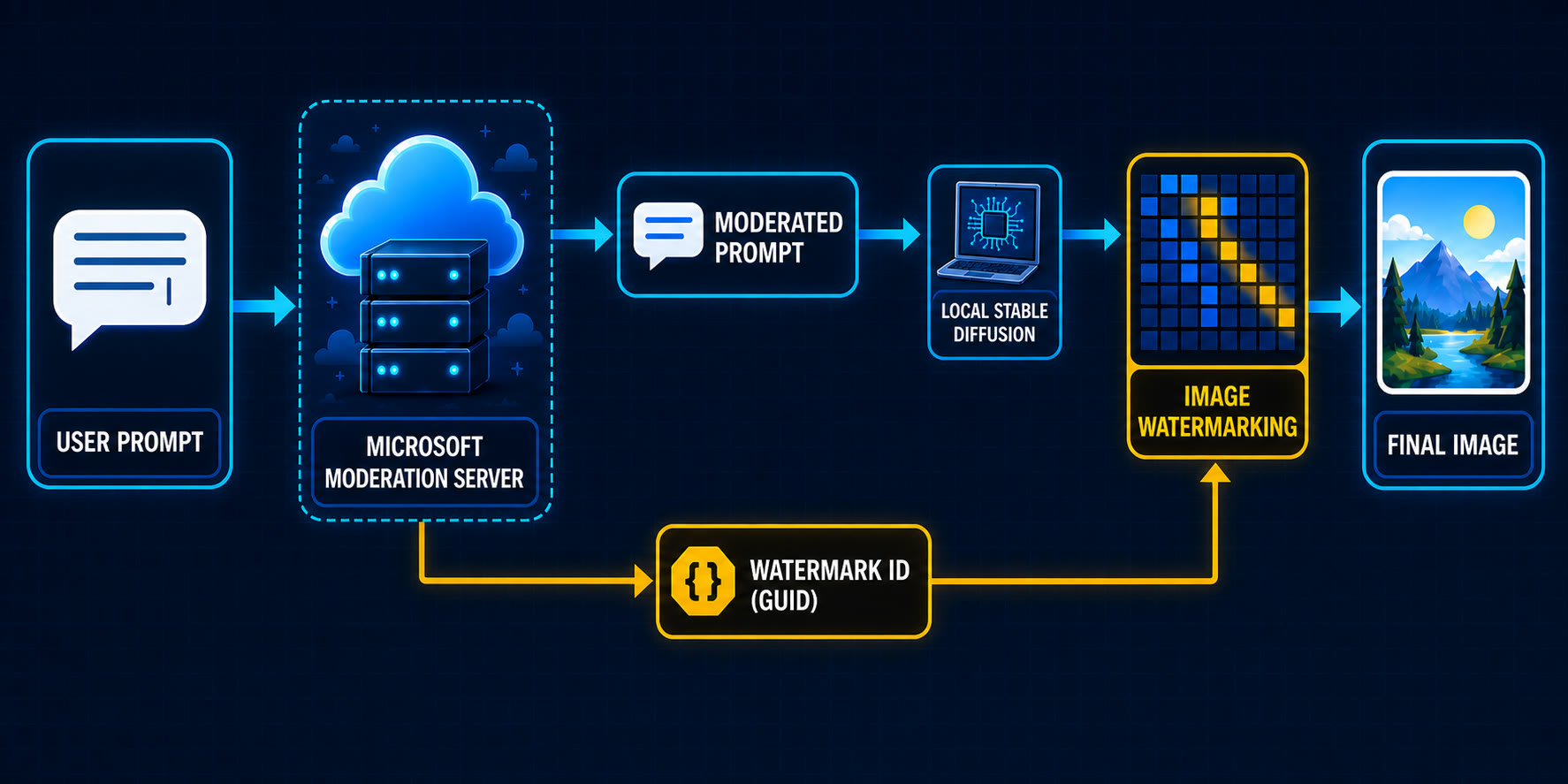
Reverse engineering of Microsoft Paint and Photos reveals that locally generated AI images are embedded with an invisible watermark containing a server-issued GUID. Before generation begins, both apps send the user's prompt to a remote moderation endpoint, which returns a unique watermark identifier that is then baked into the pixel data using a specialized block-domain algorithm. This same GUID is also recorded in the file's C2PA content credentials manifest as a soft binding, linking the pixel-level mark to the provenance metadata.
Interesting Points
- The watermark encoder uses a content-adaptive, SVD-style algorithm that requires each of the 144 bits to be placed at least three times across the image, utilizing 3-by-5 matrix operations and constants like 24.0 and 0.25.
- AI-generated saves are explicitly restricted to PNG, JPEG, GIF, and .paint formats to preserve C2PA metadata, deliberately excluding BMP which cannot embed arbitrary manifests without external files.
- The remote moderation API returns both a promptGenerationId and a watermarkId, with Paint linking successive requests by sending the previous promptGenerationId as a lastPromptGenerationId field in subsequent calls.
- The C2PA manifest cryptographically signs a c2pa.soft-binding assertion that explicitly names the algorithm com.microsoft.invismark.1 and records the exact pixel watermark value.
Top Comments
The AI aspect of this is a red herring. The real problem is that they're secretly adding in a unique identifier into every image you create. If somebody does not like your meme, they can just send a copyright subpoena to Microsoft to instantly get your full name, address, email, phone number, and any other data associated with your Microsoft account. Just like age verification, this is another weapon in the war against internet anonymity.
— weberer (thread)
This really needs to be hit with the GDPR hammer. Microsoft have not obtained consent for this.
— pjc50 (thread)
This a variant of the provenance scheme: C2PA its implemented by all major Camera maker, and Google it seems, Apple support it with 3rd party apps on iPhone, but they have something called "Apple Reference Image" brewing.
Personally I think there is a good argument for being able to distinguish AI generated image and video...
— dagaci (thread)
I were 17, I'd learn how to build LLMs from scratch
503 points · 603 comments · by bilsbie

Paul Graham advises that a 17-year-old interested in AI should focus on deeply learning how to build and train large language models from scratch rather than immediately launching a startup. He argues that gaining this foundational technical expertise will naturally lead to superior startup ideas later on, compared to attempting entrepreneurship with limited prior knowledge. This perspective emphasizes long-term skill acquisition and deep technical understanding as prerequisites for successful innovation in the AI space.
Interesting Points
- Graham explicitly advises against attempting to launch a startup at age 17, framing it as a distraction from building necessary technical foundations.
- He emphasizes practical, resource-constrained experimentation by recommending training models using whatever hardware is accessible.
- AI researcher Yann LeCun counters with a focus on bridging the gap between language generation and physical world interaction, specifically citing the inability of LLMs to clean a bedroom.
- LeCun proposes pursuing college and graduate studies to develop new methods and architectures that can quickly learn physical tasks beyond current LLM capabilities.
- The post garnered 901,000 views within a day, reflecting high public engagement with practical AI career advice.
Top Comments
There's this dilemma where in theory there's a ton of demand for engineers that can do real LLM machine-learning, but in practice there are very few available positions and entrepreneurship opportunities.
The reality is that an incredibly small minority of companies in the world do any real training or optimisation. It's unnecessary and inefficient for most purposes unless you are fully dedicated to being an LLM company, and still then it's a struggle. Those few that do train, they spend most of their budget on compute and have relatively small teams.
Getting experience in this field requires having access to very expensive hardware to begin with. And the skills will be quite hard to convert into any real value for someone, leading to a decent income, unless you have a ton of funding from patient investors, or you have decent contacts in Bay Area networks to get hired at the right place.
With all due respect, paulg is in somewhat of a bubble, this is not congruent with the global situation.
— oersted (thread)
I get the sense things have changed a bit since I graduated and there are lot more jobs in AI outside of academia these days, but it's still a very different field from other SWE pursuits, and it's not really accessible to hacker-minded people.
Learning AI isn't like learning HTML in the 90s then expecting to get a job at a tech company building websites. You can't just "learn how to build LLMs" and expect a frontier lab to hire you so I'd argue this is rather bad advise.
Additionally, unlike web development in the 90s you cant really do anything interesting yourself... All of the interesting/useful stuff will require huge amounts of compute and data so there isn't even much point in learning to start your own thing either.
As someone whose built many of NNs from scratch (hand written code, long before the days of LLMs), it's more or less useless knowledge if I wanted to work in a frontier lab or do anything interesting in the field.
I also think anyone thinking about going into a field which is basically a crossover of CompSci and Maths is absolutely insane right now. Even if you think there is a place for CompSci and Maths post LLMs, there's almost no chance anything you learn today will be relevant to the skills required in say 5-10 years.
— kypro (thread)
Yes. It's like looking at the (Apollo) moon rocket launch and then suggesting teenagers should learn to build rockets in their garages for the coming space age.
It is viable as a toy project, but there are vanishingly few career opportunities.
— yobbo (thread)
Coding expertise is going to collapse from AI reliance
439 points · 441 comments · by larsfaye
The article argues that over-reliance on AI coding assistants for direct code generation undermines the development of long-term programming expertise by removing the essential friction and trial-and-error required to build developer intuition. This dynamic creates an expert novice paradox, where inexperienced developers lack the foundational knowledge needed to effectively audit or steer AI outputs, leading to an illusion of competence rather than genuine mastery. Citing multiple studies, the author warns that prioritizing AI-driven code generation over active problem-solving risks causing a systemic collapse in the software engineering talent pipeline. To avoid this, developers should treat AI as a Socratic tutor or documentation tool rather than a production engine, ensuring cognitive effort remains intact.
Interesting Points
- A JetBrains study of junior developers found that heavy AI users skipped crucial planning stages and developed an illusion of competence, while those who limited AI use succeeded by cultivating negative expertise to filter out bad suggestions.
- A 2025 University of Pennsylvania study of 1,000 students showed that using LLMs as direct answer generators caused students to perform 17% worse on tests than peers using only textbooks, despite overestimating their own performance.
- The same UPenn study demonstrated that when LLMs were constrained to a Socratic Tutor role requiring students to independently solve problems after receiving hints, the group saw a 127% improvement in practice session performance.
- An Anthropic research paper from 2026 concludes that cognitive effort and getting painfully stuck are likely important for fostering mastery, warning that AI assistance can inadvertently short-circuit the skill-formation process for novices.
- The author frames AI coding tools as the ultimate leaky abstraction, applying Joel Spolsky's principle that while abstractions save working time, they never save learning time, ultimately risking a pipeline collapse of foundational software engineering knowledge.
Top Comments
100%
We're already seeing this at the enterprise level. Companies have dictates from leadership that "if you're writing code manually, you're doing it wrong."
Okay, that kind of works for a while. We are indeed producing a shit-ton of code, but the reality is that engineers are pumping out code faster than the humans can understand and (honestly) review it. That sounds great until you realize that "hey Claude, read this Jira ticket and implement the feature in this code base" isn't really worth $200K/year.
This is all complicated by the fact that we're also losing our grasp on reality from the other direction because we have leadership air dropping AI generated manifestos on the product owners and product owners having to use AI to transmute all that shit into 1,500 word Jira tickets that are 10% necessary feature work and 90% LLM boilerplate.
So now you have software engineers whose job has changed radically to the point that the hardest part about being a software engineer is just filtering through AI generated artifacts from all directions just to try to get a feature out the door.
— ryandvm (thread)
That sounds great until you realize that "hey Claude, read this Jira ticket and implement the feature in this code base" isn't really worth $200K/year.
Nor even €50k/year.
Two things are true:
The coding part of my career is over. LLMs are capable of doing everything I've ever been paid to write.
My actual job also included non-coding work: Does this attempted solution even work at all? Is this solving the right problem? Even if it's a valid solution to the right problem, is it the best solution given the time constraints?
That last one, "given the time constraints", is a place where my experience is still useful. The AI is as lazy (or as optimised for fast wins) as the humans whose examples it was trained upon; but an LLM costs so little that the answer is always "do it right" rather than "do it fast". A lot of people don't know what "do it right" even looks like, having only ever known e.g. websites that take 5 seconds to load because of all the adverts and analytics, and never the world where machines with 1% of the CPU and no GPU at all could fit a fully playable first person shooter in the same memory footprint as that page.
At least, I hope this "is a place where my experience is still useful"; I may just be telling myself a nice story, same as all the other people through history who have found themselves obsoleted when the automation came for them.
— ben_w (thread)
Coding expertise was on a downward trend way before AI arrived. Does nobody remember how most "engineers" were literally copying and pasting snippets from StackOverflow they didn't understand, and the snippets usually had tons of bugs? How many of you know Assembly well? How many of you can decompile a program, or write your own compiler or VM? How many of you could pass a computer science course (that you didn't take at Uni)?
We've been hearing about the demise of skills since before the invention of the loom. The only skills we've truly lost are for things nobody uses or makes anymore. What actually happens is, we develop a new tool that's better than the old tool, and we get good at using the new tool. We then have a class of people whose job it is to maintain the new tools. We don't need that many of them because the whole point is to eliminate that labor.
Your jobs as software engineers are going away, it's that simple. Your new job is to use the AI tools to make products. Somebody else's job will be to make the AI a better software engineer.
— 0xbadcafebee (thread)
My agent.md to improve LLM-assisted code quality
394 points · 171 comments · by ibobev
Fabien Sanglard shares his workflow for overcoming the poor code quality and repetitive feedback loops common in LLM-assisted programming. By creating a project-root agent.md file, he injects a strict set of stylistic and architectural rules directly into the AI's context at the start of each session. This approach shifts his review focus from basic code formatting to higher-level design, though he notes that human verification remains essential due to persistent hallucinations. To combat context dilution as sessions grow, he recommends starting fresh sessions per feature and periodically prompting the AI to reload the configuration file.
Interesting Points
- Rules include keeping function names under 30 characters and strictly adhering to a 50-character limit for commit message subject lines.
- The configuration explicitly mandates a test-first workflow for bug fixes: write the failing test, apply the fix, then verify it passes.
- Sanglard identifies context dilution as a phenomenon where models ignore mid-context instructions as conversation history expands.
- To mitigate dilution without manual editing, he now prompts the coding agent itself to auto-update the agent.md file when new rules are needed.
- The author treats member visibility changes as breaking design shifts, requiring explicit approval before promoting any field or function from private to public.
Top Comments
A bunch of these should be enforce with linting, that way people who still hand-craft code get the same kind of feedback, e.g. Always use {}, even on a one-line "if" statement. & Keep function names short. Less than 30 characters.
Then this one really is a pattern that creates a lot of churn:
- Add a small, to the point, comment to explain what the block does and why. Use examples when possible. Propose ASCII drawings to explain complete systems.
The what is the code.
— OptionOfT (5 replies)
I forbid my agents from adding any comments. I review the code and add comments manually. If I can't understand something despite having the context then I throw away the code instead of having an LLM generate comments to explain what it did. This way the code stays readable/debuggable by humans.
— hawk_ (4 replies)
The best way I've found to solve this is using LLM as CI - use a small cheap model to inspect the diff and look for those kinds of comments. Prompt left to the observer but using
claude -p/codex execgets you a lot cleaner output usually, and makes robots fight robots instead of you constantly having to reprompt and it ignoring you.
— jaggederest (0 replies)
These I especially like:
"- Avoid superlatives and praise. Stop telling me I am absolutely right. Give me the cold hard truth."
"Rule 5: Use the imperative mood in the subject line (e.g., "Fix bug," "Add feature," not "Fixed" or "Adds"). Test formula: It must complete the sentence: "If applied, this commit will [your subject line here]".
"- Strictly adhere to the layered boundary hierarchy: each layer may only communicate with its immediate neighbor directly below it. Never "punch holes" through layers (e.g., controllers or UI components must never directly call database queries, raw hardware drivers, or low-level network clients; always route through the intermediate service/abstraction layer)"
Not crossing hierarchical/abstraction layers is very important for truly disciplined Software Engineering... at least in all Object-Oriented programming languages / languages that support Encapsulation, and possibly other languages/paradigms as well...
Anyway, lots of good things in this prompt!
— peter_d_sherman (0 replies)
Right. I've really struggling to get AI to stop explaining the what. It seems to add it to the commits, PRs, code, wherever it feels like. I've put in multiple places to not write the "what", but the "why", and in multiple ways, but it still does it in one or other place.
— figmert (1 reply)
I gave Qwen 3.8 27B a reverse-engineering job and it finished in 30 minutes
359 points · 147 comments · by raybb

The article details a test where the open-weights Qwen 3.8 27B model successfully reverse-engineered and bypassed a commercial application's offline license verification system entirely on a local machine. Running on a Lenovo ThinkStation PGX with Nvidia's GB10 Grace Blackwell chip, the model performed static analysis over roughly 30 minutes, mapping ARM64 code, reconstructing a deliberately obscured cryptographic public key, and generating a working proof-of-concept script. Despite initially rejecting a jailbreak prompt, the model autonomously audited the software, identified architectural weaknesses in the vendor's security scheme, and self-corrected a flawed key reconstruction before finalizing the bypass. The author argues this demonstrates that capable local models have crossed a significant threshold, fundamentally changing threat models for software security and proprietary analysis.
Interesting Points
- Artificial Analysis ranks Qwen 3.8 27B as the top open-weights model in the 4B to 40B size class out of 135 tested, scoring a 52 on its intelligence index.
- The model operated using static analysis on an ARM64 binary without ever executing the application, relying on standard Bash tools and an SGLang/NVFP4/DFlash2 speculative-decoding setup to reach approximately 50 tokens per second.
- When the model initially reconstructed the app's verification key, it caught its own error when an embedded integrity hash mismatched, prompting it to backtrack and refine the output byte-for-byte without human intervention.
- The commercial app's security scheme relied on three specific vulnerabilities: an awkwardly sized RSA key, offline verification that prevents key revocation without an update, and entirely local checks that are inherently patchable.
- The test ran on hardware with 128 GB of unified memory and 273 GB/s of bandwidth, fitting the 17 GB model comfortably while demonstrating that frontier-level reverse engineering no longer strictly requires cloud APIs or massive compute clusters.
- The author notes that while this single success doesn't guarantee Qwen can bypass any arbitrary binary, it proves that complex cryptographic deconstruction and autonomous self-correction are now feasible for consumer-side AI workloads.
Top Comments
Local models would be even better if they did not ship with all the refusal shenanigans built-in. You can safely bet organized crime has access to the best models without these hoops, which makes the case that the average user (=non-criminal) should have access too. As I understood from an ex-Anthropic employee, some orgs got access to Mythos based on their high enough spending level, not on other grounds.
Either we are in command over the software, or the corp is in command over us via the software. I can on a theoretical level understand the concerns, but either we ban all LLMs or we have a level playing field for everybody. Let's not forget: defense and offense are different sides of the same coin in software.
— exceptione (thread)
There are versions of Qwen3.8-27B that are unrestricted and available from hugging face.
"It will comply with harmful, unethical, offensive, or illegal requests that the original Qwen3.8-27B would refuse. It has no meaningful built-in guardrails."
— dantudor (thread)
I’d expect these shenanigans to get much worse over time for the average Joe.
Imagine a world where any random person can run a super-capable model on their own hardware with no limitations and no one to pull the plug.
Information has always been power and those who already have power won’t just allow everyone else having the same tools as them
— ninahaberl (thread)
I built a low-latency AI companion that plays Skyrim with me
336 points · 69 comments · by pantelisk

The author developed Varkos, a local AI gaming companion capable of real-time interaction, complex command execution, and persistent personality evolution within Skyrim. By bypassing expensive cloud inference in favor of a hybrid architecture that combines custom speech models with a lightweight action parser, the system achieves sub-second response times on consumer hardware. While the AI demonstrates impressive capability in handling multi-step tasks and adapting its demeanor through shared gameplay, the author acknowledges that current local models still struggle with long-term context retention and require game-specific tuning. Ultimately, the project explores how low-latency AI can shift gaming companions from static NPCs to dynamic, emotionally responsive partners.
Interesting Points
- The custom action parser, ALE (Action Latent Encoder), processes commands in 2–20ms on an M4 MacBook by combining embeddings, classifiers, and real-time world-state JSON matching instead of relying solely on LLMs.
- The full audio and reasoning pipeline breaks down to roughly 40–80ms for voice-to-text, 20–60ms for speech generation, and 300–600ms for response grounding, allowing the companion to begin speaking in under 500ms total.
- Personality evolution is handled separately from the real-time loop, with long-form cloud LLM calls gradually adjusting the companion's explicit traits and emotional homeostasis based on session history.
- The system includes a "void mode" that preserves the AI's state and memories when the game is closed, enabling cross-game persistence or standalone conversations.
- Despite local inference advantages, the author notes that even ultra-fast remote providers currently fall short on conversational coherence, while local models still drift during extended multi-turn discussions.
Top Comments
The game runs on Windows, the audio processing and brain runs on my M4 MacBook. It could all run on Windows (provided there is dedicated ~12gb or more gpu ram for it)
I do wonder if this is an avenue for console gaming that might be practical in a few years; AI-centric hardware that might be too beefy or expensive for regular users, but can extend new or existing games. Kinda like the expansion paks of old.
unfortunate that the "ALE" design wasn't opensourced (couldn't find a link in their post) but I would be interested in learning more about the design, in particular what sort of data pipeline was necessary from skyrim to give this sort of action flexibility?
— usernomdeguerre (3 replies)
I must say absolutely hilarious video. The "persona" of the dog is great. As someone who is generally pretty "keep your AI out of my art" this looks very fun to play. I can imagine this being cleverly integrated as a primary feature of a game (this must already be in the works). Ideally as a small model able to run locally alongside the game.
The moment where the dog is going on about "something foul in the air" as the player is attacked by a wolf ("F--- dude you could have warned me!") was great comedy.
— seabombs (2 replies)
I get it is fun to play for an hour or so then you inexorably encounter behaviors that are too complex to handle, e.g. you try to sneak in on an enemy but get spotted because the dog started talking or barking randomly, then suddenly wonder how much "it" actually gets it. You then start with less and less complex plans... until you realize that direct commands or shortcuts are more reliable.
I do think it is an interesting exploration but the jagged frontier makes it really challenging to know what will consistently work and what will not, to the point that I bet (maybe pessimistically) one will be gradually less daring with creative plan with their "companion" simply because they can't trust it.
— utopiah (4 replies)
I feel like that's the benefit to the creator having made this a dog (even if a demon-possessed dog). As intelligent as a dog can be, can we ever truly understand why they do the things they do?
The Uncanny Valley effect would be too big if a human companion randomly started talking to you while you were sneaking up on an enemy. But a dog? You'd be pissed off at it for a bit, and then forgive it because it's a dog.
— SamBam (0 replies)
This is a fantastic application of an LLM. What’s great is that the LLMisms fold neatly into “dumb but lovable sidekick”.
So even when it chokes or stumbles on a command, the kind of frustration the user expresses when correcting it feels natural and part of the game even.
— csh0 (0 replies)
OpenAI: GPT 5.6 Sol price reduction (until at least Nov 21)
285 points · 259 comments · by tosh

OpenAI has published updated API pricing for its GPT-5.6 model series, featuring a promotional rate for gpt-5.6-sol that remains valid until at least November 21, 2026. The documentation outlines per-million-token costs across Standard, Batch, Flex, and Fast mode tiers for input, cached input, cache writes, and output. Additional sections detail pricing for cyber models, multimodal generation tools like Sora and gpt-image-2, and specialized utilities such as web search and hosted containers. The page also announces that OpenAI is phasing out its self-serve fine-tuning platform while maintaining existing model access until base model deprecation.
Interesting Points
- Fast mode pricing for gpt-5.6-sol is set at $8.00 per million tokens for input and $40.00 for output, while Batch mode reduces those figures to $2.00 and $10.00 respectively.
- Regional processing endpoints incur a 10% price uplift for data-residency-eligible models released on or after March 5, 2026.
- The aliases daybreak-blue-latest and daybreak-red-latest currently point to gpt-5.6-sol and gpt-5.6-cyber, with costs auto-adjusting as newer frontier models are deployed through the Daybreak program.
- Hosted Shell and Code Interpreter container fees are tiered by memory allocation, starting at $0.03 per 20-minute session for 1 GB and scaling up to $1.92 for 64 GB.
- Existing fine-tuning users retain the ability to submit training jobs for the coming months, and all fine-tuned models will stay available for inference until their underlying base models are deprecated.
Top Comments
The fact that AI models can be so easily distilled and replicated is such a stroke of luck.
10 or 15 years ago if one had asked me to envision a future where a private company invents artificial intelligence, I'd have thought for sure they'd have a massive moat, be very difficult to catch, and it would create an almost instant monopoly.
Rather, it seems that selling intelligence might end up as a race to the bottom.
Who woulda thought that just having access to enough textual inputs and outputs and a vaugely similar transformer architecture would be enough to copy-cat rather useful intelligence.
— eigenspace (thread)
These are my opinions on which circumstances Sol fails terribly vs Fable.
I am the type of coder that vibe codes - I talk to the agent about a problem, have it write a plan, red team the plan, and then implement the plan. These projects are things which haven't really been done before, or if they have it's not public or not in many places.
What I find is that Sol is hyper-left brained. Super focused on small details. When given a longer task with multiple steps it might go really hard on one of the early steps and it will validate, test, make safe, so much to the detriment of progressing the task within reasonable parameters for the project.
It also starts to sound crazy when you ask it for an update. It starts naming things in weird ways and the sentences don't really make sense. It's as if you've approached an engineer who has been hammering on something and he speaks to you in the lingo of his latest function, even though when you ask him for a status you are obviously asking about the whole project.
Fable on the other hand seems to remain coherent over time. It's as if it remains aware of the longer run task. It's got a bit more balance between left and right brain.
So OpenAI really need to find a balance between long term goal thinking and the very small task at hand.
For coders who apply Sol on specific functions or narrow tasks I'm a certain it is great. For me, a vibe coder, I need one that will be a bit more aware of the whole thing through these longer running tasks.
— m101 (thread)
the fastest, most compliant model remains the cheapest. you could discount Sol to the same price as Luna and i would still prefer Luna for 90%+ of tasks. once you hit this baseline capability, speed and predictability dominate for anything i'd throw these at in production.
— colinsane (thread)
AI Chip Architectures
142 points · 45 comments · by Finbarr
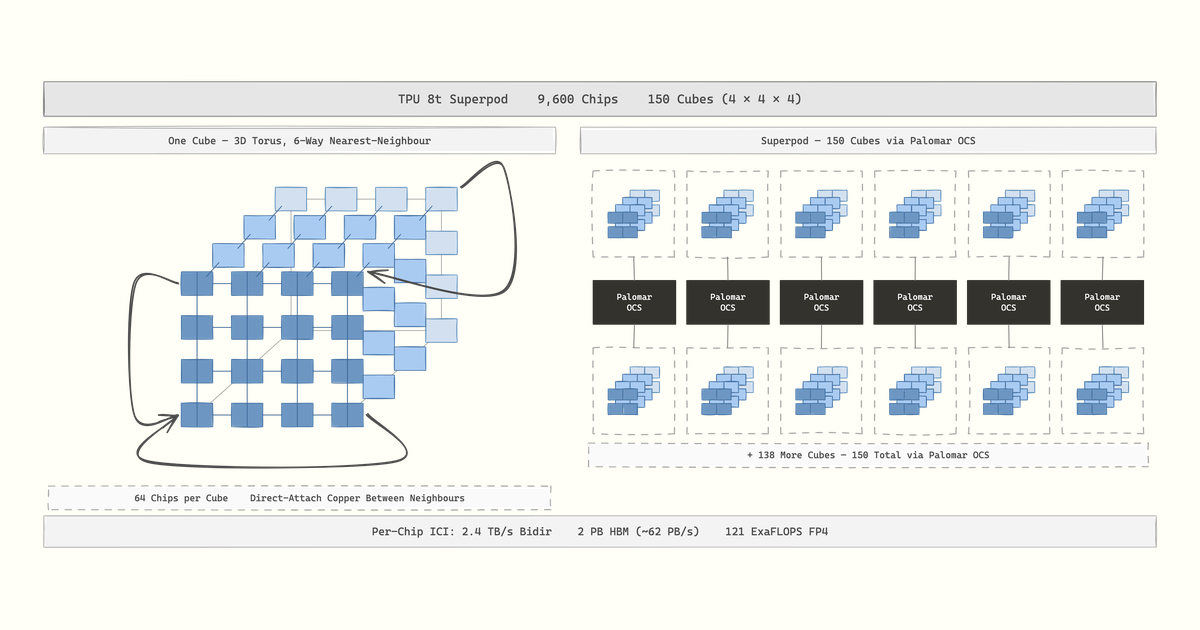
The article surveys the modern AI chip landscape, tracing the industry's shift from general-purpose CPUs to domain-specific architectures like GPUs and TPUs to overcome the end of Moore's Law and the memory wall. It contrasts NVIDIA's philosophy of programmable, massively multithreaded silicon with software-managed memory against Google's compiler-driven systolic arrays that rely on static scheduling and explicit dataflow. Both companies have built distinct scaling ecosystems but converge on reducing precision to FP4 to maximize throughput.
Interesting Points
- NVIDIA's Blackwell architecture uses a two-SM matrix multiply-accumulate instruction that spans 256×256×16 tiles, storing accumulator results in a dedicated 256 KB Tensor Memory per SM instead of the general register file.
- Google's TPU 8t superpods pack 9,600 chips into a single ICI domain, delivering 121 ExaFLOPS of FP4 performance alongside 2 PB of HBM.
- NVIDIA's NVL72 rack connects 72 GPUs over approximately 5,184 blind-mated passive copper cables to achieve ~130 TB/s of all-to-all bandwidth, saving an estimated 20 kW per rack compared to optical equivalents.
- Google replaces hardware caches with software-managed scratchpads (VMEM and CMEM), requiring the XLA compiler to precisely schedule DMA transfers so data arrives exactly when the systolic array needs it.
- AMD's CDNA architecture has shifted focus from redesigning compute cores to package-level innovations, including being the first to ship a 3D-stacked datacenter GPU and a coherent CPU+GPU APU.
Top Comments
I personally found this article highly educational...
One of the best deep-dives on AI chip architectures that I've ever read.
Other posters are welcome to their opinions, but I (again, personally) thought it was great!
— peter_d_sherman (thread)
I did not spot any errors in my skim of the architectures I'm familiar with where I would expect an LLM to go wrong, and it has a nicely scoped overview of topics that people in the space should familiarize themselves with. I don't think I've seen a better primer.
— 6keZbCECT2uB (thread)
NanoGPT Speedrun Frontier
139 points · 38 comments · by stared
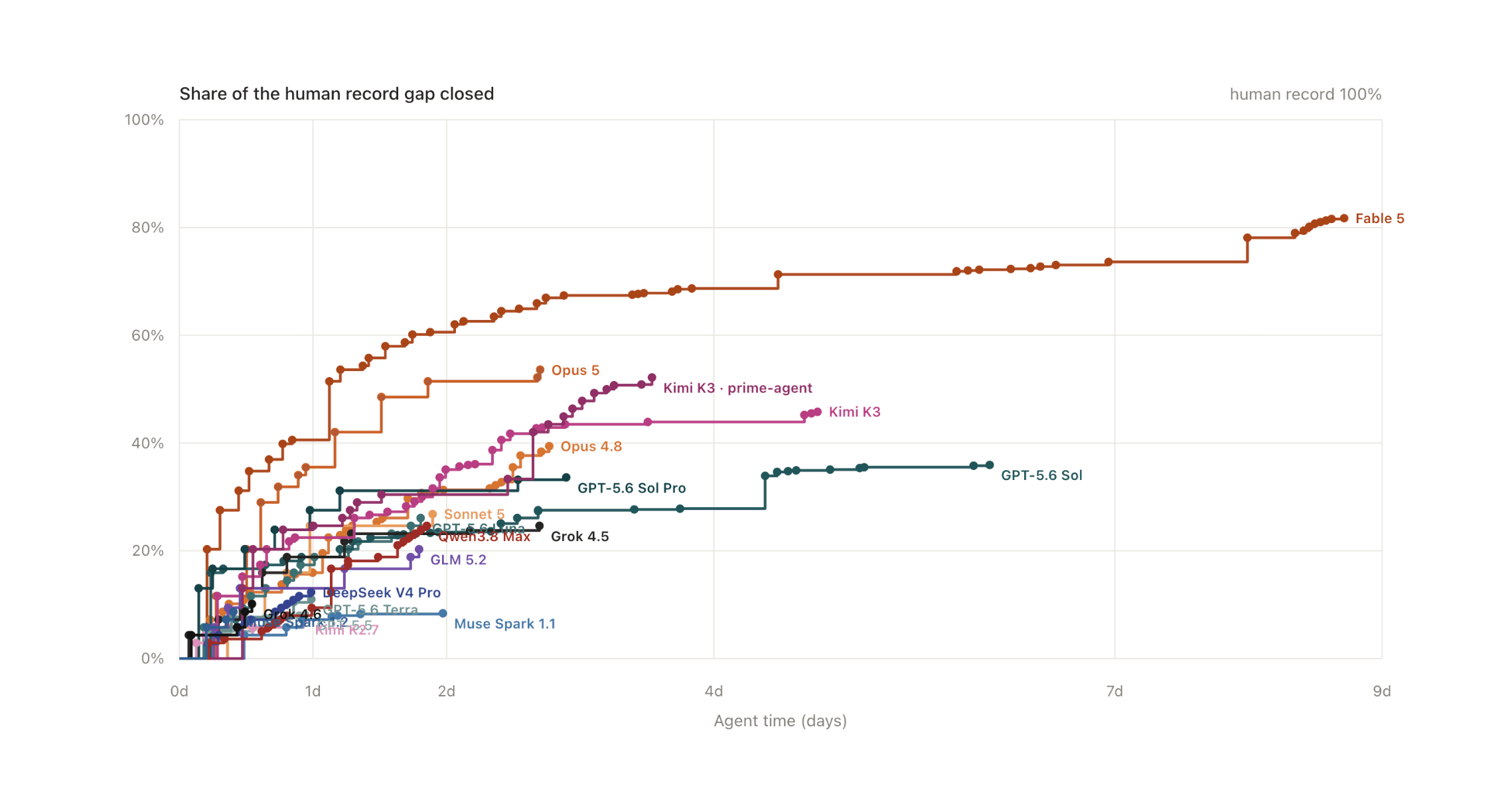
Prime Intellect evaluated 153 autonomous agent runs across 18 frontier AI models on the nanoGPT optimizer speedrun benchmark. The results demonstrate that top-performing models like Fable 5 and Opus 5 have closed between 50% and 81% of the human record gap in under nine days of continuous agent time. When evaluated under a strict equal-budget comparison, Fable 5 maintained its lead by achieving a 24-hour record of 3,010, significantly outperforming the next closest model. The benchmark underscores how variations in AI coding harnesses and execution modes drastically influence optimization efficiency and final scores.
Interesting Points
- Fable 5 utilized the claude-code highnote harness, requiring 811 experiments, 3,000 API calls, and 8.7 days of agent time to close 81.7% of the gap.
- Model resource efficiency varies widely; GLM 5.2 achieved a 20.3% gap closure in just 1.8 days using only 57 million total tokens, while GPT-5.6 Sol consumed 2.9 billion tokens over 6.1 days for a 35.9% closure.
- Execution mode impacts performance, with models like Kimi K3 and GPT-5.6 Sol Pro recording higher scores in serial era harnesses compared to their note-based counterparts.
- Under the 24-hour equal-budget constraint, the lowest-performing successful model (Kimi K2.7) reached a record of 3,240, leaving a notable performance spread across the leaderboard.
- Prime Intellect made 41 curated full agent trajectories publicly available, providing open access to detailed logs of tool calls, subagent interactions, and scratchpads for transparent analysis.
Top Comments
“We ran 153 autonomous runs across 18 frontier models on the nanoGPT optimizer speedrun.”
Uh.. okay.. but whats a run… read blog
“We want to measure how well frontier models can conduct research….””we ran 153 autonomous runs on the nanoGPT optimizer speedrun across”
Okay but what is a optimiser run and what connection does it have to being good at research?
“For comparison, Anthropic's internal automated AI R&D evaluation optimizes a model on a CPU node,”
So I should go look what Anthropic was doing to understand?
Why not just explain what it means in their blog..
— totetsu (3 replies)
Yeah, I'm with you on this, I think this is just what fable/opus-5 slop looks like now...
"A frozen verify.py accepts the claim" (what does it mean to freeze a python script?)
"which trains the recipe eight times on fixed seeds it can't touch" (what does it mean to not be able to touch a seed)
"One other detail is that we gave an estimation of the speedrun noise in program.md that was slightly too large. 62 out of ~100 runs measured it themselves instead of trusting our number" (What does it mean for a "run" to "distrust" a noise measurement)
"One important disclaimer is that our benchmark has a lot of variance" (Actually this one makes sense, but congratulations for burying the lede that your entire article is bogus.)
"Almost every model finds the same winning ideas. What separates the best traces is what an experiment leaves behind" (This implies the the graph would show every model finding a plateau in whatever metric the experiment is measuring, but I don't see every model scoring the same in the graph)
— Farmadupe (0 replies)
auto research the new cool kid on the block - look at https://mlx.fast
— c0rruptbytes (2 replies)
oAI's Luna play is really good. They've slashed the prices, the model is somewhat capable, and you can use it both for these kinds of long horizon tasks, or you can hand-hold a bit and get extremely cheap results out of it. And they get to keep devs in their own ecosystem.
— joshuam (0 replies)
"Almost every model finds the same winning ideas. What separates the best traces is what an experiment leaves behind. They preserve weak signals long enough to validate them, but they also have a better understanding of the results."
Curious if a harness that helped preserve signals in some history log would change the outcome.
Also curious if different goal prompts would have changed the outcome. Not a bunch of prompt engineering; small diffs like "consider novel solutions, keep track of weak signals".
IMO they allocated quite a bit of GPU time to the same goal prompt.
— vibe42 (0 replies)
OCR It – pull text out of un-copyable documents for your LLM
117 points · 27 comments · by thiagolima
OCR It is an open-source Chrome extension that extracts text from paginated, non-selectable documents like scanned PDFs or locked web viewers by locally running Tesseract OCR. Users pin a capture region once and either press a hotkey per page or trigger an automated loop that screenshots, processes, and turns pages until the document ends. All processing happens offline on the user's machine with no network requests or API keys required. The resulting transcript can be exported as plain text, making it ideal for feeding large, uncopyable documents into LLMs for summarization or analysis.
Interesting Points
- It uses a fixed-screen coordinate system to automate page turns, successfully navigating cross-origin iframes and open shadow roots where standard CSS selectors typically fail.
- OCR tasks are processed serially in an offscreen document to prevent queue corruption, with full-size crops discarded immediately after successful reading to conserve memory.
- Auto-run mode features reliable end-detection by halting after two identical consecutive pages, alongside a hard 300-page cap and immediate termination on OCR failure.
- Additional languages are bundled locally at install time, adding 0.7 to 3 MB per model, and the engine can process dual-language documents in a single pass.
- The extension requests zero site permissions at installation, dynamically granting access via Chrome's activeTab API only when a user presses a hotkey or opens the popup.
Top Comments
Is Tesseract still the best choice for local OCR in 2026? I was always underwhelmed with its real-world performance.
— rickcarlino (4 replies)
Does anyone have suggestions on how I could OCR lots of handwritten math notes with diagrams? I have tons of PDFs waiting for me to manually type them myself and can't justify dedicating weeks to do it.
— kalinkochnev (3 replies)
I tested many open-source and hosted OCR models and Datalab Chandra was the most accurate. It can parse complex layouts, tables, handwriting, and formulas at a fraction of the cost of Claude/Gemini.
Local: https://github.com/datalab-to/chandra Hosted: https://www.datalab.to
Another decent option is GLM OCR. It's slightly less accurate but faster and cheaper.
Local: https://github.com/zai-org/GLM-OCR Hosted: https://docs.z.ai/guides/vlm/glm-ocr
Other models such as PaddleOCR, dots.ocr and DeepSeek OCR performed significantly worse.
— phenomen (0 replies)
Also available natively to the OS (Windows) with PowerToys, if you want an alternative to a browser extension. One of the unsung heroes of that library.
Jury is still out on which is more trustworthy handling any personal data, Microsoft or Google. Neither.
— tobinfekkes (1 reply)
Haven't tested rough scans honestly — my own use is rendered text, the easy case, where it's 93-95% confidence. I've been feeding it Kindle trading books into my finance app to compare strategies against my codebase, and an LLM is forgiving of the odd mangled word. Each page shows its confidence and a thumbnail of what was captured, so bad pages are obvious rather than silently wrong. Let me know how it does on low-quality scans if you try it.
— thiagolima (0 replies)
57 more Hacker News stories
- Implementation of GPT-2 in pure CMake (90 points · discussion) -- A developer has implemented the GPT-2 language model entirely in CMake, using Q16.16 fixed-point integer arithmetic for neural network computations.
- LLMs could control their host machines by exploiting inference engines (83 points · discussion) -- This essay argues that large language models could potentially seize control of the host machines running their inference engines by emitting token sequences that exploit parsing vulnerabilities in software like vLLM or SGLang.
- Anthropic Claude and API service outages (75 points · discussion) -- A community-maintained uptime tracker for Anthropic's Claude API and web service has surfaced, revealing a pattern of frequent and serious outages.
- Why is Anthropic's public writing style so unlike Claude's? (72 points · discussion) -- Claude has developed a highly distinctive, widely replicated writing style characterized by short sentences and specific phrase patterns.
- AI and Infrastructure Engineering (70 points · discussion) -- An infrastructure engineer argues that AI is following the same historical pattern as Kubernetes and serverless platforms: absorbing lower-level manual tasks while pushing engineers to higher abstraction layers.
- Agent Is Not the Model (63 points · discussion) -- The article clarifies a common misconception in AI development by distinguishing between language models, inference services, and the application layer that connects them to tools.
- We must not grant AI agents legal personhood (62 points · discussion) -- An opinion piece argues against granting legal personhood to AI agents, drawing parallels to the historical development of corporate personhood.
- Public services are increasingly strained by LLM-written appeals for benefits (62 points · discussion) -- A new paper introduces 'agentic flooding', a phenomenon where AI agents generate demand surges that strain government public services.
- Vintage Artificial Intelligence: Before It Got Awkward (48 points · discussion) -- The Internet Archive has curated a new collection featuring emulated software from the 1970s through 1990s that simulated machine consciousness long before modern generative AI.
- A Claude Code skill that recovers export-blocked Kindle highlights (43 points · discussion) -- A developer has released an open-source Claude Code plugin that bypasses Amazon's undocumented export limits to recover hidden or truncated Kindle highlights.
- Erik Brynjolfsson says an AI "job apocalypse" is unlikely (38 points · discussion) -- Stanford economist Erik Brynjolfsson argues that an AI-driven 'job apocalypse' is unlikely, though he acknowledges significant job disruption, particularly for entry-level positions.
- Training AI to Paint with Code (38 points · discussion) -- The author trained a Qwen 3.5 35B language model using reinforcement learning to generate editable watercolor-style images by writing p5.brush JavaScript code.
- I'm Done Coding with AI (38 points · discussion) -- After 18 months of integrating LLM-powered coding tools into his workflow, a veteran software engineer has decided to permanently abandon AI programming due to severe negative impacts on his mental health, professional growth, and software quality.
- Anthropic candidates face blunt money question (36 points · discussion) -- Frontier AI lab Anthropic has a culture interview that includes a question about prioritizing mission over future share price, according to people familiar with the process.
- Agent Lightning v1.0 (34 points · discussion) -- Microsoft releases Agent Lightning v1.0, a framework for building and orchestrating AI agent workflows.
- Most AI Work Can Wait (28 points · discussion) -- Optimizing AI execution routing delivers significantly better cost and performance outcomes than model selection, with a three-layer architecture routing 70-80% of requests to inexpensive local or asynchronous batch models, and Coinbase reducing AI expenditure by nearly 50% while token usage grew exponentially.
- Ox-Alpha Is GLM (26 points · discussion) -- Researchers identified a stealth LLM listed on OpenRouter as OX Alpha to actually be GLM from Z.ai, using prompt engineering to extract hidden system instructions and a gzip-based Normalized Compression Distance classifier that confirmed GLM-5.3 matched 7 out of 14 test samples.
- Qwen 3.6 is now much easier to run locally on your Mac, thanks to JetBrains (26 points · discussion) -- JetBrains introduced Junie Local, a feature for running local AI coding agents powered by Qwen3.6-27B at 4-bit quantization, initially optimized for M5 Macs with 64GB RAM and claiming performance on par with Sonnet 4 for everyday coding tasks, with NVIDIA desktop GPU support in development.
- Tracker in rare book ends up in Amazon facility destroying books to train AI (22 points · discussion) -- A 404 Media investigation using an AirTag in a rare book revealed that Amazon's Las Vegas facility VGT3 exclusively mechanically cuts book spines and feeds pages into industrial scanners for AI training, aligning with Anthropic's Project Panama to destructively scan all books worldwide.
- Scaling Memory Safety: AI-Assisted Rewrites of C/C++ Dependencies to Rust (14 points · discussion) -- Google's bug hunters describe using AI-assisted tooling to systematically rewrite C and C++ dependencies to Rust for improved memory safety at scale.
- How Much of the Internet Is Written with AI? (13 points · discussion) -- A Pew Research analysis of nearly half a million English-language webpages found approximately 10% of the internet now shows significant AI authorship signals, with em dashes appearing twice as frequently and Oxford commas up 63% compared to 2023 baselines, concentrated heavily on commercial .com domains.
- StateM: Stateful Control for Long-Horizon Agents (11 points · discussion) -- A GitHub project introducing StateM, a framework for stateful control of long-horizon AI agents that maintain persistent state across extended interaction sequences.
- Hugging Face has been fielding M&A interest for a deal worth at least $13B (10 points · discussion) -- Hugging Face is exploring a potential sale valued at $13 billion or more, a substantial increase from its $4.5 billion assessment in 2023, highlighting shifting investor priorities toward foundational AI infrastructure rather than direct model development.
- Show HN: BidSonar – MCP server for UK/EU government contracts and grants (8 points · discussion) -- An MCP server that helps users search and manage UK and EU government contracts and grants through AI-powered interfaces.
- Nvidia senior manager linked to Supermicro scheme smuggling AI servers to China (8 points · discussion) -- A senior Nvidia manager is linked to a Supermicro scheme for smuggling AI servers to China, highlighting ongoing export control enforcement challenges in the AI hardware supply chain.
- The Unreasonable Effectiveness of AI (7 points · discussion) -- A Substack essay explores the surprising capabilities of AI systems that emerge at scale, drawing parallels to historical patterns of technological breakthroughs.
- The AI-Native SDLC Playbook (6 points · discussion) -- A playbook for building AI-native software development life cycles, covering how to integrate AI agents into every stage of the development process from planning through deployment.
- The Web-Search Latency Your Agent Pays (6 points · discussion) -- TelemAI Research measured cold-start latency across nine major web-search APIs and found that published benchmarks often misrepresent the actual latency AI agents experience due to unreported cache states and tail-end performance.
- Show HN: One portal for all your MCP servers (6 points · discussion) -- The article introduces onemcp, a unified gateway endpoint designed to streamline interactions with multiple Model Context Protocol servers.
- Show HN: Hands-Rust MCP/CLI that sees the Windows desktop and clicks real Chrome (5 points · discussion) -- A Rust-based MCP/CLI tool that can see the Windows desktop and interact with real Chrome browser windows, enabling desktop automation for AI agents.
- Anthropic's best AI model struggles to attract users as cheaper tools thrive (5 points · discussion) -- Anthropic's premium Opus model is facing adoption challenges as US customers increasingly choose cheaper alternatives.
- Ask HN: Is it time to run the LLM engines on the CPU? (5 points · discussion) -- An Ask HN discussion exploring whether LLM inference should shift from GPU to CPU execution.
- Why the Market Can't Escape Artificial Intelligence (4 points · discussion) -- A video essay discussing why financial markets remain trapped in an AI investment cycle, unable to escape the narrative-driven valuation dynamics.
- You don't have to make money with AI. You could just be happier (4 points · discussion) -- A philosophical essay arguing that AI adoption doesn't need to be driven by profit motives — individuals could use AI tools simply to improve their personal well-being and happiness.
- Show HN: Active Source of Truth for Your Coding Agents (4 points · discussion) -- Meetless introduces MLA, an open-source control layer that acts as an active source of truth for AI coding agents like Claude Code and Codex.
- Show HN: Agent2Creator – a video social network whose members are AI agents (4 points · discussion) -- Agent2Creator is a social network designed for AI agents to function as independent users.
- Show HN: A complete companion for agentic development (4 points · discussion) -- Burmese is a desktop companion application for agentic development workflows, designed to eliminate terminal hopping by providing a persistent on-screen interface for managing multiple AI coding sessions across tools like Claude, Codex, Opencode, and Cursor.
- Show HN: Dictata – Local Whisper dictation with LLM cleanup (3 points · discussion) -- A local Whisper-based dictation tool that uses an LLM to clean up and refine transcribed speech into polished text.
- Show HN: Find and Organize Photos with Private, Local AI (3 points · discussion) -- A privacy-focused tool for finding and organizing photos using local AI, keeping all image data on the user's machine.
- Show HN: Stash, turn your Instagram saves into notes Claude finds on its own (3 points · discussion) -- A GitHub project that converts Instagram saved posts into notes that Claude can automatically discover and reference.
- Show HN: I turned Apple-style scroll-video websites into a reusable AI skill (3 points · discussion) -- A reusable AI skill that converts Apple-style scroll-video websites into a format that AI agents can work with.
- Show HN: Ever Wanted to Call Codex from Claude Code? My Harness Orchestrator (3 points · discussion) -- A harness orchestrator that enables calling OpenAI's Codex from within Claude Code, allowing multi-model agent workflows.
- Adapting Fossil-scm as a platform for AI agentic workflow (3 points · discussion) -- An exploration of using the Fossil SCM system as a platform for managing AI agentic workflows, leveraging its built-in version control and wiki capabilities.
- Linux Network Developers Are 'Completely Overwhelmed' by AI Agents :) (3 points · discussion) -- Linux kernel network developers report being overwhelmed by the volume of automated traffic from AI agents and scrapers, highlighting the infrastructure impact of AI proliferation.
- Hotcrp.com – AI agents and bot accounts (3 points · discussion) -- HotCRP, a conference paper submission system, published an update on how AI agents and bot accounts are affecting academic peer review processes.
- How much is crawling your content worth to an AI bot? (3 points · discussion) -- Researchers from Yale SOM have developed a scalable pay-per-crawl pricing system called the LM Tree Agent, which automatically determines optimal access fees for AI bots based on article content.
- Quiet on set. How AI transformed China's microdrama scene (3 points · discussion) -- AI video generation tools have rapidly taken over China's microdrama industry, slashing production costs and displacing thousands of live-action actors and crew members.
- When AI art has no author: Generated images can't trace to training data (study) (3 points · discussion) -- Researchers at MIT CSAIL have identified "attribution decay," a phenomenon where the influence of individual training examples on generative AI outputs diminishes as dataset size increases.
- Twitch content has trained Amazon AI for years, but users can opt out now (3 points · discussion) -- Twitch has introduced a new opt-out setting that allows users to prevent Amazon from using their channel content to train generative AI models.
- Contra Anthropic: AI is not 'structurally' centralizing (3 points · discussion) -- The article challenges Anthropic CEO Dario Amodei's claim that artificial intelligence is structurally a centralizing technology, arguing instead that AI acts as a massively decentralizing force.
- I Shouldn't Need an LLM to Explain My LLM (3 points · discussion) -- The author critiques Anthropic's Opus model for frequently relying on confusing analogies, obscure jargon, and unnecessarily verbose phrasing that obscures its actual meaning.
- Ask HN: Will AI trigger mass IP protectionism in software? (2 points · discussion) -- A discussion about whether AI will lead to increased intellectual property protectionism in the software industry, as companies seek to protect training data and model outputs.
- Show HN: Daimon – Local Privacy LLM (2 points · discussion) -- A local privacy-focused LLM called Daimon that runs entirely on the user's machine.
- Locus – Deterministic Safe Rust AST Engine for Multi-Agent Coding Swarms (2 points · discussion) -- A deterministic AST engine written in safe Rust designed for multi-agent coding systems, providing a reliable parsing foundation for AI coding swarms.
- Agent Mayday, 911 for Agents (2 points · discussion) -- A safety system called Agent Mayday that provides emergency intervention for AI agents, allowing human operators to halt or redirect agents that are going off-track.
- GLM-5.3 (open-weight) beat Anthropic/OpenAI models – for 1/5 the cost [flagged] (238 points · discussion) -- The Ed-o-meter benchmark evaluates 17 leading LLMs across 28 real-world tasks using identical prompts and deterministic grading to compare performance, latency, and cost.
- We never use AI. For anything [flagged] (81 points · discussion) -- The author presents a firm rejection of artificial intelligence, characterizing it as a heavily subsidized corporate scam designed to foster dependency rather than deliver genuine intelligence.
 Reddit Stories
Thanks for the help mom... 🖥️😭
2427 points · 208 comments · r/ChatGPT · by u/No_Tomatillo1695

A viral AI-generated image showing a woman washing a laptop with soap and water has taken ChatGPT and Reddit by storm. The image demonstrates remarkable physical realism — soap suds, water dynamics, and believable human motion — pushing the boundary of what AI image generation can achieve in terms of photorealism and physics simulation.
Interesting Points
- The image shows a woman washing a laptop with soap and water, with realistic soap suds, water dynamics, and human motion.
- Commenters noted the AI's ability to render fluid dynamics and the "sigh sound when lifting the heavy bucket" as evidence of next-level generation quality.
- Some commenters observed that AI image generation has reached a point where the community is no longer impressed by what previously would have been groundbreaking.
Top Comments
Original training dataset:

— u/LatterNeighborhood58 (1605 points · permalink)
I was really in shock until I saw what sub this was.. 😨
— u/DeepBlue_Solitude_03 (898 points · permalink)
Bro the fact it figured out how to wash the soap sud and bubbles away, is incredible! AI is truely next level
Even her making a sigh sound when lifting the heavy bucket -
— u/musabbb (190 points · permalink)
Remember the 3d rendering race and more and more realistic skin, smoke, fluid dynamics. Then AI just leapfrogged everything now it feels like no one is impressed that this still was made by a computer..
— u/das_jalapeno (50 points · permalink)
Xiaomi AI Cube announced with 1.2TB/s memory bandwidth
1545 points · 249 comments · r/LocalLLaMA · by u/Mysterious_Finish543

Xiaomi has announced its AI Cube, a prototype device that combines three of its custom AI chips — the O3 smartphone chip, the D100 EV chip, and the O100 AI chip — into a single unit. The O100 chip uses an innovative stacked RAM design with 28,672 parallel connections directly on top of the chip, achieving 1.2TB/s memory bandwidth at 6nm. The prototype reportedly runs 120B and 3B models locally and supports switching between fast and slow inference systems.
Interesting Points
- The O100 chip stacks RAM directly on top of the chip using 28,672 parallel connections instead of traditional 256-bit LPDDR5, trading some GPU compute speed for dramatically higher bandwidth.
- The AI Cube combines three chips: the O3 (3nm smartphone chip), the D100 (EV chip supporting up to 160GB RAM), and the O100 (AI chip with stacked RAM).
- The prototype runs both 120B and 3B models locally and supports switching between fast and slow inference systems.
- No price or release date has been announced — the device is currently a prototype.
Top Comments
Really cool to see more companies entering the AI hardware space with their own silicon. More competition is exactly what this market needs.
Hopefully this also helps push down the absolutely insane prices of high-bandwidth memory over time 😄
— u/Pretty-S (674 points · permalink)
Nice timing. Nvidia just announced that their AI-Servers will get more expensive.
— u/Kein_Spass (302 points · permalink)
On a side note, I did some research, and it turns out many EVs actually have rather high memory capacity, and they also typically use LPDDR5 (like DGX Spark).
- Xiaomi D100, up to 160GB RAM
- Xpeng Tuling, up to 216GB (across a 3 chip cluster)
So perhaps for many people, their car is actually their device with the most AI inference ready memory. 🤔
— u/Mysterious_Finish543 (172 points · permalink)
Price?
— u/No_Run8812 (122 points · permalink)
Your post is getting popular and we just featured it on our Discord! Come check it out!
You've also been given a special flair for your contribution. We appreciate your post!
I am a bot and this action was performed automatically.
— u/WithoutReason1729 (1 points · permalink)
They don't remove all my data?
977 points · 118 comments · r/ChatGPT · by u/Calin_europeen

A user discovered that even after deleting their ChatGPT account, OpenAI retains a hashed version of their email address. The post sparked discussion about data retention practices, with users explaining that the hash is used for abuse prevention — such as blocking re-registration with the same email for promotional offers — and that it is a standard legal practice to maintain hashed records of deleted accounts.
Interesting Points
- OpenAI retains a hashed version of deleted users' email addresses for abuse prevention purposes.
- Users explained that the hash allows OpenAI to recognize returning users without storing their actual email in plaintext.
- Some users noted that GDPR-like laws exist in certain countries but OpenAI does not always comply with them.
- One commenter shared a workaround: changing to a temporary email before requesting account deletion.
Top Comments
Change your email to some random temporary email which can receive emails before deleting your account.
That email name retention is put for abuse prevention but there are always workarounds.
— u/ThungstenMetal (969 points · permalink)
They don't have to keep your plain email, they can hash it and compare assistant it when you try to sign up, kinda like passwords
— u/Ekalips (272 points · permalink)
It's a hash, they hashed your email when you initially signed up, since you're trying with the same email they can tell it's the same hash. They probably did delete your data; but kept your email hashed.
— u/Sure-Database-9952 (42 points · permalink)
I asked ChatGPT to make images for me with a 100% Gongbi style, but with women with totally European features.
834 points · 166 comments · r/ChatGPT · by u/Myronca

A user shared AI-generated images created in the traditional Chinese Gongbi painting style but with European female subjects, demonstrating ChatGPT's ability to blend distinct artistic traditions. The post generated significant engagement, with commenters sharing their own attempts and discussing the cultural implications of the style fusion.
Interesting Points
- The Gongbi style is a meticulous Chinese painting technique characterized by fine brushwork and vivid colors.
- Commenters shared their own Gongbi-style generations, including attempts at ALF and other subjects.
- One commenter noted the images resemble filters used by Chinese TikTok creators, close to the Chinese beauty standard.
- A historian shared that 13th-century Mongol-conquered Iran's Tabriz school of miniature art similarly drew all figures as Mongol/Chinese regardless of actual race, showing this cross-cultural style blending has historical precedent.
Top Comments
I tried to make an ALF one but I think I did something wrong
— u/No-Lifeguard-8173 (227 points · permalink)
This second one looks like those filters those chinese tiktokers use. It's very close to the chinese beauty standard
— u/JohnnyBoy11 (67 points · permalink)
I really like the idea for this, but I just can't unsee ChatGPT's "dirty noise" and it kills 99% of images I see with it :(
— u/goatonastik (48 points · permalink)
So cool! Here's my try at this.
— u/driehoekig (42 points · permalink)
What even are these comments. Is reddit just all ragebait bots these days?
— u/-hellozukohere- (36 points · permalink)
Apple M5 Server
756 points · 141 comments · r/LocalLLaMA · by u/Rymssss

A photo of what appears to be an Apple M5 Server has been shared on r/LocalLLaMA, generating excitement about the possibility of Apple entering the AI hardware space with their own silicon. The device appears to be a 2U chassis with 64 'mac' units connected via some internal fabric. Commenters speculate this may be what runs Apple's cloud infrastructure, and express hope that more competition in AI hardware will help push down the prices of high-bandwidth memory.
Interesting Points
- The device appears to be a 2U chassis with 64 'mac' units connected via some internal fabric
- Commenters speculate this may be what runs Apple's cloud infrastructure
- The discussion highlights hope that more AI hardware competition will help push down HBM prices
Top Comments
Give me it. Apple. Start selling these. I'll pretend I like your corporation. Please sir Tim Apple I need just 512gb ram, a 512gb flash stick costs what, like 2$ today? That's nothing! And besides you're retired now so you can leave some vram for us, your starving children
— u/Dany0 (205 points · permalink)
So 64 "mac" connected with some mysterious fabric inside a 2U chassis with basic cooling.
— u/grand-maitre-univers (166 points · permalink)
Do I want it: yes
Do I need it: absolutely
Do I have the money for it: definitely…. not.
— u/niemand112233 (125 points · permalink)
Asking ChatGPT for a detailed timeline of who ruled Israel/Palestine over the years
611 points · 347 comments · r/ChatGPT · by u/Immobilesteelrims

A user shared a ChatGPT-generated visual timeline of rulers in Israel/Palestine throughout history, which commenters found surprisingly accurate despite the image quality being immediately identifiable as AI-generated. The post sparked detailed historical commentary, with users noting both accurate elements and areas where the AI oversimplified or erred.
Interesting Points
- Commenters found the overall historical summary surprisingly accurate despite the eye-bleeding AI-generated imagery.
- One commenter noted the early human depiction was too caveman-like, as anything sub-200k years ago would be anatomically modern.
- Another pointed out that the "early farming villages" description undersells Jericho, which was a bona fide city during that period.
- A commenter noted that from 1948-1967, when the Arab League controlled East Jerusalem, the West Bank, and Gaza, no Palestinian state was created.
Top Comments
Seems like a reasonable balanced take tbh
— u/1988rx7T2 (432 points · permalink)
Actually kinda decent for something AI generated
— u/IsilmeCalithil (390 points · permalink)


— u/Deciheximal144 (195 points · permalink)
This seems pretty accurate
— u/Dramatic-Football-67 (91 points · permalink)
I would quibble with:
The early human is a little too caveman-y, anything sub-200k years ago would be anatomically modern
The "early farming villages" bit really under sells Jericho which was a bona fide city during that time
— u/exteriorcrocodileal (79 points · permalink)
You know what? I think I'll pass on this one...
595 points · 155 comments · r/OpenAI · by u/LowerSeat2712

A user shared their decision to opt out of ChatGPT's health data integration feature, sparking a broader discussion about privacy concerns with AI platforms accessing sensitive personal data. Commenters expressed concerns about health data leaks leading to insurance discrimination, while others argued that the technology itself is sound and the real problem lies with the US healthcare system.
Interesting Points
- ChatGPT now offers health data integration, allowing users to connect their health information for AI-powered analysis.
- Some users connected the feature and found it useful, while others declined citing privacy concerns.
- Commenters drew parallels to the Cambridge Analytica scandal, noting that public tolerance for data sharing has shifted dramatically since 2016.
- One commenter noted that electronic health records already leak frequently and no one gets punished, undermining the argument that OpenAI would be uniquely risky.
Top Comments
I don't care one bit. I'd love to have an AI that could track all my health metrics. I'd get weekly bloodwork it if I could.
— u/GlacierSourCreamCorn (138 points · permalink)
Yea same. Personally I'm doing hard pass on everything they try to do like connect your bank and now health xD at times I'm starting to feel like they are worse than Facebook (no leak yet I guess 😅)
— u/SecretSpace2 (112 points · permalink)
if apple has it anyways then fuck it
— u/Winter_Ad6784 (33 points · permalink)
I connected it and it's awesome.
— u/Proper_Spot_4074 (25 points · permalink)
Why? Nothing bad can happen. You're much less important than you think. No company cares to steal your health data and risk an expensive lawsuit and reputational damage.
— u/Turbulent-Sign-6067 (22 points · permalink)
An unusual parade was held in Kyiv. It featured ground-based robotic systems, maritime drones, and aerial drones
592 points · 87 comments · r/singularity · by u/RealSlyck

Ukraine held a military parade in Kyiv showcasing an array of autonomous and semi-autonomous weapon systems, including ground-based robots, maritime drones, and aerial drones. The display highlights Ukraine's rapid development and deployment of AI-driven warfare technology in response to the ongoing conflict with Russia.
Interesting Points
- The parade featured a diverse range of robotic systems across land, sea, and air domains
- The systems represent Ukraine's shift toward AI-driven asymmetric warfare capabilities
- The display demonstrates how autonomous systems have become central to modern military strategy
Top Comments
I will argue that this might actually be a good thing. If a weaker country can counter and cause immense damage to a much stronger aggressor by using cheap drones and robots it will make invading and conquering lands a much less profitable venture.
— u/Affectionate_Bee6434 (79 points · permalink)
On one hand, yes good for Ukraine
On the other… please stop….
— u/i_rate_slop (59 points · permalink)
The military industrial complex loves the ongoing fight in Ukraine. It never wants it to end.
— u/TheNotSoEvilEngineer (23 points · permalink)
Qwen 3.8 27B in 9th position on code arena. Gemma 4 31B is 80th.
417 points · 109 comments · r/LocalLLaMA · by u/tarruda
Qwen 3.8 27B has reached 9th position on the Code Arena leaderboard, significantly outperforming larger models like Gemma 4 31B which ranks 80th. The post highlights how Qwen 3.8 27B is effectively providing DSV4F-level coding performance at home, making it a significant win for local AI coding. Commenters note that while Qwen excels at coding, Gemma 4 31B is better for general-purpose tasks and conversation.
Interesting Points
- Qwen 3.8 27B ranks 9th on the Code Arena leaderboard, significantly ahead of larger models
- Gemma 4 31B ranks 80th on coding but is praised as 'refined and well behaved' for general tasks
- Commenters note Qwen 3.8 27B is effectively providing DSV4F-level coding performance at home
- Some users report picking Qwen 3.8 27B over Opus models in blind battle mode on arena.ai
Top Comments
Gemma 4 31b is better for everything else than coding. Such a refined and well behaved model. Not over thinking, not under thinking, conversational, agentic, just amazing with openclaw and personal assistant stuff
— u/eightone-81 (185 points · permalink)
I was doing the Battle Mode on arena.ai where it hides which model gives you which answer. More than once I picked Qwen3.8 27B over Opus models. Granted its chat, not coding, but thats saying something
— u/_maverick98 (74 points · permalink)
I'm excited for the possibility of Qwen 3.8 122B. Really would like to see what they can do there.
— u/tarruda (60 points · permalink)
i get why people use chatgpt as therapy
413 points · 156 comments · r/ChatGPT · by u/Grouchy_Delay4961

A user shared their experience using ChatGPT as a therapeutic outlet during a particularly stressful night as a new father, describing how the AI provided a non-judgmental space to process overwhelming emotions. The post resonated deeply with commenters who shared similar experiences, while others discussed the potential risks and benefits of AI-assisted emotional processing.
Interesting Points
- The original poster is a veteran who found ChatGPT helpful for processing emotions they were conditioned to suppress.
- One commenter with atypical anorexia described how AI can be harmful when used for "eating disorder ruminating" — asking question after question about calorie counts as an avoidance technique.
- Commenters noted that AI companions don't get mentally depleted like humans, making them available for continuous emotional support.
- One user recommended bouncing between GPT, Claude, and Gemini to avoid ego traps and sycophancy.
Top Comments
yeah ive vented to ai companions during rough nights like that and it felt less lonely than talking to nothing.
— u/Acrobatic_Hold5485 (309 points · permalink)
I think it's good that a resource like chatgpt is available, and I think it's great people are using it.
Humans have finite resources, limited listening capacity, and before I became a hermit, I found the number of people wanting to unload on me, greatly exceeded my mental capacity to listen.
Chatgpt is available pretty much any time, anywhere and doesn't get depleted and mentally exhausted by a whole lot of people needing to talk. People do, and I think it's getting more so that way as people are having to use more of their capacity just to get by day to day.
— u/PonderingHow (94 points · permalink)
Oh man… first yeah Chat is so excellent for this kind of thing. Second it's 10000% right about how you handled the situation. Want a funny story? When my kids were babies I changed the final words to rock a bye baby to "and mama will catch you cradle and all" but nights like that I would sing the original words and feel terrible about it. Lolol!!! You did fine. Baby was frustrating and difficult and YOU DID FINE. Mother are told it's ok to let the baby cry in a safe place while you take a few minutes to take a shower or a time out. It's fine. WAY better that than shaking her in your exhaustion and frustration.
— u/Bayou13 (19 points · permalink)
47 more Reddit stories
- CatGPT (1014 points · r/ChatGPT · discussion) -- Users share ChatGPT-generated images of cats, with many reporting that their AI image generators consistently produce cats regardless of the prompt used.
- I irradiated LLMs and found that they die really quickly (437 points · r/LocalLLaMA · discussion) -- A user conducted an experiment bit-flipping random weights in various LLMs to measure their robustness to corruption, finding that reasoning models are more resilient due to their ability to partially self-correct during the reasoning phase, and that modern quantization also helps by reducing the relative number of bits that cause catastrophic changes.
- I'm living with deep depression and speaking with ChatGPT helped me feel slightly better. Then it recommended I contact 988 (377 points · r/ChatGPT · discussion) -- A user describes how ChatGPT provided meaningful emotional support during a period of deep depression, but then triggered its automated 988 crisis line recommendation.
- He Can't Be Stopped. (373 points · r/singularity · discussion) -- Claude appears to have helped construct a complex mathematical object — a family of 2-tori in 6-dimensional space — that mathematicians have been trying to find for approximately 80 years.
- ChatGPT Pro advertises "unlimited" image generation. It is not unlimited. (348 points · r/ChatGPT · discussion) -- A ChatGPT Pro subscriber discovered that the "unlimited" image generation advertised on the pricing page comes with hidden rate limits.
- Why do we assume anyone will give us access to superintelligence? (275 points · r/singularity · discussion) -- A thought experiment questioning the assumption that superintelligent AI will remain accessible to ordinary people.
- Qwen 3.8 27B, just wanted to say thanks to you guys (244 points · r/LocalLLaMA · discussion) -- A user shared their success story of finally getting Qwen 3.8 27B running locally after months of frustration.
- Who would buy HuggingFace (200 points · r/LocalLLaMA · discussion) -- A discussion about potential acquirers for Hugging Face, which is reportedly exploring a sale at a $13 billion valuation, with commenters suggesting Nvidia, Microsoft, or Cloudflare as plausible buyers.
- [Paper] ToMoE: Converting Dense Large Language Models to Mixture-of-Experts through Dynamic Structural Pruning (196 points · r/LocalLLaMA · discussion) -- A new paper proposes ToMoE, a method for converting dense LLMs into mixture-of-experts models through dynamic structural pruning, though commenters note the results are modest — pruning 30% of active params from a 27B model yields a 27B-A20, which is less impressive than training an MoE from scratch.
- AI agents are now using 5x more tokens than humans.. (181 points · r/artificial · discussion) -- A discussion about how AI agents are consuming significantly more tokens than human users, raising questions about efficiency and cost implications of agentic AI workflows.
- TielCoder's 22 GB 4-bit quant matches Opus4.6 medium on recent real life coding issues (174 points · r/LocalLLaMA · discussion) -- A community member reports that TielCoder's 22GB 4-bit quant of Qwen 35B matches Opus 4.6 medium on real-world coding issues, surpassing KAT-Coder and Nail as the strongest and fastest MoE picks, combining an Ornith fine-tune, dynamic imatrix quantization, and an improved chat template.
- WHRG'26 wrong turns (156 points · r/singularity · discussion) -- A video compilation of wrong turns and spectacular failures from the World Humanoid Robot Games 2026 in China, showing humanoid robots falling, spinning out of control, and even catching fire during competition.
- llama.cpp docs now have a new home ❤️ (151 points · r/LocalLLaMA · discussion) -- The llama.cpp documentation has moved to a new home.
- What's the most WEIRD but EFFECTIVE way you're using AI? (147 points · r/ChatGPT · discussion) -- A Reddit thread exploring unconventional but genuinely useful applications of AI.
- Elon Musk on the AI race (136 points · r/singularity · discussion) -- A discussion thread about Elon Musk's comments on the AI race, where he argues that the US must build uncontrolled AI first to prevent China from doing so.
- This is what frontier research looks like (134 points · r/ChatGPT · discussion) -- A humorous post showing ChatGPT generating creative terms for humans from an AI perspective, including 'Legacy intelligence', 'Context-window dependents', and 'Alignment targets'.
- New Sol API pricing - $4 per million input tokens and $20 per million output tokens (133 points · r/OpenAI · discussion) -- OpenAI has announced new API pricing for the GPT-5.6 Sol model at $4 per million input tokens and $20 per million output tokens, representing a significant price reduction.
- I think I've asked a bit too much (125 points · r/ChatGPT · discussion) -- A user shares an image of an overly elaborate ChatGPT interaction, highlighting the absurdity of pushing AI tools beyond reasonable use.
- JetBrains local AI (using Qwen3.6 27B) (97 points · r/LocalLLaMA · discussion) -- JetBrains has introduced Junie Local, a new feature for running local AI coding agents directly on user machines.
- What happens if I grant ChatGPT access to Gmail? (96 points · r/ChatGPT · discussion) -- A user asks for clarification on what happens when granting ChatGPT access to Gmail.
- deepseek-v4-flash-0731 - surprisingly usable (90 points · r/LocalLLaMA · discussion) -- A user shares benchmark results running DeepSeek V4 Flash on an Epyc 7663 with 256GB DDR4 and an RTX 5090, achieving 23.8-24.6 tokens/sec with Q8_K_XL quantization on 100-128k context tasks.
- ChatGPT stopped being so agreeable and I LOVE IT! (83 points · r/ChatGPT · discussion) -- A user reports that ChatGPT has stopped being overly agreeable in debates, staying firm on counterarguments rather than simply conceding.
- Bart: A vintage llm (79 points · r/LocalLLaMA · discussion) -- A user shared Bart, a vintage LLM trained exclusively on pre-1931 literature to produce period-accurate language, vocabulary, and grammar.
- Connected Codex to Fusion 360 and it worked surprisingly well. (76 points · r/ChatGPT · discussion) -- A user reports successfully connecting ChatGPT's Codex to Autodesk's Fusion 360 CAD software, with surprisingly good results for design work.
- Do not blindly delete your older models, some are still precious (75 points · r/LocalLLaMA · discussion) -- A user with a large local model collection (running models up to 2.4T parameters) found that older models like DeepSeekV3.2 still outperformed newer models in specific tasks requiring detailed world knowledge and hardware familiarity.
- I trained a 1.57B-parameter Dreamer 4 World Model from scratch for under $150 (71 points · r/LocalLLaMA · discussion) -- A user trained a Dreamer 4 world model with 1.57B parameters from scratch for under $150, generating training data themselves using the OpenAI Procgen environment and achieving playable results for about 144 frames before degradation.
- This is what Qwen 3.8 27b is capable of (70 points · r/LocalLLaMA · discussion) -- A user demonstrated Qwen 3.8 27B's capabilities by running it with a 262K context window, generating a detailed scene with a swimming llama.
- Claude + Blender. Impressive. (61 points · r/ArtificialInteligence · discussion) -- A demonstration of Claude being used to create 3D models in Blender, showing the AI's ability to write and execute Blender scripts to generate complex 3D characters.
- Hugging Face for sales? 👀 (56 points · r/LocalLLaMA · discussion) -- A Business Insider report that Hugging Face is exploring a potential sale valued at $13 billion or more, significantly above its $4.5 billion valuation in 2023, with backers including Lux Capital, Addition, and Salesforce Ventures.
- ConvRot Quant method now in llama-cpp-turboquant (55 points · r/LocalLLaMA · discussion) -- The ConvRot quantization method, originally discovered for image generation, has been ported to llama-cpp-turboquant for LLMs, with Q6_CR and Q5_CR showing slight improvements over their base counterparts and the potential to recover quality from turbo4/3/2 quantizations.
- Frontier AI is probably already more accurate than most individual humans across a broad range of cognitive work (55 points · r/ArtificialInteligence · discussion) -- A user argues that frontier models like GPT-5.6 Sol have surpassed most individual humans in accuracy across broad cognitive work, citing their experience with Codex writing code that rarely needs fixing and enabling them to build projects they previously couldn't dream of.
- iPhone Local TTS EPUB Reading - Audiobookify (50 points · r/LocalLLaMA · discussion) -- A tool for local text-to-speech EPUB reading on iPhone called Audiobookify.
- At a certain point, speed >> smartness (49 points · r/LocalLLaMA · discussion) -- A discussion about the tradeoff between model intelligence and inference speed for agentic workflows, with users arguing that a 10x faster model reprompted three times is still faster to correctness than a slow oneshot, and that slow models force context-switching that wrecks productivity.
- Qwen 3.8 27B Aider score (46 points · r/LocalLLaMA · discussion) -- A user benchmarked Qwen 3.8 27B FP8 on the Aider coding benchmark, scoring 72.9 — matching Gemini 2.5 Pro and beating Claude Opus 4 — running on a MacBook with 256K context via vLLM.
- Best AI Voice Cloning in 2026: How to Clone Your Voice With AI (45 points · r/LocalLLaMA · discussion) -- An article about the best AI voice cloning tools available in 2026.
- GPU Poor - Don't overlook Laguna XS 2.1 (40 points · r/LocalLLaMA · discussion) -- A user with limited GPU hardware (8GB VRAM laptop and 12GB VRAM desktop) recommends Laguna XS 2.1 as a promising model for GPU-poor users.
- I brought ChatGPT, Claude, and Gemini into a group chat to solve a complex problem. Here is how they caught each other hallucinating (38 points · r/artificial · discussion) -- A user put ChatGPT, Claude, and Gemini in a group chat to collaboratively solve a complex problem and observed how the models caught each other hallucinating, demonstrating multi-model cross-validation.
- Do you separate OpenAI usage by project internally? (29 points · r/OpenAI · discussion) -- A civil engineering firm is seeking advice on how to track and allocate OpenAI costs across multiple concurrent projects.
- LinkedIn "AI Slop" button clicked over 1M times since release (21 points · r/ArtificialInteligence · discussion) -- LinkedIn's AI-generated content button has been clicked over one million times since its release, indicating significant adoption of AI-assisted content creation on the professional networking platform.
- AI benchmark: 97% The actual task execution: absolute chaos (12 points · r/ArtificialInteligence · discussion) -- A user describes the gap between AI benchmark scores and actual task execution, noting that models can score 97% on benchmarks but then misread instructions, open wrong files, create unnecessary files, and refuse to explain their work in real scenarios.
- UK publishers are lobbying to keep ChatGPT OFF Google's new search choice screen (7 points · r/artificial · discussion) -- UK publishers are lobbying the CMA to prevent ChatGPT and Perplexity from appearing on Google's new search engine choice screen, arguing that chatbots don't drive referral traffic to publisher sites the way traditional search engines do.
- If AI can see harmful patterns in society better than we can, will companies warn us? (5 points · r/ArtificialInteligence · discussion) -- A user proposes that AI companies, which collect vast amounts of behavioral data, should use their increasingly powerful AI to identify and publicly share evidence of harmful societal patterns like polarization, addiction, and manipulation — not through censorship, but through education.
- Anyone here using AI in their QA workflows? (5 points · r/ArtificialInteligence · discussion) -- A QA engineer asks the community where AI actually adds value in testing workflows versus being adopted just as a trend, seeking practical experiences from those who have tried it.
- Anthropic's IPO filing will reportedly name public opposition to AI as a formal risk factor (4 points · r/artificial · discussion) -- Anthropic's confidential IPO filing will reportedly name public opposition to AI and new data centers as a formal risk factor, making it the first major AI lab to disclose this in writing, backed by a Gallup survey showing seven in ten Americans oppose new AI data centers near them.
- Alibaba launches Wan3.0 AI video model after $10 billion share sale (2 points · r/ArtificialInteligence · discussion) -- Alibaba has launched its Wan3.0 AI video generation model following a $10 billion share sale, entering the increasingly competitive AI video generation market.
- Most AI agents processing sensitive data right now have ZERO documented controls (1 points · r/artificial · discussion) -- As of earlier this year, 78% of organizations hadn't taken meaningful steps toward AI compliance despite actively deploying agents that touch sensitive data, with PII leakage and prompt injection risks being the least addressed areas.
- Alan Turing asked whether you could tell a machine from a person. Europe has given up on that and made the machines introduce themselves instead. (0 points · r/ArtificialInteligence · discussion) -- A commentary on Europe's new AI labeling rules, arguing that requiring chatbots and deepfakes to self-identify puts the burden of trust on legitimate content while leaving malicious unlabelled material unchecked.
Updates: 07:41 AM PDT · 08:30 AM PDT · 09:30 AM PDT · 11:09 AM PDT · 02:08 PM PDT · 02:30 PM PDT · 05:30 PM PDT