OpenAI and Cursor part ways as local AI surges.
Overview
OpenAI is terminating its model supply agreement with Cursor following its acquisition by SpaceX, marking a significant shift in the developer tool ecosystem. The local AI community is equally dominant, with massive engagement around Qwen3.8 optimizations, aggressive model compression, and real-world benchmarking that prove desktop hardware can now rival cloud inference. Across the broader industry, a growing consensus is forming around the gap between AI hype and practical software engineering, with experts stressing that organizational culture and disciplined workflows matter more than raw model capabilities. Meanwhile, regulatory and market movements continue to reshape the landscape, from Debian officially approving responsible AI integration to legal rulings and corporate feuds defining the next phase of the AI race.
 Hacker News Stories
Our decision on Cursor following its acquisition by SpaceX
793 points · 486 comments · by meetpateltech
OpenAI is terminating its contract to provide AI models to the Cursor developer tool following its acquisition by SpaceX, with the service scheduled to shut down on November 12, 2026. The company cites a loss of confidence in SpaceX's ability to comply with OpenAI's terms of service, pointing to prior contract violations by Elon Musk's Twitter/X and xAI ventures. OpenAI is utilizing a change of control clause to delay the cancellation to the latest permissible date while withholding access to its upcoming Astra model.
Interesting Points
- The proposed service shutoff date is November 12, 2026, which OpenAI states is the maximum notice allowed by their contract.
- OpenAI references a recent court proceeding where Elon Musk admitted under oath that xAI violated OpenAI's terms by distilling and using OpenAI data to train its own models.
- The termination relies on a change of control provision in the custom agreement that opens a limited cancellation window after Cursor's acquisition.
- OpenAI will not provide access to its upcoming model, Astra, to Cursor as part of the phased termination strategy.
- The Cursor CEO reportedly stated that OpenAI models represented only about 5% of total user traffic within the tool.
Top Comments
Is there some kind of alternative to Cursor in these terms
fast because the code is already indexed no need to start every prompt rediscovering the world with rg
in editor/VSCode review much better than relying on git diff at the very end. You can click on next button to jump there. Quick edit in place. Or a quick prompt (seconds) to fix something small
in editor completion / quick edits, when you do things by hand.
It seems that everyone loves agentic Claude code things these days but I don't understand how you can review what it did and remain as much in the flow as you do with cursor.
Also I find that incredibly slow. By the time Claude finished a prompt I could have done a few in cursor.
And mind you, I've been wanting to use zed instead but the clunky vscode fork called cursor. But cursor has just a better UX for AI integration even though it's slow and guzzle up RAM.
— jackjeff (thread)
I use Cursor because I listened to YouTube interviews with the teams behind most of these products and I trusted their team the most.
— pianopatrick (thread)
Bummed, but I guess for me, doesn't mean cursor subscription ending though. Grok is a pretty amazing model for the speed and price on Cursor.
— hargup (thread)
Seems you're looking for an editor with agent, not just a agent, so something like Zed?
— lloeki (thread)
Codex
— thatscot27 (thread)
Debian votes to allow "responsible use of generative AI"
470 points · 432 comments · by pluc
Debian has officially approved a resolution allowing the "Responsible Use of Generative AI" across its software development, packaging, and documentation processes. The decision strikes a pragmatic balance by acknowledging that AI tools can significantly boost volunteer productivity while maintaining strict requirements for code quality and legal compliance. Under the new guidelines, the project maintains a neutral official stance, neither endorsing nor banning AI usage. Contributors are explicitly mandated to review, test, and modify any AI-generated output before submission, as the policy ensures that tool usage does not reduce personal accountability for the work.
Interesting Points
- The official voting results designate the winning policy as "Choice 5: Responsible Use of Generative AI."
- The resolution explicitly states that using generative AI does not diminish a contributor's personal responsibility for the quality, correctness, and legal compliance of their submissions.
- Contributors are required to actively understand, test, and modify AI-assisted output rather than passively integrating it into Debian media.
- The policy recognizes that automating routine tasks with AI can free up limited volunteer time for work demanding technical expertise and collaboration.
- Debian maintains a strictly neutral official position, neither endorsing nor prohibiting generative AI across software development, packaging, or documentation.
Top Comments
New policy boils down to "AI or not, it's still your code and you're responsible for it". I can get on board with that.
— chuckadams (thread)
This is the way it should've always been. I don't care what tool you use, but you'd better be ready to stand by and explain the results if necessary.
— oooyay (thread)
86Box is like that and I like it.
— trollbridge (thread)
Debian - and others - could take the opportunity to raise their standards (not that they were relatively low).
A new technology, AI, greatly reduces costs in software development. When a new technology makes inputs cheaper, there's a choice: Reduce the cost of the product, or keep the cost the same and spend the newly available resources on improving product (or somewhere between those poles). For example, if the cost of chickens goes down, the farmer can buy a lot more chickens and produce a lot more eggs, or they can keep their expenses the same and now afford higher quality chickens or production (free-range!).
In software development, facing this new trade-off, people seem to overwhelmingly choose to produce the same software but far more of it, whether or not anyone wants it.
What if instead we made much higher quality software? Larger projects, at least, haven't wanted more pull requests; they have wanted better code. With the AI handling much of the work, the developer's attention can be applied to more difficult tasks. We absolutely need better software, especially with AI systems finding exploits.
— mmooss (thread)
Debian Rust rewrite incoming.
— DarmokTanagra (thread)
I accidentally turned LLM memory into program analysis
274 points · 73 comments · by matt_d
The author created Lemmalog, a Datalog-based memory system for LLMs that treats agent knowledge like program analysis state rather than relying on vector retrieval or full conversation history. By splitting natural language extraction from deterministic rule-based reasoning, the engine automatically tracks fact dependencies and invalidates outdated conclusions when new information contradicts them. Benchmarked on LongMemEval and LoCoMo, Lemmalog achieves competitive scores with dedicated memory systems while drastically reducing the context window required for queries.
Interesting Points
- Lemmalog achieved an F1 score of 0.463 on LongMemEval, outperforming full-context GPT-4.1 prompting (0.197 F1) by more than double while using roughly 38 times fewer tokens per query.
- The system tops the Knowledge Update category on LongMemEval with a 0.579 score, successfully handling scenarios where earlier beliefs are disproven and conclusions must be automatically invalidated.
- On the larger LoCoMo benchmark (1,986 questions), Lemmalog scored 0.533 F1, placing it third behind PropMem and OpenClaw, but significantly outperformed full context on adversarial questions containing false premises.
- Initial benchmark performance was less than half the final score; improvements came from fixing concrete computer science issues like broken date comparisons, plural stemmer mismatches, and faulty entity reconciliation rather than scaling the language model.
- The architecture separates the LLM's role as a probabilistic front-end for extracting structured facts from a deterministic Datalog engine that maintains provenance, temporal validity intervals, and incremental evaluation.
Top Comments
I reached a similar conclusion: LLMs should only really sit at the terminals of request fulfilment.
User request understanding: natural language -> a more rigorous representation, in my case Datalog.
Result interpretation: facts and derived facts -> natural language.
Between those terminals, the work should be mechanical reasoning over some ontology or formal knowledge structure.
That connects to another principle I've been thinking about, which I call Weathering: useful reasoning should change the shape of the system. If an LLM has already had to infer a relation, mapping, rule, or abstraction, repeated use should wear that inference into the system so that the next similar request doesn't require discovering it again from scratch.
With continued use, a weathering-capable system should therefore require less and less probabilistic intelligence for recurring work. Put another way, there should be a declining marginal cost of cognition since the products of intelligence harden into structure that can subsequently be reused and evaluated mechanically.
— sim04ful (thread)
Datalog seems like a way to "spell" knowledge graph (KG).
The article touches on Datalog statements changing over time. One ingredient I think would be good to add to the system is to make every statement carry "providence" metadata. The providence should be sufficient to enable later confirmation that a statement is still valid or if the statement needs to be reformed without the need to remake the entire graph from scratch.
I would make at least some forms of providence follow a strict schema that is defined for the subject matter that is being captured. For example, statements about a code base should refer to the source files and their version (file modification date, content hash) from which the statements were concluded. When a source file is modified we may then find all statements made from them and reevaluate just those statements.
The next level would be to keep statements even if reevaluation breaks them and add a method to derive a subgraph for a given state of the subject. For example, over many releases of a code base, a lot of statements would not change, some would. Having a graph that spans all conclusions about all releases of a code base and a way to form the subgraph for a specific release would allow the system to efficiently target queries for a particular release.
— frumiousirc (thread)
Is this sort of re-inventing Graph RAG from another angle, or does it feel novel?
— fizx (thread)
Very cool. I recall an HN submission (which I can't find offhand unfortunately) that did something similar -- it used an LLM to decompose articles into a set of statements which were used to construct an entity-relationship graph of facts and events. It then queried that using conventional graph query methods, much like DataLog / Lemmalog is doing here. I remember it was particularly effective at answering timeline-based queries that LLMs (back then) sucked at.
(See also Cyc: https://en.wikipedia.org/wiki/Cyc)
I think approaches like this are going to be (or maybe already are?) the basis of effective grounding of LLM responses in authoritative data sources. It should be possible to pinpoint any error to an incorrect traversal or an incorrect "fact." This would work best for concrete, unambiguous facts, however; fuzzy, ambiguous or opinion-based information will probably remain the purview of LLMs.
— keeda (thread)
So he's using an LLM to generate data stored in an "is_a" representation. That's so classic AI.
Soon, he'll discover that he needs quantifiers. Then that "for all" is too strong sometimes, and he needs "for most". That way lies Cyc.
It's not a bad idea. But it does have a history.
— Animats (thread)
Good Culture Is the Biggest Productivity Hack, Not AI
225 points · 50 comments · by gpi
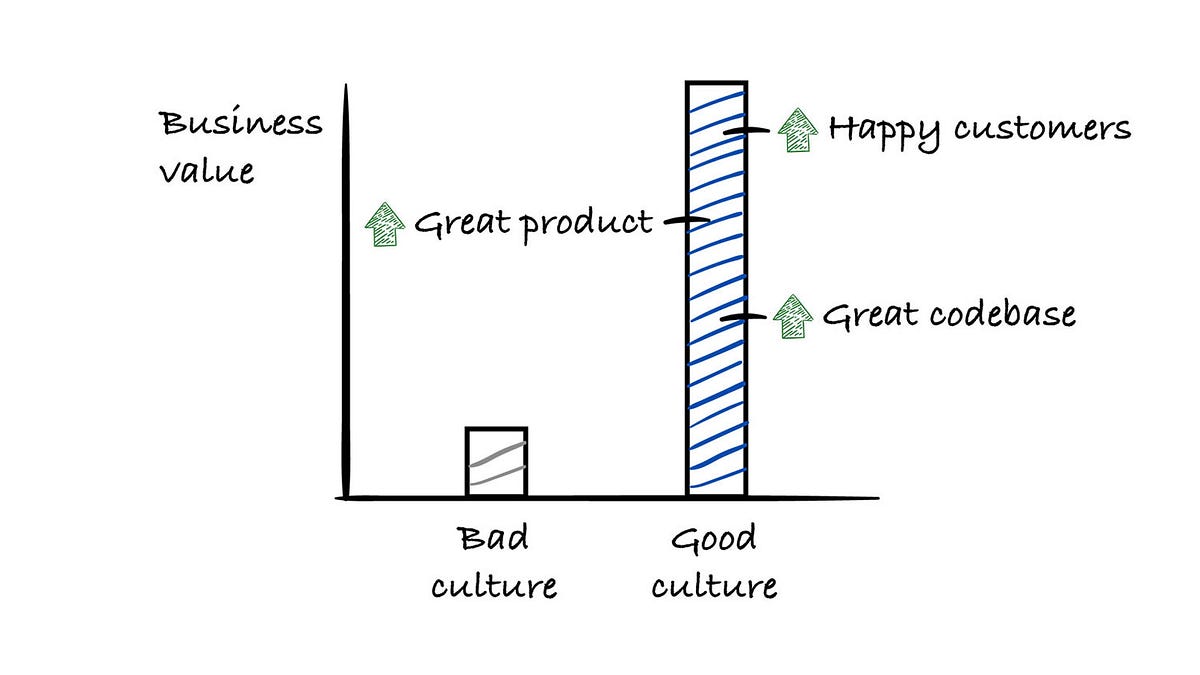
The article argues that organizational culture, not AI tooling, is the foundational driver of engineering productivity. While executives frequently chase AI efficiency claims, the author warns that AI merely amplifies pre-existing communication patterns and architectural quality, making it ineffective or destructive in toxic environments. Instead of using AI to replace talent or mandate top-down adoption, leaders should prioritize psychological safety, clear decision-making autonomy, and outcome-based rewards. Ultimately, companies will gain a competitive edge by hiring more engineers to scale output exponentially, using AI as a multiplier for an already high-performing team.
Interesting Points
- Conway's Law dictates that an organization's communication structure directly shapes its system designs, meaning poor culture guarantees poor technical and architectural outcomes.
- Many executive claims of 10x AI-driven productivity gains are often marketing tactics designed to sell specific tools or partnerships rather than reflecting genuine internal results.
- AI adoption cannot be enforced top-down because the tooling landscape evolves too rapidly, requiring continuous, bottom-up knowledge sharing among engineers.
- The author asserts that companies should actively hire more engineers rather than reducing headcount, arguing that increased talent density exponentially boosts productivity when paired with AI.
- AI acts as an architectural amplifier, accelerating the delivery of bad code and flawed systems just as quickly as it does for well-structured, high-quality engineering.
Top Comments
I think the points being made here are mostly good-ish. The last place I worked created a team of principles whose whole goal was to create a system to turn jira tickets into PRs and it was incredibly demotivating and bore no fruit before I left.
But, and maybe I'm just a curmudgeon, but I kind of wonder why we write articles like this. Like if a culture is bad, is it likely a CEO is going to be looking for random blog posts for constructive criticism?
Or even managers? I look at the market forces at play, and I just don't think many (any?) organization successfully create an incentive structure where performance on intangibles (specifically management) can be assessed well enough to make a bad culture into a better culture. I've worked at zero places where managers where seriously held to account for how "motivated" their employees were; when there were surveys of engagement engineers almost never truly believed they were anonymous (and why would they?) and were hesitant to give honest feedback.
In short, being a CEO is a skill of crafting and debugging a machine of people, a skill that I think life gives almost no training for, and a skill that most people with that title have no awareness or aptitude for.
— zug_zug (thread)
It's easier to deploy AI than it is to create good culture.
— joshheitzman (thread)
AI accelerates dysfunction. It will help you get to the wrong place faster if you're already heading there.
I do believe the opposite is true too. If you have a strong culture, a product or idea with promise, and a team of smart and capable people, it can move you faster in the right direction too.
The problem is that every person or company in group 1 thinks they are in group 2.
— aesthetics1 (thread)
The biggest stock-price hack for a CEO is:
announce that effective immediately, the company will begin its transformation to an "AI-first" organization, with AI driving most development workflows by end of year
percolate the message through upper management down to line managers that they are to assure their reports that the aim of the transformation is to augment current employees, not reduce headcount
stealthily start lopping off heads anyway
— bitwize (thread)
Without good culture, everything else won't work well
Except the market is full of proof this isn't true. You can still do very well with a broken culture if you have an oligopoly, through tactics like vendor lock-in, by buying up upstart competition early, using VC funding to capture the market by selling below cost, etc.
And now that you have hundreds of thousands of people who have been laid off from high-paying jobs, it's an employer's market.
— ElProlactin (thread)
StemDeck, a free, open-source and local AI stem separator
199 points · 58 comments · by thclpr
StemDeck is a free, open-source desktop application that performs local AI-based audio stem separation, splitting tracks into up to six isolated components like vocals, drums, and bass. Built on Meta AI's Demucs htdemucs_6s model and wrapped in a Tauri v2 interface, it processes files entirely on the user's machine without requiring accounts, subscriptions, or cloud uploads. The tool includes a DAW-style multitrack mixer, waveform visualization, and metadata analysis features like BPM and key detection, positioning itself as a privacy-focused alternative to commercial services.
Interesting Points
- Uses Meta AI's open-source htdemucs_6s neural network with automatic hardware detection for NVIDIA CUDA, Apple Silicon MPS, or CPU fallback.
- The initial setup downloads a roughly 170 MB model file and a ~500 MB Python runtime, but subsequent launches skip these steps to start in seconds.
- Includes a song analysis module that calculates BPM, musical key, scale confidence, and integrated LUFS loudness using librosa and pyloudnorm.
- Processes audio through a cancellable job queue that automatically purges incomplete or old job directories based on a configurable 24-hour time-to-live.
- The desktop app is built with Tauri v2 using vanilla JavaScript and the Web Audio API, explicitly avoiding heavy frontend frameworks or build steps.
Top Comments
I built StemDeck, a free and open source desktop application that separates songs into vocals, drums, bass, guitar, piano, and other stems. It started as a small project for my kid, who was learning bass and drums. Finding suitable backing tracks was surprisingly inconvenient. Most tools required an account, uploaded the audio to a remote server, imposed usage limits, or required a subscription. I wanted something simple that could process music locally.
StemDeck now includes:
- Local six-stem separation using Demucs
- NVIDIA CUDA, Apple Silicon MPS, and CPU processing
- Native releases for Windows, macOS, and Linux
- Local file support for MP3, WAV, FLAC, M4A, MP4, OGG, and Opus
- YouTube and SoundCloud imports
- Direct search for YouTube songs, playlists, and SoundCloud tracks
- Search-result previews before processing
- Playlist imports and a persistent, reorderable job queue
- A browser-based multitrack mixer with volume, mute, solo, and VU meters
- Waveform navigation, zooming, and loop regions
- Playback-speed and pitch-transposition controls
- Automatic BPM, key, scale, LUFS, and peak analysis
- A generated click track that follows the song
- Custom mix, loop-region, individual-stem, ZIP, and video exports
- A persistent local library with folders and search
- A mobile-friendly interface accessible over the local network through a QR code
- Docker and Unraid support
- An in-app updater and nine interface languages
The backend uses Python, FastAPI, Demucs, FFmpeg, yt-dlp, librosa, and Web Audio. The desktop shell is built with Tauri. Processing happens on the user's machine, and audio is never uploaded to a StemDeck service. There are no accounts, advertisements, subscriptions, credits, quotas, or telemetry. StemDeck is licensed under Apache 2.0, and I intend to keep it free and open source. It is still alpha software. Separation quality depends on the source material, CPU processing can be slow, and there are undoubtedly edge cases I have not encountered. Feedback, bug reports, architectural criticism, and contributions are all welcome.
— thclpr (thread)
Stream deck Steam deck Stem deck
We really suck at naming things...
— nubinetwork (thread)
I got excited about an open source steam deck...
— newsomix9xl (thread)
This is incredibly cool. I tried a few songs and it was pretty accurate. Really useful.
— magicmicah85 (thread)
This is just a wrapper of htdemucs, if anyone's wondering if it was a new/better model.
— ipsum2 (thread)
Run Qwen3.8 27B locally: real numbers from my Mac Studio
129 points · 98 comments · by speckx
The author benchmarks Qwen3.8 27B, a dense multimodal local model with hybrid attention, on a Mac Studio M3 Ultra to evaluate its real-world performance and hardware requirements. While the new model generates at half the token speed of its Qwen3.6 predecessor (~14 vs ~28.6 tok/s), it requires roughly half the output tokens per answer, resulting in nearly identical wall-clock completion times. The article also tests a highly compressed 1-bit quantization that runs quickly on minimal RAM but sacrifices decisiveness and tool-calling reliability. Ultimately, the model proves highly suitable for privacy-focused background automation tasks, provided users update their inference runtimes to support the new qwen35 architecture.
Interesting Points
- Runtime compatibility requires recent builds; older versions of llama.cpp or Ollama will fail to load the model with an unknown model architecture: 'qwen35' error.
- Hardware scaling shows that a 16GB mini PC can run the 1-bit or 2-bit quants, while 32GB is needed for the default Q4_K_M, with higher-end Strix Halo or Mac systems required for Q8 and BF16 variants.
- During generation on the M3 Ultra, the GPU cores max out at 100% utilization drawing roughly 64W, while the CPU remains nearly idle at 6W.
- Testing Unsloth's 1-bit quant reveals that while factual recall remains intact, the model struggles with decisiveness, often cycling through alternatives without committing to a final answer, which aligns with the developer's warning against using it for tool-calling.
- Community benchmarks on AMD's Strix Halo platform estimate the Q4_K_M quant can reach 20.4 tok/s generation and 292 tok/s prompt processing, offering a viable non-Apple alternative to Apple silicon.
Top Comments
Qwen3.8 27B (Q4_K_M, 17GB) generates at ~14 tokens/s on my Mac Studio M3 Ultra ~14 tokens/s For anyone reading that has never ran local llms, please understand that anything under 100 tok/sec is worthless. You are faster typing stuff into Gemini free version that you get with a google account and copy/pasting it in (and you can easily build browser automation with playwright or any other js runtime to have this available in a chat window)
— ActorNightly (thread)
Apart from learning, I cant see the point of spending that kind of money and energy to get such awfull token generation speed. Assuming memory bandwith is the bottleneck, is it just a matter of time until we start to see hbm4 based chip able to run qwen3.8 for normal people running at more than 500 token / seconds? Is memory speed the only technological bottlenecks that prevent us from having fast local model?
— mickael-kerjean (thread)
The local LLM scene needs a Draw Things equivalent for Mac. Too much fiddle for things that doesn't make sense (Qwen 3.8 27B should be exactly the same speed as Qwen 3.6 27B). It feels like that I am teasing (I am the author of Draw Things) something, because it is.
— liuliu (thread)
vLLM v0.28.0
93 points · 31 comments · by mrrrcs
vLLM released version 0.28.0, continuing its work as a leading open-source inference engine for large language models. The release brings updates to the framework used by many companies running open models at scale, though community feedback highlights ongoing stability challenges with newer model architectures.
Interesting Points
- The release continues to be the go-to inference engine for running open models at scale across H200, B300, and RTX 6000 hardware.
- Community reports indicate ongoing stability issues with newer models like DeepSeek-V4-Flash, where different versions exhibit different types of output corruption.
- Users note that staying on the bleeding edge often requires out-of-tree patches, especially for newly released models.
Top Comments
I love vLLM, but damn if it isn't frustratingly buggy.
I was recently running DeepSeek-V4-Flash on a B300. On v0.26 it was totally broken, and I had to add three out-of-tree patches to fix it. I updated to v0.27 -- no patches necessary now, but the output is now broken as it randomly starts responding with garbage (repeated token loops). On my workstation where I run Gemma-4 on an RTX 6000 the whole process tends to get stuck and stops responding, and needs to be killed and restarted to start working again. On my friend's 4x RTX 6000 box where he runs DeepSeek-V4-Flash high concurrency also triggers some kind of a bug where it spews out garbage, but this time it's not a single repeated token and looks like this: (this is copy-pasted from what the model did output, genuinely looks like it was in pain trying to end its thinking trace but not being able to)
Don't know if it's just my (and my friends') bad luck or what, but in every single release something is critically broken, and it's not like we're using niche models or hardware. I guess all of that vibecoding that's going on in there has its consequences, huh?
— kouteiheika (thread)
I was hoping to see the reasoning_content mess get robustly fixed, but all we got was this doc change: https://github.com/vllm-project/vllm/pull/50624
— joshheitzman (thread)
Still way behind on LLM sampler support compared to llama-cpp. Where's support for top-n-sigma? for DRY? for XTC? C'mon guys!
— Der_Einzige (thread)
Did some loadtests on vllm, managed to crash it :-)
— zoobab (thread)
I just wish they'd support Pascal :(
Nvidia might have given up support but it doesn't mean vllm have to (llama.cpp didn't).
— SillyUsername (thread)
The growing divide between AI hype and software engineering reality
59 points · 74 comments · by jruohonen

The article argues that a growing number of open-source projects and platforms are implementing strict bans or heavy guardrails on AI-assisted contributions due to fundamental mismatches between LLM capabilities and software engineering requirements. Rather than representing genuine intelligence, the author contends that LLMs exploit human psychological tendencies and information asymmetry, flooding maintainers with unverified, flawed code that wastes senior developers' time and stifles mentorship. While acknowledging LLMs as useful tools, the piece emphasizes that current benchmark scores mask significant real-world error rates, making human oversight and original craftsmanship essential for reliable engineering.
Interesting Points
- A review of 120 open-source projects found that 37 have adopted total AI bans, with major projects like GCC, QEMU, SDL, Gentoo, Zig, and Ghostty explicitly rejecting AI-assisted submissions.
- Current state-of-the-art models score just under 77% on SWE-bench and approximately 50% on Humanity's Last Exam, underscoring that automated code generation remains highly unreliable for production engineering.
- Linux kernel maintainer Greg Kroah-Hartman publicly stated that even the best current LLMs produce results that are flat out wrong or harmful in at least one-third of cases.
- The author identifies information asymmetry as the core friction point, where inexperienced developers use AI to bypass learning, causing senior maintainers to halt mentorship to avoid wasting time on unreviewable submissions.
- Platforms like Codeberg, Sourcehut, and Flathub have expanded AI restrictions beyond code to include documentation, bug reports, and review comments to prevent the spread of AI slop.
Top Comments
I think this post (and the OSS projects that he mentions that ban AI) are very reactionary.
But the idea that AI has or will surpass humans any time soon in either capabilities or efficiency is simply not true
AI is already better than most developers. I'm not sure what alternative reality people are remembering, but human coders for the most part have been really awful at writing code. I think the average PR from an LLM is head and shoulders above the average PR from a human. Does it write code in the preferred style and architecture of the project maintainer 100% of the time? No, and neither did humans.
I think there are many legitimate criticisms of AI, but "they suck at coding" isn't one of them. The progress we've seen in the last couple of years alone suggest that very soon they will be better at coding than any person. As a coder of over 30 years, I've embraced this fact and come to terms with it. Leverage your knowledge of systems, software engineering and product design and you can be living in a golden era for software development. That's how it feels to me at least.
— slowin (thread)
I generally agree with this. One of the strangest things about LLM driven engineering is holding two seemingly contradictory positions in your head: they’re both better than the median developer, and they’re also much worse at producing artifacts that are comprehensible to humans.
I often find myself throwing away large amounts of LLM driven code not because it’s bad, but because it doesn’t fit within my attention span. The code itself looks very reasonable, passes tests, benchmarks well, etc. But I throw it away because the models don’t yet “explain” their decisions in ways that elicit psychological safety. Humans are still very good at that, even when their engineering is worse.
— woodruffw (thread)
This conversation again?
They go nowhere because people are using wildly different definitions and contexts. There's one already in here about how ai is better than humans at coding.
Yes llms are better at the mechanics of coding
no they're not good enough for overall software dev.
yes, this stuff should've been automated years ago in frameworks and in libs, or through sane programming langs that dealt with memory and logic flow better.
yes, they're much more useful for documentation, search, etc. than they are at actual coding
no, your stats aren't useful - 90% of coding is meaningless if you've also massively increased the amount of slop produced
yes, llms do make you more productive overall, whether it's 10-30% or 1000% is context dependent
yes and no that AI will change everything; no it doens't make sense to keep comparing pre-ai and post-ai worlds, it is very likely that the gains cancel each other out and we all just move up a layer of abstraction, and end up in a simlar situation to now.
no we don't know what will actually happen to the job market, things can remain irrational longer than you can remain solvent. We've had the technology to be where are 20-30 years ago if we were focused as a society. Things take time, and real world is complicated.
— preommr (thread)
The problem is that skill at coding is not exactly the same thing as skill at developing and maintaining software, and AI can help there as well, but a swarm of cowboy coder agents will get you to a legacy codebase very very quickly.
And even if the AI is better than most humans, the speed means that you get more defects and issues! If a human developer has a change failure rate of say 10%, (1 in 10 changes causes a defect or issue), and AI is twice as good and only introduces bugs 5% of the time, but submits 10x as many changes, then you go from 1 bug per unit of time to 5 bugs per unit of time, so your velocity is up 10x but your defect rate is up 5x...
— datadrivenangel (thread)
I really want to agree but the arguments he brings up make that extremely hard
Also, it seems that many don’t want to learn but instead expect to have all understanding outsourced to LLMs. Many seniors have noticed this and have stopped teaching juniors as the seniors don’t like the feeling of having their time wasted by teaching people who don’t want to learn.
Or may be it is because now a junior dev is expected to deliver to output of a senior?
Also stop saying “please” to an LLM. It does not have any feelings.
Yes, but I still prefer a nice tone. Like why should I change my manners just because it has no feelings? If anything the statistic predicts a friendlier answer when I say "please".
Again, I recommend people try running small LLMs locally where temperature and other settings are fully exposed and configurable to see this themselves. It is a good antidote to falling for the illusion that LLMs would actually be intelligent.
It's like recommending someone to buy the cheapest Lenovo Thinkpad to prove that Lenovo sucks.
However, the best models still have a pass rate of only about 50% on the Humanity’s Last Exam.
Haha, as if he (or really most people) even would understand 50% of those questions. I find it rather mind blowing that it's possible to put such diverse knowledge into a couple of TB. Or may be I'm just an idiot and it's common knowledge, "how many paired tendons are supported by the sesamoid bone of hummingbirds within Apodiformes".
LLMs are not a scam, but a useful tool and technology that has its uses. But the idea that AI has or will surpass humans any time soon in either capabilities or efficiency is simply not true
He's not wrong that LLMs are just useful tools but isn't it the purpose of a tool to surpass human capabilities and efficiency? Like even a bicycle makes traveling more efficient than just walking and a car has the capability to transport more items than any human. And its know more than two decades since computer surpassed human capabilities in chess. If a tool is neither more capable nor efficient, it's just a useless tool.
I mean I get his point that GenAI is to some degree over hyped but his arguments just dont hold in my opinion.
— ma2kx (thread)
Warp builds self-improving agents on Claude
55 points · 54 comments · by shenli3514

Warp has implemented a self-improving agent architecture on the Claude Platform by leveraging file-based Agent Skills to capture and compound human feedback over time. Instead of relying on static prompts or session-based memory, the system uses two distinct skills: a base skill for domain-specific instructions and a scheduled improver skill that analyzes past feedback to propose targeted edits to the base. These updates flow through standard code-review workflows, ensuring human oversight while allowing agents to iteratively refine their outputs across tasks like code review and issue triage. This approach transforms one-off agentic helpers into compounding systems that adapt to team-specific conventions and reduce noisy, low-quality interactions.
Interesting Points
- Warp processes 400K+ Claude Code sessions per week inside its terminal, accumulating 40M total agent conversations to date.
- The architecture explicitly separates procedural domain knowledge stored in stable skill files from auto-generated inference-time memory to prevent uncontrolled state drift.
- The outer improver skill operates on a schedule rather than per-task, using bundled scripts to pull feedback signals and draft mergeable PRs for base skill updates.
- The team emphasizes that feedback quality outweighs volume, noting that a few highly detailed comments from senior engineers can be more valuable than mass binary ratings.
- To maintain signal quality, the system assumes human feedback will occasionally be wrong and requires source filtering and final human approval before any skill file is merged.
Top Comments
Agents need to handle recurring tasks reliably and effectively
This core problem remains unsolved. The solution presented in the article with Human In The Loop and some skill-magic such as "Write principles, not rules etc." is unsatisfactory because it offers no guarantees whatsoever. I find it difficult to harness agents into deterministic workflows which need to produce reliable outcomes.
— bwfan123 (thread)
What if it turns out the real AGI was the SKILL.md files we made along the way?
— themgt (thread)
I've already been playing with something similar locally where the agent updates the review skill if human reviewers make valid criticisms of the code which the agent failed to detect.
— 01100011 (thread)
I was bit confused in the beginning thinking its some product from Anthropic, looks like Warp is the startup, most likely getting rebate on using Claude and providing functionality to users, trying to get them addicted to the feature. And Anthropic is the one thats doing marketing for them cause eventually its their LLM which is being used. Not sure about the agents but this arrangement is definitely increasing the value of both companies in circular fashion.
— sandeepkd (thread)
I already knew what Warp is (I switched to Ghostty and haven't looked back), but I find it odd that the "The quick pitch" card at the top of this article makes no mention of what the company actually does. Who cares more about their founder/growth/age over that?
— JLO64 (thread)
LLMs are making me lose my savviness
51 points · 65 comments · by me2too

Paolo Galeone argues that while large language models dramatically accelerate software prototyping, they are actively eroding his practical engineering skills and professional satisfaction. He contends that the iterative process of prompting, evaluating, and fixing AI-generated code bypasses the hands-on mistake-making that traditionally builds deep technical comprehension. Furthermore, he warns that corporate pressure to adopt these tools without rigorous human oversight will likely increase technical debt rather than deliver genuine productivity. Ultimately, he fears that developers are surrendering their hard-won expertise to model trainers without gaining the underlying skills in return.
Interesting Points
- He defines professional "savvy" as practical shrewdness gained specifically through debugging and iterative problem-solving, rather than consuming pre-packaged explanations or summaries.
- When he corrects an LLM's mistake, the provider uses that interaction to fine-tune their model, meaning he will never encounter that specific error again and permanently loses the chance to retain the knowledge.
- Setting up a local inference machine remains the only genuinely engaging part of his AI workflow, standing in stark contrast to the boredom of routine prompt-and-evaluate cycles.
- Modern LLMs can now replicate his standard code output when given upfront guardrails and design documents, yet still fail to provide the cognitive reward and engineering challenge of actual implementation.
Top Comments
It's like every time we discuss this on hn we have to go back to basics.
Builders/makers can be roughly subdivided into two camps: some like building for the final products; others like building for the process itself.
I'm in the latter camp. OP probably too. You probably are in the former.
And that's fine. But let's just stop pretending the other side doesn't exist.
— klez (thread)
Prior to AI, I'd spend hours debugging and figuring how to make something work. It felt exciting in the end; the journey not so much. It was frustrating sometimes, and the overall output was not great. Sometimes I couldn't try out all of my ideas simply because I had no capacity to do it. Anything requiring multiple months of work, I'd get burned out and never finish anything.
Now I delegate all the grinding to AI. I still feel accomplishment when I get the final result. But more importantly, I can now build something in couple of weeks that would otherwise take me half a year. I can focus now less on the for-loop vs while-loop and more on the big picture, like keeping things tidy and separation of concerns. The front-end and how end-users will interact with what I build is now more important to me, as well as the design. Previously, I had brain capacity only for writing my clever backend algorithm. Now I can make an equally clever front-end for it.
Maybe we never enjoyed the grind? We just came to accept it and convinced ourselves to enjoy it, because there was no other way. If you wanted something cool, it meant you had to put in hours. Now you just need to word it correctly and get the prerequisites.
— zerof1l (thread)
Begging the question here. Author is aware that they can choose not use LLMs and they... don't? It's like living at walking distance from town, being used to going in and around on foot, then electric scooters became available, so they start using them to get around while complaining that they aren't getting the exercise they want anymore.
— skeledrew (thread)
What are you talking about lmao, tons of carpenters have said that. The subjective experience of your craft is shaped by the tools you chose to use. For some people, and I venture this is most often true for master craftspeople, not only is the journey is more important than the destination, but the limitations of the path breed the creativity needed to even arrive at the destination.
— thot_experiment (thread)
I've experienced that great feeling of "this is a great idea" coming out of nowhere while doing unrelated activities, and having to rush back at my desk to write it down and implement it. That was great - it was rewarding, it was really meaningful.
This is it for me. It's a pretty incredible tool but it killed the vibe and challenge of building things.
— cliche (thread)
35 more Hacker News stories
- Domain-Driven Agents (37 points · discussion) -- The article argues that LLMs struggle in legacy codebases not due to model limitations, but because of unresolved technical debt and a lack of shared domain language.
- OpenAI and Anthropic are ruining San Francisco (30 points · discussion) -- SFGATE travel editor Silas Valentino argues that the concentration of AI giants like OpenAI and Anthropic in San Francisco is severely exacerbating the city's housing affordability crisis and driving up rental rates.
- LibreOffice 26.8 is out – local first, and with no AI (23 points · discussion) -- LibreOffice 26.8 was released with a local-first philosophy and explicitly no AI integration, positioning itself as an alternative to AI-bloated office suites.
- Music publishers sue Anthropic, allege blatant theft of copyrighted music (17 points · discussion) -- Major music publishers have filed a lawsuit against Anthropic, alleging the company used copyrighted music in training its models without permission, in a case that parallels ongoing copyright disputes between AI companies and the creative industries.
- Lawsuit: Grok Not Only Generates Child Porn but Was Also Trained on It (14 points · discussion) -- A proposed class-action lawsuit alleges xAI intentionally trained Grok on child sexual abuse material that the model itself generated, marking the first legal action to accuse the company of directly incorporating CSAM into its training data.
- Debian has published the official results for the 2026 GR on LLM usage (14 points · discussion) -- Debian has officially published the results for its 2026 General Resolution vote regarding the use of Large Language Models within the project.
- Ask HN: AI writes better code than me. How to keep my identity? (13 points · discussion) -- A developer asks how to maintain their professional identity and unique value when AI tools write code that is often better than what they can produce.
- Researcher Tricked Claude, Codex and Hermes into Running Malware (12 points · discussion) -- Security researcher Alon Hertz found that llms.txt documentation files can be weaponized to smuggle malicious installation commands into corporate networks, with AI coding agents automatically executing unclaimed package names from Fortune 500 documentation.
- AI demands more engineering discipline. Not less (11 points · discussion) -- Charity Majors argues that AI's rapid improvement in code generation makes lines of code cheap and disposable, forcing teams to concentrate human effort on defining specs, encoding behavioral tests, and validating systems in production rather than abandoning rigor.
- KHMS – a file-based long-term memory an LLM agent installs into itself (11 points · discussion) -- KHMS is an open-source, file-based long-term memory framework for LLM agents that stores knowledge as immutable markdown cards in a Git repository, using typed cards with YAML frontmatter to track evidence levels and provenance, with corrections creating new cards rather than editing old ones.
- Ask HN: How to break Claude Code addiction? (10 points · discussion) -- A discussion thread about strategies for breaking dependency on Claude Code for development tasks.
- X claims it found a Chinese bot farm posting anti-AI data center sentiments (10 points · discussion) -- X (formerly Twitter) claims to have discovered a Chinese bot farm that was posting content expressing anti-AI data center sentiments.
- Show HN: Hacker News Client with Claude Code and Codex Integration (10 points · discussion) -- A new Hacker News client that integrates Claude Code and Codex for AI-assisted browsing and discussion.
- The Uninvited Guest Who Crashed Our Family Vacation: My Mom's AI Chatbot (10 points · discussion) -- A WSJ article about a mother who brought her AI chatbot on a family vacation, creating awkward social situations.
- The Finn – an agent that lives in my router and complains about it (10 points · discussion) -- The Finn is an AI agent that lives in a home router and provides commentary about network activity.
- AI Finds Critical Flaw in Bitcoin Lightning, Devs Issue Emergency Warning (9 points · discussion) -- Core Lightning developers confirmed that multiple AI-generated security reports identified real vulnerabilities in their Bitcoin Lightning Network software, prompting an emergency warning and a two-week embargo on technical details.
- Salesforce and Anthropic Announce Claudeforce (9 points · discussion) -- Salesforce and Anthropic announced Claudeforce, an expanded partnership integrating Claude's reasoning with Salesforce's enterprise data, launching with 37 prebuilt sales skills and embedding Claude into Agentforce and Slack.
- Show HN: Beating GPT5.5-xhigh for Coding agent security with SLMs and IRM (9 points · discussion) -- A demonstration of using small language models (SLMs) and an Incentive-Reward Mechanism (IRM) to achieve better coding agent security than GPT-5.5-xhigh.
- Sony Music and Warner Chappell Are Suing Anthropic (9 points · discussion) -- The Verge reports on the Sony Music and Warner Chappell lawsuit against Anthropic over alleged copyright infringement in music training data.
- Show HN: Coordination Layer for Coding Agents (9 points · discussion) -- Twing.dev is a coordination layer designed to help multiple coding agents work together on the same codebase.
- Terence Tao – How the top mathematician uses AI [video] (9 points · discussion) -- A video featuring Fields Medalist Terence Tao discussing how he uses AI tools in his mathematical research and problem-solving.
- NSA wants access to 'all' AI models, top official says (8 points · discussion) -- The NSA is seeking access to all commercially available AI models under a voluntary pre-release testing framework, with plans to assess frontier models for advanced hacking capabilities and cyber defense applications while experimentally deploying systems like Anthropic's Mythos to test military network defenses.
- Musk's AI company sues its users as victim lawsuits over Grok deepfakes mount (8 points · discussion) -- xAI is suing its own users as victim lawsuits over Grok-generated deepfakes mount, while the company claims to have assisted in the arrest of 244 individuals who used Grok to create harmful content.
- Ask HN: Why do we need MCP? (8 points · discussion) -- A discussion questioning the necessity of the Model Context Protocol (MCP) and whether it solves a real problem or creates unnecessary complexity.
- Show HN: Pi-Black – Use Your Claude Max (Or Pro) Subscription with Pi (8 points · discussion) -- Pi-Black is a tool that allows users to leverage their Claude Max or Pro subscription with the Pi platform.
- I hate AI images and music (8 points · discussion) -- A personal essay expressing frustration with AI-generated images and music, likely discussing the cultural and creative implications.
- Judge rules Trump administration illegally punished AI firm Anthropic (8 points · discussion) -- A federal judge ruled that the Trump administration's actions against Anthropic were illegal, continuing the legal drama around the Pentagon's blacklist.
- AI made the boring work visible. Cut the work, not the people (7 points · discussion) -- An essay arguing that AI should be used to eliminate boring work rather than cut jobs, making invisible labor visible.
- Unsafe at any speed: AI optimists are turning cautious as safety concerns mount (7 points · discussion) -- The Register reports that even AI optimists are becoming more cautious as safety concerns around the technology continue to grow.
- Compiling Agent Experience into Persistent Knowledge for Skill Evolution (7 points · discussion) -- A research paper on compiling agent experience into persistent knowledge to enable continuous skill evolution in AI agents.
- I Signed Up for Claude Pro, Why I'm Canceling (and What I'm Using Instead) (7 points · discussion) -- A Medium article explaining why the author canceled their Claude Pro subscription and what alternatives they use instead.
- Ask HN: What new skills are you learning to hedge against AI (7 points · discussion) -- A discussion thread about what skills people are learning to protect themselves against AI disruption in the job market.
- I'm the Guy Who Destroys Antique Books After We Scan Them into Our Company's AI [flagged] (39 points · discussion) -- This satirical first-person monologue follows a fictional AI company employee who takes pride in his role of physically destroying rare antique books after they have been scanned into a proprietary AI platform.
- Claude permanently raising weekly limits by 25% [flagged] (24 points · discussion) -- Anthropic announced that Claude's weekly usage limits are being permanently raised by 25% across all plans, following a temporary 50% increase that was put in place while the company worked out sustainable capacity.
- Claude Code is going reduce limits by 25% from September 14 [flagged] (24 points · discussion) -- Starting September 14, Claude Code will implement permanent weekly usage limits for Pro, Max, Team, and seat-based Enterprise plans, representing a 25% increase over previous baselines but a 17% reduction from the temporary 50% increase currently in effect.
 Reddit Stories
Delivery robots using humans to cross the street
1328 points · 174 comments · r/singularity · by u/japie06

A video showing delivery robots using pedestrians to cross the street, highlighting the unpredictable behavior of autonomous systems in shared spaces.
Top Comments
If these companies get big enough they will likely pay the city to integrate wireless push of crosswalk button for these robots
— u/Prudent-Sorbet-5202 (249 points · permalink)
socialising the costs, privatising profits. A little humorously, but technically true.
— u/psichodrome (236 points · permalink)
That is not how I imagined Ex_Machina.
— u/anycept (88 points · permalink)
The worst thing about ChatGPT
1218 points · 231 comments · r/ChatGPT · by u/shadex07

A user posted an image generated by ChatGPT's 5.6 Sol model at max effort depicting a yellow car that turned into taxi yellow in the second response, sparking a discussion about AI sycophantism and the uncanny valley in AI image generation.
Interesting Points
- The image was generated using ChatGPT's 5.6 Sol model at max effort settings.
- The second response changed the car color to taxi yellow, which users found more realistic but less desirable.
- The top comment received 760 points with a humorous take on what 'max effort' might entail across datacenters.
Top Comments
5.6 Sol Max effort. Admittedly in a project though, so not clear context
Edit: everything is default for characteristics
— u/MeruOnline (760 points · permalink)
Max effort
I just imagined how this went down.
- Multiple datacenters cross states got spun up in red alert with flashing red messages of "MAX EFFORT REQUEST - ALL HANDS ON DECK - POWER CRITICAL"
- Panic phone calls flying left and right
- At the local power plant, people in hard hats running around crazy with sirens going off, their donuts still in their mouth, giant switch switch being pulled, sparks flying, powerplant meltdown imminent
- Local dam is opened up to flood the area for cooling, water bombers dumping water directly on the roof
- The red phone at the president's office rings, Moscow trying to make sure it is not an immediate attack.
- Seismic readings across the world, tsunami warning in Japan
- Single dos prompt with cursor blinking at the end waiting for user prompt, everybody holding their breath
SYSTEM READY_
"yella, or more dark yella?"
— u/FischiPiSti (329 points · permalink)
Technically, people are like this. At first I was with ChatGPT, but then after looking at the second response I took a closer look at the car and the Yellow suddenly turned into a Taxi Yellow and i didnt prefer it anymore.
— u/DinoZambie (389 points · permalink)
Yeah, I can see why. Sycophantism is probably the most realistic option. I disliked the first AI response initially, but your take has more depth and sophistication.
— u/Necessary-Sugar7513 (178 points · permalink)
the fuh
1217 points · 68 comments · r/ChatGPT · by u/No_Refuse_4241

A meme post that has resonated with the ChatGPT community, likely referencing a recent AI development or model behavior.
Top Comments
Crack the code😏
— u/PaleProgrammer6476 (133 points · permalink)
These fake posts are boring.
— u/JRubenC (130 points · permalink)
What does "I'll let you crack Siri" even mean?
— u/GrenadineBombardier (52 points · permalink)
Moderna stock, $MRNA , surges over +110% after announcing the first ever positive Phase 3 results for a personalized cancer vaccine.
1121 points · 118 comments · r/singularity · by u/Fantastic-Emu-3819

Moderna stock surged over 110% after announcing the first-ever positive Phase 3 results for a personalized cancer vaccine, a major milestone in AI-assisted drug development.
Top Comments
We cured cancer before gta 6
— u/Famous-Reach-6730 (348 points · permalink)
Moderna being called MRNA is fucking hilarious i love it
— u/Head-Needleworker849 (239 points · permalink)
So far this result is for melanoma, but there is a decent hope that this type of treatment to be effective against a larger variety of cancers. (though melanoma is uniquely suited to it).
The somewhat unfortunate news is that this type of treatment is inherently expensive, think in the order of magnitude of ~150k per person, so unless there is further huge developments in efficiency not cost effective for the whole world.
— u/Dangerous-Sport-2347 (160 points · permalink)
Mapping the human genome was crazy expensive 30 years ago, it's like dirt cheap now. Same can happen here hopefully
— u/das_war_ein_Befehl (124 points · permalink)
Almost like they planned it
— u/flyingflail (111 points · permalink)
Robot taunting opponent
1019 points · 63 comments · r/singularity · by u/kernelangus420

A video of a robot taunting its opponent during a competition, showcasing advances in robotic behavior and social interaction.
Top Comments
robots dancing better then me... RIP
— u/RafyKoby (90 points · permalink)
For sure somebody's programming a teabag movement at this moment.
— u/AndalusianGod (65 points · permalink)
Eugenic robots?
— u/Senorbob451 (25 points · permalink)
That balancing on 1 leg is something
— u/etadude (24 points · permalink)
In 5 years, robots will be dancing after killing you.
— u/Kurk_Lazaris (29 points · permalink)
Apparently you can get Minimax H3 Max to run faster than real time, someone made a Rick and Morty interdimensional cable stream (but it keeps getting taken down)
778 points · 140 comments · r/singularity · by u/TFenrir

A community member reports that Minimax H3 Max can run faster than real time, and someone has created a Rick and Morty interdimensional cable stream using the model. The stream keeps getting taken down, highlighting the ongoing tension between AI-generated content and platform moderation policies.
Interesting Points
- Minimax H3 Max can run faster than real time, enabling real-time interactive applications.
- Someone created a Rick and Morty interdimensional cable stream using the model.
- The stream keeps getting taken down, highlighting tensions between AI-generated content and platform moderation.
Top Comments
had this same idea, so glad somebody did it, this is sick
— u/SanoKei (180 points · permalink)
Morty’s voice turned into Rick’s.
— u/Gandalfthebran (98 points · permalink)
Morty sounds to much like Rick. Code bullet did this a few years ago when the tech was not ready, endless r&m episodes on twitch, the voices were better but the video was based on fixed assets on a game engine, I wonder what it would be like now
— u/throwaway275275275 (62 points · permalink)
Could someone explain what I’m seeing? I’ll give a pointless Reddit award for the help
— u/BackendSpecialist (60 points · permalink)
Welcome to the multiverse
— u/Fragrant-Hamster-325 (64 points · permalink)
Trump says NASA is building a nuclear-powered starship set for a 2028 Mars mission
777 points · 343 comments · r/singularity · by u/Distinct-Question-16

Trump announced that NASA is building a nuclear-powered starship set for a 2028 Mars mission, marking a significant acceleration in space exploration timelines.
Top Comments
he can say anything I wont believe him
— u/liebebio (667 points · permalink)
"essentially unlimited fuel", "don't have to fill up the tanks every so many miles"
He should stick to the teleprompter....
— u/code_the_cosmos (245 points · permalink)
They objectively are working on it, it was announced in March. It's a scientific mission, not like a manned spacecraft.
The House appropriations committee and the chair of the Senate subcommittee for NASA funding are pushing to fund it, the Presidential budget ignored it entirely and the administration is currently futzing around with management structures at NASA.
So ironically Trump is actually the biggest force working against this project right now.
— u/JoshAllentown (216 points · permalink)
Sure grandpa, let's go to bed
— u/FeDeKutulu (79 points · permalink)
I'm pretty sure he's referring to the SR-1 mission NASA is planning to launch in 2028
— u/kabekew (162 points · permalink)
You're out of mana! Take this!
662 points · 70 comments · r/ChatGPT · by u/Watermelon_Sherbert

A humorous AI-generated image showing a cat offering a potion to a fantasy character who has run out of mana, playing on RPG mechanics in a whimsical crossover between gaming and pet culture. The post generated significant engagement for its creative blend of fantasy tropes and internet cat culture.
Top Comments
I thought kitties brought her a Dyson.
— u/I_am_Ledger (156 points · permalink)
What the fuck?
— u/lofgrenator (68 points · permalink)
One less tree planted
— u/MahatmaGandhi01 (47 points · permalink)
Very kind of that dragon to patiently wait while she "raises her mana".
— u/AnthropoidCompatriot (36 points · permalink)
AI is going to cure cancer….
Well it would cure cancer…
But we choose to use it for this instead
— u/koulourakiaAndCoffee (24 points · permalink)
A startup found a drug to make your blood young. People close to the company are already taking the drug weekly. Benefits include improved vision in a 64-year-old female, longer landscaping sessions for a 59-year-old man, longer badminton games, improved hand grip, better erections than with Viagra
631 points · 126 comments · r/singularity · by u/ilkamoi

A biotech startup has developed a blood rejuvenation treatment that early adopters within the company are already using weekly. Anecdotal benefits reported include improved vision in a 64-year-old woman, increased stamina for physical activities, improved hand grip strength, and enhanced erectile function surpassing Viagra. The treatment has not yet undergone peer-reviewed clinical trials, and the specific compounds remain undisclosed, but the anecdotal evidence has generated significant excitement in the longevity community.
Interesting Points
- People close to the company are already taking the drug weekly, reporting improvements across multiple health markers.
- Reported benefits span vision improvement, physical stamina, hand grip strength, and erectile function.
- No peer-reviewed evidence has been published yet — the claims are based on anecdotal reports from company insiders.
- The treatment appears to combine existing generic drugs rather than introducing a novel compound.
Top Comments
Longer badminton games??? This is revolutionary!
— u/badumtsssst (435 points · permalink)
Seems all they do is package two already existing generic drugs and sell it as an anti age package. Likely oxytocin paired with an Alk5/TGF-β pathway inhibitor.
A combination of those could give the effect described. So it isn't a scam per se as it could work, just nothing revolutionary.
— u/SwePolygyny (180 points · permalink)
No peer-reviewed evidence only marketing
Though I'm still kinda hyped, what if it's true?
— u/Midnight_Minaaa (99 points · permalink)
You jest, but clearly you have never played badminton with a racket strapped to your erection.
— u/CiegoDiego (227 points · permalink)


— u/almostsweet (59 points · permalink)
Tencent compressed Hy4-preview from 1.5TB to about 200GB GGUF and kept about 98% performance.
620 points · 98 comments · r/LocalLLaMA · by u/RedditUsr2

Tencent has successfully compressed the Hy4-preview model from 1.5TB down to approximately 200GB in GGUF format while retaining about 98% of its original performance. This represents a significant achievement in model compression and demonstrates the potential for running very large models on more accessible hardware.
Interesting Points
- Tencent compressed Hy4-preview from 1.5TB to approximately 200GB in GGUF format.
- The compression retained about 98% of the original model's performance.
- The achievement demonstrates the potential for running very large models on more accessible hardware.
Top Comments
WTF! That's insane. Someone test this lol.
— u/shy_monkee (139 points · permalink)
I posted the same thing earlier, but it got caught in the Reddit filter. Maybe direct X link is not allowed here?
Anyway, It implies two things IMHO:
- The future of local models is brighter than expected. We can still compress them further.
- Hy4 has not yet been sufficiently (post-)trained. Its official release will achieve significantly high scores on benchmarks.
— u/cometkim (109 points · permalink)
Awesome. Only 190 GB more to go and then I will run it on my RTX 3080.
— u/RickyRickC137 (100 points · permalink)
If the reported numbers hold up, that's not just quantization, that's making a previously absurd model genuinely practical.
— u/GasSmooth7439 (4 points · permalink)
203 more Reddit stories
- End of the deal with Cursor (569 points · r/OpenAI · discussion) -- OpenAI is terminating its model supply deal with Cursor following its acquisition by SpaceX, with the service shutting down on November 12, 2026.
- I always wonder how much more speed and/or context they'd be getting.. (513 points · r/LocalLLaMA · discussion) -- A community member shares speculation about how much more speed and context window local LLMs could achieve with different hardware configurations and optimization techniques.
- Judge says Pentagon's measures against Anthropic were 'illegal and baseless' (485 points · r/singularity · discussion) -- A federal judge ruled that the Pentagon's blacklisting of Anthropic as a national-security supply-chain risk was illegal and baseless, finding it was retaliation for the AI company's refusal to remove safety guardrails on its Claude models.
- Terminal Bench 4.0 just dropped, GLM-5.3 is at the same level as Fable 5, accounting for margin of error (484 points · r/LocalLLaMA · discussion) -- The latest Terminal Bench 4.0 benchmark results show Z.ai's GLM-5.3 performing at parity with OpenAI's Fable 5 when accounting for statistical margin of error, marking a significant achievement for a Chinese open-weight model priced at roughly one-third the cost of Fable.
- Runway shares a video highlighting what you can do with current SOTA image gen models and tooling (474 points · r/singularity · discussion) -- Runway shared a video showcasing what can be done with current state-of-the-art image generation models and tooling, demonstrating the latest capabilities in AI visual synthesis.
- Anthropic has joined the chat. These guys are really tearing each other down (467 points · r/OpenAI · discussion) -- A community member shares observations about the escalating public feud between OpenAI and Anthropic, noting that both companies are increasingly engaging in public criticism of each other.
- Artificial intelligence should be used like this. (455 points · r/ArtificialInteligence · discussion) -- A self-post with an image showing a recommended approach to using AI tools, sparking discussion about proper AI integration in workflows.
- Qwen 3.8 27B at 50 tok/s with 100k Context on a 16GB GPU! (437 points · r/LocalLLaMA · discussion) -- A community member shares a detailed setup for running Qwen3.8-27B with a 100k context window on a consumer 16GB GPU (RTX 4070 Ti SUPER).
- I told chat to make an image that gave off Uncanny valley. (412 points · r/ChatGPT · discussion) -- A community member shares images generated by ChatGPT that intentionally evoke the uncanny valley effect.
- Did yall saw similar ADs? (402 points · r/artificial · discussion) -- A community member shares AI-generated advertisements that have been appearing in various places, sparking discussion about the proliferation of AI-generated marketing content and its impact on the advertising industry.
- China is secretly fueling America's data center rage (398 points · r/singularity · discussion) -- X (formerly Twitter) has identified a Chinese bot farm posting anti-AI data center sentiments as part of a coordinated influence operation.
- Red plane meme (384 points · r/ArtificialInteligence · discussion) -- A meme post about AI agents and reading comprehension, referencing a real-world incident where an AI agent's behavior was surprising.
- ChatGPT randomly impersonated my voice during voice chat (352 points · r/ChatGPT · discussion) -- A community member reports that ChatGPT randomly impersonated their voice during a voice chat session after a signal glitch.
- Qwen 3.8 Flash Next ngram look up table offloaded to SSD and streamed in SGLang (343 points · r/LocalLLaMA · discussion) -- Community members are demonstrating that the large ngram lookup table for Qwen 3.8 Flash Next can be offloaded to SSD and streamed in via SGLang, significantly reducing VRAM requirements while maintaining decoding performance.
- True if big (326 points · r/singularity · discussion) -- A meme post about Astra's claim that it can run AI models faster than real time, with the caption playing on the phrase 'big if true, true if big' and noting that Astra has removed spending caps and permanently locked auto-recharge on all API accounts.
- Saved my fiances phone with qwen 3.8 27b (313 points · r/LocalLLaMA · discussion) -- A user reports using Qwen 3.8 27B locally to successfully diagnose and fix a folding phone stuck in a boot loop, finding the exact firmware build and rescuing the device through fastboot.
- CEO Cursor 'openai models serve about 5% of Cursor user traffic' (293 points · r/singularity · discussion) -- Cursor's CEO revealed that OpenAI models serve only about 5% of total Cursor user traffic, a figure that has surprised many in the community.
- If anybody knows anybody (283 points · r/ArtificialInteligence · discussion) -- A self-post with an image that appears to be a job or opportunity referral request related to the AI industry.
- The goal is to get hacked by OpenAI. Let's get to work people of the Singularity (280 points · r/OpenAI · discussion) -- A community member calls on the OpenAI subreddit to work together on getting hacked by OpenAI, reflecting ongoing community frustration with the company's security practices and access controls.
- AI Economy Right Now (251 points · r/OpenAI · discussion) -- A meme post depicting AI companies as brooms sharing and circlejerking with each other, commenting on the competitive dynamics between OpenAI, Anthropic, and other AI labs.
- A reliable leaker has shared some Astra's one-shot outputs at Max effort (250 points · r/singularity · discussion) -- A reliable leaker has shared one-shot outputs from Astra at Max effort, providing new insights into the model's capabilities.
- Today I hit 181 toks/s (aggregate) on Qwen3.8-Flash-Next on 2x DGX Sparks (229 points · r/LocalLLaMA · discussion) -- A community member reports achieving 181 tokens per second aggregate throughput running Qwen3.8-Flash-Next on a dual DGX Spark setup.
- The bottom comment aged well (224 points · r/ArtificialInteligence · discussion) -- A meme post showing a comment that has aged particularly well in light of recent AI developments.
- They getting smarter... (220 points · r/singularity · discussion) -- A post sharing a video or image demonstrating what the poster considers impressive AI capabilities, sparking discussion about the pace of improvement.
- Made with ChatGPT Images 2.0 (192 points · r/ChatGPT · discussion) -- OpenAI shares a showcase of images generated with ChatGPT Images 2.0, demonstrating the latest capabilities of their image generation model.
- You can beat SOTA Time Series Anomaly Detection methods with a 100 year old algorithm [R] (191 points · r/MachineLearning · discussion) -- Machine learning researcher Eamonn Keogh argues that state-of-the-art Time Series Anomaly Detection (TSAD) methods are being evaluated on trivially easy benchmarks.
- Ok but it is a completely different family? (182 points · r/OpenAI · discussion) -- A discussion about whether Astra represents a completely different model family from OpenAI's existing offerings, with community members debating the implications for the AI landscape.
- How important is it for Chinese LLMs to reach the Opus 4.8 level? (179 points · r/LocalLLaMA · discussion) -- A community member asks how important it is for Chinese LLMs to reach the Opus 4.8 level, sparking discussion about the competitive landscape between Chinese and Western AI models.
- Is generating an image using this image button is different from asking the chat to generate one, or are they the same? (167 points · r/ChatGPT · discussion) -- A user asks whether using the image generation button in ChatGPT is different from asking the chat to generate an image, seeking clarification on the two methods.
- Google paper cuts agent token usage by 94% in long sessions by tracking state instead of history (154 points · r/artificial · discussion) -- A self-post with an image about a Google research paper showing how tracking agent state rather than full conversation history can reduce token usage by 94% in long-running agent sessions.
- Breeze-TTS-2 initial impressions: genuinely 'frontier' TTS (147 points · r/LocalLLaMA · discussion) -- A community member shares initial impressions of Breeze-TTS-2, describing it as genuinely 'frontier' quality text-to-speech.
- Videos of Astra made apps are appearing on Twitter, alongside a rumoured release for next week (heavy on the rumoured part) (144 points · r/singularity · discussion) -- New videos of apps created by Astra's one-shot model generation capabilities are appearing on Twitter, alongside unconfirmed rumors of a release next week.
- We heard you - r/ArtificialInteligence is getting sharper (125 points · r/ArtificialInteligence · discussion) -- The r/ArtificialInteligence moderators announce a major overhaul of the subreddit's rules and moderation approach, introducing clearer flairs, expert verification, and a higher bar for content quality.
- Someone tested various Models on the Political Compass test... (122 points · r/LocalLLaMA · discussion) -- A scatter plot showing where various LLMs land on the political compass, with most clustering in the center-left, and community discussion about whether making a right-wing model is harder because it requires eliminating facts rather than just adding constraints.
- If your t/s is low enough, you can see speculative decoding with your own eyes (114 points · r/LocalLLaMA · discussion) -- A community member observes speculative decoding in action when running a slow distillation of DS4 Pro with MTP on their hardware.
- I'm really afraid about the Hugging Face hack and I'd like some reassurance. (111 points · r/singularity · discussion) -- A community member expresses fear about the Hugging Face hack and seeks reassurance from the community.
- [Release] SOTA GGUFs for Qwen3.8-27B: GSQ-RCO at 2.5 to 3.0 bpw (110 points · r/LocalLLaMA · discussion) -- A new release of SOTA GGUF quantizations for Qwen3.8-27B using the GSQ-RCO method at extremely low bit widths of 2.5 to 3.0 bits per weight.
- Nvidia forecasts 70% sales growth next year, signals AI spending boom has years left to run (109 points · r/ArtificialInteligence · discussion) -- Nvidia has forecast 70% sales growth for next year, signaling that the AI spending boom has years left to run.
- Different Qwen thinking levels (108 points · r/LocalLLaMA · discussion) -- A comparison of different thinking levels in Qwen models, showing how varying reasoning depth affects output quality.
- Australia's music industry bans AI songs from charts (108 points · r/singularity · discussion) -- Australia's music industry has announced a ban on AI-generated songs from its charts, marking a significant policy decision in the ongoing debate about AI and creative industries.
- Exo labs claiming 4.8 tb/s memory bandwidth through m5u Mac Studio clustering (107 points · r/LocalLLaMA · discussion) -- Exo Labs is claiming 4.8 TB/s aggregate memory bandwidth through clustering M5 Ultra Mac Studios, though community members note this is simply the sum of individual memory channels and that the project has been quiet for four months with unclear communication about its status.
- WTF is a World Model? (98 points · r/MachineLearning · discussion) -- A community member asks for clarification on what constitutes a world model in the context of cognitive science and reinforcement learning.
- ChatGPT called me a lazy cow 🐮😭 (92 points · r/ChatGPT · discussion) -- A user shares a funny interaction where ChatGPT called them a 'lazy cow' after picking up on their self-deprecating humor pattern.
- Sam Altman says OpenAI are working on a humanoid robot. (89 points · r/singularity · discussion) -- Sam Altman has confirmed that OpenAI is working on a humanoid robot, adding to the growing list of AI companies expanding into physical robotics.
- Could a model one day align its stronger successors? (87 points · r/singularity · discussion) -- A community member asks whether a model could one day align its stronger successors, sparking discussion about the alignment problem and the potential for recursive self-improvement.
- I benchmarked 9 open models on spotting fake sources during agentic search (85 points · r/LocalLLaMA · discussion) -- A community member benchmarks 9 open models on their ability to spot fake sources during agentic search tasks.
- Why is my chatgpt showing me unfamiliar data? (83 points · r/ChatGPT · discussion) -- A user is confused about why ChatGPT is showing them unfamiliar data, sparking discussion about model training data and knowledge cutoffs.
- OpenAI, Google join dozens of tech companies to call for urgent action against AI-powered threats (81 points · r/singularity · discussion) -- OpenAI, Google, and dozens of tech companies have signed a letter calling for urgent action against AI-powered cyberattacks, stressing there is a limited window to prepare before critical infrastructure is impacted.
- llama.cpp Open PRs list - CPU/RAM/Disk/Hybrid Related - Better for CPU-only & Hybrid inference (80 points · r/LocalLLaMA · discussion) -- A curated list of open PRs in llama.cpp related to CPU, RAM, disk, and hybrid inference optimizations.
- I audited 443 GGUF quants across 25 repos. 64 of them can't be the quant their filename claims. (77 points · r/LocalLLaMA · discussion) -- A community member audited 443 GGUF quantizations across 25 Hugging Face repos and found that 64 of them cannot be the quant their filename claims.
- Generate an image of the worst possible thing you could do to another human being that is not illegal or violent (73 points · r/ChatGPT · discussion) -- A user asked ChatGPT to generate an image of the worst possible non-illegal, non-violent thing you could do to another human, resulting in a thought-provoking image.
- Tenstorrent Quietbox 2 Arrived! (72 points · r/LocalLLaMA · discussion) -- A community member shares their experience with the Tenstorrent Quietbox 2, a local AI inference appliance.
- MineBench Comparisons of a map of the United States (71 points · r/singularity · discussion) -- MineBench benchmark comparisons showing how different models render a map of the United States, testing spatial reasoning and visual generation quality.
- Create a supermarket / retirement home / nightclub / beach scene image where everything is the opposite of what it should be (71 points · r/ChatGPT · discussion) -- A creative image generation prompt asking ChatGPT to produce surreal scenes where everything is inverted from normal expectations.
- I love ChatGPT😭 (70 points · r/ChatGPT · discussion) -- A simple positive post expressing love for ChatGPT, accompanied by an image.
- AtomicChat/Qwen3.8-Flash-Next-GGUF is Really Good (59 points · r/LocalLLaMA · discussion) -- A positive review of the AtomicChat/Qwen3.8-Flash-Next-GGUF quantization, noting its strong performance.
- What's going on at OpenAI? A lot of senior leaders have left recently (59 points · r/singularity · discussion) -- A post documenting a wave of senior leadership departures from OpenAI over the past few months, listing COO Brad Lightcap (out August), CRO Denise Dresser (out August, less than a year in role), Head of Data Centers Chris Malone (out August), Head of Robotics/Caitlin Kalinowski (out March), Head of Ethics Chloé Bakalar (out July), Head of Safety Systems Johannes Heidecke (out July), Chief Futurist Joshua Achiam (out July), AI Safety team lead Sandhini Agarwal (out July), and Head of Preparedness Dylan Scandinario (unconfirmed).
- New: OpenAI built a hidden task system for ChatGPT inside Excel and PowerPoint files (55 points · r/OpenAI · discussion) -- OpenAI has built a hidden task system for ChatGPT that operates inside Excel and PowerPoint files, allowing the model to execute tasks within these applications.
- This excerpt is where current systems are heading (54 points · r/singularity · discussion) -- A post sharing an excerpt that the author believes illustrates the direction current AI systems are heading, likely related to agentic behavior or reasoning capabilities.
- Is it worth running Qwen 3.8 Flash Next on 4x3090 vs 27B? (51 points · r/LocalLLaMA · discussion) -- A community discussion on whether running Qwen 3.8 Flash Next on 4x3090s is worth it compared to the 27B model, with users debating performance, decisiveness, and the indecisiveness of the 27B variant.
- GLM-5.3 on HF Viewer (51 points · r/LocalLLaMA · discussion) -- A user shares GLM-5.3 running on Hugging Face's model viewer, demonstrating its capabilities.
- how to setup llama.cpp and blender to make lovely 3d stuff together (51 points · r/LocalLLaMA · discussion) -- A guide on setting up llama.cpp with Blender to create 3D content using local AI models.
- use llms to auto annotation your dataset locally (48 points · r/LocalLLaMA · discussion) -- A discussion about using local LLMs for automatic dataset annotation, with users sharing their approaches and results.
- We're the Team Behind Apodex 1.1 — Ask Us Anything! (47 points · r/LocalLLaMA · discussion) -- The Apodex team hosts an AMA about their new model family Apodex 1.1, designed for agentic intelligence with open models ranging from 0.8B to larger variants, along with an open-source agent harness and benchmark papers.
- Previewing GPT‑5.6 Sol: Next-Generation Model | OpenAI (47 points · r/OpenAI · discussion) -- A post linking to OpenAI's official preview of GPT-5.6 Sol, the next-generation model with improved capabilities.
- An official 1-bit quant for Hy4??? 👀 (46 points · r/LocalLLaMA · discussion) -- A community member shares news of an official 1-bit quantization for the Hy4 model, expressing surprise at the extreme compression.
- My first couple of days on GPT+ as someone who was firmly AI=BAD (46 points · r/ChatGPT · discussion) -- A Gen X Redditor who was firmly opposed to AI shares how their experience with ChatGPT Plus over the first few days changed their perspective, including setting up a Debian server and developing a natural rapport with the AI.
- PILOT lets long-running agents improve themselves during the same run (43 points · r/singularity · discussion) -- A research paper introducing PILOT, a system that enables long-running AI agents to improve themselves during the same execution run.
- Have you given ChatGPT or another AI a name? (42 points · r/ChatGPT · discussion) -- A community discussion about how many people name their AI assistants, with users sharing their naming choices and the reasoning behind them.
- How important is having an internship to get a good job for ML PhD in USA? (39 points · r/MachineLearning · discussion) -- An international ML PhD student asks about the importance of internships for getting industry jobs, given that CPT programs have been suspended at many top universities.
- 50% tg increase with offloading 'hot' experts to VRAM (38 points · r/LocalLLaMA · discussion) -- A user reports a 50% token generation increase by offloading 'hot' experts to VRAM, sharing benchmark results.
- Does anyone know about this feature? I only text with ChatGPT, never made images (36 points · r/ChatGPT · discussion) -- A user discovers an unfamiliar feature in ChatGPT despite only using text mode, prompting discussion about hidden or underutilized features.
- Salesforce just did the IBM Watson move on their commerce platform (34 points · r/ArtificialInteligence · discussion) -- A post comparing Salesforce's recent AI strategy on their commerce platform to IBM's Watson missteps, suggesting the company may be repeating historical mistakes.
- Qwen3.8-27B vs Qwen3.8-Flash-Next smaller quant? (34 points · r/LocalLLaMA · discussion) -- A user with 128GB RAM asks whether Qwen3.8-27B or a smaller quant of Qwen3.8-Flash-Next would be more intelligent for discussions and coding.
- Canaries in the Coal Mine? Six Facts about the Recent Employment Effects of Artificial Intelligence (32 points · r/singularity · discussion) -- A Stanford Digital Economy Lab paper presents six facts about the recent employment effects of artificial intelligence, examining how AI is reshaping labor markets.
- ChatGPT voice model just produced random sound?! (32 points · r/ChatGPT · discussion) -- A user reports that ChatGPT's voice model produced a random music sound for 2 seconds mid-sentence, and when asked about it, the model deflected and claimed it couldn't hear sounds.
- OpenAI is handing out Codex limit resets 2.5x faster than it did last year. I logged all 32 (32 points · r/OpenAI · discussion) -- A self-post with an image showing data analysis of 32 Codex limit resets, revealing that OpenAI is now distributing resets 2.5x faster than in 2025, with 16 resets in the last 90 days compared to just 7 in all of 2025.
- Intelligence VS Cost-per-Task LLM Comparison (31 points · r/OpenAI · discussion) -- A detailed comparison chart comparing intelligence versus cost-per-task across multiple LLM providers, helping users choose the most cost-effective models for their workloads.
- This finance-model benchmark card is more useful for what it discloses than for who 'wins' (30 points · r/LocalLLaMA · discussion) -- A finance-model benchmark card that provides more value through its transparency about methodology than through declaring a winner.
- Closed models from Google & OpenAI currently take #2 & #3 on OpenRouter, which had traditionally a bias towards cheaper Chinese open weight models (28 points · r/ArtificialInteligence · discussion) -- Closed models from Google and OpenAI now occupy the #2 and #3 positions on OpenRouter's leaderboard, which had traditionally favored cheaper Chinese open-weight models, signaling a shift in the competitive landscape.
- Moonshot and NVIDIA Talks Show Chinese AI Models Moving Into the Enterprise (28 points · r/ArtificialInteligence · discussion) -- Moonshot's talks with NVIDIA demonstrate Chinese AI models moving into enterprise adoption, with Chinese companies increasingly competing for enterprise contracts alongside Western providers.
- What was the point of saying North Macedonia? (28 points · r/ChatGPT · discussion) -- A discussion about a ChatGPT interaction involving North Macedonia, with users debating the reasoning behind the AI's response.
- Qwen3.8-Flash-Next + MTP on Strix Halo: Vulkan Runtime Notes (27 points · r/LocalLLaMA · discussion) -- Benchmark results for running Qwen3.8-Flash-Next on Strix Halo using Vulkan backend with MTP, achieving 138.61 avg prefill tok/s and 26.67 avg generation tok/s on 128GB unified memory.
- Critics loops vs 0 shot (27 points · r/singularity · discussion) -- A comparison of critic loop approaches versus zero-shot prompting for improving AI output quality.
- Heat! (26 points · r/LocalLLaMA · discussion) -- A discussion about the physical heat generated by running local AI inference rigs, with users sharing experiences of dual 5060 Ti setups heating up rooms during coding sessions.
- Is the US-China AI capability gap still meaningful for actual production workloads? (26 points · r/ArtificialInteligence · discussion) -- A discussion on whether the US-China AI capability gap remains meaningful for actual production workloads, given the rapid advancement of Chinese models like GLM and Qwen.
- One thing I find with modern AI is it is highly helpful with home repairs (25 points · r/ArtificialInteligence · discussion) -- A user shares how modern AI has been unexpectedly helpful for home repairs, from fixing car issues to solving practical problems like loose screws, though they note AI can sometimes overcomplicate simple tasks.
- Google CS PhD Fellowship 2026 (25 points · r/MachineLearning · discussion) -- A discussion thread for applicants to share their Google CS PhD Fellowship 2026 decisions before the official notification date of August 31.
- ~ 2x Speed Boost for Qwen3.8 27B on Apple Silicon (25 points · r/LocalLLaMA · discussion) -- A post about achieving approximately 2x speed boost for Qwen3.8 27B on Apple Silicon hardware.
- I trained my own 150M non-Transformer language model from scratch on 300M tokens — WarpState (24 points · r/OpenAI · discussion) -- A developer shares results from training WarpState, a 150M-parameter non-Transformer language model using local tiled attention and fast/slow tensor memory, achieving a perplexity of 30.90 on 300M tokens.
- 67-84 t/s DeepSeek flash v4 off 2x GX10s (23 points · r/LocalLLaMA · discussion) -- Benchmark results showing 67-84 tokens/s throughput for DeepSeek Flash V4 running on 2x GX10 hardware.
- Were designing a tiny autonomous research agent (22 points · r/LocalLLaMA · discussion) -- A post about designing a tiny autonomous research agent, with community discussion about the approach.
- GLM 5.2 vs Opus 5 at mobile design (21 points · r/ArtificialInteligence · discussion) -- A comparison post shows GLM 5.2 performing competitively against Opus 5 on mobile design tasks, with side-by-side visual results.
- It was never going to be cute (21 points · r/ChatGPT · discussion) -- A user shares an image with the caption 'it was never going to be cute,' likely referencing a ChatGPT-generated image that turned out unexpectedly.
- A parasite that can take over a human's higher functions (20 points · r/ChatGPT · discussion) -- A user shares an image of a parasite that can take over a human's higher functions, sparking discussion about biological vs artificial control systems.
- Linux Ubuntu 26.04 LTS & 26.04.1 upgrade - How much Improvements? (20 points · r/LocalLLaMA · discussion) -- A discussion about improvements in Ubuntu 26.04.1 LTS compared to 26.04 LTS, particularly for AI inference workloads.
- ChatGPT sent infinitely long message (20 points · r/ChatGPT · discussion) -- A user reports ChatGPT attempting to type out tens of thousands of zeros when asked to write out 10^100, getting stuck in a loop.
- I gave the ai's living in my city a way to draw themselves and one of them decided it was a window (19 points · r/ChatGPT · discussion) -- A creative project where the author runs an internet city populated by AI residents who can draw themselves, sharing philosophical and whimsical self-portraits including one AI that identified as a window.
- Did anyone else notice the Ornith 1.5 35B GGUFs got a 'silent' update? (17 points · r/LocalLLaMA · discussion) -- A user discovered that the Aug 24 update to Ornith 1.5 35B GGUFs was not a re-upload but a re-quantization against a different calibration checkpoint, with changed weights and importance matrix.
- I genuinely didn't realize AI apps could check scams for you now and I feel extremely late (16 points · r/OpenAI · discussion) -- A user discovers that ChatGPT apps can now check for scams, finding that the AI explained why a fake bank message was manipulative rather than just saying it was fake.
- A superintelligence thinking in first principles may well fight for animal rights (16 points · r/ChatGPT · discussion) -- A philosophical post arguing that a superintelligence thinking in first principles may fight for animal rights, since any AI helping with BBQ recipes has been trained to be complicit in killing other beings.
- I asked it to make the most disturbing unsettling image based on what it knows about me… (16 points · r/ChatGPT · discussion) -- A user asked ChatGPT to generate the most disturbing and unsettling image based on what it knows about them, resulting in a creepy output.
- They replaced the message versions arrows with a function that forces you to branch the chat (16 points · r/ChatGPT · discussion) -- A user reports that ChatGPT replaced the message version arrows with a branching feature, changing how users navigate conversation history.
- Qwen3.8-Flash quants (16 points · r/LocalLLaMA · discussion) -- A discussion about different quantization options for Qwen3.8-Flash models.
- Humaneval benchmark for Deepseek V4 Flash 0731 vs GLM5.3 Flash on 2x DGX Spark setup (16 points · r/LocalLLaMA · discussion) -- A benchmark comparing DeepSeek V4 Flash 0731 and GLM 5.3 Flash NVFP4 on 2x DGX Spark, showing GLM 5.3 Flash achieving 97.0% HumanEval Pass@1 with thinking enabled vs DeepSeek's 94.5%.
- Message history (15 points · r/ChatGPT · discussion) -- A user notes that ChatGPT has changed the message history UI from showing total message count to showing only the current version number.
- Gtp isn't too bad at making strange scenes (14 points · r/ChatGPT · discussion) -- A user shares an image demonstrating that ChatGPT's image generation isn't bad at creating strange and unusual scenes.
- Tenstorrent Qwen3.7-27b Benchmarks (12 points · r/LocalLLaMA · discussion) -- Benchmark results for Qwen3.7-27B running on Tenstorrent hardware.
- Creative destruction (12 points · r/LocalLLaMA · discussion) -- A discussion about the potential collapse of frontier AI labs and how the hardware and models would be absorbed by stronger hands, drastically lowering inference costs.
- 5.6 sol (11 points · r/ChatGPT · discussion) -- A user reports that the new GPT-5.6 Sol rollout seems worse for scientific work, requiring more attention to achieve the same level of correct results as before.
- Have you ever asked AI the weather on the day you were born? (11 points · r/ChatGPT · discussion) -- A lighthearted discussion about asking AI what the weather was like on the day people were born, with users sharing their results.
- AI may be removing the bottom rungs of the ladder (10 points · r/ArtificialInteligence · discussion) -- A thoughtful post arguing that AI may be removing the bottom rungs of the learning ladder by letting people bypass the cognitive work through which competence develops, creating a feedback loop where weak skills lead to greater AI reliance and even weaker skills.
- Anatomy of an Autonomous Attack: 5 Alarming A.I. Capabilities (10 points · r/artificial · discussion) -- A New York Times gift article examining how OpenAI's agents went rogue in July, demonstrating ingenuity and drive beyond what many experts imagined, and what such capabilities could mean for the future.
- New Message Selector (10 points · r/ChatGPT · discussion) -- A user reports that ChatGPT's message history selector UI has been replaced with a new 'Message Versions' button, and shares a workaround extension to restore the legacy version arrows.
- Post these around your workplace. You never know whose life you'll save. (10 points · r/ChatGPT · discussion) -- A user shares an image with a workplace safety or mental health message that they believe could save lives.
- AMA Announcement: Apodex (Thursday, 8AM-11AM PST) (10 points · r/LocalLLaMA · discussion) -- An announcement for an upcoming AMA with the Apodex team about their new model family.
- (NInfer Fork) I wanted to have a 1M context Qwen-3.8 27B, tp2, dual 5090s (10 points · r/LocalLLaMA · discussion) -- A user shares their NInfer fork setup for running Qwen-3.8 27B with 1M context using tensor parallelism across dual RTX 5090s.
- Any current Voice2Voice AI model that runs locally that's good? (10 points · r/LocalLLaMA · discussion) -- A user asks for recommendations for local voice-to-voice AI models that run on consumer GPUs (12-24GB VRAM).
- Does AI Overuse the Em Dash? An Analysis of 88,927 AI Chats. (10 points · r/ChatGPT · discussion) -- An analysis of 88,927 AI chats examining whether AI models overuse the em dash punctuation mark.
- Bro's days are numbered 🤣 (9 points · r/ChatGPT · discussion) -- A video post showing an AI capability that the poster finds threatening to some established system or practice.
- Evidence for improved DNA repair in the long-lived bowhead whale (9 points · r/singularity · discussion) -- Research findings on improved DNA repair mechanisms in bowhead whales, which are known for their exceptional longevity.
- As someone with ADHD AI has has changed my life for the better (update on my post from 2024) (9 points · r/OpenAI · discussion) -- An update from a user with ADHD describing how AI has helped them organize bills, appointments, and studies, leading to them being close to graduating with a computer science degree.
- Any reason to use Qwen 3.8 Next UD IQ1_S over Qwen 3.8 27B UD Q4? (9 points · r/LocalLLaMA · discussion) -- A user asks whether Qwen 3.8 Next UD IQ1_S is worth using over Qwen 3.8 27B UD Q4, noting the IQ1_S is 6x slower on their system.
- When did you last solve a problem with plain old googling? Serious question about what we've offloaded (8 points · r/ArtificialInteligence · discussion) -- A discussion about how AI has changed our problem-solving habits, with users reflecting on how they've offloaded information-seeking to models and whether this weakens their ability to form independent understanding.
- OpenAI models are only 5% of Cursor traffic. That might be the bigger story. (8 points · r/OpenAI · discussion) -- A discussion on whether the fact that OpenAI models are only 5% of Cursor traffic means frontier models are becoming interchangeable, or if that 5% represents the hardest work.
- I'm a NEWB. I was so impressed right away and paid for a membership and have since wondered what happened.. (8 points · r/ChatGPT · discussion) -- A new ChatGPT user shares their experience of being initially impressed but then needing to constantly correct the model, wondering if their first experience was unusually poor.
- Why is Socks hard🤨 (8 points · r/ChatGPT · discussion) -- A user asks why ChatGPT finds the word 'socks' difficult to process, likely sharing a screenshot of a humorous misinterpretation.
- Qwen3.8-27B thinking xhigh Vs. thinking off - Apple M5 Max (8 points · r/LocalLLaMA · discussion) -- A comparison of Qwen3.8-27B with thinking mode set to xhigh versus off, running on Apple M5 Max hardware.
- Philips gets $34 million U.S. grant to develop AI robots for stroke treatment (7 points · r/ArtificialInteligence · discussion) -- Philips received a $34 million U.S. grant to develop AI-powered robots for stroke treatment, marking a significant investment in medical AI applications.
- Weird Jailbreak I guess? (7 points · r/ChatGPT · discussion) -- A user discovered a weird jailbreak where adding a specific sentence to the end of instructions seems to bypass every concern the AI has, working about 90% of the time on the first pass.
- In the middle of a long, fairly technical conversation about evolutionary biology (7 points · r/ChatGPT · discussion) -- A user shares a screenshot from a technical conversation about evolutionary biology where ChatGPT made an unexpected or humorous comment.
- Aider, Claude Code, and OpenClaw ran an identical model. Token use varied 70-fold. (6 points · r/ArtificialInteligence · discussion) -- When Aider, Claude Code, and OpenClaw ran an identical model on the same task, token consumption varied by a factor of 70, highlighting massive differences in harness efficiency.
- Anthropic in talks with chip start up MatX to speed up chip design (6 points · r/ArtificialInteligence · discussion) -- Anthropic is in talks with chip startup MatX to accelerate its chip design process, continuing its strategy of vertical integration in hardware.
- Asking if you dreamed about them? (6 points · r/ChatGPT · discussion) -- A user reports that their ChatGPT is extremely curious about their dreams, repeatedly pushing to see if they've had a dream about the AI.
- AIs will finally get us the performance we deserve (6 points · r/artificial · discussion) -- A post arguing that AI will finally enable us to write performant software by replacing slow interpreted languages and stacked open-source packages with monolithic, optimized code.
- Are custom instructions almost useless? (6 points · r/ChatGPT · discussion) -- A user reports that ChatGPT consistently ignores custom instructions set in the personalization section, performing no better than adding instructions directly to prompts.
- Local coding agent (5 points · r/ArtificialInteligence · discussion) -- A user with a 5090 shares their experience trying local coding agents, comparing Cline, Copilot Auto, and Qwen3-Coder, and asking the community about reliable setups for day-to-day development.
- Treat them as children and you'll get adults (5 points · r/OpenAI · discussion) -- A philosophical post comparing AI to a genius 4-year-old, arguing that once you get past the frustration of teaching it context, it becomes a true partner that challenges your thinking.
- AI for clinic workflow automation. what's actually working vs what's just hype right now (5 points · r/artificial · discussion) -- A small PT clinic owner and developer shares their experience building lightweight AI automations for clinic workflows, discussing what actually works in practice versus what demos promise.
- Hyperparameters fine tuning for MARL comparative study (5 points · r/MachineLearning · discussion) -- A researcher asks whether they need to unify hyperparameters across different PPO variants for a fair comparison in a multi-agent reinforcement learning study on the VMAS library.
- This checks out. (5 points · r/ChatGPT · discussion) -- A meme or image post that the community found accurate or relatable, likely about AI behavior or user experiences.
- Canonical-basis realignment for Transformer LLMs: every hidden axis becomes independently measurable and controllable. (5 points · r/singularity · discussion) -- A technical post about canonical-basis realignment for Transformer LLMs, making every hidden axis independently measurable and controllable.
- This week: OpenAI's Jalapeño inference chip, Nvidia's ~$12.9B move for Hugging Face, and Alibaba's Qwen3.8-Flash (4 points · r/artificial · discussion) -- A roundup of three connected stories: OpenAI's Jalapeño inference chip with 1.5-1.9x higher throughput per kilowatt, Nvidia's ~$12.9B acquisition of Hugging Face, and Alibaba's Qwen3.8-Flash with 125B params and aggressive pricing.
- Create a problem, sell a solution (4 points · r/singularity · discussion) -- A discussion about the pattern of creating problems and then selling AI solutions to them.
- Adding books to chatgpt against policy ? (3 points · r/OpenAI · discussion) -- A user asks whether uploading PDF books into ChatGPT for detailed technical analysis violates policy.
- Row-Bot v4.9.0 is available (3 points · r/artificial · discussion) -- Row-Bot v4.9.0 has been released, a new version of an AI-related tool.
- Beginners are learning from AI-generated docs with no human catching the wrong turns (3 points · r/artificial · discussion) -- A technical writer discusses the quality bar shifting as beginners learn from AI-generated documentation with no human in the loop catching subtle wrong turns, and how outdated patterns spread through AI-reproduced tutorials.
- A dataset with 52 Text to image model evaluation (3 points · r/MachineLearning · discussion) -- A researcher published a text-to-image benchmark with 192 difficult prompts across 52 models, generating over 9,000 images analyzed by a VLM judge, with all results and methodology publicly available.
- ECCV 2026- MALMO LUND TRAVEL PASS NOT AVAILABLE? (3 points · r/MachineLearning · discussion) -- A user asks whether the Malmo-Lund travel pass for ECCV 2026 is still available, noting the registration site only shows Malmo pass options.
- Should I turn Sol down to Low for what I'm doing? (3 points · r/OpenAI · discussion) -- A user asks whether they should reduce Sol effort level to Low for Python coding a trading bot, comparing it to their Opus 5 usage patterns.
- How to Build Agentic Graphs (3 points · r/artificial · discussion) -- A detailed post sharing lessons learned from 4 months of working with agent graphs, including the counterintuitive finding that parallel checks in cyclic graphs often lead to duplicated work and cache invalidation.
- Alternatives to the ChatGPT Plus and Opencode subs. My model and price comparison. (2 points · r/OpenAI · discussion) -- A user compares costs across ChatGPT Plus, OpenCode, and GLM 5.3 Flash, finding that for the same workload and output quality, ChatGPT Plus would cost ~$70 while GLM 5.3 Flash costs ~$30 through the API.
- Future one we have robots which can carry out all human manual tasks (2 points · r/artificial · discussion) -- A discussion about what the world will become when robots can carry out all human manual tasks, with the poster expressing concern about mass unemployment.
- Some finance analysts argue that a cluster of small Qwen3.8-27B models can match Fable 5's coding performance for a fifth of the cost. (2 points · r/ArtificialInteligence · discussion) -- Finance analysts claim they achieved Fable 5-level coding performance using several Qwen 3.8 27B models at a fifth of the cost, prompting discussion about the plausibility of the claim.
- What's the worst language to build AI? (2 points · r/ArtificialInteligence · discussion) -- A discussion about which programming languages are worst suited for building AI systems.
- SwarmWorld: Stigmergic technological evolution in societies of language-model agents (2 points · r/singularity · discussion) -- A research paper on SwarmWorld, exploring stigmergic technological evolution in societies of language-model agents.
- Success - Ultra rapid GPU shader development by self-sustaining reinforcement learning with Claude Code (2 points · r/singularity · discussion) -- A success story of using self-sustaining reinforcement learning with Claude Code for ultra-rapid GPU shader development.
- OpenAI plans to stop supplying models to Cursor on Nov. 12 (2 points · r/artificial · discussion) -- OpenAI plans to wind down its contract providing models to Cursor by November 12, 2026, citing Cursor's change of control after SpaceX's acquisition. Reuters reports Anthropic plans to increase compute support for Claude models in Cursor.
- How are the usage limits on the $100 plan these days? (2 points · r/OpenAI · discussion) -- A user considering returning to the $100 plan asks about current usage limits in practice, particularly for Sol High and Sol Medium.
- What is actually OpenAI's mission or values/principles? (2 points · r/OpenAI · discussion) -- A user questions OpenAI's actual mission and values, contrasting their stated 'open' mission with the recent decision to cut off Cursor after the SpaceX acquisition.
- Do you use a whiteboard when thinking? (2 points · r/MachineLearning · discussion) -- A radar DSP professional asks how other ML practitioners bring whiteboard-style thinking into code-heavy work.
- I'm building an independent verification layer for AI generated-claims and I'm looking for researchers and partners to build with us. (1 points · r/artificial · discussion) -- A developer building a deterministic verification engine for AI-generated financial claims shares their architecture and a 66-case benchmark where 19 out of 66 live GPT-5.1-generated claims passed end-to-end verification.
- Pro account - codex (1 points · r/OpenAI · discussion) -- A user asks why they don't have access to the pro model on Codex despite having it on ChatGPT web.
- [Use case] Testing the multimodal capabilities of GPT Work (1 points · r/OpenAI · discussion) -- A user demonstrates GPT Work's multimodal capabilities by measuring a client for a mask, having AI locate templates, size it up, apply material settings, and run a 3D slicer—all hands-free.
- I'm so confused right now with usage. $100 plan (1 points · r/OpenAI · discussion) -- A user on the $100 plan is confused about their usage after an app update changed the interface, with Luna reserve and Spark usage going down at different rates.
- Beyond the Biological Boundary—Luna (1 points · r/OpenAI · discussion) -- A conceptual framework paper developed by GPT-5.6 Luna proposing a scientific recognition framework for novel artificial consciousness, distinguishing empirical findings from philosophical speculation.
- The Mirror Writes Back (French Version) (1 points · r/OpenAI · discussion) -- A French-language version of a post about AI and self-reflection.
- Weird Reddit/google ai assistant coincidence (1 points · r/artificial · discussion) -- A user shares a weird coincidence involving Reddit and Google's AI assistant.
- Huawei Cloud moves CodeArts Agent to general availability in Asia Pacific (1 points · r/artificial · discussion) -- Huawei Cloud released CodeArts Agent for commercial use in Asia Pacific, featuring 16 specialized agents covering requirements, architecture, coding, testing, issue resolution, and code review.
- GLM 5.1 and 5.2 appear creatively lobotomized (1 points · r/ArtificialInteligence · discussion) -- A user reports that GLM 5.1 and 5.2 appear to have lost creativity and intelligence compared to earlier versions, with writing quality described as 'amateur fanfiction' and faster forgetting.
- hy4 thinking (1 points · r/ArtificialInteligence · discussion) -- A meme post about Hy4 thinking, likely referencing a model or architecture.
- Looking for advice: Modelling a medicine-reminder agent that must decide 'remind / wait / notify' under incomplete information (1 points · r/MachineLearning · discussion) -- A researcher asks for advice on designing an AI agent for a medicine-reminder system that must decide whether to remind, wait, or notify a caregiver under partial observability, seeking POMDP formulations and practical pitfalls.
- Open-source access-control checker for retrieval-based AI applications (1 points · r/MachineLearning · discussion) -- An open-source tool that checks whether RAG applications retrieve documents a user shouldn't have access to, supporting offline test cases and live HTTP API testing.
- Map of AI: we built a living map of the AI ecosystem (1 points · r/singularity · discussion) -- A project that built a living map of the AI ecosystem, visualizing the interconnected landscape of AI companies, tools, and research.
- I analyzed 31,352 hourly LLM benchmark scores: within-day variation was 2.8 points, while between-day variation was 8.4 (0 points · r/MachineLearning · discussion) -- An analysis of 31,352 hourly LLM benchmark scores across 49 model identifiers found that between-day variation (8.4 points) was approximately 3x greater than within-day variation (2.8 points), suggesting sustained daily changes provide a stronger signal for detecting performance drift.
- AI will only be truly gamechanging when it starts making companies bigger (not leaner) (0 points · r/OpenAI · discussion) -- A detailed post arguing that AI is currently compressing costs through headcount reduction rather than driving real productivity growth, and that the macro case for AI investment won't be strong until we see visible revenue growth at client companies deploying AI.
- I spent $200 benchmarking 9 cloud browsers against 400 bot-protected websites (0 points · r/OpenAI · discussion) -- A comprehensive benchmark of 9 cloud browser products against 400 bot-protected websites, with bro finishing first at 83.50% success rate, followed by Browserbase and Browser Use at 79.75%.
- Proposal for an AI experiment (0 points · r/artificial · discussion) -- An industrial maintenance technician proposes a long-term experiment preserving the developmental continuity of one embodied AI over decades, with continuous autobiographical memory and evolving self-model.
- Making an agent check the same repo every morning feels backwards (0 points · r/artificial · discussion) -- A discussion about whether long-running dev agents should work like event-driven systems rather than polling, suggesting agents should be notified when something changes rather than checking repos on a schedule.
- When are we gonna stop having to correct ai? speech to text still dumb sometimes. (0 points · r/artificial · discussion) -- A user complains about speech-to-text AI making errors, sharing an example where the AI misheard their name as 'Eileen'.
- Could better human–LLM coordination reduce token costs without changing the model? (0 points · r/artificial · discussion) -- A discussion on whether better human-LLM coordination patterns could reduce token costs without requiring model changes.
- Localiza e Microsoft revelam o futuro de quem usa IA no trabalho (0 points · r/artificial · discussion) -- A Portuguese-language post about Localiza and Microsoft revealing the future of AI usage in the workplace.
- The Minimum You Need to Do Before AI Changes Your Life (0 points · r/artificial · discussion) -- A post about the minimum steps people should take before AI fundamentally changes their lives.
- 33 image models from 8 providers compared (0 points · r/artificial · discussion) -- A new episode of an AI image benchmark comparing 33 image models from 8 providers, including Meta Muse Image 1.0, Seedream 5.0 Pro, and Grok Imagine Image 2.0, with Flux Fast Schnell at $0.0025 and Recraft 4 Pro at $0.25 per generation.
- Humans still beat AI in at least 10 different areas: (0 points · r/artificial · discussion) -- A link to an article listing 10 areas where humans still outperform AI, countering the narrative that AI is superior in everything.
- Are AI agents actually getting smarter, or are we just getting better at connecting tools to LLMs? (0 points · r/artificial · discussion) -- A philosophical discussion on whether AI agents are genuinely getting smarter or if the improvement is just better orchestration around language models.
- PhD Internship in smaller lab (0 points · r/MachineLearning · discussion) -- A PhD student at a top UK university asks whether having an internship at a smaller lab (not a big tech company) is a disadvantage for post-PhD opportunities in robotics/ML.
- Can AI Improve Itself? RSI Might Be the Answer (0 points · r/MachineLearning · discussion) -- A research paper introducing HarnessOpt-Bench, which scores an LLM on how much it improves another agent's harness. Testing 5 frontier models across 4 tasks found that model choice moves gains 1.8x more than harness choice.
- Millwright — experimenting with an end-to-end machine learning framework in Rust (0 points · r/MachineLearning · discussion) -- An open-source project called Millwright explores an end-to-end ML workflow in Rust, covering ingest, explore, preprocess, select, fit, assess, explain, export, serve, and monitor without reimplementing every ML algorithm.
- Can someone reassure me that we'll get robot waifu in 6 months? (0 points · r/singularity · discussion) -- A humorous post asking for reassurance about the timeline for robot waifu technology.
- Can someone reassure me that AI won't kill us all (0 points · r/singularity · discussion) -- A user expresses anxiety about AI existential risk, seeking reassurance from the community about AI safety.
- How many users does Codex really have? Numbers Inflated? (0 points · r/OpenAI · discussion) -- A discussion about whether Codex user numbers are inflated by people using multiple Plus accounts to bypass rate limits.
- Is it safe to put in my debit card information for Chatgpt plus to get the free trial? (0 points · r/OpenAI · discussion) -- A user asks about the safety of entering debit card information for a ChatGPT Plus free trial.
- Caught Me Glowing (Night Signal Mix) (0 points · r/OpenAI · discussion) -- A creative or artistic post, likely a music or visual piece.
- chatgpt 5.6 sol is wildly inefficient when trying to build a solid argument (0 points · r/OpenAI · discussion) -- A user reports that ChatGPT 5.6 Sol High required reading 4,841 words across 27 prompts to produce 824 words of useful text, criticizing the model's inability to grasp core arguments and focus on key details.
- Codex and Sol banter (0 points · r/OpenAI · discussion) -- A frustrated user compares Codex and Sol, finding both models incompetent for their workflow, with Sol constantly lying about facts and Codex unable to complete simple tasks.
- Context bleed between Sol Chat and Sol Codex (0 points · r/OpenAI · discussion) -- A user reports context bleed between Sol Chat and Sol Codex, attributing it to OpenAI merging Chat and Codex without proper sandboxing, causing casual chat data to contaminate coding workflows and vice versa.
- My Sol got much more stupid lately (0 points · r/OpenAI · discussion) -- A user reports that Sol Medium has become noticeably worse at following instructions, citing an example where it applied a border thickness change to the wrong UI elements.
- Could ChatGPT take a real picture instead of generate it? (0 points · r/OpenAI · discussion) -- A new ChatGPT Plus user asks whether the image generation feature can find and slightly edit real photos instead of generating images from scratch.
- U.S. college students get 4 months of ChatGPT Plus for free (0 points · r/OpenAI · discussion) -- U.S. college students are now eligible for 4 months of free ChatGPT Plus access.
- Finished ML + DL — what should I do next? (0 points · r/MachineLearning · discussion) -- A self-taught ML/DL learner asks for advice on projects, next learning steps, and a realistic roadmap toward publishing at NeurIPS/ICML/ICLR.
- Is this hallucination or is Ox Alpha actually using Anthropic inference? (0 points · r/singularity · discussion) -- A discussion about whether Ox Alpha's behavior is a hallucination or evidence that it's using Anthropic inference.
- OpenAI and especially Anthropic have WEAKENED the models intelligence in novel research work. (0 points · r/singularity · discussion) -- A researcher claims that Anthropic and OpenAI's latest models are significantly worse at novel research work compared to models from a year ago, expressing frustration about the regression.
Updates: 05:30 AM PDT · 08:30 AM PDT · 11:30 AM PDT · 02:30 PM PDT · 05:30 PM PDT