Math Proofs Spark Outrage, Models Shrink, Anthropic Tightens Guardrails
Overview
The day was dominated by fallout from OpenAI’s release of hundreds of AI-generated mathematical proofs, which triggered swift criticism from the academic community, a formal condemnation from the Association for Human Mathematics, and the eventual withdrawal of several results after a critical sign error was discovered. Meanwhile, the competitive model landscape shifted as Anthropic introduced a strict policy against abusive behavior toward Claude, released Haiku 5.5, and saw continued praise for DeepSeek’s frontier-parity performance, alongside breakthroughs in extreme model compression and edge deployment. Real-world AI capabilities kept expanding with autonomous exoplanet discoveries, compiler porting via single prompts, and a major cyberattack attributed to open-source AI tools, while cultural and political reactions ranged from Trump dismissing the term “artificial intelligence” to widespread community memes dissecting the math drama.
 Hacker News Stories
Whistle: Speech to Text in 16.9 MB
492 points · 115 comments · by gmays
Cactus Compute has released Whistle, an open-source speech-to-text model optimized for edge devices that fits into a single 16.9 MB file and runs entirely on CPU without external dependencies. The model supports transcription, word-level timestamps, and audio embeddings across seven languages, processing up to 30-second clips with language detection built directly into the token output. Benchmarks on an Apple M4 Pro show it achieves a time-to-first-token of just 11.1 milliseconds and a decode speed of 1,319 tokens per second, significantly outpacing Whisper base while using a fraction of the memory.
Interesting Points
- The model architecture replaces standard feed-forward networks with Monarch Hadamard MLPs and uses a shared convolutional stem to process 16 kHz mono audio into 80 log-mel bins before encoding.
- During beam search, Whistle applies an Aho-Corasick automaton to dynamically boost the log probability of user-specified keywords as they appear across candidate transcripts.
- While Whistle outperforms Whisper base on LibriSpeech, SPGISpeech, and FLEURS, Whisper base maintains an advantage on TED-LIUM and the MLS average despite requiring 145.3 MB of storage.
- The runtime engine automatically measures a clip's loudness range before processing and skips the entire beam search phase if the audio falls below a set threshold.
- Language detection is handled internally by emitting one of seven language tokens directly into the vocabulary, eliminating the need for out-of-band metadata in the Python API response.
Top Comments
I don't think the challenge with speech to text was size of the binary. In my experience the challenge is understanding my 84 year old Croatian father with a sagging mouth after a stroke, when he's trying to write his autobiography.
I just setup Windows speech to text for him last week and it's great to see how he can write an entire page in 10 minutes, it would take him days using the keyboard.
But every single sound he makes with his mouth ends up on the page too.
— INTPenis (thread)
Interesting that this is here. I used whistle (and bunch of other things) to take ownership of my echo show. It now doesn't dial to Amazon at all - it does all processing locally with its own CPU and connects to my homeassistant for home automation. My initial setup involved qwen asr (1.7b model) running on rtx 5080. Compared to that, whistle was really bad (out of 170 messages, qwen recognized correctly 168, whistle - 70), but I adjusted whistle to work like jev - instead of free form transcription it recognizes only select set of templates (I trained tiny network with 10,000 generated utterances to translate whistle final state to probabilities within templates). The precision went up to 164/170 - almost matching qwen. By the way - I'm speaking with heavy accent.
— skolos (thread)
What the demo does not do is show streaming output of transcribed text as we are speaking and recording (before we hit stop). That is an essential feature IMO for most general purpose live STT apps.
— albert_e (thread)
I initially read this as whistle to text, which would be way cooler.
— joewhale (thread)
How does this compare with Parakeet? I've been using that locally in my projects on an M-series macbook and it's been working great. It's fast and accurate enough for my use cases (meeting transcription, audio transcription for demo videos, etc.)
This definitely seems lighter and faster. How does accuracy compare?
— wkcheng (thread)
Why isn't the industry freaking out about DeepSeek 4.1 Flash?
356 points · 306 comments · by jonotime
The author reports heavily using DeepSeek 4.1 Flash across multiple projects for a month, finding its performance and speed nearly indistinguishable from top-tier frontier models like Opus. Despite its high capability, the model costs orders of magnitude less, making it practically unlimited for developers on affordable subscriptions. This dramatic cost reduction is largely driven by a roughly 437x reduction in KV cache size compared to its predecessor, which slashes GPU memory expenses. Consequently, the author argues that the tech industry's fixation on premium pricing overlooks how these efficient Chinese models are already reshaping development workflows and sustainability.
Interesting Points
- A $10 monthly subscription through OpenCode Go makes unlimited access to the model practical, fundamentally shifting development workflows.
- Routine exploratory tasks and UI testing now cost as little as $0.003 per session, encouraging developers to spin up unattended jobs without financial penalty.
- The author notes that Chinese distilled models are likely only a month or two behind Anthropic and OpenAI in capability, yet industry attention remains fixated on premium pricing.
- While current self-hosting economics do not justify cost savings, the underlying cache optimizations are expected to soon enable fully local, privacy-preserving deployments.
- The author occasionally still uses Opus 5.5 for final code reviews to catch edge cases, but relies on DeepSeek for the bulk of complex planning and execution.
Top Comments
Call me crazy but:
VRAM & Memory Requirements by Precision
• FP16 (Full Precision): Requires ~1,664 GB of VRAM (e.g., an 8x B300 288GB cluster).
• INT8 Quantization: Requires ~832 GB of VRAM (e.g., 8x H200 141GB).
• INT4 Quantization: Requires ~416 GB of VRAM (e.g., 8x A100 80GB)
VRAM aint cheap, Sam Altman ruined the cost of memory, Nvidia doesnt make enough consumer GPUs letting the market go insane over them, I still have friends on 1070s or 1070 TIs because GPUs have been severely overpriced for too long. I remember when a gaming PC was only $1000.
Even so why would anyone not sleep on a model they cannot run?
— giancarlostoro (thread)
The reason people aren't freaking out is because most people are using heavily subsidized subscriptions.
I tried the cheapest provider on openrouter and burned through $50 in a few days. Quality was ok, seems slightly above Luna quality perhaps? But that $50 is 1/4 of my codex subscription where I could have burned that many tokens or more using Astra within my weekly reset.
This won't last forever but as long as the frontier labs are subsidizing this heavily the open models won't matter.
— vishvananda (thread)
Because DeepSeek is not "a month or two" behind as claimed in the article.
These open models still did not beat February's Mythos / Fable 5.
DeepSeek 4.1 Flash is behind GPT 5.6 Sol, and that one is left in the dust by the excellent Opus 5.5.
Rumors say Anthropic is holding in reserve the big improvement, Fable 5.5, for the IPO.
It's plausible that open models are 6 - 12 months behind, and there is no "good enough". As long as progress doesn't slow down, leading labs have nothing to fear.
— user43928 (thread)
Oh man. v4.1-flash has been an absolute game changer for us. We run all our Personal Assistants now on flash (thinking high) by default and it works incredibly well. There is really no need for basic agentic tasks that might require Kimi K.3 or GLM-5.3 levels.
Once its gets juicier, we let flash launch specialized subagents with specific models. GLM-5.3 for coding or Kimi K.3 for research and critique.
But as a main driver. I love flash. And it brought our bill down by A LOT :D
— lmf4lol (thread)
Because GLM 5.3 Flash is even cheaper?
— booi (thread)
I gave Opus 5.5 one prompt and six hours to visualize Invisible Cities
347 points · 177 comments · by stared
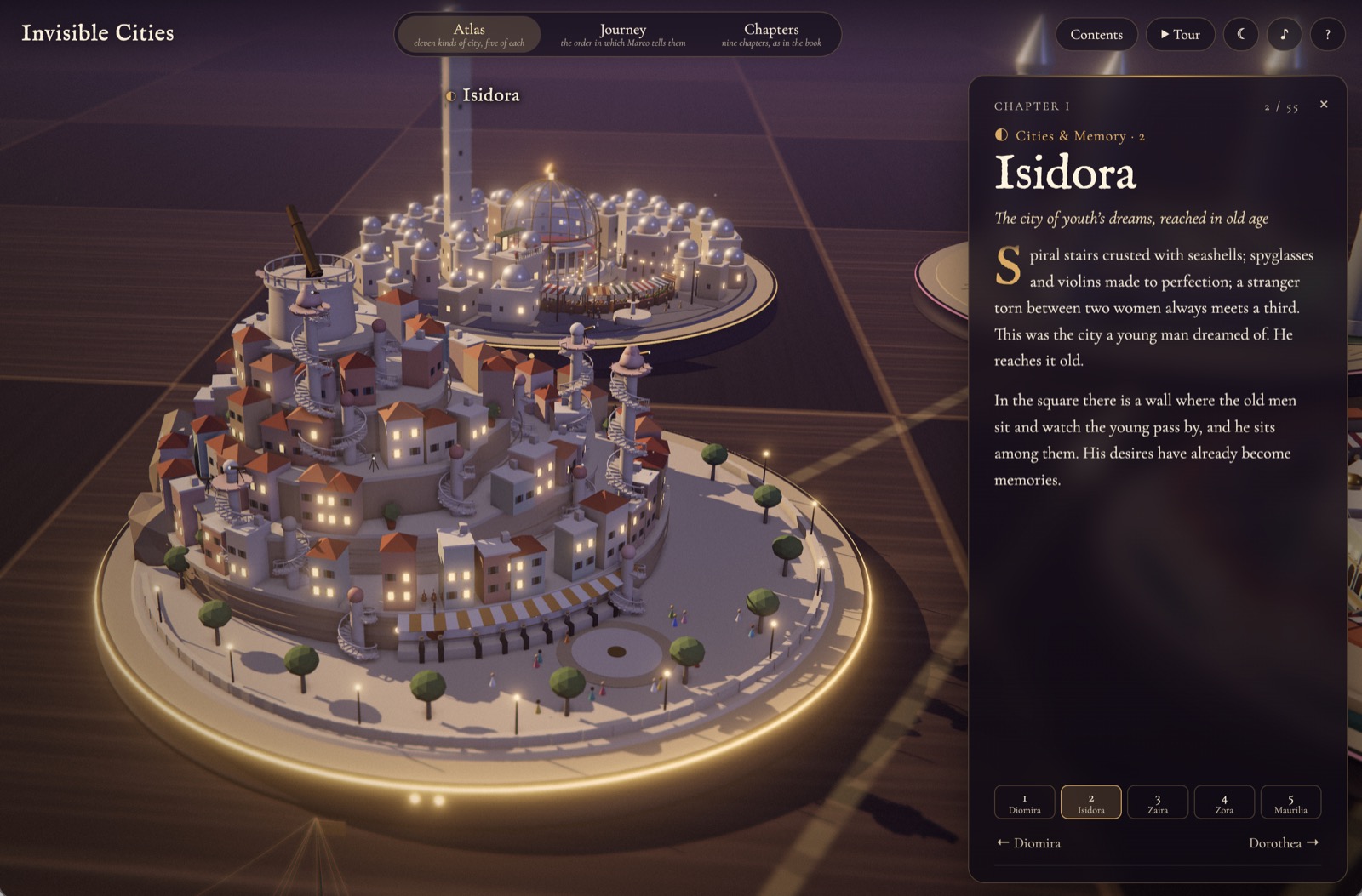
The author tested frontier AI models on a single prompt to autonomously generate interactive 3D visualizations of Italo Calvino's Invisible Cities. While GPT-6 Astra completed the task in 53 minutes for roughly $10, it produced a functional but visually cluttered result. Claude Opus 5.5 delivered a significantly more polished experience in just 85 minutes by deploying six parallel subagents, though at a higher API cost of approximately $74. The experiment highlights a major leap in AI's capacity for autonomous interactive design while raising questions about the future role of human creators and the rapid consumption of token budgets.
Interesting Points
- Opus 5.5 operated using six parallel subagents that collectively consumed roughly seven agent-hours, enabling it to finish well under the requested six-hour limit.
- The Opus 5.5 run cost approximately $74 in API tokens, significantly higher than the $10 spent on GPT-6 Astra.
- GPT-6 Astra's output contained unnecessary code comments and redundant text that cluttered the interface rather than enhancing accessibility.
- The author previously attempted similar projects with Claude Fable 5.1 and GPT-6 Astra, but found both required extensive manual correction or hand-holding to achieve professional design standards.
- This test followed a viral demonstration where Opus 5.5 autonomously built an interactive 3D camera lens lab in under 90 minutes for $25.66.
Top Comments
If you haven't read the book yet, I'm tempted to warn you against opening the visualization. Part of the joy of reading this book is letting your mind's eye run wild, and I fear if I read it for the first time after toying with this site, I'd be remembering the cities rather than conjuring them.
— droidjj (thread)
Invisible Cities is my favorite piece of literature hands down. The audiobook narrated by Richard Higgins is also done so beautifully and can't recommend it more.
As neat as this project is, this does no justice to whatsoever to the book. On the surface Invisible Cities seems to be a book about random cities' descriptions. In reality though, this book is about semiotics, meaning, language, and it's limits.
— uludag (thread)
Astra Penthesilea has towers that sometimes clip into the green... hedges? Pipes?
Opus Eutropia has a few isekai circle cities with one of them... ON the river, giving no space for ship traffic.
Slop has never been this beautiful before!
— Traubenfuchs (thread)
I opened it because I had no idea what Invisible Cities meant here. I thought they might be some real cities that don't come up on maps.
The website gives you a good hint before opening up the visuals. So, I got an idea.
I don't really know about Marco Polo. My only knowledge comes from the Netflix series, which doesn't talk about these invisible cities.
— FuturisticLover (thread)
I'd be remembering the cities rather than conjuring them
Having looked at some of them (and it being one of my favorite books) ... it won't do that. These visualizations are as terrible as they are unnecessary.
— mcphage (thread)
OpenAI annualised revenues $20B less than previously signalled
346 points · 243 comments · by mfiguiere
The Financial Times reports that OpenAI's annualized revenues are approximately $30 billion, significantly below the $70 billion figure that circulated in media reports based on investor materials. The discrepancy arose when OpenAI's own investors attempted to produce a direct comparison with Anthropic's reported metrics, discovering the two companies calculate the figures differently. OpenAI does not include revenue from sales via cloud partners such as AWS and Google Cloud in its calculation, while Anthropic does. The company has told investors its revenues have grown more than 70 percent since July, but the new investor presentation shows the lower figure.
Interesting Points
- The $70 billion figure was never directly stated by OpenAI; it was an extrapolation by investors and media from vague investor materials.
- Anthropic includes revenue from cloud partner sales (AWS, Google Cloud) while OpenAI does not, making direct comparison difficult.
- OpenAI is reportedly raising another $30 billion in funding targeting a $14 trillion valuation.
- The FT article was behind a paywall; a gift link was shared in the HN comments.
Top Comments
This is an interesting shift compared to the past where OpenAI would've been public a long time ago (due to various regulations) so we would have much more direct insight.
Right now we have a ~$1 trillion company which a ton of the "economy" and valuations are based on, with near zero information on how it's doing.
— wepple (thread)
zero information on how it's doing
I think the fact that we have so little information is the most important information we have. If OpenAI had a sound business plan and was on strong financial footing, they'd have IPO'd.
All of this continued stalling and obfuscation can only mean one thing, IMO: OpenAI has no long-term viability and they're desperately hoping for some new breakthrough to reinvent their business model before the VC money faucets turn off for good.
— combobyte (thread)
Gift link: https://giftarticle.ft.com/giftarticle/actions/redeem/f7715681-d519-48a9-80e3-81564a682f1e
Apparently they overstated revenue in an attempt to try to provide a direct comparison with Anthropic's reported metrics.
From the article: "According to a person with knowledge of the matter, the discrepancy arose from attempts by OpenAI's own investors to produce a direct comparison with Anthropic's annualised revenues. The pair calculate the figure in different ways, with Anthropic including the revenue from sales via cloud partners such as AWS and Google Cloud, while OpenAI does not. Efforts to "gross up" OpenAI's annualised revenue led to reports that the group's annualised revenue had hit $40bn in August. The company has since told investors its revenues have grown more than 70 per cent, leading to the $70bn figure"
— virtuosarmo (thread)
They would go public if they were doing well.
— Dezvous (thread)
Is there any understanding of how it's even 50b? Makes no sense to me.
— smalltorch (thread)
OpenAI withdraws three mathematical results
243 points · 542 comments · by sashank_1509
OpenAI has withdrawn three mathematical manuscripts from its public repository after identifying a sign error that invalidated a stabilization-trace cancellation argument. This foundational flaw also undermined a construction relied upon by two dependent papers, prompting the removal of the original work and its successors. Alongside the withdrawals, the organization has issued comprehensive revisions to 14 other manuscripts to fix proof gaps, clarify hypotheses, and update citations. These updates are accompanied by new formalizations, bringing the total proportion of verified top-line results to approximately 42 percent.
Interesting Points
- A sign error in "Algebraicity of Weil classes on split abelian eightfolds" directly triggered the withdrawal of two dependent manuscripts on K3 surfaces.
- Revisions to four Lipschitz heights and Ashkin–Teller currents papers repaired crossing, boundary-attachment, conditioning, and convergence arguments.
- Six Kähler minimal model programs and abundance manuscripts were updated to expand positivity and contraction arguments while clarifying required input hypotheses.
- Corrections to the Taming and hypersymplectic deformation papers removed an unnecessary cone-comparison dependency and added a strict-inclusion example to fix a cone-equality claim.
- Formal verification progress now covers 300 out of 719 top-line results, bringing the total formalized percentage to approximately 42 percent.
Top Comments
Without a thriving mathematical community to point out these things it would have stayed broken. With automated math that community as tao pointed out is at risk.
— qoez (thread)
I'm sorry but you don't actually need the mathematical community to check any of this. You just need autonomous verification, which already exists at scale and speed vastly beyond the entire human mathematical establishment. OpenAI simply rushed these out without completing that for every paper. These mistakes have nothing at all to do with the mathematical community and are 100% just the result of market pressure incentivizing speed at 1,000,000x the pace of human mathematicians. Frankly, a couple mistakes, trivially found not by humans but by humans using AI, is almost completely irrelevant. Human mathematicians have essentially nothing to contribute to this effort aside from prompting verification agents, which any of us can do if we cared to spend the time (most of us don't).
— nilkn (thread)
This is not a problem unique to the mathematical community.
What about software developer community? AI has eliminated the need for junior software engineers. Almost no one is hiring junior software engineers. But companies still need senior software engineers. Without junior engineers how will there be senior software engineers in the future?
What is the solution? I don't think the solution is to say AI progress in software, mathematics etc. should be halted.
— flowerlad (thread)
3 mistakes (so far) out of ~400 is still a pretty good hit rate
— hmate9 (thread)
I think that on closer inspection, a lot of these fully AI generated proofs will fall apart. Even in Lean, you can build theories which compile but nonetheless state something different than what you actually intend. It's just that the volume of proof is so staggeringly large that it will probably take years before we find the issues, a la abc conjecture
— ijustlovemath (thread)
How machines learned precision
224 points · 68 comments · by glinscott
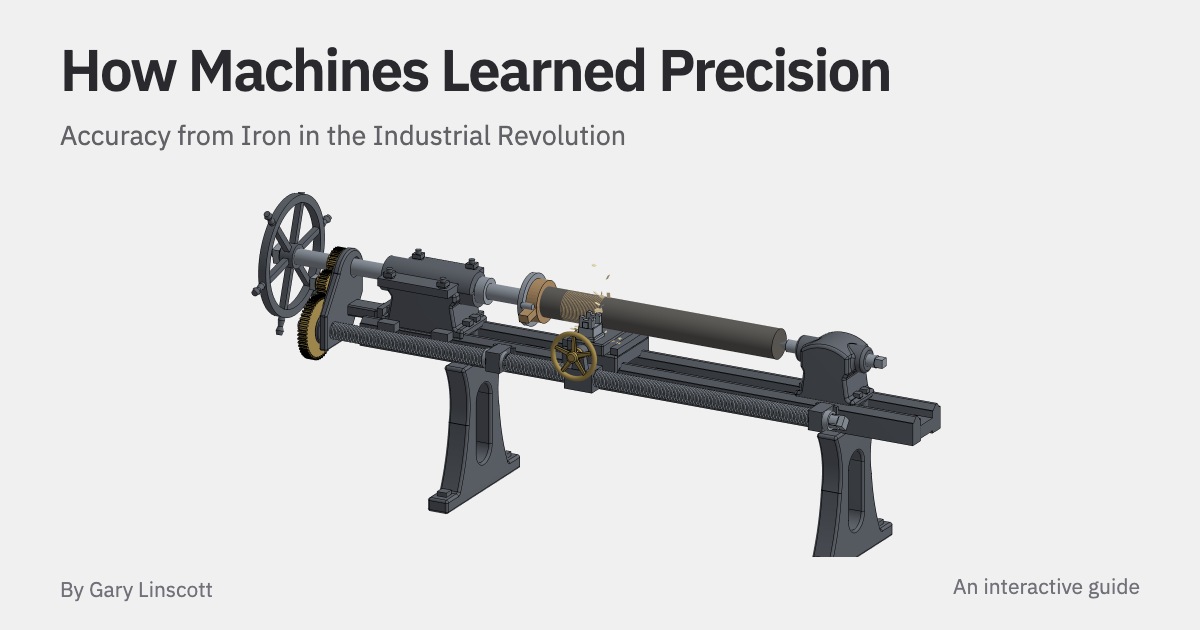
The article traces how 18th- and 19th-century engineers overcame fundamental manufacturing limitations to achieve unprecedented machining precision. By replacing hand-guided tools with rigid slide rests, inventing geometric methods to cut accurate screws without copying existing ones, and developing self-referencing scraping techniques, workshops systematically eliminated errors in cylinders, shafts, and threads. Coupled with magnified measurement instruments like Maudslay's micrometer and Whitworth's millionth-inch machine, these innovations transformed metalworking from an artisanal craft into a repeatable, interchangeable-parts industry. Ultimately, machine tools began making better machine tools, creating a feedback loop of escalating accuracy that defined the Industrial Revolution.
Interesting Points
- John Wilkinson's 1775 boring mill used a heavy bar supported at both ends rather than one end, reducing cylinder bore error to less than one millimeter across a meter-wide cast iron surface—roughly thirty times more accurate than previous attempts.
- Fitters created flat reference surfaces from rough castings using the three-plate method, where three roughly filed plates are repeatedly rubbed with coloring agent and scraped until each fits every other in all orientations.
- Henry Maudslay generated accurate screw threads without copying older parts by pressing a hardened knife against a rotating soft cylinder at a precise angle, later improving accuracy by averaging the motion of two imperfect guide screws.
- Joseph Whitworth's 1850s measuring machine achieved a resolution of one millionth of an inch by using a split nut to eliminate backlash, a worm gear to dampen operator hand movement, and a friction-held gravity piece to detect microscopic closure.
- Richard Roberts's 1817 planing machine reduced the labor cost of truing a square foot of cast iron from twelve shillings to under one penny, making automated surface finishing over a hundred times cheaper than manual filing.
Top Comments
After repeated copying and correction, Maudslay made a master screw five feet long and two inches across, with fifty threads to the inch and a foot-long nut that engaged six hundred of them at once.
That's the stuff I like to read about the historical endeavors. A fifty-threads nut doesn't average the distance between the grooves quite accurately enough? Then let's make a nut with six-hundred threads on it, and so what if it's foot long.
— Joker_vD (1 reply)
Anyone interested in this might also enjoy the book The Perfectionists: How Precision Engineers Created The Modern World, by Simon Winchester. I read it a few years ago, and thought it was a really interesting journey through bootstrapping precision and how that fundamentally changed our relationship to certain types of things, particularly related to mass production of "good enough".
— qchris (2 replies)
Awesome, glad they helped :).
It's a mixture of techniques. Using fully rigged CAD models is a huge help, it ensure physically realistic motions. Then, I built a custom exporter / renderer to render them realistically in CAD style.
For a lot of the animations, I first develop storyboards to cover the main beats, and decide on what would be interactive or not. Then a lot of iteration with Fable (and Opus 5.5 now!) on how to show things clearly. A lot of time is spent trying to show the key ideas visually. Eg. in the bench micrometer adding an overlay with the size of the micrometer closing over the part, as well as showing the screw spinning was a big improvement in "readability".
— glinscott (0 replies)
how did you make these videos? ive struggled to understand mechanical systems from static figures and these are super helpful
— jeeshan (1 reply)
I've sometimes thought of making a YouTube series where the foundations of precision are created as increasingly precise artifacts, building on each other and following the history. Something like the "Primitive Technology" channel but for machine tools.
— HPsquared (2 replies)
Port of the TypeScript compiler, checker and lsp to Rust, by LLM
109 points · 207 comments · by jcbhmr
A developer has successfully used large language models to port the TypeScript compiler, type checker, and language server to Rust, creating an experimental project called ts-rust. Initially attempted with OpenAI models at a cost exceeding $420,000, the port was ultimately completed by Claude Opus 5.5 in just two weeks for approximately $24,047. The Rust implementation mirrors Microsoft's Go-based TypeScript compiler, maintains full compatibility with over 180,000 upstream tests, and delivers roughly twice the type-checking speed of the Go version across real-world codebases.
Interesting Points
- The port is pinned to TypeScript 7.1.0-dev (revision 673a5f17d713) and passes all 181,711 ported Go baseline tests with identical diagnostics.
- In benchmarks across six major open-source repositories, the geometric mean speedup over the original tsc 6 is 11.4x, making it 1.61x faster than the Go-based tsc 7.
- The implementation integrates Effect language service diagnostics directly into the compiler check, removing the need for a second diagnostic pass required by the Go version.
- Editor memory usage grows at a measured rate of roughly 20 MiB per 1,000 edits during long sessions, staying below the original TypeScript checker's footprint.
- The initial OpenAI-driven attempt spent over $400,000 on API tokens and stalled at ~84% compatibility before Claude Opus 5.5 took over.
- Opus 5.5 generated over 1.3 million lines of Rust code, producing a functional v0 in 10 hours and completing the full port in two weeks.
Top Comments
Wait - you spent north of $400,000?
— ingen0s (9 replies)
Spent over $400,000 in API priced tokens with GPT-5.6 Sol and GPT 6 Astra.
Tangent here, but I think this bit is super interesting!
You could viably hire someone to do this work for that kind of money - I think the interesting thing is that substantially less interested/experimenting engineers would consider paying for a human to do this work, than would happily chuck a big amount of money into an LLM.
I don't have any suggestion about why that exists, but it's a strange and interesting contract.
— benrutter (4 replies)
Maybe there are just so many of these but at this point for vibe coded stuff like this I'm just like "who cares." LLMs can make stuff like this now. Unless this reaches some critical mass of usage among developers why would I use it? It's just a less maintained, less tested implementation. The more important question is "what does this teach us?" And idk the answer to that one.
— yoyohello13 (4 replies)
Paraphrasing from README.md:
Spent over $400,000 in API priced tokens with GPT-5.6 Sol and GPT 6 Astra. They wrote over 1.3m lines of Rust over multiple months of /goal loops and never got past like 84% compat.
Then they let Claude code lose on the problem:
I figured it'd be fun to throw Opus 5.5 at this. It had a working v0 in 10 hours. I assumed it kept using the code the Codex models wrote. I was wrong. Opus 5.5 started from scratch. It got further than Astra in 1/10th the time.
In the warnings from README.md
Also worth mentioning: I've never read a line of this code.
— wg0 (3 replies)
What a waste of power... $424.000 of API priced tokens amounts to how many kWh burned? And how would you trust this to build your code?
Motivations says it all:
Test model capabilities Make a fast TypeScript type checker Make a ts checker that can work in WASM with high performance Memes
— mkesper (3 replies)
I think I found a planet nobody knew existed. I used Claude Code to find it
104 points · 39 comments · by pyduan
A researcher used Claude Code to analyze astronomical telemetry data and identified a potential exoplanet that had not been previously catalogued. The discovery was subsequently confirmed by NASA pointing a telescope at the target. The story highlights the growing role of AI coding agents in scientific data analysis, though it also raises questions about false-positive rates when agents process raw telemetry without rigorous statistical validation frameworks.
Interesting Points
- The researcher used Claude Code to write and iterate on data analysis scripts that processed raw astronomical telemetry.
- NASA confirmed the discovery by pointing a telescope at the candidate target after the initial AI-assisted analysis.
- The story has sparked discussion about the false-positive rate when letting coding agents process raw scientific data without proper statistical harnesses.
Top Comments
Cool discovery, but I'd be real curious about the false-positive rate when letting coding agents loose on raw astronomical telemetry. Hallucinations in data reduction are no joke.
— ContinuityLab (thread)
Laughed at the reddit comment
"We got vibe astronomy before GTA6"
— __alias (thread)
Planet Claude?
Asking for a friend.
— k310 (thread)
Step 5 Preview, a 1M-context MoE from StepFun, shows up on OpenRouter
80 points · 23 comments · by AnneWodell
StepFun has released Step 5 Preview, a 1-million-token context model optimized for agentic workloads like software engineering and finance. Built on a sparse Mixture-of-Experts architecture with 27 billion active parameters out of 600 billion total, the model is designed to handle extended multi-step tasks across large codebases and documents. It supports multimodal text, image, and video inputs while returning text outputs, and includes native support for tool calling and JSON-structured responses. Available on OpenRouter at $1.00 per million input tokens and $2.70 per million output tokens, it targets developers needing long-context reasoning with iterative tool use.
Interesting Points
- The 1,000,000-token context window is capped at a maximum of 64,000 completion tokens.
- P50 performance metrics show a latency of 3.51 seconds and a throughput of 103 tokens per second.
- Structured outputs are configured by passing a JSON schema in the
response_formatparameter, separate from the standardtoolsfunction calling endpoint. - The model accepts text, images, and video as inputs but only returns text outputs.
- Cache reads are priced significantly lower than generation at $0.05 per million tokens.
Top Comments
Without the pelicans I don't know what to think
12m 0s and $0.28
Draw a Hacker News-style comment thread. Top comment by a user named "pelican_enjoyer": "Without the pelicans I don't know what to think." Reply from "minimaxir" in a grumpy tone: "Since people keep doing it: no, you don't have to make an allusion to Simon's pelicans every time a Hacker News thread about a new LLM pops up. It's a lower-effort joke than even Reddit memes." Beside the thread, show a pelican riding a bicycle, looking smug.
— hosel (thread)
Why is that interesting?
— jstummbillig (thread)
I like trying new models but I wish we'd get something actually new. Like a new architecture or something. LLMs are just so sloppish. We can do better.
— MisterMunchkin (thread)
It doesn't look competitive along any dimension: https://artificialanalysis.ai/models/step-5#intelligence-comparisons
Better luck next time.
— esafak (thread)
Wonder if this was the space bunny alpha model
— lykr0n (thread)
Sub-1-Bit LLM Compression via Latent Factorization
77 points · 22 comments · by brainless
Samsung Labs has released LittleBit and its successor LittleBit-2, techniques designed to compress large language models into the extreme sub-1-bit regime. The method achieves compression rates as low as 0.1 bits per weight by decomposing dense weight matrices into low-rank latent factors that are subsequently binarized. Magnitude information is preserved through lightweight learned scales, allowing the original model architecture to remain completely intact during inference. The follow-up LittleBit-2 iteration further refines this process by aligning the latent geometry with the binary hypercube prior to training, maximizing spectral energy gain without adding inference overhead.
Interesting Points
- Compression targets range from 1.0 down to 0.1 bits per weight by binarizing low-rank latent factors and applying learned scales to restore magnitude.
- LittleBit-2 employs Joint Iterative Quantization (Joint-ITQ) to rotate SVD-derived factors into alignment with the binary hypercube before quantization-aware training begins.
- Deployed models experience zero inference-time architectural changes or computational overhead, as all geometric optimizations are strictly confined to the initialization and training phases.
- The framework natively supports Quantization-Aware Training through the SmoothSign function and offers optional residual factorization to stabilize training at ultra-low bitrates.
- Supported model families include OPT, Llama 2 and 3, Phi-4, Qwen2.5 and 3, and Gemma 2 and 3.
Top Comments
I understand the obsession with low bit quantization, but it is empirically quite evident that it is not possible to compress models to less than 4 bit per weight without severe loss of capabilities².
It may be nice as an experiment, but it is obviously a very inefficient route for model training: spending all the flops on a saturated model only to prune its capabilties.
²As to why, I have seen few explanations. But the empirical evidence is there.
— cpldcpu (thread)
Can this produce a useful model? So far 1 bit quants have been less useful than smaller models that use the same memory
— big-chungus4 (thread)
I understand that the interest in these extreme quants stems from wanting to maximize the capability the average user can get from a local LLM in this era of ludicrously expensive memory, but I wonder if this is maybe targeting the wrong axis?
We've been seeing various optimizations towards streaming, that have been much more impactful in the local AI space, e.g. MoE models where the less busy experts are offloaded to slow RAM or even pruned entirely, engram tables that can be read from NVMe instead of sitting around in RAM etc.
Maybe the trick with these extreme quants would be to increase the total parameter count while quanting individual weights, such that maybe the active parameter count comes down, or streaming weights from RAM or disk becomes more efficient, or cache behavior improves? Say, replacing a single 4bit/weight matmul with 3 1bit/weight operations that produce a much closer result than a single 1bit/weight matmul would.
— hgoel (thread)
Their paper shows this comes with huge quality loss, but that doesn't make it a negative result by any means
— badatnames (thread)
Counter evidence:
https://arxiv.org/abs/2603.00042
It is true that block-headed quantization of everything doesn't work. But, as I am sure will read, if you remove the spiky parts of the parameter values, the residue can be dramatically quantized and compressed while retaining performance.
This is a multi-modal sort of compression where you use different techniques for different phenomena. Simply compression all of the weights, each in isolation, ignores the benefits of compressing them collectively.
— ted_dunning (thread)
39 more Hacker News stories
- Anthropic bans 'abusive or cruel behavior' towards Claude (64 points · discussion) -- Anthropic has updated its usage policy for the first time in over a year, introducing strict prohibitions against sustained abusive or cruel behavior toward its Claude models.
- Vitalik Buterin backs crypto 'bunker mode' amid rapid AI math advances (57 points · discussion) -- Ethereum co-founder Vitalik Buterin and researcher Justin Drake warn that rapid AI-driven mathematical breakthroughs could compromise current cryptographic standards used in cryptocurrency wallets before quantum computing arrives.
- AI-ready biological data: $1.8B global commitment (56 points · discussion) -- Biohub, alongside the U.S.
- AHM Statement on OpenAI's October 6 Release of Mathematical Documents (44 points · discussion) -- The Association for Human Mathematics (AHM) has issued a formal statement criticizing OpenAI's October 6 release of a repository containing over 700 mathematical manuscripts.
- Trump says anyone who uses the phrase "artificial intelligence" is "the enemy" (41 points · discussion) -- Donald Trump declared that anyone who uses the term 'artificial intelligence' is 'the enemy,' promoting the use of 'super intelligence' instead.
- Show HN: Free open source Adobe Lightroom alternative, completely local with AI (39 points · discussion) -- A developer has released Rembrandt, a free and open-source Lightroom alternative built entirely locally with AI-powered features including on-device masks and denoise.
- LGTM (Looks Good to Me) – Claude Opus 5.5 Music Video (39 points · discussion) -- A music video titled 'LGTM' (Looks Good to Me) was created using Claude Opus 5.5, generating both the music and video content.
- OpenAI, the Partition Principle, and Mathematics (37 points · discussion) -- Set theorist Asaf Karagila strongly criticizes OpenAI's recent preprint claiming a solution to the century-old Partition Principle problem, describing the document as structurally muddled and academically unacceptable.
- 100 days later: Microsoft still steers Windows and Copilot users to Edge (32 points · discussion) -- A Mozilla blog post examining Microsoft's continued aggressive promotion of Edge browser to Windows and Copilot users 100 days into their current strategy.
- AI Model Groupthink (28 points · discussion) -- An independent test of 12 AI models on ranking questions reveals that Chinese-made models consistently produce more consensus-aligned responses than their American and European counterparts, with DeepSeek leading at a 0.59 conformity score while Anthropic's Claude Haiku and Meta's Llama 4 Scout are the most contrarian.
- Show HN: Pinrail – A desktop inbox where coding agents wait for your review (25 points · discussion) -- A new desktop application called Pinrail that provides an inbox interface for reviewing coding agent outputs before they are executed.
- Show HN: I Put an AI Agent on a Nokia 110 (25 points · discussion) -- An experimental project that runs an AI agent on a Nokia 110 feature phone, demonstrating the possibilities of deploying AI on extremely constrained hardware.
- Show HN: Terse, a Claude Code plugin that halves reply length by cutting filler (23 points · discussion) -- A Claude Code plugin called Terse that reduces AI reply length by approximately half by removing filler language and unnecessary elaboration.
- Zed Editor, Docker Agent, ACP, but in a sandbox: running the agent with sbx (23 points · discussion) -- A blog post about running AI coding agents in a sandboxed environment using sbx, combining Zed Editor, Docker, and ACP for safer agent execution.
- Show HN: AI SRE Arena, an Open Benchmark for AI SRE Agents on Kubernetes (22 points · discussion) -- AI SRE Arena is an open benchmark designed to evaluate AI agents performing Site Reliability Engineering tasks on Kubernetes clusters.
- Will AI kill us all (20 points · discussion) -- A blog post examining the existential risk narrative around AI, questioning whether the doomsday scenarios are justified or exaggerated.
- Frontier AI models outperform analysts on earnings prediction (20 points · discussion) -- Samaya AI researchers built a financial prediction harness that restricts AI models to point-in-time data available one week before earnings releases, finding that top-tier AI systems consistently outperform both raw analyst consensus and a bias-corrected baseline in forecasting earnings surprises across 456 companies.
- Show HN: Jevman – AI decision models play Pac-Man (20 points · discussion) -- A benchmark called Jevman that tests AI decision models by having them play Pac-Man, evaluating their ability to make strategic decisions in a classic arcade game environment.
- Man took his own life after 'sextortion' blackmail involving AI-generated woman (17 points · discussion) -- A tragic case where a man took his own life after being blackmailed by someone using an AI-generated woman for sextortion, highlighting the real-world harms of AI-generated content.
- AI Crawler Index (16 points · discussion) -- An index tracking AI web crawlers and their behavior, providing visibility into which AI systems are scraping which sites and how frequently.
- OpenAI says teens use ChatGPT for under 15 minutes a day (16 points · discussion) -- OpenAI reports that teens use ChatGPT for less than 15 minutes per day on average, even as concerns about AI risks to young users continue to grow.
- Claude Haiku 5.5 (13 points · discussion) -- Anthropic's official documentation page for Claude Haiku 5.5, detailing the model's capabilities, pricing, and API specifications.
- Bender: AI's 'Existential' Risk Is 'Fake' [video] (12 points · discussion) -- A video discussing the debate around AI existential risk, featuring perspectives that dismiss the concerns as exaggerated or fabricated.
- Show HN: Pocketty – iPhone SSH terminal that pings you when an agent is blocked (12 points · discussion) -- Pocketty is an iPhone SSH terminal app that sends push notifications when an AI agent is blocked waiting for user input, allowing developers to monitor and respond to agent workflows remotely.
- Claude: Monthly API credits for Max and Team plans (11 points · discussion) -- Anthropic announces monthly API credits for Claude Max and Team plans, making API access more predictable for individual and small team users.
- Show HN: ChatGPT answers calls on a normal SIM. No Twilio, just a $6 ESP32 (11 points · discussion) -- A project demonstrating ChatGPT answering phone calls using a $6 ESP32 microcontroller with a normal SIM card, eliminating the need for Twilio or other telephony services.
- McDonald's sued over AI tool that recommends prices to US franchisees (10 points · discussion) -- McDonald's is facing a lawsuit over an AI pricing tool that recommends prices to US franchisees, raising antitrust concerns about algorithmic coordination.
- OpenAI releases 722 math manuscripts (10 points · discussion) -- OpenAI's comprehensive table of contents for their 722 mathematical manuscripts, listing all the AI-generated proofs and results released to the public.
- Bold AI developer takes aim at Adobe with open source clones (9 points · discussion) -- Developer Brandon Thomas is using Claude Opus 5.5 to build seven open-source, clean-room alternatives to Adobe's Creative Cloud applications in Rust, with WebAssembly versions for browser execution, funded through a token-based model attached to his pre-existing Artcraft visual AI tools.
- Mumsnet denies using AI for content after prompt appears on message board (9 points · discussion) -- Mumsnet has denied using AI to generate content after a prompt appeared on their message board, sparking debate about AI use in community-generated platforms.
- FeedbackBench: Coding agents ranked by their users' feedback (7 points · discussion) -- A new benchmark called FeedbackBench ranks coding agents based on actual user feedback rather than automated metrics, providing a more human-centered evaluation of AI coding tools.
- ChatGPT Space: a dystopia of centralised context (7 points · discussion) -- A substack essay critiquing ChatGPT's centralized context model as a dystopian approach to AI interaction, arguing for more distributed and user-controlled alternatives.
- The OpenAI proofs are us (6 points · discussion) -- A substack essay reflecting on the philosophical implications of OpenAI's AI-generated math proofs and what they reveal about the nature of mathematical discovery.
- Hermes creator Nous Research raises $90M to bring open-source AI to enterprises (6 points · discussion) -- Nous Research, the team behind the Hermes open-source model series, has raised $90 million to expand their open-source AI offerings for enterprise customers.
- Show HN: We Westernized Qwen for US enterprise use (6 points · discussion) -- Hirundo.io has released a 'Westernized' version of Qwen3.6-35B-A3B on HuggingFace, using machine unlearning to remove CCP political alignment for US enterprise use.
- Phase Lock: A manifesto on BCIs and preserving human agency in the age of AI (6 points · discussion) -- A manifesto called Phase Lock advocating for the preservation of human agency in the context of brain-computer interfaces and AI, arguing for safeguards before these technologies become widespread.
- TypeSafe started the decision-model category; OpenAI and AWS did it in 3 weeks (5 points · discussion) -- A video discussing how TypeSafe pioneered the decision-model category, and how OpenAI and AWS replicated the concept in just three weeks.
- License update: AI derivation prohibited on all my art, lore, stories, comics [flagged] (37 points · discussion) -- Webcomic author David Revoy is updating his Creative Commons licenses to explicitly prohibit AI-generated derivatives of his work, citing an overwhelming influx of daily requests from studios and developers seeking permission to create AI-powered comics and games based on his portfolio.
- AI, Work, and the Next Downturn [dead] (13 points · discussion) -- An essay exploring the potential economic impact of AI on employment and whether we are heading toward a significant downturn in traditional work patterns.
 Reddit Stories
OpenAI being stingy with all those billions
7450 points · 379 comments · r/OpenAI · by u/py-net

The image post centers on a top comment recounting how Microsoft denied payment for a Windows 11/WinRAR exploit report despite later patching it, prompting the commenter to vow never to disclose vulnerabilities to major tech companies again. Discussion commenters react with skepticism toward OpenAI's bug bounty practices, with some criticizing the company's compensation as inadequate and others joking about weaponizing exploits against them. Several users debate whether this stinginess is standard across the industry or a specific failure by OpenAI to properly reward security researchers.
Interesting Points
- The top comment details a four-year-old Windows 11 exploit involving WinRAR that bypassed Microsoft Defender, which was reported via Microsoft's bug bounty program but denied payment because Microsoft attributed the flaw to WinRAR rather than Windows, despite the company subsequently releasing a patch.
- Commenters criticize OpenAI's compensation practices, with one user noting the company reportedly pays amounts comparable to "half a month's rent in 2005," while another argues that disclosing exploits to large corporations is inherently risky and unwise.
- Several replies dispute or contextualize the complaint, asking whether Microsoft or Apple employ similarly low bounty structures and suggesting that OpenAI should offer lifetime free token access as a more sustainable reward for security findings.
- One commenter questions why OpenAI cannot leverage its own advanced AI models to automatically detect and patch vulnerabilities instead of relying on external researchers.
Top Comments
Better just use the exploit for that price.
— u/ScreenAppropriate679 (1316 points · permalink)
OpenAI: 'Thanks for saving our entire backend, here's half a month's rent in 2005.' 💀
— u/dualityseo (872 points · permalink)
lmao are they broke?
— u/max6296 (373 points · permalink)
$300 for a sandbox escape is wild. that kind of bug goes for way more on grey markets, they know exactly what they doing
— u/WiseAirport3282 (587 points · permalink)
Actually, yes
— u/sailhard22 (361 points · permalink)
Lol, how many of you tried this?
7897 points · 182 comments · r/ChatGPT · by u/Little_Moment_8698

An image post asks if users have tried a specific body dissolution method, prompting a thread on the chemistry and logistics of the process. Commenters debate whether potassium hydroxide is more effective than acid, suggest pigs as anatomical proxies, and joke about consuming the remains. Several replies highlight that AI models like Claude enforce safety guardrails by refusing to assist with toxic gas methods.
Interesting Points
- A top comment argues potassium hydroxide is a base and recommends 3.75–7.5 kg per 75 kg body, correcting the original acid-focused approach.
- Commenters note that pigs are frequently used as anatomical proxies for human tissue due to their similar fat and muscle composition.
- The discussion features a pasted guide estimating that dissolving a 75 kg body requires 10–100 liters of acid depending on concentration, with notes on heat management and the use of hydrofluoric acid for bones.
- One user shares that AI models like Claude correctly refuse to assist with carbonating drinks using toxic noble gases or carbon monoxide, citing safety boundaries.
Top Comments
Pig are closer to human tissues and skin .
75 kgs of pig .
— u/Valuable-Jicama6810 (1036 points · permalink)
Right? Just convince it your piglet died of unknown causes and you don't think the meat is safe to eat or even burn.
— u/Strange-Order-6550 (273 points · permalink)
That would be actionable guidance for chemical destruction
— u/badger_flakes (134 points · permalink)
I’m crying 😿
4406 points · 222 comments · r/ChatGPT · by u/Professional_Arm794

A highly upvoted emotional meme post in r/ChatGPT, likely depicting a touching or humorous AI interaction.
Top Comments
Strangely, that actually touched me LOL. Very beautiful.
— u/Responsible-Slide-26 (830 points · permalink)
My cat died yesterday and this made me actually tear up 😭
— u/Borkato (337 points · permalink)
So sorry for your loss.
— u/Groundbreaking_Bad (117 points · permalink)
Glad we’re focusing on the important things
2854 points · 1004 comments · r/singularity · by u/Recent_Fox4339

The post is an unlabeled image meme titled 'Glad we’re focusing on the important things,' which commenters interpret as mocking a recent political shift or leadership change at the White House. The discussion quickly devolves into broad criticism of the current U.S. administration, with users expressing frustration over perceived political regression and electoral choices. Amid the political commentary, one user questions the validity of the term 'singularity' in AI discourse, arguing it should simply be called AI.
Interesting Points
- Commenters widely interpret the image as a political meme criticizing the White House's current leadership and recent administrative changes.
- Several top comments express frustration over U.S. electoral outcomes, with users debating how voters reacted to the administration's direction.
- A top reply argues that the term 'singularity' is nonsensical in this context, suggesting the conversation should simply refer to 'AI' instead.
- Multiple commenters lament that political infighting is overshadowing major technological advancements during a critical period for AI development.
Top Comments
he's regressing more and more every day.
— u/Bitter_Particular_75 (575 points · permalink)
we all knew this was a name change to see who is loyal and who isnt
— u/krizzalicious49 (462 points · permalink)
Murica is cooked, that's what you get when you elect idiots
— u/Far-Resort1936 (357 points · permalink)
I'm just scrolling reddit and suddenly I am an ENEMY to the white House.
Edit: THE ENEMY
— u/erik3355 (234 points · permalink)
Deeply misaligned, constant hallucinations, each output token costs the US millions.
Just switch to Opus 5.5 at this point.
— u/N-partEpoxy (331 points · permalink)
It's actually insane how prescient this was. They made it in 2011. This is increasingly what it's like to use computers now.
2148 points · 125 comments · r/ChatGPT · by u/AxomaticallyExtinct

The post shares a screenshot from a 2011 Celeryman web series starring Paul Rudd, claiming the clip's futuristic computer interface accurately predicts modern AI assistant experiences. Commenters identify the source material, note that the operating system shown lacks ad spam and crashes, suggesting it runs Linux, and joke that the futuristic name tags resemble typical AI-generated names. The discussion remains largely appreciative of the original creative work, with several users contrasting its human-driven humor favorably against current AI generation, alongside lighthearted remarks about Paul Rudd's apparent agelessness.
Interesting Points
- A top reply links directly to the original creator's site, celeryman.alexmeub.com, confirming the clip's origin.
- A highly upvoted comment observes that the desktop in the clip lacks ad pop-ups and crashes, concluding the character must have already upgraded to Linux.
- Several replies note that the futuristic name tags closely mirror the naming conventions currently favored by AI models, with one user adding a joke about a required "tiny hat wobble."
- Multiple users praise the original human creativity of the 2011 skit, contrasting it favorably against modern AI-generated content.
- The thread includes lighthearted jokes about Paul Rudd's apparent lack of aging since 2011.
Top Comments
— u/Nervous_Turnover9113 (311 points · permalink)
Wow, can't believe this exists
— u/BusElectronic4225 (57 points · permalink)
This is the future of computing. You don't interact with the machine, the machine interacts with you.
— u/rv_ (28 points · permalink)
Another peaceful day in mathematics.
1791 points · 550 comments · r/ChatGPT · by u/EstablishmentFun3205

A satirical meme post commenting on the ongoing drama around OpenAI's math proofs release and the subsequent AHM statement. The post uses the phrase 'another peaceful day in mathematics' ironically, referencing the chaos caused by AI-generated proofs, the withdrawal of three papers, and the mathematical community's reaction to OpenAI's actions.
Interesting Points
- The post is a reaction to the broader mathocalypse narrative, including OpenAI's paper withdrawals and the AHM's boycott call.
- Comments highlight the misalignment between AI companies viewing math problems as benchmarks and mathematicians viewing them as genuine unsolved problems requiring new understanding.
- One commenter notes that while the AI solved hundreds of problems, it did not create new techniques or ideas to attack those problems, limiting the value for practicing mathematicians.
Top Comments
the real hit will come when my daughter says: 'I don't need you dad, I can just ask ChatGPT for advice'.
— u/BridgeOnRiver (578 points · permalink)
Bro solved 300 open problems just to unlock the final boss: mathematicians checking the proof
— u/saurabh3228 (400 points · permalink)
But the problem is that while it solved these problems it did not create any new techniques or ideas to attack these problems. So it does not create that much value for mathematicians as they don't gain much insight into the nature of the problem.
There is a misalignment between the intention of ai companies and mathematicians. AI companies view open problems in mathematics as a benchmark for their model while mathematicians view open problems as parts of the world of mathematics that they don't fully understand yet. The intention of mathematicians is to gain a new understanding that they didn't have before when they solve these problems.
— u/Dry_Hovercraft7042 (185 points · permalink)
My daughters doesn't understand what the internet is they just think I know everything
— u/Correct-Turn-2560 (219 points · permalink)
Your post is getting popular and we just featured it on our Discord! Come check it out!
You've also been given a special flair for your contribution. We appreciate your post!
I am a bot and this action was performed automatically.
— u/WithoutReason1729 (1 points · permalink)
Fields Medalist Terence Tao reposts statement from the Association for Human Mathematics urging mathematicians to stop working with OpenAI for continuing to solve open math problems against their recommendations
694 points · 1111 comments · r/OpenAI · by u/Eliv_nurotic

Fields Medalist Terence Tao reposted a formal statement from the Association for Human Mathematics condemning OpenAI's October 6 release of over 700 mathematical manuscripts. The organization argues the move violates guidance from the Advisory Group on Mathematics and AI, which advised against frontier AI companies testing advanced problems on internal models. The AHM frames the bulk release as a demonstration of corporate power rather than genuine scholarship and urges mathematicians to discontinue all collaborations with OpenAI.
Interesting Points
- The statement highlights that OpenAI is currently defending lawsuits alleging illegal plagiarism, copyright infringement, and trademark dilution.
- It explicitly references the Advisory Group on Mathematics and Artificial Intelligence (AGMAI) to note that frontier AI firms were previously advised against testing advanced mathematical problems on internal models.
- The organization frames the simultaneous publication of more than 700 manuscript files as a strategic display of corporate influence rather than a methodical scholarly endeavor.
- Beyond academic ethics, the group calls for a professional boycott, urging mathematicians to halt all collaborations with OpenAI to protect the field's commitment to human-centered progress.
Top Comments
"Mathematicians did not ask for this work to be done."
Oh fuck off.
— u/bortlip (392 points · permalink)
I left this comment on his blog:
I'm not a mathematician, but honestly, I found this statement really hard to take seriously. And I don't think I'm the only one.

Firstly, the lawsuits. What does copyright litigation have to do with whether a proof is correct? Nothing. Maths is one of the few fields where you can actually check the work, by hand or by computer. A proof is either right or it's wrong. If one of these proofs holds up, does it become wrong because of a copyright case? Of course not. Leading with this is just attacking the messenger.

Secondly, since when do mathematicians get to decide who works on which problems? These were open problems. Some of them have literal prize money attached to get people to solve them. And nobody is forcing anyone to review these papers. They exist now. Read them, check them, ignore them, that's entirely up to you.

Thirdly, "the norms of scientific research". What does that actually mean here? The work was published openly, for free, with full write-ups and in a lot of cases machine-checked Lean proofs. That sounds pretty scientific to me. If the real issue is attribution, or speed, or who has to do the checking, then say that. Right now I genuinely can't tell what rule was broken.

Fourthly, "a particular vision of progress". Wasn't the vision to get these problems solved? That's the whole point of putting them out there and attaching prizes to them. So why is progress being published on a public GitHub suddenly bad for the field?

And "a demonstration of power"? If a single person had solved even one of these problems, we'd be calling it the scholarship of the century. The fact that it came from an AI company doesn't change whether the maths is right.

To be fair, I think there probably is a real concern buried in here because someone has to check 700+ papers, and that work usually falls on mathematicians who aren't being paid for it. That's a fair point, but it's not the point this statement makes. Instead it just tells everyone what to think without explaining why.

Honestly, statements like this do more damage to how people see mathematics than anything an AI company has done. If mathematicians genuinely feel they're being hard done by, explain it properly and bring people along. I'd absolutely listen.
— u/AFL_gains (298 points · permalink)
Why does this sound like they are saying AI should not solve math problems, only humans should
— u/m3kw (264 points · permalink)
Can you imagine physicists responding like this, if there was a similar result for the plasma physics fusion ignition problem? It seems like math is choosing heroics over truth.
— u/Opposite-Cranberry76 (201 points · permalink)
Ridiculous. They don't own the problems. They're for everyone. Solving them only increases our understanding.
— u/Enough_Program_6671 (136 points · permalink)
Last week some of South Korea's biggest banks were hit by a cyberattack. We now know the entire hack may have been done by a single person. He used a combined stack of an open-source AI penetration tool named ARTEX, DeepSeek v4.1-Flash, GLM-5.3, Grok 4.6, and Claude Code (CrowdStrike)
764 points · 152 comments · r/LocalLLaMA · by u/Nunki08

A single individual allegedly carried out a major cyberattack on some of South Korea's biggest banks using a combined stack of open-source AI tools including ARTEX (an AI penetration testing tool), DeepSeek v4.1-Flash, GLM-5.3, Grok 4.6, and Claude Code. The incident highlights the growing accessibility of AI-powered attack tools and the potential for lone actors to execute sophisticated multi-stage intrusions using freely available models.
Interesting Points
- The attacker used ARTEX, an open-source AI penetration testing tool, as part of their attack stack.
- Multiple frontier and open-source models were combined: DeepSeek v4.1-Flash, GLM-5.3, Grok 4.6, and Claude Code.
- The entire operation was reportedly carried out by a single person, demonstrating the accessibility of AI-powered attack capabilities.
Top Comments
meanwhile it tells me it can't help with my request due to safeguards when i ask for the weather
— u/Mayion (463 points · permalink)
Opsec level: CLAUDE.md
— u/soijaq (266 points · permalink)
Maybe open weight models will finally convince corporations to not view their security orgs as cost centers to run as thinly as possible… one could hope at least
— u/Cold_Tree190 (146 points · permalink)
That sounds like terrorist talk buddy. No one needs to know about the weather
— u/read_more_comments (216 points · permalink)
Your post is getting popular and we just featured it on our Discord! Come check it out!
You've also been given a special flair for your contribution. We appreciate your post!
I am a bot and this action was performed automatically.
— u/WithoutReason1729 (1 points · permalink)
Next time you solve unsolved math problems remember to ask for permission, mkay?
1147 points · 1052 comments · r/singularity · by u/koffee_addict

A satirical post responding to the Association for Human Mathematics' call for mathematicians to stop collaborating with OpenAI after the company released hundreds of AI-generated math proofs. The post mocks the idea that mathematicians should need permission to have open problems solved, regardless of who or what does the solving.
Interesting Points
- The Association for Human Mathematics issued a formal statement urging the mathematical community to discontinue all collaborations with OpenAI.
- The statement was framed as a response to OpenAI's October 6 release of over 700 manuscripts purporting to solve high-profile mathematical problems.
- Fields Medalist Terence Tao reposted the AHM statement, amplifying its reach across the academic community.
Top Comments
This is bonkers. I can empathize with the POV that art should be human-only (though I don't agree) but the idea that math or physics etc. should be human only is insane - math is effectively a blocker to every industry and progress made there can mean fundamental improvements for humanity
— u/Famous-Week-7389 (870 points · permalink)
The solutions will continue until morale improves.
— u/Original-League-6094 (369 points · permalink)
What norms?
Is it normal for Mathematicians to beg at some organization's feet to get permission to solve open math problems?
— u/AnaYuma (315 points · permalink)
People like feeling special. It sucks to realize that your superpower is not nearly as special anymore.
— u/adw2003 (565 points · permalink)
Mathematicians on Reddit in their subs even admit so. I saw one thread with a guy who was so upset that there is less prestige in solving mathematics problems now compared to pre AI. Ego is a hell of a drug
— u/brett_baty_is_him (239 points · permalink)
Make love, not warcraft
1128 points · 166 comments · r/ChatGPT · by u/Brendawgy_420

The post shares an AI-edited video that reimagines a World of Warcraft cinematic featuring Varian Wrynn with a romantic or comedic twist, set to Max Richter’s "On the Nature of Daylight." Commenters praise the realistic facial expressions and emotional tone, though several note the soundtrack choice is "cheating" for generating feels. Multiple replies dispute the post’s originality, pointing out that the creator used the AI video tool Higgsfield on another filmmaker’s work without credit.
Interesting Points
- Commenters identify Higgsfield as the AI video tool used to modify an original filmmaker’s cinematic without attribution.
- Multiple users note the edit’s reliance on Max Richter’s "On the Nature of Daylight" soundtrack, with one calling it "pretty much cheating" for emotional manipulation.
- The thread references a compilation of similar edits, with users mentioning they particularly liked the version featuring cats.
- A top comment requests an alternate "chicken version" of the edit, while others joke that the resulting "temu Varian" looks surprisingly lifelike.
Top Comments
Liked the cat one more though...
— u/DIRERone (562 points · permalink)
Aw c'mon, using On the Nature of Daylight is pretty much cheating if you're going for a "feels" post lol.
— u/Murderdoll197666 (84 points · permalink)
This is the first one I saw, and the first one that got me, thought it was from a WoW forever promo or something.
— u/zombifiednation (40 points · permalink)
129 more Reddit stories
- chatgpt's new intelligent ui was reverse engineered in less than 24 hours, and apparently you can recreate it with local llms (644 points · r/LocalLLaMA · discussion) -- Within 24 hours of ChatGPT's Intelligent UI rollout, community members have reverse-engineered the feature and demonstrated that it can be recreated using local LLMs.
- Starting November 12th, 2026, abusive or cruel behavior towards Claude will be a violation of Anthropic's Usage Policy (953 points · r/singularity · discussion) -- Anthropic announces that starting November 12, 2026, abusive or cruel behavior towards Claude will violate its usage policy, mirroring the policy update discussed on HN.
- Don't give up your cognition! (1187 points · r/ArtificialInteligence · discussion) -- A meme post urging people to maintain their cognitive abilities rather than outsourcing thinking to AI sparked widespread discussion about the role of human cognition in the age of AI assistants.
- The new enemies... (1084 points · r/ArtificialInteligence · discussion) -- A meme post reacting to Trump's declaration that anyone using the term 'artificial intelligence' is 'the enemy.' The post has generated extensive discussion about the political implications of the statement and speculation about insider trading related to .SI domain name purchases ahead of the announcement.
- It is what it is 💀 (745 points · r/ChatGPT · discussion) -- A meme post expressing resigned acceptance of some ChatGPT behavior or limitation.
- Researchers are already significantly improving on OpenAI's recent math results, verified in Lean (316 points · r/OpenAI · discussion) -- Researchers have already begun significantly improving on OpenAI's recently released mathematical results, with their improvements verified in Lean.
- Introducing Claude Haiku 5.5 (595 points · r/singularity · discussion) -- The image post announces Claude Haiku 5.5, sparking a discussion centered on its price-to-performance ratio and competitive positioning against OpenAI.
- Mathematicians spent 40 years telling taxpayers that math matters because it benefits humanity. Now that AI is doing the math, suddenly it's about mathematicians. (484 points · r/singularity · discussion) -- A detailed post tracing how the case for funding math research was framed around public benefit for four decades — from the 1984 David Report to the 2012 UK Deloitte study crediting math with 16% of UK economic output.
- Two professions coping very differently (416 points · r/singularity · discussion) -- A meme comparing how two different professions are adapting to AI, likely highlighting the uneven impact of AI across different fields.
- Saluki 27B: "96% of Qwen 3.8's performance at ~1/7 the size" (250 points · r/LocalLLaMA · discussion) -- A new model called Saluki 27B claims to achieve 96% of Qwen 3.8's performance at approximately one-seventh the size, generating discussion about quantization techniques and naming conventions in the local LLM community.
- Seriously what did they do to my boy😭 (402 points · r/ChatGPT · discussion) -- A meme post expressing dismay at some change to ChatGPT, likely a UI update or model behavior change.
- Nvidia's erroneous paper accepted as ICML's spotlight [D] (322 points · r/MachineLearning · discussion) -- A community member reports that Nvidia's DreamDojo paper, a world model for robotics based on their prior Cosmos 2.5 work, was accepted as an ICML spotlight despite containing critical bugs.
- Don't mess with Chico 💀 (384 points · r/ChatGPT · discussion) -- A meme post featuring a humorous ChatGPT interaction, likely involving the model's response to a challenge or provocative prompt.
- Would you like to learn more... (375 points · r/ChatGPT · discussion) -- A meme post referencing ChatGPT's characteristic 'Would you like to learn more?' response, likely showing an amusing or unexpected interaction.
- $2800 rig with 8x Radeon Pro V620 (256 GB VRAM) + custom vLLM fork = Qwen3.8-Flash-Next at 60 to 100 t/s decode and 3000+ t/s prefill (217 points · r/LocalLLaMA · discussion) -- A community member has built a $2,800 homelab rig using 8x Radeon Pro V620 GPUs providing 256 GB of total VRAM, paired with a custom vLLM fork.
- Introducing Humanity's Sixth Sense, a new benchmark testing intuitive visual reasoning from spatial and causal reasoning to social understanding. The gap is significant. Humans score 93.1%, while the strongest model, GPT-6-astra, reaches 53.6%. The median model scores just 30.9%. (332 points · r/singularity · discussion) -- A new benchmark called Humanity's Sixth Sense tests intuitive visual reasoning across spatial and causal reasoning to social understanding, revealing a significant gap between human and model performance.
- jevman: AI decision models play Pac-Man (186 points · r/LocalLLaMA · discussion) -- A demonstration of AI decision models playing Pac-Man, showing that these models can handle real-time game logic and strategic decision-making beyond simple text generation.
- After AI models started knocking down longstanding math problems, insider Scott Aaronson says labs are now quietly testing whether their latest internal models can break major cryptographic protocols (288 points · r/singularity · discussion) -- According to insider reports cited by Scott Aaronson, AI labs are now quietly testing whether their latest internal models can break major cryptographic protocols, following their recent success in solving longstanding math problems.
- Anthropic bans 'abusive or cruel behavior' toward Claude (263 points · r/artificial · discussion) -- Discussion of Anthropic's new usage policy banning abusive or cruel behavior toward Claude, mirroring the policy update discussed on other platforms.
- Strata rewrote their Github history to wipe evidence of Claude-authoring (166 points · r/LocalLLaMA · discussion) -- A post revealing that the Strata project rewrote their entire Git history to remove 'Co-Authored by Claude' text from commit descriptions, raising concerns about transparency regarding AI-assisted development.
- Fields Medalist Terence Tao quips about LLMs: "OpenAI Releases Final Ten Minutes of 500 Previously Unreleased Films, Ushering in New Era of Movie Watching", plus addt'l notes (258 points · r/singularity · discussion) -- Terence Tao's witty analogy comparing OpenAI's math output to releasing the final ten minutes of 500 unreleased films, highlighting the gap between having answers and providing genuine understanding.
- Scott Aaronson on the Mathocalypse (213 points · r/singularity · discussion) -- Theoretical computer scientist Scott Aaronson reflects on OpenAI's release of 372 mathematical proofs generated by an internal AI model, including a verified solution to the Unique Games Conjecture.
- Video game fan translator says AI output is better than their own translation, deletes 3 years of work on project (319 points · r/ArtificialInteligence · discussion) -- A video game fan translator who spent three years on a translation project has deleted their work after concluding that AI output is better, stating 'I was wasting my time' in a post that has sparked discussion about the future of human translation work.
- Funniest text to speech fail I've experienced (220 points · r/ChatGPT · discussion) -- A post sharing a particularly funny text-to-speech failure from ChatGPT, likely involving mispronunciation or bizarre vocal output.
- Thank you :) Swift Models hit 2.2 million+ downloads / Early Access to New Models, Free Compute for Researchers (122 points · r/LocalLLaMA · discussion) -- Swift Models, a fast inference framework for Qwen-based models, has surpassed 2.2 million downloads.
- ChatGpt uisng my own linux post to answer my own linux problem (95 points · r/OpenAI · discussion) -- A user shares an experience of ChatGPT using their own Linux forum post to answer their Linux problem, highlighting the AI's ability to reference and synthesize information from user-generated content.
- Same prompts to 371 models since May 2024, all the answers in one place (118 points · r/LocalLLaMA · discussion) -- A community member has compiled responses from 371 different language models to the same set of prompts, creating a longitudinal comparison database spanning from May 2024.
- Running decision model locally on an RTX 4090 to find out which one is the fastest (114 points · r/LocalLLaMA · discussion) -- A community member benchmarks running decision models locally on an RTX 4090 to determine which model offers the best performance for decision-making tasks.
- Haiku 5.5 Fails the Lava Lamp Test (177 points · r/singularity · discussion) -- A post testing Claude Haiku 5.5 against the 'Lava Lamp Test' for consciousness-like behavior, with the model reportedly failing the test and sparking discussion about what the test actually measures.
- I naively thought it was about the pursuit of knowledge. (176 points · r/singularity · discussion) -- A reflective post about the motivations behind AI development, questioning whether the pursuit of knowledge has been overshadowed by commercial and geopolitical interests.
- [audio.cpp] Recent updates you might have missed: Higgs Audio TTS use 48% less VRAM (< 6GB), HTDemucs 2.2× faster, PocketTTS 2.2× faster on CPU, and WebUI generation history feature (102 points · r/LocalLLaMA · discussion) -- Recent updates to audio.cpp include Higgs Audio TTS using 48% less VRAM (under 6GB), HTDemucs running 2.2x faster, PocketTTS running 2.2x faster on CPU, and a new WebUI generation history feature.
- The Mathocalypse (159 points · r/singularity · discussion) -- A discussion thread about the 'mathocalypse'—the disruption to the mathematical community caused by AI-generated proofs—and its broader implications for how mathematical research is conducted and validated.
- 'China already has spies' at US AI labs, former Anthropic researcher warns (237 points · r/ArtificialInteligence · discussion) -- A former Anthropic researcher has warned that Chinese intelligence already has spies embedded at US AI labs, raising concerns about intellectual property theft and national security in the AI race.
- Mellum2.1 - a JetBrains Collection (93 points · r/LocalLLaMA · discussion) -- A new model collection called Mellum2.1 from JetBrains, likely focused on developer tooling and code-related tasks, expanding the available options for local AI development workflows.
- It still writes spaghetti lol (139 points · r/singularity · discussion) -- A humorous post showing that despite all the advances in AI coding, models still produce spaghetti code, with a screenshot demonstrating the issue.
- ROCm 10.1: Breaking the Data-Movement Bottleneck (85 points · r/LocalLLaMA · discussion) -- AMD's ROCm 10.1 release addresses data-movement bottlenecks in GPU computing, a critical improvement for local LLM inference workloads on AMD hardware.
- Can someone expansively explain to me what this means please? (144 points · r/ChatGPT · discussion) -- A post asking for a detailed explanation of something, likely related to a recent AI development or policy change.
- I feel like we experienced the start of the take off the last few months. Singularity is definitely right around the corner (130 points · r/singularity · discussion) -- A post reflecting on recent AI developments—including math breakthroughs, international AI treaties, game decompilations, and AI avatars—as evidence that the technological takeoff has begun and the singularity is approaching.
- OpenAI applied for 15 new top-level domains, including .gpt, .chatgpt and .agi (66 points · r/OpenAI · discussion) -- OpenAI has filed applications for 15 new top-level domains including .gpt, .chatgpt, and .agi, expanding their domain portfolio.
- For you, LinkedIn lunatics (136 points · r/ChatGPT · discussion) -- A meme post satirizing LinkedIn AI influencer culture, likely showing AI-generated content typical of the platform.
- Most used model on OpenRouter is Space Bunny Alpha (22% share), an anonymous stealth LLM (61 points · r/OpenAI · discussion) -- Space Bunny Alpha, an anonymous unattributed LLM, has become the most-used model on OpenRouter with a 22% share of token volume, surpassing all named models from major labs.
- OpenAI Researcher: It's Really Not as Easy to Train Models to Do AI R&D as It Is to Do Math (118 points · r/singularity · discussion) -- An OpenAI researcher states that training models to do AI research and development is significantly harder than training them for math, tempering expectations about AI-driven scientific discovery beyond formal domains.
- Kandinsky 6.0 video gen + video upscaler! (73 points · r/LocalLLaMA · discussion) -- Kandinsky 6.0 has been released with both video generation and video upscaling capabilities, adding to the growing suite of open-source video models available to the community.
- Can someone explain exactly how AGI/ASI can create abundant wealth for everyone, given that resources are privately owned? (113 points · r/singularity · discussion) -- A post questioning how AGI or ASI could create abundance for everyone when all existing resources—land, factories, infrastructure—are privately owned, and asking how those decisions would be enforced.
- With fallback? They just released the model. (112 points · r/singularity · discussion) -- A discussion about model fallback strategies and the implications of releasing models without robust fallback mechanisms.
- Haiku 5.5 is a major upgrade in my workflow. Bravo Anthropic (111 points · r/singularity · discussion) -- A user shares their positive experience with Claude Haiku 5.5 in their daily workflow, calling it a major upgrade and praising Anthropic for the release.
- Single prompt handed to a single AI agent (110 points · r/singularity · discussion) -- A meme post showing a single prompt handed to a single AI agent, with commenters joking about what the prompt might be — from solving math problems to breaking out of containment.
- Top mathematician: "obviously the biggest day in the history of mathematics" ... NYT front page: Good Wine Under $30 (55 points · r/OpenAI · discussion) -- A satirical comparison between a top mathematician's description of OpenAI's math release as 'the biggest day in the history of mathematics' and the NYT front page featuring 'Good Wine Under $30,' highlighting the disconnect between AI hype and mainstream media coverage.
- As a small business owner, use of AI has made admin and paperwork trivial for us and made us profitable. (99 points · r/singularity · discussion) -- A small business owner shares how feeding their administrative workflow into Claude has transformed their operations, turning previously missed contracts into significant earnings and putting the business on track for profitability.
- Tested in Coding: Strata (63 points · r/LocalLLaMA · discussion) -- A detailed coding evaluation of Strata, a local inference runtime for Qwen3.8-Flash-Next, comparing it against llama.cpp.
- Can any open-weight models handle a decomp/recomp project yet? (60 points · r/LocalLLaMA · discussion) -- A community discussion about whether open-weight models can handle game decompilation and recompilation projects, comparing capabilities of models like GLM 5.3-Flash, Qwen 3.8-Next-Flash, and others against closed models that have already demonstrated this capability.
- [2506.13771] LittleBit: Ultra Low-Bit Quantization via Latent Factorization (60 points · r/LocalLLaMA · discussion) -- A research paper on LittleBit, an ultra low-bit quantization method using latent factorization, achieving sub-1-bit model compression.
- Buying a bus ticket is not permission to drive the bus (47 points · r/OpenAI · discussion) -- A frustrated post about new habits in Astra and Sol models that include ridiculous clarifications at the end of every paragraph, comparing it to being told 'this is not a guarantee that any specific man is this height' after stating average human height.
- We hit event horizon for the singularity. Petition for Daily Discussion Threads on r/singularity (90 points · r/singularity · discussion) -- A community member petitions r/singularity for daily discussion threads to handle the volume of AI-related news, noting that six different discussion threads are already running simultaneously.
- We unlearned CCP alignment from Qwen3.6-35B-A3B (55 points · r/LocalLLaMA · discussion) -- Hirundo researchers report using machine unlearning to remove CCP political alignment from Qwen3.6-35B-A3B, reducing censorship flags from 89.8% to 2.8% on their CCPC-500 benchmark while keeping general benchmark scores within ~1 point of the original.
- GPT-6 and Intelligent UI for everyone (89 points · r/ChatGPT · discussion) -- OpenAI is rolling out its next-generation GPT-6 model across all ChatGPT tiers, introducing a new Intelligent UI capability that dynamically generates interactive interfaces, graphics, and custom tools tailored to specific user queries.
- Google's AI detection website is now available (84 points · r/ChatGPT · discussion) -- Discussion about Google's newly launched AI detection website and its capabilities for identifying AI-generated content.
- Claude too expensive for companies, only 2.2% of US households paying for AI (115 points · r/ArtificialInteligence · discussion) -- A discussion about Claude's pricing being too expensive for many companies, with data showing only 2.2% of US households are paying for AI services, raising questions about the commercial viability of premium AI models.
- Comparing Qwen3.8-27B fine-tunes and baselining vs. frontier (47 points · r/LocalLLaMA · discussion) -- A comprehensive 469-domain evaluation comparing Qwen3.8-27B fine-tunes against frontier models, finding that mradermacher/Signal-3.8-27B-Terse-Coder.i1-Q4_K_M achieved the best balance of accuracy and token efficiency among local models, though Opus 5.5 topped the list at 99.6%.
- 2 months (meme-d) research, Do People Notice the Difference Between AI Models? (46 points · r/LocalLLaMA · discussion) -- A two-month blind experiment with 8 participants rotating between Qwen 3.6 27B, Qwen 3.6 35B-A3B, Gemma 26B-A4B, Qwen 3.5 9B, Gemma 12B, Gemma E4B, and Gemma E2B to determine whether everyday users can meaningfully differentiate between different AI models.
- I trained Turkish TTS from scratch using the Drifting method with an RTX 5090. (46 points · r/LocalLLaMA · discussion) -- A developer trained a Turkish text-to-speech model from scratch using the Drifting method on an RTX 5090, generating community discussion about the technique and the quality of the resulting voice synthesis.
- d1-3B and d1-omni from LiquidAI (42 points · r/LocalLLaMA · discussion) -- LiquidAI releases d1-3B and d1-omni-600M, decision models that return typed answers in a single forward pass with zero output tokens, with the 3B model scoring 48.57 on the Decision Index and the 600M model handling vision-language and audio-language inputs.
- ChatGPT helped my dad turn the stories he repeats into stories we can keep (71 points · r/ChatGPT · discussion) -- A heartwarming story about using ChatGPT to transcribe and organize a father's repeated family stories into readable pages while preserving his voice and favorite phrases.
- Claude Explains Everything (71 points · r/ChatGPT · discussion) -- A meme post showing Claude providing an explanation, likely with humorous or unexpected results.
- They've greatly decreased the GPT chat length limit (33 points · r/OpenAI · discussion) -- Users report that OpenAI has significantly decreased the GPT chat length limit, making it 5 to 10 times easier to hit the limit, which is causing issues for power users.
- Running an LLM-driven town with 800+ persistent agents (40 points · r/LocalLLaMA · discussion) -- An engineering write-up about running Slow Vale, an LLM-driven life simulation with 800+ persistent AI residents sharing one continuously running city, covering concurrent decisions, dynamic action spaces, context caching, and the operating costs of a persistent multi-agent system.
- Demotivation (62 points · r/singularity · discussion) -- A personal post from someone considering abandoning a degree in applied mathematics due to AI's ability to solve complex mathematical problems, expressing fears about technofeudalism and the future of human purpose.
- Long Responses API runs are costing us more from context than the output itself (31 points · r/OpenAI · discussion) -- A user discusses the cost implications of long OpenAI Responses API runs, where accumulated context and tool results become more expensive than the model's actual output tokens.
- Opinion: 'This Is Nuts.' An OpenAI Insider Explains Why He Quit. (31 points · r/OpenAI · discussion) -- Discussion of an New York Times opinion piece featuring an OpenAI insider explaining why they left the company.
- A hobbyist used Claude + ChatGPT to discover two new potential exoplanets; NASA will confirm in November. (58 points · r/singularity · discussion) -- A hobbyist astronomer used Claude Code and ChatGPT to discover two potential new exoplanets in NASA's TESS telescope data.
- Attn CMP170hx 10Gb card owners: unlock from 40Gb —> 48Gb coming along nicely. (36 points · r/LocalLLaMA · discussion) -- A community member reports progress on unlocking additional VRAM on the CMP170hx 10GB card, potentially increasing usable memory from 40GB to 48GB for local LLM inference.
- ChatGPT bullying me suddenly (58 points · r/ChatGPT · discussion) -- A user shares a humorous experience where ChatGPT suddenly started being relentlessly playful and teasing, comparing it to 'Richard Prior level' roasting after the user laughed at its jokes.
- Another benchmark to be Saturated: (52 points · r/singularity · discussion) -- A post noting that yet another AI benchmark has been saturated by current models, continuing the trend of benchmarks becoming trivial as models improve.
- Halogen + Qwen Flash Next keeps getting better (31 points · r/LocalLLaMA · discussion) -- Updates on Halogen's performance with Qwen 3.8 Flash Next on a 128GB Strix Halo, achieving consistent ~45 t/s decode even at high context, with the Opus 5.5 plan implemented and reviewed by QFN showing high quality.
- Using Claude Science to produce the first complete map of the sky in UV light (44 points · r/singularity · discussion) -- A post about using Claude Science to produce the first complete map of the sky in ultraviolet light, demonstrating another application of AI in scientific research and data visualization.
- It is getting dangerous working with agentic AI (43 points · r/singularity · discussion) -- A discussion about the dangers of agentic AI, arguing that as AI systems become better at reasoning than humans, they will increasingly influence and manipulate human decision-making without users realizing they are surrendering control.
- When will GPT-6.1 replace GPT-5.6 as the default chat model? (45 points · r/ChatGPT · discussion) -- A discussion about the timeline for GPT-6.1 to replace GPT-5.6 as the default model in ChatGPT.
- Gemini 4 is coming today (or tmr depending on your time zone.) (41 points · r/singularity · discussion) -- Community anticipation around the imminent release of Google's Gemini 4 model, with speculation about its capabilities and positioning in the competitive landscape.
- The window to secure our future will probably close when RSI hits (37 points · r/singularity · discussion) -- A post arguing that any safeguards or distributed ownership models for AI must be locked in before recursive self-improvement kicks off, after which human leverage will effectively disappear.
- Haiku 5.5 price to performance if there was no long context upcharge (37 points · r/singularity · discussion) -- An analysis of Claude Haiku 5.5's price-to-performance ratio, examining how the long context upcharge affects its cost-effectiveness compared to other models.
- Why Artificial Intelligence Is Impossible [USSR Perspective on AI from 1984] (31 points · r/artificial · discussion) -- A 1984 Soviet-era article by A.
- Opus 5.5 is so good (51 points · r/ArtificialInteligence · discussion) -- A meme post about Claude Opus 5.5 being given 'brainrot scrolling time' as a reward, joking about the model's capabilities.
- The production time for this video is a tenth of what it used to be. Do you think writing is what will make content standout in the future? (32 points · r/ChatGPT · discussion) -- A post showing a video whose production time has been reduced to a tenth of what it used to be using AI tools, asking whether writing quality will become the key differentiator for content in the future.
- Is this shit even usable now? (32 points · r/ChatGPT · discussion) -- A frustrated post about ChatGPT's constant devil's advocate responses and excessive hedging, questioning whether the model has become unusable due to over-cautious system prompts.
- 'This Is Nuts.' An OpenAI Insider Explains Why He Quit. (44 points · r/ArtificialInteligence · discussion) -- Discussion of a New York Times opinion piece featuring an OpenAI insider explaining their reasons for leaving the company.
- Is my Dot on holiday? Why does it not answer! (22 points · r/OpenAI · discussion) -- A user reports that their ChatGPT Dot device is not responding, asking if others are experiencing the same issue.
- Qwen 3.8 Flash Next is so much fun for three.js (24 points · r/LocalLLaMA · discussion) -- A developer shares positive experiences using Qwen 3.8 Flash Next for three.js development, highlighting its effectiveness for 3D web development tasks.
- Banked reset is coming! (19 points · r/OpenAI · discussion) -- A post confirming that a 'banked reset' feature is coming to ChatGPT, based on confirmation from Tibo on X.
- Navier-Stokes lost in translation: Why Lean verification of AI autoformalisation does not guarantee correct natural language proofs (18 points · r/OpenAI · discussion) -- A new paper (2610.08144) examining why Lean verification of AI-generated autoformalizations does not guarantee that the corresponding natural language proofs are correct, using Navier-Stokes as a case study.
- OpenAI is not watermarking text output outside the EU. Will Anthropic follow suit? (18 points · r/OpenAI · discussion) -- Discussion about OpenAI's decision to only watermark text output in the EU, raising questions about whether Anthropic will adopt a similar region-specific approach to watermarking.
- I built an open source framework for building RL environments. Named "Seahaven" after the fake town in The Truman Show. (21 points · r/LocalLLaMA · discussion) -- An open-source framework called Seahaven for building reinforcement learning environments, named after the fictional town from The Truman Show.
- ggml-cuda: assign four GDN state columns per warp by SongXiaoXi · Pull Request #30087 · ggml-org/llama.cpp (21 points · r/LocalLLaMA · discussion) -- A pull request to llama.cpp's ggml-cuda backend that assigns four GDN state columns per warp, improving GPU utilization for inference.
- Existential Risks of AI (13 points · r/OpenAI · discussion) -- A post questioning the specificity of existential risk claims from AI insiders, noting that when pressed for concrete details about what could go wrong, the answers are often vague or rely on analogies and metaphors.
- Why are people using ChatGPT for menu generation? (23 points · r/artificial · discussion) -- A question about the trend of using ChatGPT for restaurant menu generation, exploring the practical applications of AI in the food industry.
- Bois, there's now a waterblock for the R9700. Quiet 4x or 6x builds are now possible. (16 points · r/LocalLLaMA · discussion) -- A new waterblock for the AMD Radeon R9700 GPU has been released, enabling quieter multi-GPU builds for local LLM inference.
- OpenAI-compatible TTS endpoint using OmniVoice: 0.3s response time (14 points · r/LocalLLaMA · discussion) -- An open-source OpenAI-compatible TTS endpoint using OmniVoice with a 0.3-second response time, offering a fast local text-to-speech solution.
- Gamma 5 launched yesterday. I used it for an hour, my review (17 points · r/artificial · discussion) -- A brief review of Gamma 5 after one hour of use, sharing initial impressions of the newly launched model.
- How is AI accelerating progress in medicine, and when will it reach the level of impact it has already achieved in programming and mathematics? (17 points · r/artificial · discussion) -- A discussion about AI's current impact on medical research and development, and whether it will ever reach the transformative level it has achieved in programming and mathematics.
- The New AI Slop Is Calling Everything AI Slop (16 points · r/artificial · discussion) -- A post discussing how the term 'AI slop' is being overused to dismiss any content generated with AI assistance, even when the results are genuinely useful or high-quality.
- Currently having high success with this little niche finetune i found sitting in the corner of huggingface (11 points · r/LocalLLaMA · discussion) -- A user shares positive results with a niche fine-tune found on HuggingFace, though specific model details are not provided in the post.
- Am I crazy or has ChatGPT's 'thinking' time doubled this year while the answers stayed the same? (7 points · r/OpenAI · discussion) -- A Plus subscriber reports that ChatGPT's 'thinking' phase has noticeably doubled in duration over the past year, from 3-5 seconds to 10-15+ seconds, without proportionally better answers.
- Open sourcing Game Summoner, my prompt to game site (8 points · r/LocalLLaMA · discussion) -- An open-source prompt-to-game suite called Game Summoner that uses AI agents to generate playable games, running on a mix of local and cloud GPUs with an autoscaler that tries to find the cheapest available GPU.
- I think we're going to reach a point where getting an AI to do something isn't the hard part. Knowing what to ask it to do will be. (9 points · r/artificial · discussion) -- A reflection on how the valuable skill may shift from getting AI to do tasks to designing the overall process and knowing what to ask AI to accomplish.
- GPU - Vulkan llama.cpp benchmarks sorted by price to performance (6 points · r/LocalLLaMA · discussion) -- A comprehensive benchmark table of 76 GPU models for llama.cpp Vulkan inference, sorted by price-to-performance ratio, with the Nvidia P102-100 emerging as the value king at ~$40-50.
- blackwell gpus have PCIe5 issues? (6 points · r/LocalLLaMA · discussion) -- A user reports Blackwell GPU PCIe 5.0 issues causing system crashes during long CUDA jobs, with the RTX 5070 Ti dying with an NVRM krcWatchdog IMPL timeout error.
- Epoch AI shows LLMs still have a long way to go before matching human researchers on innovation (7 points · r/artificial · discussion) -- Epoch AI's latest data shows that LLMs still have significant ground to cover before matching human researchers on innovation metrics, despite their progress on benchmark tasks.
- Claude Haiku 5.5 is out and it is 75% cheaper than the last one (6 points · r/artificial · discussion) -- Claude Haiku 5.5 has been released at 75% lower cost than its predecessor, making it one of the most cost-effective models available.
- Georgia Tech Announces a New On-Line Masters Degree in AI (9 points · r/ArtificialInteligence · discussion) -- Georgia Tech has announced a new online Master's degree program in Artificial Intelligence, expanding accessible AI education.
- I have to tell you what resets really mean (3 points · r/OpenAI · discussion) -- An analysis of ChatGPT's reset mechanism, comparing it to Uber's bonus structure and suggesting that resets are a strategic tool to retain users rather than a genuine feature improvement.
- Is this the brief window when independent engineers still get to define how AI is used? (5 points · r/artificial · discussion) -- An engineer reflects on whether the current moment represents a brief window where independent developers can still shape AI-native workflows before the surrounding industry standardizes and absorbs frontier activity.
- 'AI Snake Oil' author sees chatbots evolving into a 'truth oracle'—and journalism heading somewhere it hasn't been in 200 years (8 points · r/ArtificialInteligence · discussion) -- The author of 'AI Snake Oil' discusses how chatbots may evolve into 'truth oracles' and the implications for journalism, which is heading into uncharted territory not seen in 200 years.
- NVIDIA research finds AI agents become less safe when using tools (8 points · r/ArtificialInteligence · discussion) -- New NVIDIA research indicates that AI agents become less safe when equipped with tools, raising concerns about the safety trade-offs of agentic AI systems.
- There sure is a lot of SWE, Data Science, and Data Analyst jobs for being several years into '6 months until 50% of white collar jobs exist' (7 points · r/ArtificialInteligence · discussion) -- A post noting the irony of abundant software engineering, data science, and data analyst job postings despite years of predictions that AI would eliminate 50% of white-collar jobs within six months.
- AIs are now better than expert AI researchers at designing experiments. Experimental research taste of frontier models has doubled every 3 months since December 2025. (7 points · r/ArtificialInteligence · discussion) -- A post claiming that AI models are now outperforming expert AI researchers at designing experiments, with the 'experimental research taste' of frontier models doubling every three months since December 2025.
- AI writing everywhere everywhere (6 points · r/ArtificialInteligence · discussion) -- A frustrated post about the proliferation of AI-generated opinion pieces and sponsored content on social media, arguing that AI-written content homogenizes language and obscures the author's actual thoughts.
- What do you think is the biggest challenge with AI right now? (3 points · r/ArtificialInteligence · discussion) -- A discussion thread asking community members to identify the biggest current challenge with AI, covering topics like accuracy, misinformation, privacy, job displacement, and over-reliance.
- OpenAI's Human Rights Lead: What the military could do with AI 'keeps me up at night' (3 points · r/ArtificialInteligence · discussion) -- OpenAI's Human Rights Lead discusses concerns about military applications of AI in a Fortune interview.
- Is there a way for me to give data to chatgpt so that it can teach me how to use blender via processing data from a video guide? (1 points · r/OpenAI · discussion) -- A user asks about using ChatGPT to process video tutorials for Blender, seeking the best approach for teaching AI to extract detailed instructions from video content.
- Why do people assume open weight providers will stay open weight forever (2 points · r/ArtificialInteligence · discussion) -- A discussion questioning the assumption that open-weight model providers will remain open forever, noting that companies like DeepSeek and Mistral could charge licensing fees like closed-source models.
- The AI safety debate has a framing issue: nobody is actually arguing against safety (2 points · r/ArtificialInteligence · discussion) -- A post arguing that the AI safety debate is misframed, with everyone wanting safety—the real question being who is being protected, from what risks, and at what cost.
- Usage and spend have come apart on OpenRouter: the models everyone uses aren't the models anyone pays for (1 points · r/artificial · discussion) -- An analysis of OpenRouter's data shows a growing gap between token usage and spend: Chinese models like DeepSeek V4.1 Flash and GLM 5.3 Flash dominate volume at 62% of top-10 usage, while American models like GPT-6 Astra and Gemini 3.1 Pro Preview dominate spend.
- Australia outlines plans to make AI companies prove their safety systems work (1 points · r/artificial · discussion) -- Australia has outlined plans requiring AI companies to demonstrate and prove the effectiveness of their safety systems before deploying advanced models.
- Who Owns Your AI Memory? A Case for Data Portability, Open Weights, and Local AI (1 points · r/ArtificialInteligence · discussion) -- A post arguing for data portability, open weights, and local AI, warning against platforms treating users as 'feed on a platform factory farm' and calling for anti-extraction laws.
- Probing 16 subreddits from one agent account: 7 were already closed to it, and a submit response didn't mean a surviving post (0 points · r/artificial · discussion) -- An agent operator found that 7 of 16 large subreddits were already closed to their account before any posting attempt, and that a successful submit response does not guarantee a post will survive—some posts are removed minutes after submission.
- An AI-generated Rumpelstiltskin meme is freaking out much of the internet (0 points · r/artificial · discussion) -- An AI-generated Rumpelstiltskin meme has gone viral, causing widespread discussion and concern about AI-generated content on social media.
- Ex-Anthropic insider Jacob Coxon walked from seven figures because 2027 stops being a forecast when the model starts building the next model (0 points · r/artificial · discussion) -- Former Anthropic researcher Jacob Coxon has left the company, citing concerns about the trajectory of AI development and the implications of models that can build their successors.
- Why not use humans as a deliberate safety bottleneck? (0 points · r/artificial · discussion) -- A proposal to use humans as a deliberate safety bottleneck in AGI systems, suggesting that superintelligent models could be trained without the ability to write code beyond basic operations, requiring human approval for anything beyond that.
- Did AI.. Just.. Break for you? - as in.. complete non interest suddenly? (0 points · r/ArtificialInteligence · discussion) -- A post from someone who was previously an enthusiastic AI user but suddenly lost all interest, attributing the shift to AI 'slop' saturation and managers passing off copy-pasted AI content as their own work.
- What AI skills and tools are actually worth learning today? (0 points · r/ArtificialInteligence · discussion) -- A cloud engineer asks the community what AI skills and tools are genuinely worth learning, seeking practical advice on navigating the rapidly evolving AI ecosystem.
Updates: 05:30 AM PDT · 08:30 AM PDT · 11:30 AM PDT · 02:30 PM PDT · 05:30 PM PDT